

America’s planned 250th birthday concert on the National Mall collapsed into open chaos Saturday as President Donald Trump called for the whole event to be scrapped and replaced with a Make America Great Again rally, five of nine headlining acts quit over safety fears and political concerns, and the remaining lineup drew a wave of mockery on social media.
Trump announced all of it on Truth Social in a pair of posts that careened from self-promotion to fury to calls for cancellation.
“We should have a giant MAKE AMERICA GREAT AGAIN RALLY, for 250, instead of having overpriced singers, who nobody wants to hear, whose music is boring, and yet who do nothing but complain,” Trump wrote Saturday night. “Cancel it, just like I canceled my involvement with the failing and unsafe to be in Kennedy Center.”
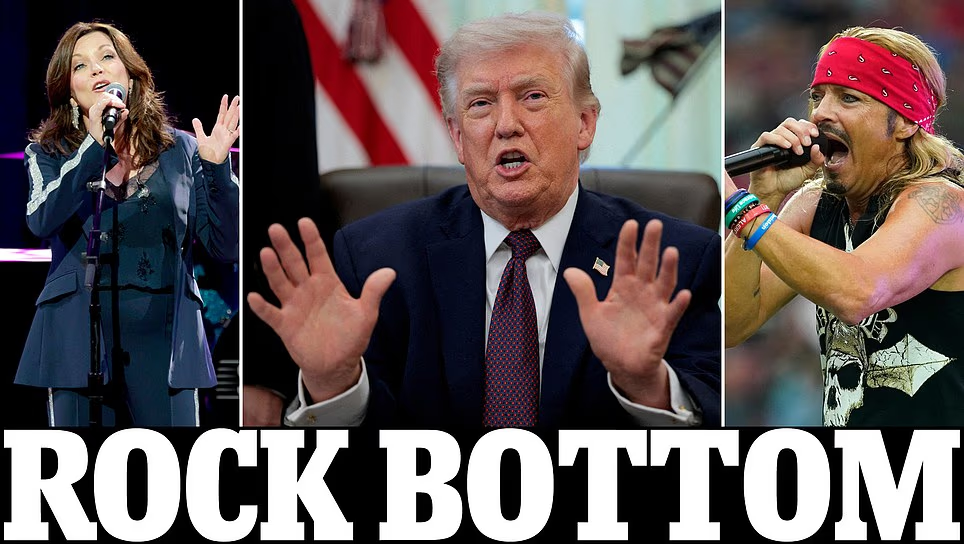
Earlier in the day he had volunteered himself as the replacement headliner, describing himself in a lengthy post as “the Number One Attraction anywhere in the World, the man who gets much larger audiences than Elvis in his prime, and he does so without a guitar.” He called himself “THE GOAT” — his own shorthand for greatest of all time — and said he would give a major speech at what he described as an “AMERICA IS BACK Rally.”
“Same time, same location,” Trump wrote. “Only Great Patriots invited — It will be a Wild and Beautiful Celebration of America!”
Freedom 250, the organization behind the event, confirmed Saturday that Trump would personally kick off the celebration on June 24, calling it a historic moment. The broader fair is scheduled to run June 25 through July 10.
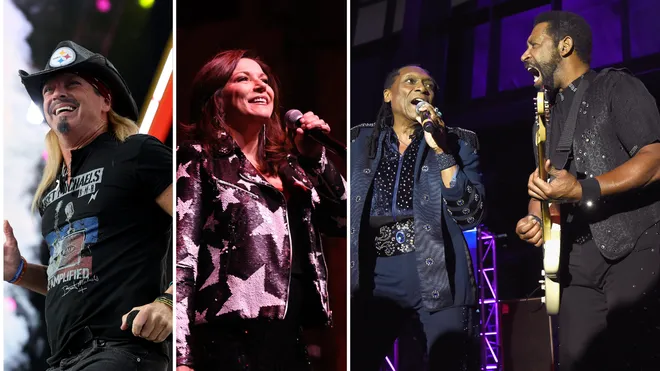
The unraveling began Wednesday when Freedom 250 announced a concert lineup that included Bret Michaels, the Commodores, Martina McBride, Morris Day and the Time, and Young MC alongside Vanilla Ice, Flo Rida, C+C Music Factory, and Milli Vanilli’s Fab Morvan. By Saturday, five of the nine headliners had quit. The four who remain — Vanilla Ice, Flo Rida, C+C Music Factory, and Morvan — are acts whose commercial peaks came three decades ago, a fact that social media users did not let pass without comment.
The departing artists told largely the same story. They had been recruited for what they were told was a nonpartisan celebration of America’s anniversary. When they looked more closely, they concluded the event was politically aligned with the Trump administration and that performing would put them in the middle of a fight they had not signed up for.
Michaels, the Poison front man, was among the last to exit and among the most specific about his reasons. He said he had been sold on an event honoring veterans, first responders, teachers, and working Americans and had been excited to participate on those terms. He said the event had “evolved into something much more divisive than what I agreed to be a part of,” and said threats against his family, friends, and bandmates had forced his hand.
“Concerns have also been raised regarding the safety of my fans, band, crew, family and myself, including threats that are completely unfounded and unforgivable,” Michaels said in a statement. “This isn’t about politics. It’s about staying true to what I’ve always believed in.”
McBride said in an Instagram statement that she had been “presented with an opportunity to perform at a nonpartisan event but that turned out to be misleading.” The Commodores said briefly that they chose “not to publicly affiliate with any single political party.” Young MC expressed similar frustration.
Vanilla Ice, whose real name is Robert Matthew Van Winkle, defended his decision to stay. He told TMZ the point was simple. “I’m here to party with America, man. Music is made to bring people together and that’s what we are here to do.” He said he did not take the political dimension seriously and did not think anyone else should either.
Trump’s call to cancel the Freedom 250 concerts arrived the same weekend he acknowledged stepping away from his Kennedy Center renovation project after a federal judge blocked his plans. U.S. District Judge Christopher Cooper ruled Friday that the Kennedy Center board had exceeded its authority when it added Trump’s name to the building and halted the administration’s plans to close the venue for a multi-year renovation.
Trump responded to the ruling by attacking the judge on Truth Social, calling for his impeachment and declaring the building structurally unsafe and financially doomed. “The Kennedy Center is broken, unsafe, and $busted, and has been for many years!” Trump wrote. “So now, the Kennedy Center will collapse, both structurally and financially.”
He drew the explicit connection to Freedom 250 himself, framing both situations as instances of an institution resisting his direction and requiring either full control on his terms or abandonment.
Trump’s comparison of himself to Elvis Presley on Saturday was not new territory. He has referenced the comparison repeatedly over the years, including a 2018 comment at an event in Tupelo, Mississippi, where he recalled being told he resembled Presley as a young man. That same year, after awarding Elvis the Presidential Medal of Freedom posthumously, Trump said he had attended one of his concerts. Earlier this year, Trump toured Graceland in Memphis and asked a staff member whether they thought he could beat Elvis in a fight. The employee said Elvis would have let him win.
Trump campaign events have long featured Presley songs including “Suspicious Minds,” “If I Can Dream,” and “An American Trilogy.” His Saturday comparison, characterizing himself as drawing larger crowds than Elvis without needing a guitar, was the most direct version of the parallel yet, offered in the context of explaining why he was the superior replacement for acts that had backed out of a national birthday celebration.
The collapse of the Freedom 250 concert lineup is not primarily a story about artists being difficult or about political cowardice. It is a story about what happens when a national celebration is organized in a way that makes its political alignment undeniable while its public marketing describes it as nonpartisan.
Freedom 250 was launched by Trump. It is led by a Trump State Department appointee. Trump announced himself as the headliner. Trump subsequently called for the concerts to be replaced with a MAGA rally. These are not ambiguous signals. They are a clear and sequential demonstration of what the event is and who controls it.
The artists who withdrew were not wrong when they said the event’s character had shifted from what they were told. The event’s character was always what it turned out to be. What shifted was their ability to maintain the fiction that accepting a booking was a civic act rather than a political one.
Trump’s instinct to convert everything he touches into a rally is genuine and consistent. From his perspective, there is no meaningful distinction between a celebration of American history and a celebration of his administration’s view of that history. The 250th anniversary of the nation’s founding is, to Trump, an occasion that belongs to the movement he leads rather than to the country at large.
The artists who disagreed with that premise withdrew. The ones who stayed either share it or have decided the performance fee is worth the association. And somewhere on the National Mall in late June, whatever form the event ultimately takes, a president who compares himself to Elvis will take the stage to celebrate a country he has said was dead before he saved it.
Dailymail/USWeekly/AP




