

Lebanon announced a partial ceasefire between Israel and Hezbollah on Monday that would limit Israeli strikes on Beirut and its southern suburbs in exchange for Hezbollah halting rocket attacks on Israel, but the agreement left the fighting in southern Lebanon entirely intact and did almost nothing to calm a situation that was already escalating by the time the announcement was made.
President Donald Trump declared the arrangement on social media after a call with Israeli Prime Minister Benjamin Netanyahu, saying Hezbollah had agreed through intermediaries that all shooting would stop and that Israel would not attack the group’s territory if the group did not attack Israel. He said Israeli troops heading toward Beirut had been turned back.
Netanyahu confirmed the conversation but offered a substantially different framing. He said he told Trump that Israel would strike Beirut if Hezbollah attacks do not stop, and that Israeli forces would continue operations in southern Lebanon as planned.
There was no direct statement from Hezbollah.
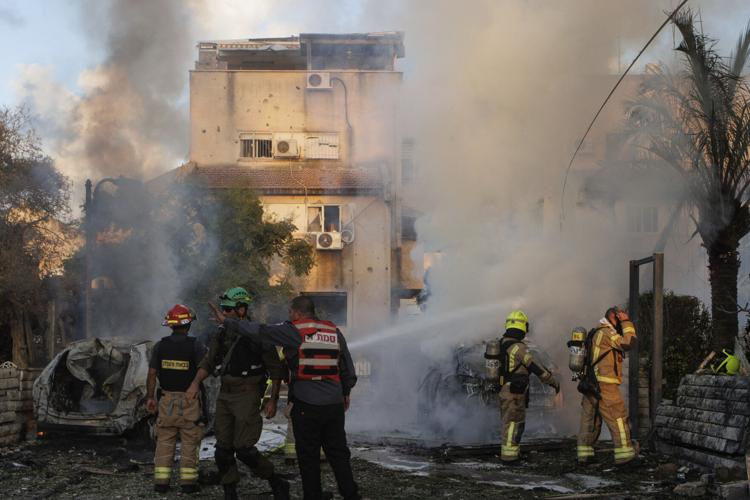
Within minutes of Trump’s announcement, the Israeli military detected missile launches from Lebanon and issued cover warnings to residents in parts of northern Israel. Israeli airstrikes overnight killed six people in southern Lebanon. A strike Monday afternoon hit the Jabal Amel Hospital in the port city of Tyre, blowing out windows and sending women and children fleeing through damaged corridors, video released by Lebanon’s Health Ministry showed.
In Beirut, Israeli military Arabic-language spokesman posted on X that residents of the Dahiyeh neighborhood and southern suburbs should evacuate, warning that continued Hezbollah attacks on Israeli communities would trigger strikes on those areas. Large numbers of people were seen abandoning their homes and jamming roads out of the area within hours of the warning.
Mohammed Farhat, 23, fled Haret Hreik on a motorcycle with his mother, heading to relatives elsewhere in the city. “We are worried. I am used to it but left for my parents,” he said.
What the Agreement Actually Does
According to a statement from Lebanon’s embassy in Washington, Lebanese authorities secured Hezbollah’s approval of a proposal by Secretary of State Marco Rubio under which Israel would refrain from striking Beirut’s southern suburbs and Hezbollah would halt attacks on northern Israel. The agreement does not cover southern Lebanon, where Israeli ground forces have pushed to their deepest position inside Lebanese territory in more than 25 years, advancing toward the Zaharani River.
Trump described the arrangement as a meaningful de-escalation. Netanyahu described it as a conditional warning. Hezbollah lawmaker Hassan Fadlallah said the group would support a full ceasefire across all of Lebanon as a precursor to Israeli troop withdrawal but did not confirm whether the group would stop attacks on Israeli territory.
Lebanon said it would seek to expand the ceasefire through direct talks with Israel in Washington on Tuesday and Wednesday. Those talks, the first direct Israel-Lebanon diplomatic contact in more than three decades between two countries that have no formal diplomatic relations, began in April in Washington. Beirut remains committed to the negotiating track despite the escalating violence, a Lebanese diplomatic official told the Associated Press anonymously in line with regulations.
Iran Threatens to Walk Away
The Lebanon escalation arrived at the worst possible moment for negotiations over the broader Iran war. Iranian state media said Monday that Tehran was halting indirect peace talks with the United States and might terminate the ceasefire that has largely held since early April, citing the fighting in Lebanon as justification.
Iranian Foreign Minister Abbas Araghchi made the Iranian position explicit. “The ceasefire between Iran and the U.S. is unequivocally a ceasefire on all fronts, including in Lebanon,” Araghchi wrote on X. “Its violation on one front is a violation of the ceasefire on all fronts.”
Trump, asked by an NBC reporter whether he had heard from Iran, said he had not. In a CNBC interview Monday, he said the peace talks had become tedious and that he was indifferent to their status. “I really don’t care, I couldn’t care less,” Trump said.
There was no direct official confirmation from Iranian authorities that talks had been suspended, and the mixed signals from Tehran and Washington left the actual state of the negotiations genuinely unclear. The Iran-U.S. ceasefire has held in a technical sense since early April but has been punctuated by multiple mutual strikes in recent weeks as both sides have accused the other of violations.
Adding a sharper edge to Monday’s tensions, the head of Iran’s Revolutionary Guards Quds Force, Esmaeil Qaani, threatened to expand Iran’s blockade of the Strait of Hormuz to the Bab El Mandeb Strait at the mouth of the Red Sea, an additional chokepoint for global shipping whose closure would compound already severe disruptions to the oil and gas trade. Oil prices rose 4 percent Monday on the heightened tensions.
The Broader War’s Unresolved Link to Lebanon
The Israel-Hezbollah conflict erupted March 2 when Hezbollah fired rockets into northern Israel in solidarity with Iran, two days after the U.S. and Israeli strikes on Iran began. Since then, it has been entangled with the broader Iran war even as the United States has insisted the two conflicts are separate and must be resolved independently.
Iran has consistently made a halt to Israeli operations in Lebanon a non-negotiable condition of any peace agreement with the United States. The U.S. has consistently resisted that linkage. The emerging framework for an Iran deal contains language calling for a ceasefire between the U.S. and its allies against Iran and its proxies, while preserving Israel’s right to act in self-defense. Israel has used that self-defense language to justify continuing its Lebanon operations throughout the ceasefire period.
At the United Nations, Assistant Secretary-General Martha Pobee told an emergency Security Council meeting Monday that Israel’s military advance into Lebanon violates Lebanese territorial integrity and contravenes the 2006 Security Council resolution requiring Israel to withdraw south of the U.N.-drawn border. She also said Hezbollah remained in violation of the same resolution’s requirement that the group disarm.
U.S. Ambassador Mike Waltz said at the Security Council that de-escalation would come quickly “if Hezbollah immediately ceases its attacks, as apparently it’s promised, and the government of Lebanon asserts its full sovereignty, rebuilds, and brings its people home.”
Saudi Arabia condemned Israeli military operations in Lebanon in a statement, saying it categorically rejected Israel’s advance into Lebanese territory and called on the international community to prevent Israel from pushing further in.
The Human Toll
The latest round of fighting between Israel and Hezbollah has killed 3,433 people in Lebanon and displaced more than 1 million, according to figures cited by the Associated Press. Israel’s military said a soldier was killed in southern Lebanon overnight in a Hezbollah drone strike. Netanyahu’s office said at least 26 Israeli soldiers and one defense contractor had been killed in or near southern Lebanon, with two Israeli civilians also killed in the north.
Hezbollah’s use of fiber-optic guided drones has proven particularly lethal for Israeli forces, which have struggled to develop effective countermeasures against a guidance technology that operates without the radio signals that conventional drone jamming systems target.
Lebanese parliament speaker Nabih Berri, a Hezbollah ally, said Sunday he could guarantee the group’s “full, comprehensive and immediate commitment to a ceasefire” but posed the harder question directly: “But who will force Israel to stop its aggression?”
Lebanese President Joseph Aoun reaffirmed his government’s commitment to negotiations Monday, saying talks were “safer” than continued war.
A Ceasefire That Covers Half the Conflict
The partial ceasefire announced Monday is an agreement whose most notable characteristic is the significant portion of the fighting it does not cover. Beirut’s suburbs may be spared for now, assuming Hezbollah holds to what Trump described as its commitment. But southern Lebanon, where Israeli ground forces have made their deepest incursion in 25 years and where the bulk of the killing is occurring, remains a fully active combat zone. The agreement pauses the most visible dimension of the conflict, the risk of Beirut being struck, while the underlying military campaign continues unaffected.
That structure reflects the incompatible positions the parties actually hold. Israel wants to continue its southern Lebanon operations until Hezbollah is militarily degraded below the threshold it considers a security threat. Hezbollah wants a full ceasefire that requires Israeli withdrawal as a precondition for any further negotiation. Lebanon wants exactly what it said: to expand Monday’s partial arrangement into something comprehensive through Washington talks. Iran wants Lebanon included in any Iran-U.S. deal as a non-negotiable condition.
None of these positions have moved toward each other. Monday’s arrangement is the smallest possible agreement that all parties could claim some version of without conceding anything they were not already prepared to give up. Whether the Washington talks Tuesday and Wednesday produce something more substantive will determine whether the partial ceasefire becomes the foundation for a broader settlement or simply the framework that describes what was already happening while the bombs keep falling in the south.
AP/Reuters





