

Several airline employees were injured Thursday after the nose landing gear of a Boeing 787 Dreamliner operated by Lufthansa collapsed while the aircraft was parked at a gate at Frankfurt Airport.
Airport authorities activated emergency protocols and dispatched all available response units after the incident involving the stationary aircraft. Officials indicated that the collapse occurred before passengers boarded, limiting the number of people exposed to risk.
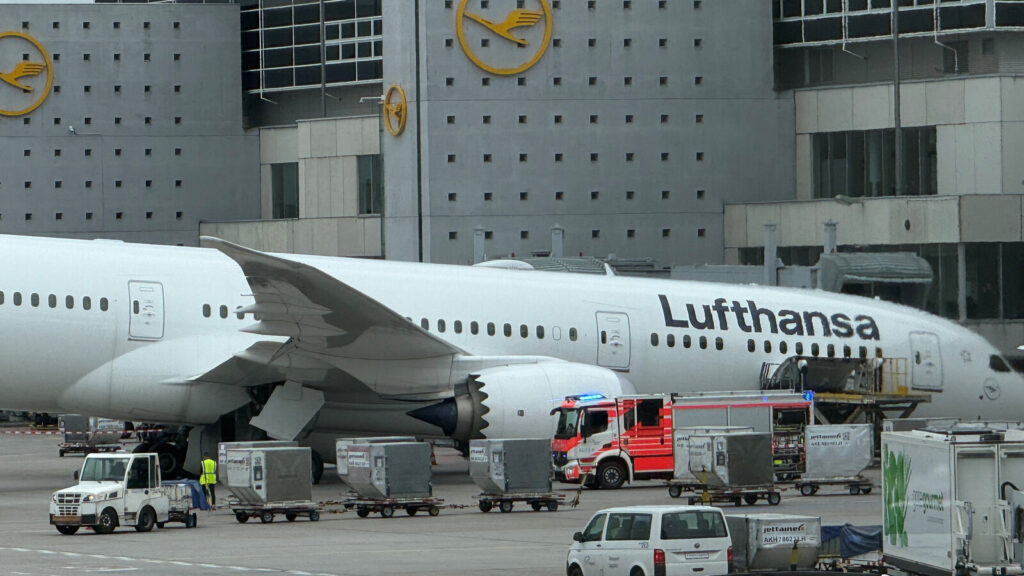
Lufthansa confirmed that several crew members and ground staff sustained injuries and were receiving treatment. Images from the scene showed the front section of the aircraft lowered onto the tarmac, surrounded by emergency vehicles.
Flight tracking data reviewed by Reuters and The Associated Press showed the aircraft had been scheduled to depart for Los Angeles later in the day. The jet, approximately one year old, is part of Lufthansa’s newer long haul fleet.
The airline said it is working with aviation regulators to determine the cause of the landing gear failure. Authorities have not yet indicated whether the incident stemmed from mechanical malfunction, maintenance issues or human error.
The Boeing 787 Dreamliner is widely used on international routes and is considered a modern aircraft designed for efficiency and long range travel. Lufthansa has been expanding its use of the model as it phases out older planes.
A similar ground incident involving a Dreamliner occurred in 2021 at London’s Heathrow Airport, when a British Airways aircraft experienced a nose gear malfunction that caused it to tip forward. Investigators later traced that case to incorrect placement of a locking pin in the landing gear system.
Ground incidents involving landing gear failure remain rare but carry significant operational and reputational consequences. Because the aircraft was stationary and not yet boarded, the Frankfurt episode avoided a more severe outcome, though it still raises concerns about inspection routines and equipment handling.
The incident is likely to draw close scrutiny from regulators, particularly given the aircraft’s relatively recent delivery. Investigators will examine maintenance records, pre flight checks and ground handling procedures to identify any gaps.
For airlines, such events highlight the importance of rigorous safety systems beyond in flight operations. For passengers, even minor incidents involving newer aircraft models can influence confidence in airline reliability.
As Lufthansa continues modernizing its fleet, the findings from this investigation could shape how quickly new aircraft are integrated and how maintenance protocols are reinforced across its operations.
People





