

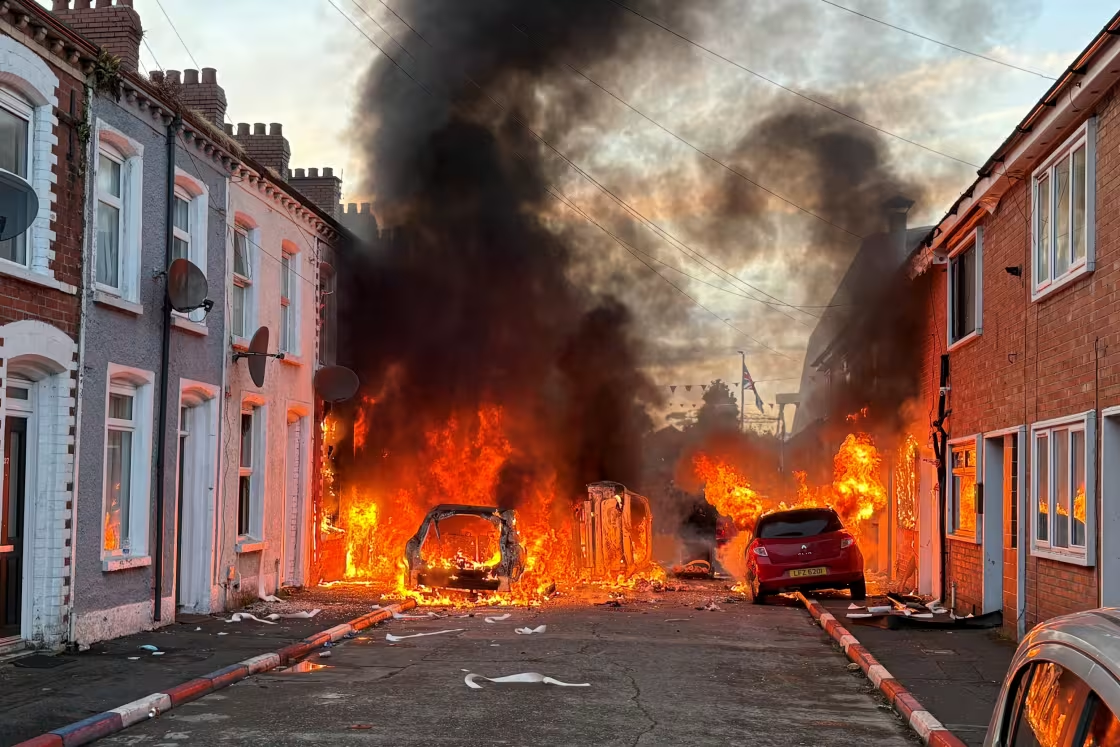
Violent anti immigrant protests broke out across Belfast on Tuesday, with fires engulfing homes and vehicles and crowds clashing with police, following a knife attack that left a man seriously wounded and triggered widespread public anger.
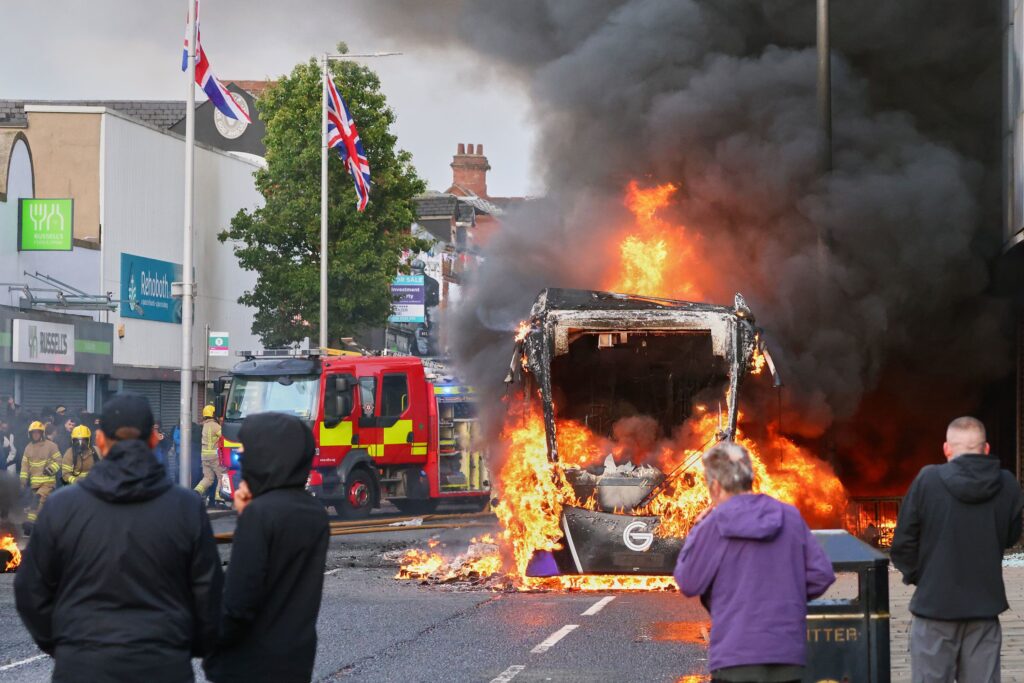
The unrest followed the charging of a 30 year old Sudanese national over an attempted murder in north Belfast late Monday. The victim, a man in his forties, suffered severe injuries to his neck, face and eyes. Authorities confirmed the suspect is due in court, while disturbances spread across multiple neighborhoods and into other parts of Northern Ireland.
What we know so far:
- Hundreds of protesters gathered across Belfast, with some setting fire to buses, homes and cars.
- Police described the situation as scattered but serious disorder, with masked youths involved in several flashpoints.
- Emergency services responded to multiple fires, including residential properties where families were forced to flee.
- Public transport services in and out of Belfast were suspended for safety reasons.
- The suspect in the stabbing has been charged with attempted murder and related offenses and is expected in court.
- The attack is not currently being treated as terrorism, police confirmed.
What authorities are saying:
Prime Minister Keir Starmer condemned the stabbing as shocking, while senior police officers appealed for calm, warning that violence would only deepen divisions.
Assistant Chief Constable Ryan Henderson urged communities to avoid escalating tensions, stressing that justice must take its course. Chief Constable Jon Boutcher confirmed the suspect had no prior record on national security databases.
Political leaders across Northern Ireland, including First Minister Michelle O Neill and Deputy First Minister Emma Little Pengelly, denounced the violence, describing it as harmful to communities and calling for peaceful expression of concerns.
Northern Ireland Secretary Hilary Benn echoed those calls, stating that disorder puts lives at risk and undermines public safety.
Why this matters:
The unrest highlights growing tensions over immigration policy across the United Kingdom, where political debate has intensified in recent years. Incidents involving violent crime have increasingly been linked, rightly or wrongly, to broader concerns about border control and asylum systems.
From an economic standpoint, the violence carries immediate costs. Damage to infrastructure, disruption of public transport and emergency response efforts place pressure on local budgets and insurance systems. Businesses in affected areas face lost revenue, while investor confidence in regional stability can be shaken during prolonged unrest.
The situation also feeds into a competitive political landscape, where parties with differing immigration policies seek to influence public opinion ahead of future elections. Rising public anxiety may strengthen populist narratives, potentially reshaping policy direction at both regional and national levels.
Historically, Northern Ireland has experienced periodic unrest tied to identity and political tensions. The current protests risk reviving instability in communities still navigating post conflict recovery.
What happens next:
Authorities are expected to increase police presence across Belfast and other affected areas in the coming days. Investigations into both the stabbing and the subsequent unrest are ongoing, with additional arrests likely.
Court proceedings for the suspect will be closely watched, as the case may influence public sentiment and the trajectory of protests. Government officials are also expected to review security measures and communication strategies to prevent further escalation.
Analysts warn that if tensions persist, there could be broader social and economic consequences, including reduced tourism and heightened security spending.
As Belfast confronts another night of unrest, leaders face mounting pressure to restore calm while addressing deeper concerns driving public anger, with the outcome likely to shape both local stability and the wider debate on immigration across the United Kingdom.
BBC/Skynews/Reuters




