

Gunmen killed at least 15 people in a farming community in northwestern Nigeria’s Zamfara state on Friday, the latest in a relentless string of deadly attacks on rural communities across Nigeria’s troubled north, even as a separate incident in Niger State revealed the hollow nature of protection deals struck with armed gangs, with bandits burning down a primary school days after the community paid a ten million naira levy to prevent exactly that.
The two incidents, separated by hundreds of kilometers but connected by a pattern of rural terror that has defied years of government promises, underscore the deepening crisis gripping Nigeria’s north.
What We Know So Far
The Zamfara attack took place Friday in the Talata Mafara area, a district that has endured recurring violence over years of sustained insecurity, the Associated Press confirmed. No group claimed immediate responsibility.
Abdullaziz Yari, a federal lawmaker representing the district, described the assault as a “terrorist attack” in a statement on social media. Yahaya Yari, the elected local government chairman for the area, appeared in a widely circulated video at the victims’ funeral Friday evening, making an emotional public appeal directly to President Bola Tinubu and to a junior defense minister from the region, calling on them to intervene and end the killings.
Earlier this month, gunmen killed 17 farmers and wounded at least 13 others while they worked their fields in Goron Namaye, in a separate part of Zamfara state, the Associated Press noted.
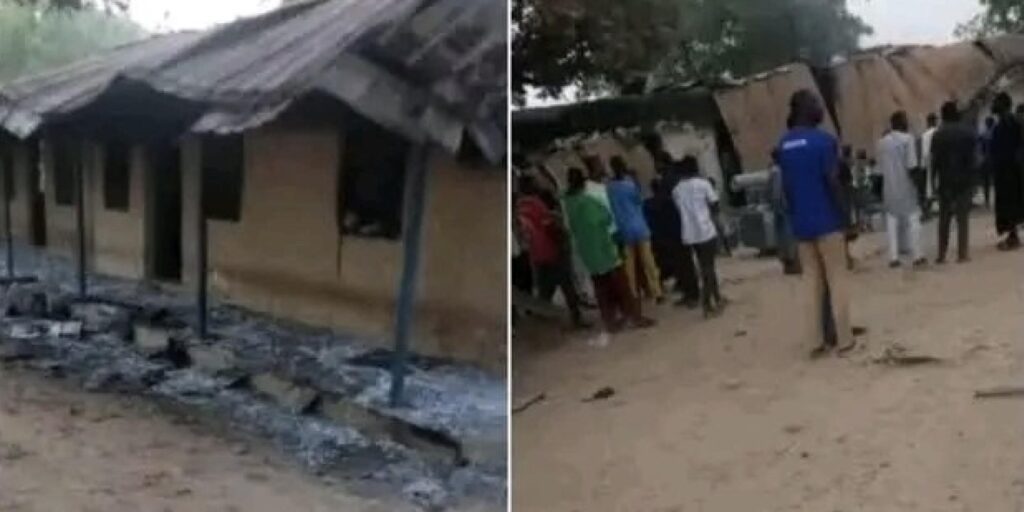
In Niger State, security analyst Bakatsine disclosed Saturday on his verified X account that bandits had burned down the Central Primary School in Dekara community, Borgu Local Government Area, on Wednesday, despite residents having raised and paid a ten million naira levy the attackers had themselves demanded in exchange for sparing the community from violence, Sahara Reporters confirmed.
The attackers, believed to have emerged from the Kainji Lake National Park that borders the area, stormed Dekara, set the school ablaze, and departed, leaving behind a community that had paid for protection it never received.
“Bandits have reportedly razed Central Primary School, Dekara community, in Borgu Local Government Area of Niger State, despite the community paying a ten million naira levy imposed on them,” Bakatsine wrote, sharing photographs of the gutted building.
What Authorities And Analysts Are Saying
Bakatsine framed the Niger State school burning as more than a single criminal act, describing it as evidence of how deeply armed groups have embedded themselves into the social and economic fabric of rural communities.
“The destruction of the school despite compliance raises troubling questions about the growing influence armed groups wield over vulnerable communities,” he wrote. “When criminals impose taxes and still unleash violence, hope becomes the next casualty.”
Abdullaziz Yari’s characterization of the Zamfara attack as terrorism reflects a growing consensus among Nigerian officials that the armed gangs operating across the northwest can no longer be described simply as bandits engaged in opportunistic crime. Their capacity to strike repeatedly in the same areas, impose financial demands on entire communities, and operate with apparent impunity has led to louder calls for the federal government to classify them as terrorist organizations, a step with significant legal and operational implications for how security forces may engage them.
An insurgency in northern Nigeria has killed thousands and displaced millions over the years, the United Nations has confirmed. Armed groups in the north-central and northwest regions engage in kidnapping for ransom, the forced taxation of farming communities, and illegal mining operations that generate revenue to sustain and expand their activities.
The Tinubu administration has repeatedly promised to curb the crisis. The attacks of the past week suggest those promises have yet to translate into durable security gains on the ground.
Last year, Nigeria signed a military cooperation agreement with the United States following a diplomatic dispute in which American officials asserted that a “Christian genocide” was underway in the country. Nigeria’s government rejected that characterization. Analysts noted it oversimplified a complex and multi-layered conflict in which victims are frequently targeted regardless of their religious identity. Nigeria is broadly divided between a predominantly Christian south and a predominantly Muslim north, though the conflict in Zamfara and Niger states is driven primarily by criminality and resource competition rather than religious motivation.
Why This Matters
The school burning in the Dekara community carries a significance that goes beyond the physical destruction of a single building.
Rural communities across Nigeria’s northwest and north-central zones have been caught for years in an impossible situation. When they resist armed groups or report attacks to authorities, they risk violent reprisals that security forces often cannot prevent. When they comply with demands, as Dekara’s residents did by raising ten million naira, they discover that compliance offers no actual protection and may in fact encourage further extortion by demonstrating a community’s willingness and capacity to pay.
Security experts have repeatedly warned that this cycle of levy imposition has evolved into a functioning parallel taxation system through which criminal networks finance their expansion while simultaneously demonstrating to rural populations that the Nigerian state cannot protect them. The repeated failure of the formal state to fill that security vacuum deepens mistrust and drives communities toward accommodations with the very groups terrorizing them, creating a dynamic that becomes progressively harder to break.
The targeting of schools adds another dimension. Educational disruption forces children out of classrooms, permanently altering life trajectories in communities where school attendance rates were already fragile. The United Nations and international humanitarian organizations have repeatedly flagged the link between attacks on education and longer-term cycles of poverty and conflict.
Borgu Local Government Area’s proximity to the Kainji Lake National Park is not incidental. Security agencies have identified the park’s vast forested terrain as a base of operations for armed groups moving across Niger, Kwara, and neighboring states, a geography that complicates conventional military responses and allows groups to attack communities and withdraw into territory where pursuit is difficult.
What Happens Next
No arrests had been announced in either the Zamfara or Niger State incidents as of Saturday. Federal and state security agencies had not issued detailed operational responses to either attack.
The Zamfara lawmaker’s appeal for presidential intervention and the local government chairman’s emotional funeral address suggest that elected officials in affected communities are placing diminishing confidence in existing security protocols and are seeking direct engagement from the highest levels of government.
For Dekara community, the immediate question of whether the destroyed school will be rebuilt is secondary to the more fundamental question of whether the community can expect any protection from future attacks without paying further levies to the same groups that burned their children’s school.
Niger State has consistently ranked among the states most severely affected by banditry in recent years, with Borgu Local Government Area repeatedly appearing in incident reports. Without a substantive change in the security approach, the coming weeks are likely to produce further attacks across the same terrain that has been generating them for years.
Punchng/SaharaReporters





