

The United States launched a new round of military strikes against multiple targets inside Iran on Saturday after fresh attacks in the Strait of Hormuz and the Gulf raised fears that a fragile ceasefire between Washington and Tehran could rapidly unravel.
The U.S. military said the operation was carried out on the orders of President Donald Trump after Iranian forces allegedly violated the ceasefire by attacking a commercial vessel near the Strait of Hormuz earlier in the day.
In a statement posted on X, U.S. Central Command said Iran had been given an opportunity to uphold the ceasefire agreement but instead chose to continue military operations.
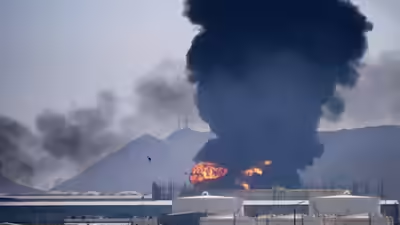
“Iran had a chance to honor the ceasefire agreement, but elected not to,” the military said while confirming that American forces struck multiple Iranian targets.
Iranian state television later reported explosions north of the Strait of Hormuz, although Iranian authorities did not immediately provide details on the locations or the extent of any damage.
The latest military exchange came after Iran launched what officials described as a drone assault targeting Bahrain while a separate attack struck a commercial tanker navigating the Strait of Hormuz, one of the world’s most strategically important shipping corridors.
Bahrain’s Foreign Ministry said several Iranian drones targeted the country, describing the operation as a direct threat to the safety of citizens and foreign residents. Officials did not immediately report casualties or significant damage.
Earlier, Iran’s Revolutionary Guard announced that it had targeted several locations used by what it described as United States military forces in the region. The statement, carried by the state run IRNA news agency, did not specify the locations involved.
The latest confrontation follows overnight American airstrikes that targeted Iranian missile and drone storage facilities along with coastal radar installations. U.S. officials said those attacks were conducted in response to Iran’s earlier drone strike against the Singapore flagged cargo ship M V Ever Lovely while it was transiting the Strait of Hormuz.
The renewed military action has placed growing pressure on the interim ceasefire reached between Washington and Tehran, an agreement intended to create space for negotiations aimed at ending months of escalating hostilities.
Vice President JD Vance, who has played a leading role in diplomatic contacts with Iran, urged Tehran to resolve disputes through negotiations instead of military action.
“Iran should pick up the phone if there are disagreements about the ceasefire agreement,” Vance wrote on social media. “Violence will be met with violence.”
Negotiators from both countries continue working on a broader agreement covering freedom of navigation through the Strait of Hormuz, the future of Iran’s nuclear program and the management of its stockpile of highly enriched uranium. The interim arrangement provides both sides with 60 days to negotiate a permanent settlement.
The latest violence also affected maritime security operations across the Gulf.
The United Kingdom Maritime Trade Operations center confirmed that a tanker came under attack Saturday while passing through the Strait of Hormuz. The crew remained safe, and officials reported no environmental damage. No group immediately claimed responsibility for the attack, although suspicion quickly focused on Iran.
Shortly afterward, the Joint Maritime Information Center, which operates under the oversight of the United States Navy, announced the expansion of a protected shipping corridor near Oman’s coastline to accommodate both inbound and outbound commercial traffic.
The adjustment is intended to improve maritime safety as commercial vessels continue attempting to leave the Gulf despite increasing security risks.
Iran has repeatedly insisted that vessels transiting the Strait of Hormuz must comply with its directives and has warned that it could impose transit fees on commercial shipping.
Iranian lawmaker Ebrahim Azizi, who chairs parliament’s National Security Commission, declared Friday that the Strait of Hormuz is governed by Iran and urged vessels to follow what he described as Iranian rules.
The United States and Gulf Arab nations have rejected that position, maintaining that the Strait of Hormuz remains an international waterway protected under international maritime law despite lying within the territorial waters of Iran and Oman.
The Joint Maritime Information Center warned that the security threat to commercial vessels remains substantial because of the possible presence of naval mines and ongoing military operations. Shipping companies were advised to remain alert as mine clearance efforts continue throughout the area.
The International Maritime Organization also suspended its latest effort to coordinate the evacuation of commercial vessels from the Gulf until stronger security guarantees can be established. The organization said approximately 115 ships have successfully exited the Strait of Hormuz during recent days despite the heightened military activity.
The continuing conflict has placed global energy markets on edge because nearly one fifth of the world’s crude oil exports pass through the narrow Strait of Hormuz. Analysts say even brief disruptions to shipping traffic can trigger increases in oil prices, shipping insurance premiums and transportation costs across international supply chains.
Financial markets are also watching developments closely as prolonged instability could increase inflationary pressures, particularly in countries heavily dependent on imported energy. Energy companies and shipping firms are expected to continue reviewing contingency plans should the conflict further disrupt maritime trade.
Geopolitical analysts believe the latest exchange demonstrates how fragile the ceasefire remains despite ongoing diplomatic contacts. Although negotiations continue, each new military incident raises the risk of a broader regional confrontation involving additional Gulf states and international naval forces operating in the area.
For commercial shipping companies, insurers and global energy producers, stability in the Strait of Hormuz remains essential. Any sustained interruption to maritime traffic through the waterway could have far reaching consequences for international trade, commodity prices and economic growth.
What we know so far
The United States launched fresh military strikes against Iranian targets after accusing Tehran of violating a ceasefire through attacks on commercial shipping and Bahrain. Iran confirmed explosions near the Strait of Hormuz while acknowledging attacks on United States military interests in the region.
What authorities are saying
U.S. Central Command said Iran chose not to honor the ceasefire and defended the strikes as a response to continued aggression. Bahrain condemned the drone attack on its territory, while Vice President JD Vance urged Iran to return to negotiations instead of escalating military operations.
Why this matters
The latest confrontation threatens one of the world’s most important maritime trade routes and raises concerns about global energy supplies. Continued instability in the Gulf could disrupt international shipping, increase oil prices and complicate diplomatic efforts to reach a lasting agreement over Iran’s nuclear program and regional security.
What happens next
Diplomatic negotiations remain underway, but military commanders across the region are expected to maintain heightened readiness. International shipping operators are also likely to continue rerouting vessels and strengthening security measures until the situation in the Strait of Hormuz stabilizes.
Source: Associated Press





