

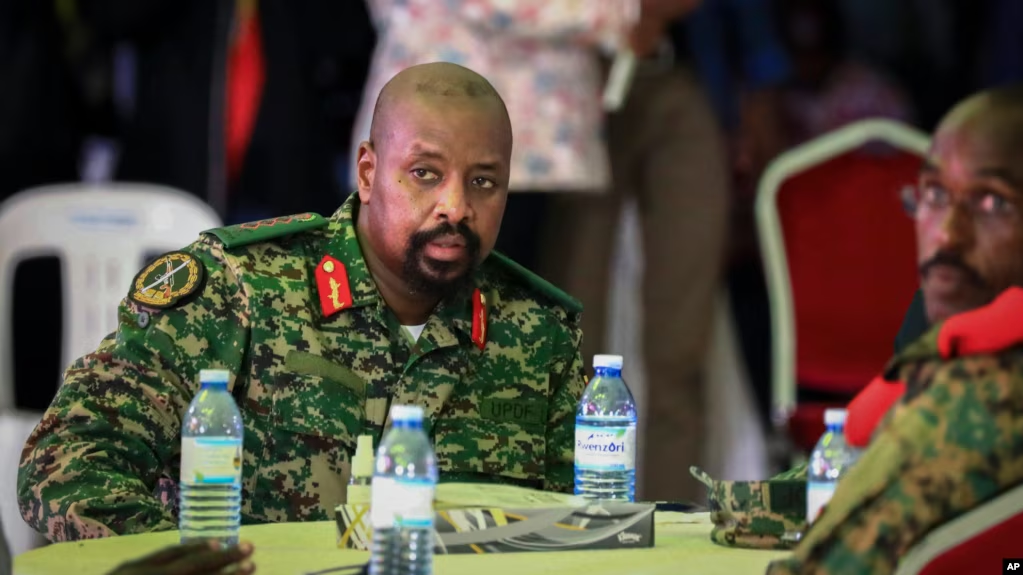
Uganda’s military chief General Muhoozi Kainerugaba, the eldest son of President Yoweri Museveni, ordered the closure of two of the country’s leading independent media outlets Sunday and declared that he did not believe in a free press, deploying soldiers to seal off offices and cut power to broadcasting facilities in a sweeping assertion of authority that alarmed press freedom advocates across the region.
The shuttered outlets, the Daily Monitor newspaper and NTV Uganda, are both owned by Nation Media Group, a Nairobi-based media conglomerate listed on the Nairobi stock exchange and among the most prominent independent media companies in East Africa.
What We Know So Far
Kainerugaba announced the closures in a series of posts on X beginning at 1:07 a.m. Sunday. “NTV and Monitor are being shut down from today,” he wrote. “Both NTV and Monitor will not reopen without my permission.”
He added: “In Uganda, I do not believe in a free press. The press should be guided by cadres of the revolution.”
In a separate post, Kainerugaba asserted the legal basis for his action. “I have the power in Uganda to shut down any media house I want to. I have had this power since 2017. This power was given to me by my great father,” he wrote on X, the Associated Press confirmed.
Military personnel were deployed before dawn at two locations in Kampala. Soldiers sealed off the Kampala Serena Conference Centre, which houses NTV Uganda and Spark TV studios, by 5:00 a.m., preventing employees from accessing their workplaces, a staff member told Uganda Radio Network. Security personnel also shut off both the main electricity supply and the backup generator at the facility.
A second military deployment sealed off Nation Media Group’s headquarters in Namuwongo, where the Daily Monitor, 93.3 KFM, and 90.4 Dembe FM operate. Staff who arrived for early shifts were denied entry, Reuters confirmed.
NTV Uganda and all other NMG television and radio broadcasters in the country were off air as of Sunday morning. Nation Media Group Uganda employs more than 500 people in the country and operates some of Uganda’s largest media platforms, including Spark TV, Ennyanda, and several radio stations.
The National Association of Broadcasters confirmed that at least six publishing and broadcasting outlets, all under Nation Media Group, had been closed. “We are deeply concerned about this action and its impact on the media ecosystem,” the association said in a statement.
Kainerugaba did not provide specific reasons for the closures. He had previously accused NTV Uganda and the Daily Monitor of persistently insulting him and his father, the Associated Press noted.
Nation Media Group Uganda had not issued an official statement by the time of initial reporting. The Uganda People’s Defence Forces, Uganda Police Force, and Uganda Communications Commission also offered no public explanation for the deployment. Susan Nsibirwa, managing director of NMG in Uganda, declined immediate comment. Ugandan government spokesperson Alan Kasujja did not respond to a request for comment from Reuters.
What Authorities Are Saying
Kainerugaba has been increasingly assertive in the days since Museveni was sworn in for a seventh consecutive term as president, issuing directives and making statements that go well beyond the conventional authority of a military commander and encroach on territory normally reserved for the head of state, the Associated Press reported.
His claim that he has held the power to close media outlets since 2017, a power he says was granted by his father, reflects the informal concentration of authority within the Kainerugaba-Museveni family arrangement that now effectively governs Uganda’s security and political landscape.
Kainerugaba has openly asserted that he expects to succeed his father as president. Museveni, 81, who has ruled Uganda since 1986, has not indicated when he plans to retire and has no rivals within the ruling party. Many analysts believe the military will play a decisive role in determining his successor, with Kainerugaba already positioned as the most powerful figure in that process.
Earlier this month, Kainerugaba moved against a prominent attorney, Erias Lukwago, who had sought to hold the military chief accountable for his alleged role in the rights violations of opposition leader Kizza Besigye. Besigye was seized in Nairobi in 2024 and has since been imprisoned on treason charges he describes as politically motivated. Lukwago was taken from his home and later charged with an offense related to the concealment of treason.
Kainerugaba is also well known internationally for a series of inflammatory social media posts, including past threats directed at leading opposition figure Bobi Wine, Reuters noted.
Why This Matters
The closure of Nation Media Group’s Ugandan operations is not without historical precedent in Uganda’s relationship with independent media. In 2013, police raided Daily Monitor and Dembe FM offices following the publication of a letter linked to succession politics and kept the premises closed for more than a week. In 2007, NTV Uganda was temporarily taken off air in the months after its launch following government criticism of its coverage. President Museveni himself once publicly described the Daily Monitor as an “enemy and evil newspaper” because of its reporting.
What makes Sunday’s closure categorically different is who ordered it and how. A military commander, acting without stated legal process, deploying armed soldiers to seal off newsrooms and cut power to broadcasting facilities, and publicly declaring his personal opposition to press freedom, represents a qualitative shift from previous encounters between the state and Uganda’s independent media.
The claim that Kainerugaba has held and exercised this power since 2017 is also significant. It suggests the authority to suppress media has been quietly embedded in Uganda’s informal governance architecture for years, surfacing now at a moment when Kainerugaba appears to be consolidating the public dimensions of the power he has long held behind the scenes.
Nation Media Group’s regional footprint adds a cross-border dimension to the story. The company is headquartered in Kenya and listed on the Nairobi stock exchange, meaning the closure of its Ugandan operations carries implications for investors, journalists, and press freedom organizations well beyond Uganda’s borders. The simultaneous shutdown of television, radio, and print operations under a single military order is also operationally unusual, reflecting a degree of coordination and pre-planning that goes beyond an impulsive social media announcement.
For Uganda’s broader democratic trajectory, the events of Sunday morning send a signal that is difficult to misread. A country where the military chief can order newsrooms sealed at 1 a.m. and face no immediate legal or institutional check is a country where the mechanisms for holding power accountable are themselves at serious risk.
What Happens Next
Nation Media Group Uganda’s management was expected to issue a formal statement in the hours following the initial closure. The company’s response, whether it challenges the closure through Uganda’s courts, appeals to the Uganda Communications Commission, or seeks diplomatic intervention through its Kenyan parent company’s government, will be closely watched.
Regional and international press freedom organizations, including Reporters Without Borders and the Committee to Protect Journalists, are likely to respond formally to what amounts to one of the most dramatic single acts of state media suppression in East Africa in recent years.
Whether the Daily Monitor and NTV Uganda are permitted to resume operations quickly, as happened after the 2013 raid, or whether Kainerugaba intends a longer or permanent shutdown will become clear in the coming days. His statement that neither outlet “will reopen without my permission” leaves the timeline entirely at his personal discretion, a position that in itself reflects the scale of the institutional breakdown Sunday’s events represent.
More than 500 Nation Media Group employees in Uganda face immediate uncertainty about their ability to work and about the safety of the newsrooms they had been locked out of.
AP/Reuters/Observer.ug





