

President Donald Trump told world leaders at the United Nations General Assembly on Tuesday that he is weighing whether to “annihilate” Iran and drive it “into hell,” even as he predicted a deal to end the nearly seven month war would come together once November’s midterm elections have passed.
“I have a big decision to make,” Trump said, with an Iranian delegation in the audience. “Will a deal be made with Iran that lets them rebuild and create a far greater country than it ever was before, maybe one of the greatest in the Middle East or even the world? Or do I annihilate the Islamic Republic and do it quickly, never giving them a chance to kill and destroy people and countries again? Do I drive them into hell with no chance of survival and no hope of future greatness or generations?”
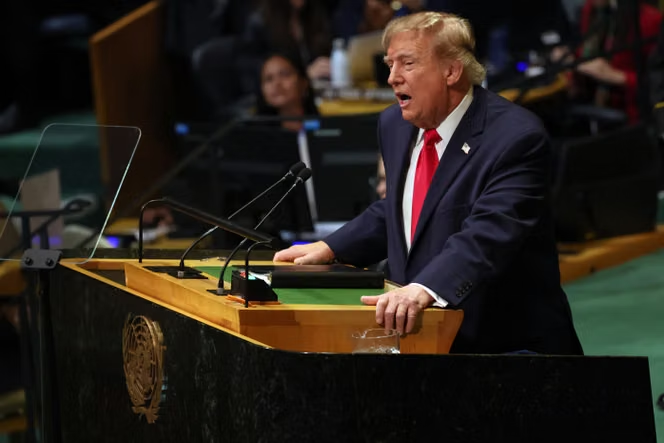
Trump said ensuring Iran never obtains a nuclear weapon remains his most important objective, drawing applause from the assembly. He accused Iran of stalling on reopening the Strait of Hormuz and negotiating an end to the war until after the U.S. midterms. “I believe we’ll make a deal right after the election because it doesn’t make sense for them not to. They’re waiting to see how I do in the midterm election,” Trump said.
What We Know So Far
Later Tuesday, Trump told reporters that U.S. and Iranian officials had held a three hour meeting earlier that day, though he offered few details. “It ended an hour ago. It was a meeting that lasted for three hours. It was a very good meeting,” Trump said.
Trump struck a markedly different tone a few hours after his UN address, speaking alongside British Prime Minister Andy Burnham. “I think that a settlement is going to be reached,” Trump said of the Iran war. “They want to talk to us. They have been talking to us, even today. They’ve been talking to us, and the relationship is developing.”
Trump’s UN remarks came as the UN Human Rights Council found in a report last week that there are reasonable grounds to believe the United States committed war crimes during what it described as indiscriminate attacks on an Iranian school and a residential area in February. Trump did not directly address that finding in his address, instead describing Iran’s nuclear potential as a reality the world had to confront and one too many countries had preferred to ignore.
Beyond Iran, Trump used his address to highlight peace deals he has pursued, U.S. actions in the Western Hemisphere, and progress on his 20 point peace plan for the Gaza Strip. He also touted the U.S. economy, immigration policy and artificial intelligence initiatives, calling the American economy the envy of the world and describing the U.S. military as the most powerful on Earth.
Domestic Political Context
Trump’s confident economic framing contrasts with domestic polling. An NBC News poll conducted in September found 56 percent of registered voters disapprove of Trump’s job performance, and 55 percent said they believe his policies have hurt the economy. Gas prices have remained elevated, averaging $4.47 per gallon, an increase of about 50 percent since the Iran war began. Diesel prices have also spiked, driven by both the Iran war and the ongoing war between Russia and Ukraine; diesel hit a record $6 per gallon earlier this month before rising further to $6.52 as of Tuesday, according to AAA.
Other Developments at the UN
UN Secretary-General Antonio Guterres, delivering his final address to the General Assembly before leaving office at the end of the year, called for a world built on interdependence, continuing his longstanding appeals for international cooperation amid what he has described as accelerating global challenges and rising competition among major powers.
Trump is separately hosting Chinese President Xi Jinping in Washington this week as economic and technological competition between the two countries continues to escalate. Both leaders are seeking to stabilize the relationship, though no major agreements are expected from the meeting, which is considered significant primarily because of the deep differences and limited trust between the two governments.
During a meeting with Ukrainian President Volodymyr Zelenskyy, Trump said the two are working on a solution to end Russia’s war in Ukraine. He said continued Ukrainian strikes on Russian oil refining capacity represent a serious hit to Russia and to diesel prices. Sources told Reuters that Russia’s major Moscow refinery halted crude oil processing after fires broke out at its primary distillation units following a Ukrainian drone attack on September 20, part of the large scale strike that hit Moscow during Russia’s recent parliamentary elections.
Why This Matters
Trump’s willingness to threaten annihilation of an entire country from one of the world’s most prominent diplomatic platforms, with that country’s own delegation present in the chamber, represents an unusually stark escalation in rhetoric even by the standards of a war already in its seventh month. The shift to a considerably softer tone just hours later, describing an improving relationship and an expected settlement, illustrates the volatility characterizing the administration’s public posture toward Iran even as private negotiations reportedly continue.
The UN Human Rights Council’s war crimes finding adds significant international scrutiny to the conflict, a finding Trump did not directly address in his address, even as he continued to frame the war’s continuation as necessary to prevent Iran from developing nuclear weapons. The gap between Trump’s confident domestic economic messaging and the polling showing majority disapproval, alongside continued elevated gas and diesel prices tied directly to the war, suggests the war’s economic costs remain a significant vulnerability heading into the midterms, one that may partly explain his stated prediction that a deal will only materialize once the political stakes of the election have passed.
The Moscow refinery’s halted operations following Ukraine’s September 20 drone attack demonstrate the tangible impact of Ukraine’s long range strike campaign, connecting Trump’s comments about the strikes hurting Russia economically to a concrete operational outcome at one of Russia’s most significant oil facilities.
What Happens Next
Trump has predicted a deal with Iran will emerge shortly after the November midterm elections, though he has offered few concrete details about what such an agreement might include or how the current talks, including Tuesday’s three hour meeting, are progressing. Given his repeated invocation of the annihilation threat alongside talk of a developing relationship, the coming weeks are likely to continue featuring a mix of escalatory rhetoric and reported diplomatic engagement.
Trump’s meetings with Xi Jinping this week and his continued engagement with Zelenskyy on the Ukraine war suggest a busy diplomatic period ahead, even as none of the major conflicts Trump addressed at the UN, Iran, Gaza or Ukraine, appear close to full resolution based on his own remarks.
Reporting drawn from NBC News, the Associated Press and Reuters




