A Russian cargo ship linked to Moscow’s military burned through the night in Finnish waters after being struck by drones in the Gulf of Finland, Finland’s coast guard said Sunday, as a rare air raid alert sounded in Russia’s Baltic exclave of Kaliningrad, the vessel’s destination.
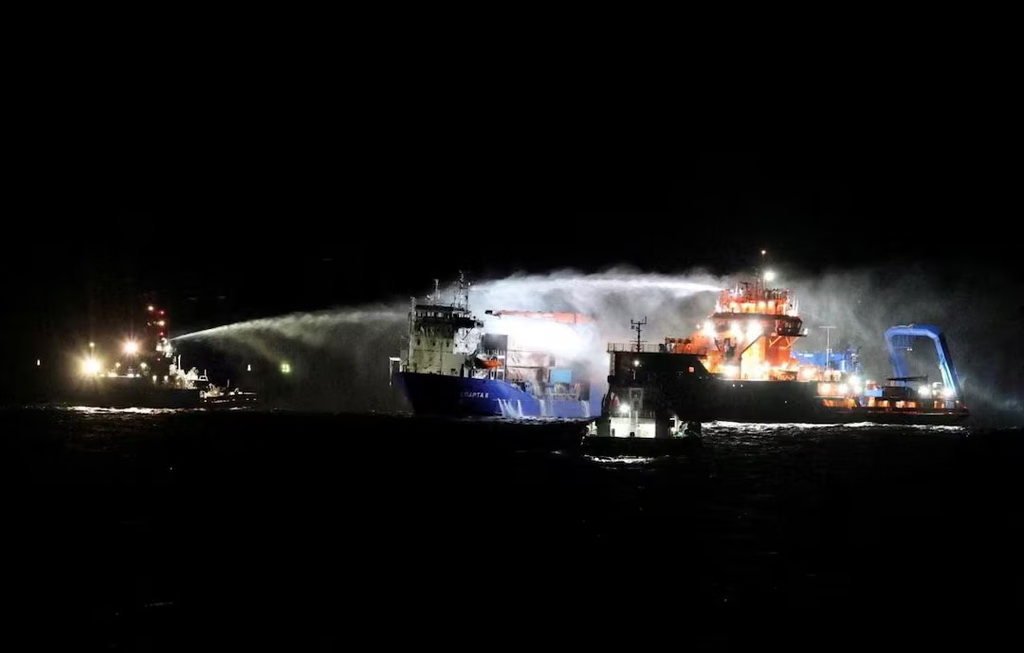
Finland’s military said Saturday’s attack on the Sparta II was likely carried out by Ukraine. The ship was hit in international waters west of Russia’s Gogland island and later drifted into Finnish waters, where it remains at anchor, Reuters said.
All 16 crew members abandoned ship for lifeboats before transferring to a nearby Russian vessel, which was carrying them back to Russia, Finnish Border Guard Commander Ilja Iljin told public broadcaster Yle, The Independent said.
Fire fought through the night
Photos and video released by Finland’s coast guard showed several vessels spraying the Sparta II with water cannons overnight to put out the fire and cool containers stacked on its deck. Finland is leading the rescue operation, and officials said Russian vessels may eventually tow the wreck back to Russia.
Estonia’s government said it sent a navy vessel to help with firefighting and pollution response.
Mikko Simola, commander of the Gulf of Finland Coast Guard, said a Russian helicopter was suspected of briefly violating Finnish airspace during the rescue effort.
A sanctioned ship tied to Russia’s military
The Sparta II is a 121-meter (397-foot) Russian-flagged cargo ship owned by Oboronlogistika, which provides logistics services to Russia’s Defense Ministry, according to the company’s website. The vessel left St. Petersburg on Friday, according to LSEG data, and is subject to U.S. sanctions, according to the U.S. Treasury Department.
“At the moment, there is no confirmed information about what cargo is on board, but it cannot be ruled out that there is military materiel on board,” Iljin said.
“It is likely that Ukraine… is behind (the attack),” said Finnish armed forces spokesperson Aki-Mauri Huhtinen, adding that it was unclear why the ship was targeted.
Leningrad region Gov. Aleksandr Drozdenko said on Telegram that two drones struck the vessel in international waters about 3 nautical miles from Russia’s border. He also said 80 drones were shot down over the region overnight.
Ukraine’s Foreign Ministry and Russia’s embassy in Helsinki did not immediately respond to requests for comment. Moscow has previously described attacks on its commercial ships outside its territorial waters as terrorism and piracy.
Sirens in Kaliningrad
Late Saturday, hours after the strike, an air alert sounded in Kaliningrad, the regional governor said, as claims spread online of drone activity near a major naval base, The Associated Press said.
Photos and video posted online appeared to show drones around Baltiysk, home to much of Russia’s Baltic Fleet. The AP could not immediately verify them. Local media said it was the first time air raid sirens had been heard in Kaliningrad since Russia’s full-scale invasion of Ukraine on Feb. 24, 2022.
Kaliningrad Gov. Alexei Besprozvannykh said the ship incident posed no threat to supplies to the region, which lies between NATO members Poland and Lithuania and has periodically been a flashpoint between Russia and the West.
‘The war is spilling over’
Finland introduced temporary aviation and maritime restrictions in the eastern Gulf of Finland to protect civilians and allow authorities to intercept drones if necessary.
“The war is spilling over into our neighbouring areas. Finnish authorities are handling the situation in the Gulf of Finland, where a drone strike has hit a Russian merchant vessel. Ukraine has the right to fight against the aggressor,” Prime Minister Petteri Orpo wrote on X.
Swedish combat aircraft operating under Finnish command helped protect Finland’s and NATO’s territorial integrity after the incident, Swedish Defense Minister Pål Jonson said. Finland and Sweden joined NATO in 2023 and 2024, respectively, in response to Russia’s invasion.
“The consequences of fighting Russia’s aggression have reached the Baltic Sea. Another signal for the aggressor to stop. But nothing will stop us from supporting Ukraine,” Estonian Prime Minister Kristen Michal wrote on X.
Estonian Navy Commander Ivo Värk told public broadcaster ERR that further attacks in the Gulf of Finland cannot be ruled out.
Ukraine has launched waves of drones toward Russia’s Leningrad region this year, some of which strayed into the airspace of Baltic countries, raising fears the war was spilling onto NATO territory. Finland’s military said last week it detected a strike on a Russian warship in the same area during Ukrainian drone attacks.
A new front in the Baltic
The strike on the Sparta II, combined with the alert in Kaliningrad, marks a notable expansion of the war’s geographic reach. The Gulf of Finland and the waters around Kaliningrad are tightly packed with NATO and Russian assets, and incidents there carry a higher risk of drawing in alliance members than strikes deep inside Russia.
The target’s profile matters. A sanctioned vessel owned by a company that services Russia’s Defense Ministry and sailing to the home of the Baltic Fleet fits the pattern of Ukrainian efforts to disrupt Russian military logistics. Finnish officials’ acknowledgment that military cargo could be aboard supports that reading, though nothing has been confirmed.
The incident places Finland in a delicate position. As the nearest state, it has taken responsibility for the rescue, pollution response and airspace protection, while its prime minister openly backed Ukraine’s right to strike Russia. The suspected Russian helicopter incursion during the rescue shows how easily routine emergency operations can create friction. Moscow, which treats such attacks as terrorism and piracy, may view the drift of the ship into Finnish waters and Finland’s handling of it with suspicion.
The swift involvement of Swedish jets under Finnish command and Estonia’s naval support also demonstrates closer regional defense coordination among the newer and older NATO members along the Baltic.
The first air raid sirens in Kaliningrad since 2022, if confirmed as linked to drone activity, would signal that Russia’s westernmost military stronghold is no longer beyond reach. That could prompt Moscow to strengthen air defenses in the exclave and raise tensions with neighboring Poland and Lithuania. With Estonia’s navy chief warning of more attacks, the Baltic is likely to become an increasingly contested arena in the months ahead.
Sources: Reuters; The Associated Press (AP); The Independent