Explosive-laden drones struck a military base in northern Colombia, killing three soldiers and wounding at least eight others, the country’s army said in a statement Saturday, the latest in a wave of attacks on security forces that has accompanied the government’s hard-line turn against armed groups.
The assault targeted a base in Santa Rosa del Sur, a small town in the foothills of the San Lucas mountain range. Authorities have not identified who was behind it, The Associated Press noted. The surrounding region, rich in gold mines, has long been fought over by the Gulf Clan, the National Liberation Army and smaller factions led by former members of the Revolutionary Armed Forces of Colombia.
Video circulated on social media showed smoke pouring from the base after three blasts, as soldiers took cover in shelters built from sandbags.
President Abelardo de la Espriella vowed a forceful response. “Those who were behind this attack … will have nowhere to hide,” he wrote Saturday on X. “Every attack against our soldiers strengthens our resolve to defend Colombia.”
Truck bomb hits Cauca
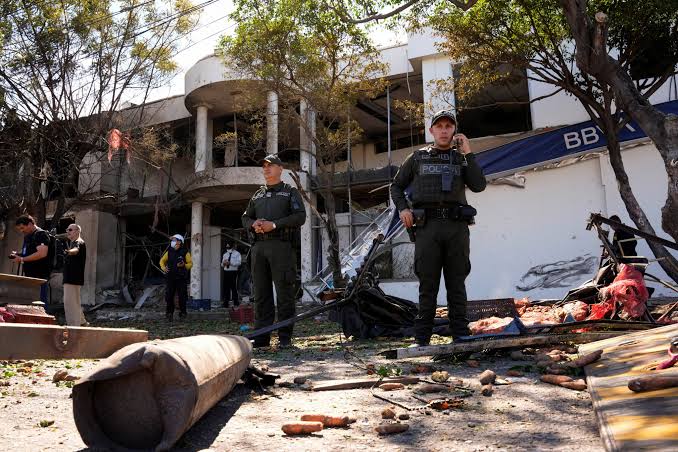
The drone attack came days after a separate bombing in the country’s southwest. On Wednesday morning, a dump truck packed with explosives blew up near a police substation in El Estrecho, in the municipality of Patía in Cauca department, according to The City Paper, a Bogotá-based English-language publication.
The vehicle, a modified dump truck known locally as a volqueta, appeared to have been rigged to strike the police post, the newspaper said. Motorists on the Pan-American Highway alerted authorities after spotting the suspicious truck, and security checks by public forces allowed officers to identify it before it reached its target.
With interception imminent, the attackers apparently detonated the explosives rather than let the truck be stopped. At least one person was killed and six others were injured, and the blast damaged nearby homes and businesses. Emergency crews were assessing the damage as authorities worked to determine whether there were additional casualties.
Officials had not released a full account of the explosion or formally assigned responsibility as of the latest information.
The bombing followed another attack on the same stretch of highway less than a month earlier. On Oct. 12, a vehicle loaded with explosives destroyed the El Bordo toll station in Patía, injuring at least three civilians, damaging homes and disrupting traffic. The army preliminarily blamed the Carlos Patiño structure, a FARC dissident faction active in the area.
That blast capped a violent weekend in Cauca. On Oct. 10, an ELN drone attack on army personnel in La Vega killed a professional soldier, and a sergeant died the next day in clashes between troops and dissidents of the Estado Mayor Central, led by the commander known as “Iván Mordisco.”
Further threats have since surfaced. On Oct. 21, residents of El Tambo found buried explosive cylinders along a road linking the municipality to Popayán. On Nov. 4, police bomb specialists acting on community warnings uncovered three gas cylinders filled with explosives and four improvised explosive devices in the same municipality.
The Pan-American Highway connects Cali, Popayán and Pasto and carries freight, farm produce and passenger traffic across southwestern Colombia, making attacks on the corridor a threat to regional trade and access to essential services as well as to security installations.
A harder line, and a violent response
Violence has escalated across several rural areas since de la Espriella took office in August. The conservative leader canceled peace negotiations with Colombia’s remaining rebel groups and adopted a more confrontational strategy, expanding the use of airstrikes, militarizing some cities and forming joint task forces to protect strategic assets, including a pipeline running from the Caribbean coast to central Colombia.
Some drug trafficking organizations and rebel groups have answered by intensifying attacks on the armed forces. Last week, a military base in Tolima province was hit with improvised missiles made from gas canisters in an attack that killed four civilians. In the border city of Cucuta, police have been targeted repeatedly with remotely detonated bombs.
Before de la Espriella’s inauguration, the previous government pursued several parallel peace processes with armed groups, with limited results. The current administration contends that drug gangs and rebels exploited government-granted ceasefires to strengthen their hold on rural territory, where they extort local businesses and profit from drug trafficking.
The 2016 peace agreement with the FARC led more than 14,000 fighters to lay down arms and allowed the former guerrillas to form a political party. In the years since, smaller groups have battled over territory the FARC left behind.
Data from ACLED, an organization that tracks armed conflict worldwide, shows that state forces and illegal armed groups carried out 34 attacks using bombs or explosives in Colombia during the four weeks ending Oct. 16, a 9% rise over last year’s four-week average.
A conflict adapting to new tactics and a new government
Taken together, the Santa Rosa del Sur drone strike and the Patía truck bomb show how Colombia’s armed groups are adjusting their methods.
Drones, once a novelty in the country’s conflict, are becoming a routine weapon, allowing attackers to hit fortified positions from a distance with little risk to themselves.
Their use against soldiers in Cauca last month and in the San Lucas foothills now suggests the technology has spread across multiple groups and regions.
The truck bomb points to a different but equally worrying trend: a willingness to detonate large explosives near populated areas even when the intended target is out of reach.
That the attackers apparently set off the blast rather than lose the vehicle suggests a priority on causing damage over precision, with civilians absorbing much of the cost.
The surge also tests President de la Espriella’s central argument. His government maintains that dialogue and ceasefires gave armed groups room to expand, and that military pressure is the only answer.
Critics of that approach are likely to point to the rising number of attacks as evidence that confrontation is fueling retaliation. Supporters may counter that the violence reflects groups lashing out as the state reasserts itself.
ACLED’s modest 9% increase in explosive attacks offers some support to both readings, signaling an uptick without yet showing an explosion of violence.
What remains clear is that the struggle centers on valuable territory. Gold mines in the San Lucas range and drug corridors in Cauca generate revenue that armed groups are willing to fight for.
As long as those economies remain lucrative and the state’s presence in rural areas remains thin, attacks on soldiers, police and vital roads like the Pan-American Highway are likely to continue, regardless of which strategy Bogotá pursues.
Sources: AP/TheCityPaperofBogota