Thick fog blanketing a key motorway in eastern Bulgaria set off a chain of crashes involving 86 vehicles on Tuesday, killing at least 12 people and injuring dozens more, officials said, in one of the country’s worst road disasters in recent memory.
The collisions on the Trakia motorway, which connects the capital, Sofia, with the Black Sea port of Burgas, produced two separate pileups near the village of Zimnitsa and forced authorities to shut the road in both directions, Health Minister Katya Ivkova said, as quoted by The Associated Press.
Ivkova said 10 people “died on the spot” and two more died after being taken to hospitals in Yambol and Sliven. She said 46 injured people were taken to medical facilities across the country.
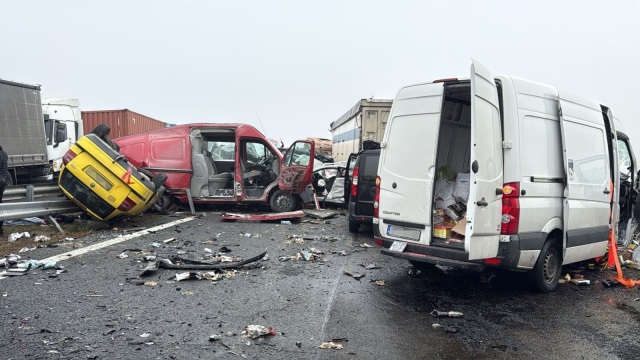
Casualty figures shifted throughout the day. Prime Minister Rumen Radev initially put the toll at 11 dead and 48 injured, the Sofia News Agency’s Novinite.com said. The Express Tribune and The Charlotte Observer, citing Reuters, also cited 11 deaths, with the Interior Ministry saying 50 injured people were taken to hospitals. Law enforcement later said the injured were spread across three regions: 28 in Sliven, 16 in Yambol and six in Burgas.
Visibility collapsed to 10 meters
Authorities said 86 vehicles were caught up in the crashes, 63 in the lanes toward Burgas and 23 in the opposite direction, Novinite.com said. Images in local media showed crushed and overturned cars and trucks strewn across six lanes, with some pushed off the roadway.
Lyubomir Nikolov, acting chief secretary of the Interior Ministry, said fog was the likely cause. Witnesses told investigators visibility was initially 70 to 80 meters before plunging suddenly to about 10 meters.
Nikolov said the first crash occurred in the Burgas-bound lanes when a truck blocked a passenger bus. A second truck carrying grain was then struck, and a passenger car slammed into its rear. All of those killed were traveling toward Burgas, he said, and no children were among the dead or injured.
Officials believe the crash on the Sofia-bound side followed soon after. “We assume that the accident in the direction of Sofia occurred in the same manner. The fact that both incidents happened in the same location is likely linked to drivers becoming distracted after noticing the major pile-up in the lanes heading toward Burgas,” Nikolov said.
Sliven Regional Governor Mihail Kasherov, who was at the scene, offered a different account of how the chain began, saying the first collision involved two cars that crashed and caught fire. He said more than 70 vehicles were involved and that no vehicle crossed the central barrier into oncoming traffic.
Chief Inspector Todor Mishinev of the Yambol regional police told Nova TV that some people were still trapped in their vehicles. “Right now, the priority is rescue operations. Once they are completed, the procedural and investigative actions will be carried out,” he said.
Rescue from a burning truck
An eyewitness described the chaos to Nova TV. “There was very thick fog. The crash happened up ahead. Suddenly, everything went black. I got out of my vehicle and headed forward. Using a car jack, I smashed the window of a burning cab and pulled a person out,” the witness said, adding that vehicles in the opposite lanes then began colliding.
Military aircraft deployed; EU visit cut short
The disaster struck during a visit to Bulgaria by European Commission President Ursula von der Leyen. Radev, who learned of the crashes aboard the government plane en route to Varna, called the accident a “tragedy,” canceled his remaining engagements and a scheduled Council of Ministers meeting, and said he would visit the affected areas.
“I would like to thank Ms. von der Leyen for her understanding regarding the curtailment of our scheduled agenda today,” Radev said.
He sent the government aircraft to Burgas to ferry injured people to Sofia if needed. Two Spartan military transport planes carrying medical teams and stretchers were also dispatched and later moved to Bezmer Air Base near Yambol, closer to the hospitals receiving most of the wounded.
Von der Leyen shortened her visit. “I offer my deepest condolences to the families of those who lost their lives and to the entire Bulgarian people. My respect goes to the rescue teams!” she said, Novinite.com said.
Deputy Prime Minister Alexander Pulev said the state had mobilized every available resource and set up a crisis task force. “Everything with wings is in the air; everything with wheels is on the road,” he said. The BG-ALERT emergency warning system was activated.
Fifteen fire engines, hundreds of police officers and medical teams were sent to the scene, along with more than 20 soldiers from the 42nd Mechanized Battalion in Yambol, the Defense Ministry told the BTA news agency.
Hospitals strained, blood appeal issued
Ivkova said 18 patients were brought to the hospital in Sliven, with others taken to Yambol, Burgas and the Military Medical Academy. Hospitals in Sofia, Plovdiv, Kazanlak and Stara Zagora were placed on standby.
Sliven’s Dr. Ivan Seliminski hospital suspended scheduled operations and issued an urgent appeal for blood donations, saying some patients needed emergency transfusions. In Burgas, a 42-year-old man being treated at Deva Maria Hospital was in very critical condition, officials said.
The Road Infrastructure Agency said the motorway would remain closed for an extended period in the Yambol area because of poor visibility, the large number of heavy trucks involved and the ongoing investigation. It set up detours through surrounding towns including Karnobat, Sliven and Straldzha and urged motorists to check conditions at traffic.api.bg.
Fog, speed and a motorway’s vulnerabilities
The scale of the disaster points to a familiar but deadly combination: sudden fog, high-speed traffic and insufficient following distance. A drop in visibility from roughly 80 meters to 10 leaves drivers traveling at motorway speeds almost no time to react, and once heavy trucks and a bus collided, the chain reaction became nearly impossible to stop.
Nikolov’s comments suggest investigators will focus partly on driver behavior. He said damp roads demanded greater distance and adherence to speed limits, a message likely to fuel debate over enforcement on the Trakia motorway, one of Bulgaria’s busiest routes.
His suggestion that highly reflective road markings, used elsewhere in Europe, could replace ordinary white paint in fog-prone stretches signals that infrastructure may also come under review. The fact that the Sofia-bound crash appears linked to drivers distracted by the first pileup raises questions about warning systems capable of alerting motorists in real time.
The government’s rapid response, including military aircraft and a crisis task force, reflected the gravity of the moment. The shifting death and injury counts, however, show the difficulty of coordinating information across multiple regions and hospitals. As investigations proceed, pressure is likely to grow for concrete safety measures before the next season of heavy fog.
Sources: The Associated Press (AP); Reuters; The Express Tribune; The Charlotte Observer; Sofia News Agency’s Novinite.com; Nova TV; BTA