Democrat Scott Colom defeated Republican Sen. Cindy Hyde-Smith in Mississippi’s razor-close U.S. Senate race, media outlets projected Wednesday, making him the state’s first Black senator since the Reconstruction era and handing Democrats one of the most striking victories of the 2026 midterm elections.
The Associated Press called the race for Colom after local election officials spent days processing absentee ballots and affidavit ballots, as provisional ballots are known in Mississippi. Reuters said the latest tallies showed Colom ahead by more than 4,500 votes, or about half a percentage point, in a contest so tight that at times he led by only a few dozen votes.
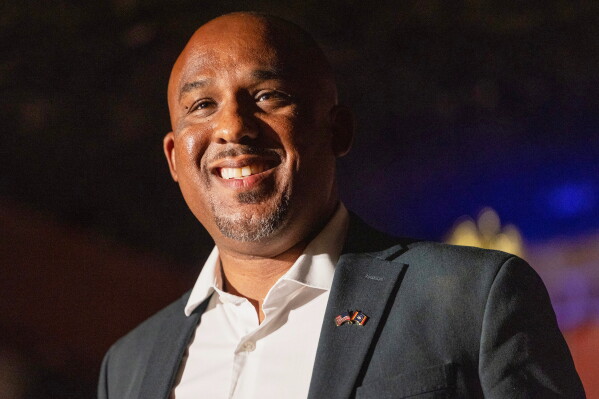
Colom, a 43-year-old district attorney, becomes the first Mississippi Democrat to win a Senate race since John Stennis in 1982, Reuters noted. The last time the state sent a new Democrat to the Senate was 1947, when it elected a staunch segregationist, the AP said. The last Black senator from Mississippi was Blanche Bruce, a formerly enslaved man elected in 1874.
Hyde-Smith concedes
Hyde-Smith, 67, conceded in a brief video posted online.
“While this is not the outcome we worked for or hoped for, I respect the decision of Mississippi voters,” she said. “I want to congratulate Scott Colom and wish him well as he takes on the tremendous responsibility of representing our great state.”
A spokesman said she telephoned Colom to concede before releasing the video. Colom planned a victory celebration with supporters Wednesday night in Jackson.
A bigger Democratic majority
The result widens Democrats’ Senate advantage to 55-44, with the Alaska race still undecided, Reuters said. In the House, Democrats have flipped 41 seats so far and lead 254-168, with 13 races yet to be called.
Having lost both chambers in the Nov. 3 elections, President Donald Trump will face a Democratic-controlled Congress for the first time in either of his terms, giving the opposition the power to block legislation and launch investigations into his administration.
Hyde-Smith, first appointed to the Senate in 2018, had consistently led in polls in a state Trump carried by nearly 23 points in 2024. Trump rallied for her in Corinth late in the campaign.
Grassroots strategy
Colom told Reuters in October that Mississippians felt betrayed by Trump administration policies, including the war with Iran, which has pushed up fuel prices. He also criticized tariffs he said hit the state’s farmers especially hard, while avoiding personal attacks on Trump or his voters.
Instead, he focused his fire on Hyde-Smith, casting her as ineffective in Washington, an argument aimed at voters accustomed to influential senators such as Stennis, Thad Cochran and Trent Lott, who rose to powerful posts and steered federal money home.
He campaigned through town halls and visits to public housing complexes, festivals and food trucks. “We did it the hard way, the grassroots way,” he said.
One of his campaign’s most widely shared ads followed a remark by Hyde-Smith that appeared to brush aside high beef prices by suggesting consumers choose other proteins. Colom’s 30-second response showed incredulous voters saying they would “pick another senator instead.”
When Trump came to Corinth for the late-October rally, Colom walked along the line of supporters waiting outside, introducing himself and asking about their concerns. Inside, Hyde-Smith spoke only briefly when called to the stage. “Is this not the best president in our lifetime?” she asked, before stepping back.
Colom closed his campaign with an ad filmed at the Jackson home of civil rights leader Medgar Evers, who was assassinated in his driveway by a white supremacist in 1963. “He was killed for helping Mississippians vote,” Colom said. “On Tuesday, use your vote and honor everyone who died for that right.”
He received campaign help from Democratic Sens. Raphael Warnock of Georgia and Cory Booker of New Jersey, former President Bill Clinton and former Vice President Kamala Harris, along with fundraising support from Senate Democratic leader Chuck Schumer and Illinois Gov. JB Pritzker.
A history with Hyde-Smith
The two candidates had crossed paths before. In 2022, then-President Joe Biden nominated Colom to serve as a federal judge in the Northern District of Mississippi. The nomination was backed by Republican Sen. Roger Wicker and former Gov. Haley Barbour, but Hyde-Smith blocked it, citing Colom’s positions on transgender issues. Colom said his campaign was never about settling scores.
Reaction
“Scott Colom is the only person who could’ve gotten this done,” Schumer posted online, saying Colom “re-imagined what’s possible for Democrats in the South.”
Clinton told Colom on social media that he won “because you believe in the promise of your state’s people. And they believed in you right back.”
NAACP President Derrick Johnson, a Mississippi resident, said voters “made history because they refused to be intimidated, discouraged, or counted out.”
Colom said he hoped his success would open doors for others. “My job is to do well enough as the next United States senator that the next time some young Black boy or girl has the work ethic, the vision, and the values,” he said, “and they want to be United States senator, that nobody says because of anything I’ve done that they shouldn’t get a chance.”
What Mississippi’s upset may and may not signal
Colom’s victory carries both historic and political weight. Historically, it closes a gap of more than 150 years since Mississippi last sent a Black senator to Washington, in a state that has the largest share of Black voters in the nation and a long history of struggles over voting rights. That context helps explain why the result resonated so quickly beyond the state.
Politically, the reading of the outcome is likely to divide along familiar lines. Democrats, as Schumer’s comments suggest, see evidence that the South is becoming more competitive, pointing to upsets from North Carolina to Texas.
Results showed strong turnout in the majority-Black Mississippi Delta, but also leftward shifts across nearly all of the state compared with 2024, suggesting Colom drew support beyond his party’s base.
Republicans may counter that the race turned on circumstances unlikely to repeat: a national environment shaped by the Iran war and rising fuel prices, candidate-specific missteps such as the beef remark, and a challenger who ran an unusually disciplined campaign. The margin of roughly half a percentage point, in a state Trump won by nearly 23 points two years earlier, indicates Mississippi remains closely divided rather than newly Democratic.
The state’s 2023 governor’s race, which Republican Tate Reeves won by about 3 points, also showed statewide contests there can be competitive under the right conditions.
Colom’s approach may be studied by strategists in both parties. He critiqued policies rather than the president personally, made a localized argument about effectiveness in Washington and invested heavily in in-person outreach. Whether that model can be replicated elsewhere, or depended on this year’s unusual climate, will be tested in future elections.
In the Senate, Colom will join a Democratic majority with greater leverage over Trump’s agenda, judicial nominations and oversight. His campaign pledge to represent rural, suburban and urban Mississippians alike will soon be measured against his votes in a chamber where his party now holds a firm advantage.
Sources: Reuters; The Associated Press (AP)