An Israeli airstrike slammed into the surgical wing of Nasser Hospital in southern Gaza early Thursday, killing six people, including a surgeon, and wounding many others, Palestinian health officials said, in an attack the Israeli military said was aimed at a senior Hamas commander operating inside the complex.
Gaza’s Health Ministry said the dead included medical staff, patients and people accompanying them, Al Jazeera noted. Among them was a surgeon whose name was transliterated variously as Rizk Abu Shaira, Rizq Abu Shuaira and Rezik Abushira by different news outlets. Al Jazeera said a child was also among those killed.
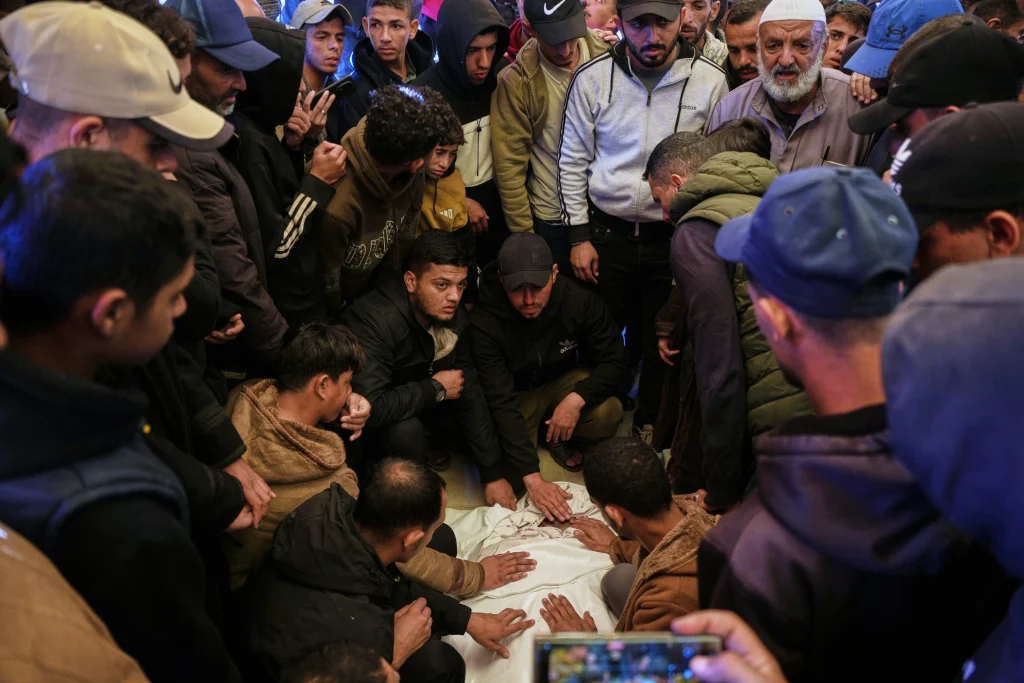
Figures for the wounded varied. The Associated Press, citing the Health Ministry, said at least a dozen people were hurt. Mahmoud Basal, a spokesperson for Gaza’s civil defense service, told Reuters that 20 people were wounded.
Israel says Hamas used hospital as headquarters
The Israeli military confirmed it carried out the strike and said it targeted Muhammad Abu Ismail, commander of Hamas’ Khan Younis Brigade, “along with additional terrorists who were hiding at Nasser Hospital,” Al Jazeera said.
“In his role, Muhammad Abu Ismail was responsible for managing the brigade’s terrorists’ activities and directing them to plan and carry out terrorist plots against Israel,” the military said, adding that he was “also responsible for holding many hostages captive throughout the war.”
In a separate statement cited by the AP, the military said Hamas had “established a presence within the hospital complex” and that the commander had turned it “into a headquarters.” The military told Reuters that Hamas used the complex for weapons storage, command-and-control rooms, observation posts and shelter for fighters.
The military did not provide evidence, and neither the AP nor Reuters could independently verify the allegations. The military did not say whether Abu Ismail was killed.
Hamas rejected the accusations, calling Israel’s initial claim that it used the hospital for military purposes a “blatant attempt to cover up a new war crime,” Al Jazeera said. A Hamas spokesperson told Reuters the strike was a “fully-fledged war crime.”
The Health Ministry described the attack as a “flagrant violation” of international laws that protect medical facilities, staff and patients, and urged the international community and U.N. agencies to intervene and hold those responsible to account.
Destruction inside surgical wing
Inside the surgical building, sections of several floors were heavily damaged or destroyed, the AP said. Debris covered hospital beds and equipment, and steel reinforcing bars hung from the ceiling where the munition struck.
Reuters video showed rubble and furniture scattered through rooms and wires dangling from shattered ceilings. People carried injured patients on stretchers through debris-strewn corridors and helped others limp through the wreckage, while bodies were carried away and firefighters worked outside.
One of Gaza’s last functioning hospitals
Nasser Hospital in Khan Younis is one of the few medical facilities still operating in Gaza, whose health system has been devastated by more than three years of war.
Israeli forces have raided or besieged hospitals across the territory, accusing Hamas of using them as command centers and to hide fighters. Israeli operations have also destroyed medical equipment and supplies and killed or detained hundreds of health workers, the AP said.
Under international humanitarian law, hospitals and their staff are protected during armed conflict, though a hospital can lose that protection if it is used for military purposes.
Nasser Hospital has been struck before. In 2025, an Israeli strike on a gathering point for journalists at the complex killed five reporters, including AP contributor Mariam Dagga.
Strikes continue despite ceasefire
The strike occurred despite a U.S.-backed ceasefire that took effect in October 2025. Israel controls at least 60% of the territory and has continued to carry out strikes, saying Hamas is trying to regroup and rearm. Hamas says it remains committed to the truce and accuses Israel of undermining it.
Health authorities say Israeli strikes and gunfire have killed more than 1,600 Palestinians since the ceasefire began. The AP put the figure at 1,622. Israel says four soldiers have been killed in that period, according to Reuters, while the AP put the number at five.
The war began Oct. 7, 2023, when Hamas-led militants attacked southern Israel, killing about 1,200 people and taking 251 hostages. Israel’s offensive has since killed more than 74,600 people, according to Gaza’s Health Ministry, which is part of the Hamas-run government but whose figures are generally regarded as reliable by international organizations.
A hospital strike tests the fragile truce
The Nasser Hospital strike brings into sharp focus one of the most contested issues of the Gaza war: when, if ever, a hospital becomes a legitimate military target. Israel’s case rests on the claim that Hamas turned the complex into a headquarters and that a senior commander was present.
Palestinian officials and Hamas insist the hospital was a civilian facility and the strike a grave violation of international law. Without independent verification of the military’s claims, the dispute is likely to remain unresolved, though international legal experts generally hold that even where a hospital loses protection, attacking forces must still weigh harm to patients and staff.
The human cost is especially significant given Nasser’s role. As one of the few hospitals still functioning, damage to its surgical wing further erodes Gaza’s capacity to treat trauma and chronic illness, compounding a health crisis that aid agencies have long described as catastrophic. The death of a surgeon removes scarce expertise from a system already stripped of personnel.
The strike also raises questions about the durability of the ceasefire. More than 1,600 Palestinian deaths since the truce began, alongside Israeli military losses, indicate that the agreement has reduced but not halted the violence.
Israel frames its continuing operations as necessary to prevent Hamas from rebuilding; Hamas portrays them as efforts to unravel the deal. Each high-profile strike, particularly on a protected facility, adds strain to an arrangement that the United States has backed as a path toward a longer-term settlement.
The targeting of a brigade commander suggests Israel remains focused on dismantling Hamas’ leadership structure in southern Gaza. Whether that campaign can coexist with a ceasefire that both sides say they support is likely to be a central question for mediators in the weeks ahead.
Sources: The Associated Press (AP); Reuters; Al Jazeera