An explosion ripped through a primary and middle school in eastern Afghanistan’s Kunar province on Saturday, killing 10 people and wounding 110 others, most of them children, Taliban officials said. Initial findings suggested the blast began at a nearby depot storing explosives for mining companies.
Interior Ministry spokesperson Abdul Mateen Qani gave the toll of 10 dead and 110 injured, The Associated Press said. Earlier figures released by the ministry, cited by Reuters, put the toll at seven students killed and up to 99 hurt.
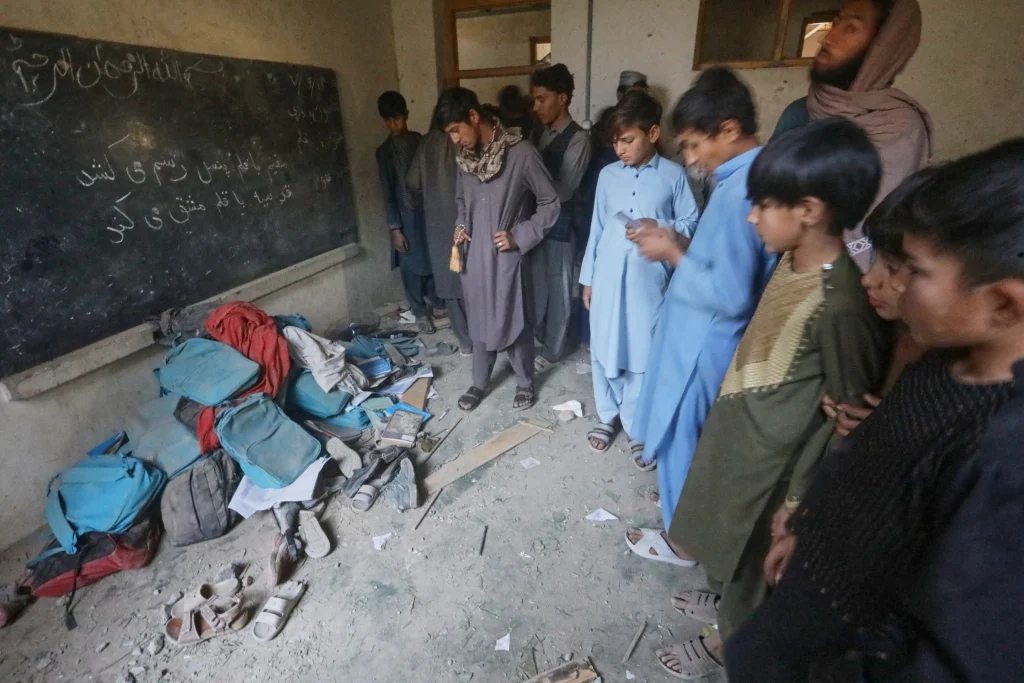
The explosion happened at about 10 a.m. at a school in the Andar Ser area on the outskirts of the provincial capital, Asadabad, said Farid Dehqan, spokesperson for the Kunar provincial police.
Negligence blamed
Kunar Culture and Information Director Sami ul Haq Bayan said preliminary information indicated the blast was caused by negligence at the depot, which held explosives belonging to mining companies. An investigation is underway.
Taliban deputy spokesperson Hamdullah Fitrat said early findings showed that inadequate precautions in handling and storing the explosives led to the disaster, Afghan news outlet Khaama Press said.
That account was challenged. Khaama Press said a Pakistani government source alleged the building where the blast occurred was being used as a bomb-making site by Tehreek-e-Taliban Pakistan, or TTP. The outlet also cited local residents who claimed the Taliban had set up an explosives manufacturing facility near the school. Khaama Press said it could not verify those claims, and the Taliban maintain the explosives belonged to mining firms. Who operated the facility has not been independently established.
‘I saw the hand of my niece’
The blast partially brought down the school building, trapping students and teachers under rubble. Footage showed a collapsed section of the school and, in one classroom, blue UNICEF schoolbags scattered across a dust-covered floor.
Noor Rahman, who lives next door, said he heard the explosion and saw dust rising. “I ran straight into the dust, our own children were there,” he said. “I entered one of the rooms, where there was screaming and shouting. I saw the hand of my niece, she was moving it. I rushed in, cleared away the bricks, and managed to pull her out, along with other injured (people).”
Haji Sulaiman, whose son was wounded, said he was walking to his shop when he heard the blast and ran to the school. Speaking from his son’s hospital bedside, he described finding children dead and bloodied beneath collapsed roofs. “Nothing remained of the school,” he said.
Another resident, Ali Rahman, joined the rescue effort. “Some had sustained wounds from broken glass, others had been struck by collapsing walls, and some were trapped,” he said.
Hospital footage showed injured young children, several with bandaged heads, some sharing beds. Some of the wounded were transferred to hospitals in neighboring Nangarhar province, Khaama Press said.
UNICEF: ‘Schools must be safe’
UNICEF said it was “devastated” by the reports and that it and its partners were on the ground providing emergency medical support and assessing the needs of affected children and families.
“Schools must be safe places for every child,” the agency said.
Mining boom, weak safety
Afghanistan is rich in iron ore, copper, lead, zinc, gold, coal and precious stones, and mining is a major industry. But safety standards are often poor, leading to frequent accidents. Gemstone mining has been expanding in Kunar, which borders Pakistan, with companies extracting stones that are later sold at auction.
In August, an attack on an education center in Kabul wounded more than 40 children. The AP described it as a hand grenade attack; the U.N. Assistance Mission in Afghanistan said at least 42 children were injured, and a hospital that treated at least 35 of them said all were between 10 and 14.
A disaster that raises hard questions
Whatever its cause, the Kunar blast exposes how dangerous materials can end up next to places where children gather. If the Taliban’s explanation is correct, the disaster points to weak regulation in a fast-growing mining sector where explosives are stored with few safeguards and, in this case, beside a school. That would add to long-standing concerns about safety in Afghan mining, an industry the Taliban government sees as a key source of revenue.
The competing claim, that the site was a TTP bomb-making facility, carries far greater political weight. Pakistan has repeatedly accused the Taliban of sheltering TTP fighters who carry out attacks across the border, a charge Kabul denies. Kunar’s location on the Pakistani frontier makes the allegation sensitive, and the Pakistani government source’s claim is likely to feed into already strained relations between the two neighbors. Without independent verification, neither account can be confirmed.
The scale of child casualties will also draw scrutiny from humanitarian groups. Afghanistan’s education system has been under heavy strain since the Taliban takeover in 2021, including restrictions on girls’ schooling beyond the primary level. Attacks and accidents at schools, such as the Kabul incident in August, add to fears for children’s safety even in places meant to protect them.
A credible, transparent investigation into who stored the explosives, under what permits and why so close to a school is likely to be the main test of the authorities’ response. Relatives of the dead and injured will want answers about how such a facility was allowed to operate in a residential area.
Sources: The Associated Press (AP); Reuters; Khaama Press