The Trump administration on Wednesday proposed sweeping new tariffs on imports from China, the European Union, Taiwan and 11 other economies, accusing them of subsidizing factories that churn out excess goods and undercut American manufacturers.
The duties also aim to recover revenue lost after the Supreme Court ruled in February that President Donald Trump could not use an economic emergency declaration to bypass Congress and impose across-the-board tariffs, The Associated Press said.
U.S. Trade Representative Jamieson Greer told CNBC that many trading partners had adopted “market distorting practices that tilt the trade balance in their favor while eroding America’s manufacturing base.”
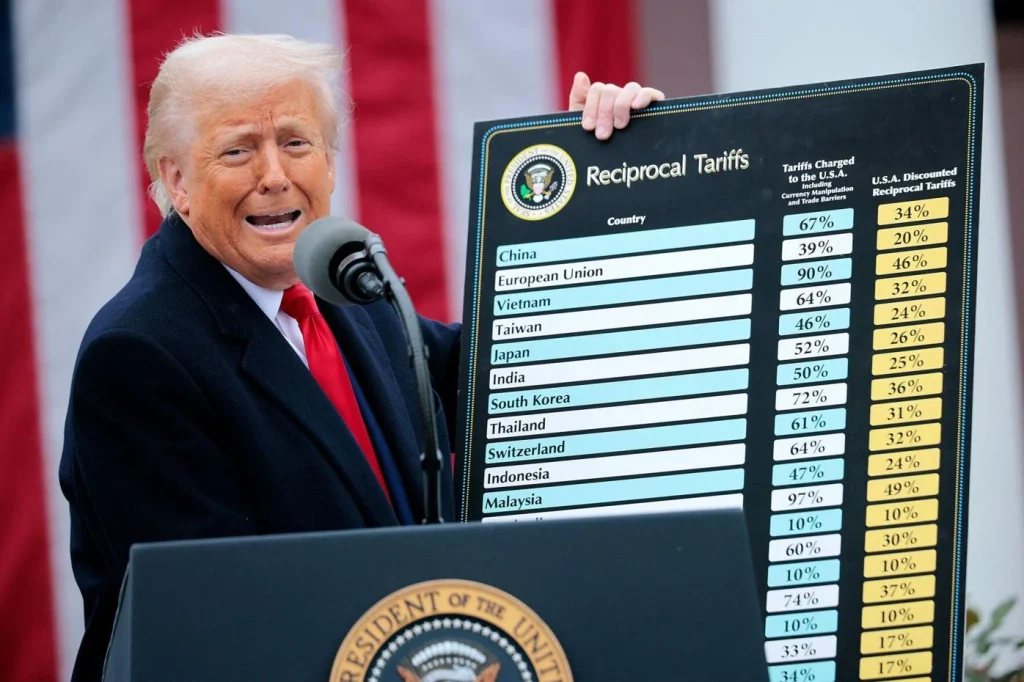
The proposed rates range from 15% to 35% and could apply to about three-fifths of U.S. imports. The administration also proposed exemptions for semiconductors and other high-tech goods from Taiwan and South Korea that are critical to the artificial intelligence buildout.
Besides China, the EU, Taiwan and Brazil, the countries facing the new tariffs are Bangladesh, Cambodia, India, Indonesia, Malaysia, Singapore, Switzerland, Thailand and Vietnam. Mexico and Norway face pending investigations.
Modest economic impact expected
Economists said the duties largely replace tariffs first imposed in April 2025 and should have a limited effect on inflation and growth.
The new levies “were widely expected, are relatively small, and would return us roughly to where we were earlier in the year,” said Mark Williams, chief Asia economist at Capital Economics.
Goldman Sachs estimates the plan would bring most tariffs on the affected countries back to their levels before the Supreme Court ruling. It calculates that the overall U.S. tariff rate would rise from 7.8% to 9.2%, with “a very small incremental impact” on inflation.
The tariffs target specific products and would not stack on separate duties on cars, steel, aluminum and other goods imposed under Section 232 of the Trade Expansion Act of 1962. Nor would they add to the 10% to 12.5% levies announced in July on 60 trading partners the White House said had failed to enforce bans on goods made with forced labor.
“We’ve talked to our trading partners about this — they know what we’re proposing,” Greer said. “I think a lot of this is baked in.”
The administration will gather comments from affected industries and hold a hearing Jan. 25, suggesting the tariffs would not take effect until February or March.
Democrats vow to fight
The proposal comes weeks after voters gave Democrats control of both the House and Senate in the midterm elections. About two-thirds of voters said Trump’s policies had worsened the economy, according to AP VoteCast, the AP’s survey of the electorate in all 50 states.
Sen. Ron Wyden, the Oregon Democrat who will chair the Senate Finance Committee next year, pledged to “use every tool at my disposal to end Trump’s tariffs chaos.”
“This is another blatant attempt by Donald Trump to reconstruct his illegal global tariffs,” Wyden said. “Global overcapacity is a serious problem, but Trump’s unilateral price-hiking tariffs are not the solution.”
Overturning the duties will be difficult, however. Some Democrats are likely to back certain tariffs, especially on China, and Trump can veto any bill to undo them.
Dan Anthony, executive director of the small business group We Pay the Tariffs, criticized the move. “Three weeks ago, voters unambiguously rejected tariffs that have worsened the affordability crisis and devastated small businesses,” he said.
Brazil threatens retaliation
The tariffs will be imposed under Section 301 of the Trade Act of 1974, which allows the president to act against countries found to engage in unreasonable or discriminatory trade practices. The administration said they would be consistent with trade deals Trump struck with dozens of countries last year.
Brazil was targeted for extra penalties after trade talks stalled. Washington proposed higher tariffs on raw and refined sugar and a new 10% duty on aircraft, which would hit Embraer, Brazil’s largest plane maker.
Brazil’s government called the move “an unacceptable action within the framework of the ongoing bilateral negotiating process” and said it “will not yield to this type of threat.” It said it would keep negotiating “without ruling out the possibility of adopting retaliatory measures.”
China in the crosshairs
Some Chinese goods would face a new 20% tariff on top of existing duties, for a total rate of 45%, the AP said. Reuters said the increase would come on top of 25% levies dating from Trump’s first term, a limit the two leaders agreed in their truce, and estimated the latest move raises China’s tariffs by roughly 7.5 percentage points.
The U.S.-China trade truce reached last year expires Jan. 10, 2027. Greer said the administration is proposing a “broad exemption” for $30 billion worth of Chinese goods in line with the truce.
Trump met Chinese leader Xi Jinping in Shenzhen last week and plans to host him next month at the Group of 20 summit in Miami, where the truce, rare earth minerals and Chinese purchases of U.S. farm goods are likely to come up.
China’s Foreign Ministry rejected the accusations of unfair practices but stopped short of threatening retaliation. “A tariff war or a trade war serves no party’s interests,” spokesperson Guo Jiakun said, urging dialogue.
Reuters said China is a central focus even in the reports on other countries. The USTR’s findings on Vietnam mention China more than 250 times, and its EU report more than 300 times. The China report alone runs 456 pages.
“If the trade war does start up again, (the latest) measures provide the US with some ammunition,” Williams told Reuters.
Some analysts said the measures were too mild. China “is a bigger source of excess production than the rest of the world combined,” said Derek Scissors, a senior fellow at the American Enterprise Institute, but the proposal “barely raises existing tariffs on China and will make no difference to the country’s trade behavior.”
Recent signals suggest the truce is holding. Beijing this week extended its suspension of rare earth export controls on the U.S., and China Southern Airlines said its subsidiary Xiamen Airlines agreed to buy 50 Boeing 737 MAX 8 jets, Reuters said.
“China definitely does not want to fight another trade war with the US, and the US probably doesn’t want to either,” said Chen Bo of the National University of Singapore’s East Asian Institute.
Legal challenges likely
The new duties are likely to be challenged in court, as the forced labor tariffs already have been. Ryan Majerus, a trade lawyer who served in Trump’s first administration and under President Joe Biden, said some of those earlier duties could be overturned because the USTR did not provide detailed evidence for each of the 60 countries. Section 301 requires a country-specific analysis, which is why the agency published extensive reports this time.
A legal rebuild with political risks
Wednesday’s proposal is best understood as a reconstruction rather than a new escalation. After the Supreme Court closed off emergency powers as a route to broad tariffs, the administration turned to Section 301, a slower but more legally established tool that requires country-by-country findings. The voluminous reports appear designed to withstand the kind of court challenges that have weakened other tariff programs.
The economic effect may be limited, as Goldman’s estimates suggest, but the political timing is striking. Coming weeks after a midterm defeat in which voters cited the cost of living, the move signals that the White House remains committed to tariffs as a central policy tool. That sets up an early clash with a Democratic-controlled Congress, though Trump’s veto power and Democratic support for tougher action on China make a full reversal unlikely.
China remains the real target, even when tariffs are aimed elsewhere. By pressing the EU, Vietnam and others over their dealings with Chinese imports and investment, Washington is trying to build a wider front against Chinese overproduction. Analysts such as Macquarie’s Viktor Shvets argue that China’s export-heavy economy will drive trade friction regardless of U.S. policy, predicting more tariffs and trade barriers worldwide.
The proposal also preserves leverage ahead of the January truce deadline and Xi’s visit to Miami. Scissors’ criticism, that the measures barely move China’s tariffs, suggests the administration is keeping its options open rather than forcing a confrontation. Brazil’s threat of retaliation, meanwhile, shows the plan carries diplomatic costs beyond China.
Sources: The Associated Press (AP); Reuters; CNBC