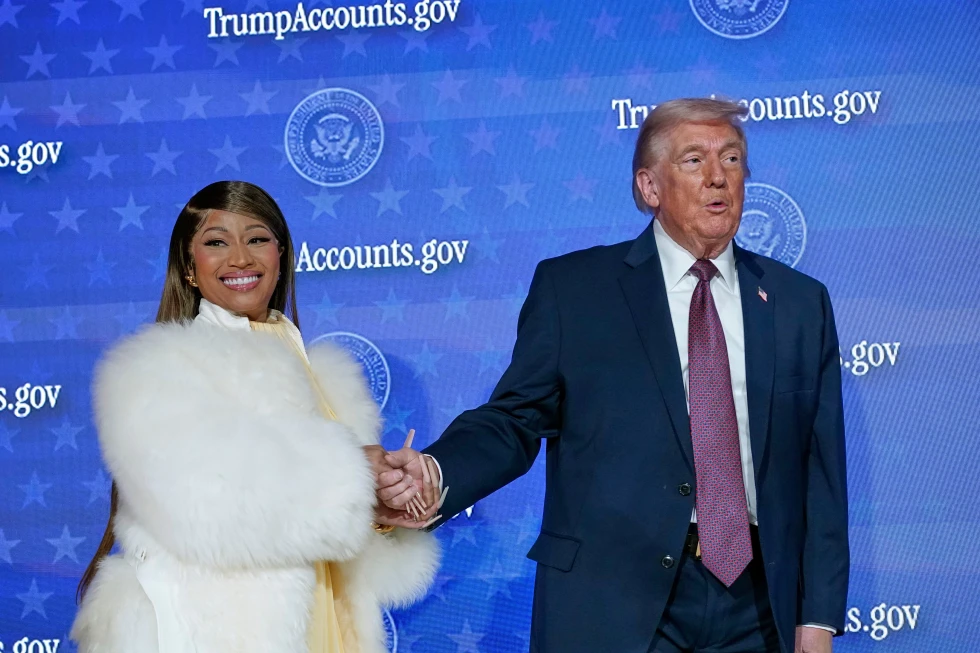
The White House and U.S. Treasury are promoting the upcoming rollout of “Trump Accounts,” a new savings initiative aimed at newborn children that President Donald Trump and his allies say reflects a broader promise to improve affordability and long-term economic security for American families.
The program, embedded in Trump’s signature tax legislation, would provide a $1,000 government contribution for every qualifying newborn whose parents open an account. The money would be invested in the stock market by private financial firms and remain inaccessible until the child turns 18. Administration officials describe the initiative as a landmark effort to expand asset ownership and expose more Americans to equity markets from birth.
Treasury officials and White House advisers marked the initiative Wednesday at a public event in Washington that drew an eclectic mix of political figures and high-profile business and entertainment personalities, including Texas Republican Sen. Ted Cruz, rapper Nicki Minaj and “Shark Tank” investor Kevin O’Leary. Speakers framed Trump Accounts as a tool to narrow wealth gaps and strengthen what they described as the country’s capitalist foundations.
President Trump told the gathering that the program is designed to ensure children begin adulthood with tangible financial resources, not just obligations. He urged employers nationwide to make matching contributions part of their benefits packages, noting that several major companies have already pledged to participate.
“Every president in modern history has left our children with nothing but debt,” Trump said during the event. “But under this administration, we’re going to leave every child with real assets and a shot at financial freedom.”
Under the plan, parents who open a Trump Account for a qualifying newborn would trigger a $1,000 contribution from the U.S. Treasury. The funds must be invested in U.S. equity index funds that track the broader stock market and are subject to a strict cap on management fees of no more than 0.10% annually. The accounts would be administered by private banks and brokerages rather than the federal government.
Parents would be allowed to add up to $2,500 a year in pretax contributions, similar in structure to retirement savings vehicles. Total annual contributions would generally be capped at $5,000, though donations from employers, governments and charitable organizations would not count toward that limit. Friends, relatives and philanthropic groups would also be permitted to contribute.
Trump described the approach as preferable to direct cash assistance, arguing that long-term investment fosters a sense of ownership and responsibility. “We’re doing something much better than giving the next generation a handout,” he said. “We’re giving them ownership of America’s future.”
Eligibility for the $1,000 seed money is limited. To qualify, a child must be a U.S. citizen, have a Social Security number and be born between Jan. 1, 2025, and Dec. 31, 2028, the years covered by Trump’s current term. Parents of older children may still open accounts, but they will not receive the government contribution. The child’s access to the funds would generally be restricted until age 18, and withdrawals would be taxable.
The administration has emphasized that a parent’s immigration status does not affect a child’s eligibility, a detail Treasury officials say is intended to ensure broad participation among U.S.-born children.
Some older children may receive smaller seed contributions through private philanthropy rather than federal funding. In December, billionaires Michael and Susan Dell committed $6.25 billion to provide $250 to certain children age 10 and younger whose families live in ZIP codes with median incomes of $150,000 or less and who do not qualify for the Treasury contribution. Hedge fund founder Ray Dalio and his wife, Barbara, later pledged $75 million to fund similar contributions for children in Connecticut. On Wednesday, Trump announced that investor Brad Gerstner would donate $250 for every child under 5 in Indiana.
Several major corporations, including Uber, Intel, IBM, Nvidia and Steak ’n Shake, have indicated they plan to incorporate Trump Account contributions into employee benefits. Treasury Secretary Scott Bessent has promoted those efforts under what he calls a “50 State Challenge,” encouraging businesses and local governments to expand participation nationwide.
The accounts will not be open for contributions until July 2026. Parents of eligible children can register using IRS Form 4547, either while filing taxes this year or through an online portal expected to launch this summer, the Trump Accounts website says. Registration is required for the Treasury contribution, and parents who enroll by May will receive instructions on completing the account setup.
Supporters say the broader goal is to expand stock market participation among households that have historically been excluded. Roughly 58% of U.S. households owned stocks or bonds in 2022, based on data from the Securities and Exchange Commission, though the wealthiest 1% controlled nearly half of total stock value. Advocates argue that early exposure could help close that divide over time.
“This makes every child in America a capitalist from birth,” Gerstner said at the Treasury event, arguing that expanded ownership is a counterweight to rising interest in socialist economic ideas.
The initiative also fits into a wider national debate over “baby bonds.” Before Trump Accounts were created, California, Connecticut and the District of Columbia launched state-run programs that provide investment accounts to children, often targeting those born into poverty, foster care or families affected by the COVID-19 pandemic. Several other states, including Maryland, are considering similar models. Unlike Trump Accounts, those programs typically exclude wealthier families and are managed by public agencies.
Critics of the Trump Accounts argue that the program does little to address children’s immediate needs, particularly during early childhood when poverty rates are highest. They also contend that the accounts fail to offset reductions in other safety-net programs, including food assistance and Medicaid, enacted alongside the tax legislation that created the accounts.
Some economists and advocacy groups warn the program could widen wealth inequality rather than reduce it. Families with higher incomes are better positioned to make regular contributions and benefit from compounded investment returns, while lower-income households may be unable to add funds beyond the initial government contribution. Assuming a 7% annual return, analysts note, the $1,000 seed money would grow to roughly $3,570 over 18 years, a sum critics say may be modest compared with the advantages gained by families able to maximize contributions.
Administration officials counter that the accounts represent a long-term strategy rather than a short-term poverty intervention, and that expanding asset ownership complements, rather than replaces, other economic policies.
As the program moves toward implementation, Trump Accounts are emerging as a defining element of the administration’s economic message: a bet that early exposure to markets and private investment can reshape how future generations build wealth, even as questions remain about who stands to benefit the most.
Real Madrid was pushed into the Champions League qualifying playoffs Wednesday after a dramatic loss at Benfica, where a last-gasp header by the Portuguese club’s goalkeeper capped a stunning night that reshuffled the tournament’s knockout field.
Madrid entered the final round of league-stage matches sitting third in the expanded 36-team standings but slipped to ninth following a 4-2 defeat in Lisbon, despite two goals from Kylian Mbappé. The result left the Spanish powerhouse one place outside the top eight, the cutoff for direct qualification to the round of 16.
Benfica, coached by former Madrid manager José Mourinho, advanced in extraordinary fashion. Ukrainian goalkeeper Anatoliy Trubin scored with a header in the eighth minute of stoppage time, a moment that ultimately secured Benfica a place in the knockout phase on goal difference, finishing 24th. Madrid ended the match with nine players after red cards were shown late to Raul Asencio and Rodrygo.
Madrid’s slide out of the automatic qualification places was sealed when Sporting Lisbon struck in stoppage time to claim a 3-2 win at Athletic Bilbao, a result that lifted Sporting into the top eight.
Sporting joined Liverpool, Tottenham, Barcelona, Chelsea and Manchester City in securing direct passage to the round of 16. Arsenal, which completed a perfect league-stage campaign with an eighth straight victory, and Bayern Munich had already confirmed their places at the top of the table.
Real Madrid’s French forward #10 Kylian Mbappe and teammates walk after losing the UEFA Champions League league phase day 8 football match between SL Benfica and Real Madrid CF at Estadio da Luz in Lisbon on January 28, 2026. (Photo by PATRICIA DE MELO MOREIRA / AFP)
Paris Saint-Germain also dropped into the playoff round after a 1-1 draw at home against Newcastle. Both clubs began the day inside the top eight but fell to 11th and 12th respectively as results elsewhere went against them.
Madrid, PSG, Newcastle and last season’s runner-up Inter Milan will all feature in Friday’s playoff draw for teams finishing between ninth and 24th, with the winners advancing to the last 16 in March. PSG traveled this route last season, navigating the extra February matches on its way toward another deep European run.
Elsewhere, Norwegian debutant Bodo/Glimt secured a place in the knockout phase by winning 2-1 at Atletico Madrid, underscoring the importance of last week’s home victory against Manchester City in Arctic conditions. Benfica’s late heroics also proved costly for Marseille, which fell out of contention after a 3-0 loss at Club Brugge.
Italian clubs Juventus and Atalanta progressed to the playoffs, while Napoli was eliminated after a 3-2 home defeat to Chelsea, finishing 30th in the standings.
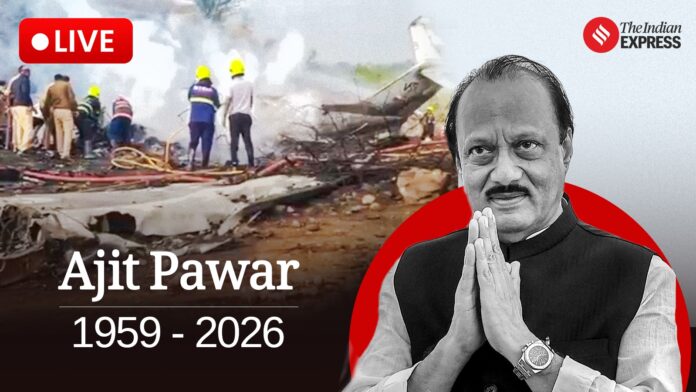
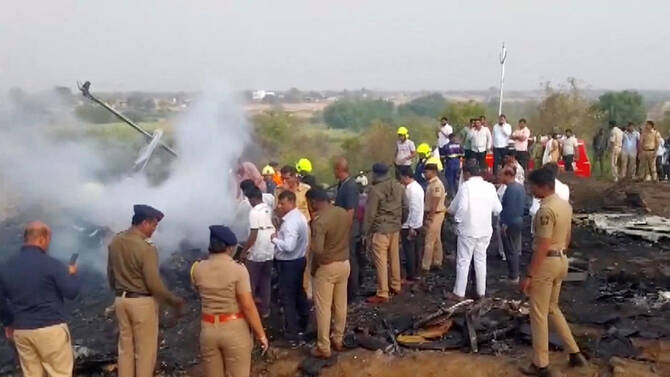
A privately operated jet carrying a senior political leader plunged into an open field in western India on Wednesday, killing Maharashtra Deputy Chief Minister Ajit Pawar and four others in one of the deadliest aviation incidents involving a sitting Indian official in recent years, authorities confirmed.
The mid-size Learjet 45 was attempting to complete its journey when it went down in a rural area near Baramati, erupting into flames on impact and leaving no survivors, officials with India’s aviation regulator said. Television footage broadcast nationwide showed thick plumes of smoke curling into the sky as emergency crews converged on the wreckage scattered across farmland.
The Directorate General of Civil Aviation said the aircraft was carrying Pawar, two members of his staff and two flight crew members. All five were pronounced dead at the scene.
The aircraft had departed from Mumbai earlier in the day and was headed toward Baramati, Pawar’s political base and home constituency, where he was scheduled to take part in election campaigning, officials familiar with the itinerary said. The crash site was roughly 254 kilometers, or 159 miles, southeast of Mumbai.
The cause of the crash remained unclear late Wednesday. Aviation authorities said investigators from the Aircraft Accident Investigation Bureau would lead a formal probe, with support from local police and airport officials.
Ajit Pawar, 66, was among Maharashtra’s most influential political figures and served as the state’s second-highest elected official within the coalition government aligned with Indian Prime Minister Narendra Modi. Known for his deep roots in the state’s sugar-producing regions, Pawar wielded significant influence in rural politics and was regarded as a formidable organizer during election cycles.
India’s Prime Minister expressed shock over the tragedy, calling Pawar’s death a major loss to public life.
“His grasp of governance and his dedication to uplifting the poor and marginalized were widely recognized,” Modi wrote in a post on X. “His sudden passing is deeply distressing. My condolences go out to his family and countless supporters.”
Indian media outlets, including The Indian Express, reported that the aircraft went down during landing near Baramati airport, citing preliminary information from aviation officials. The newspaper said Pawar had been traveling on a chartered flight while moving between political engagements tied to ongoing local elections.
The DGCA confirmed that the jet was staffed by a pilot-in-command and a first officer, accompanied by Pawar, a personal security officer and an attendant. Officials said coordination between federal investigators and Pune rural police was underway as authorities secured the crash site and began collecting evidence.
In Maharashtra, the state government announced a three-day period of mourning as political leaders from across party lines paid tribute to Pawar’s legacy. Government buildings were ordered to fly flags at half-staff, and several campaign events were postponed.
Leaders within Pawar’s Nationalist Congress Party described him as a pragmatic politician with a strong grassroots connection who had maintained influence across decades of shifting political alliances. His death is expected to have immediate repercussions for Maharashtra’s electoral landscape, particularly in rural districts where he maintained personal loyalty among local leaders.
Family members, including senior political figures Sharad Pawar and Supriya Sule, were in New Delhi attending the opening day of Parliament’s budget session when news of the crash broke, party officials said. Arrangements were being made for the family to travel to Baramati.
As investigators worked through the wreckage, early commentary from the aircraft’s operator pointed to possible visibility challenges. VK Singh, director of VSR Corp., told reporters that initial indications suggested the pilot may have struggled to visually acquire the runway.
Singh said the aircraft made multiple maneuvers before the final attempt to land, including at least one missed approach. He spoke outside the company’s Mahipalpur compound after meeting with investigators from the Aircraft Accident Investigation Bureau.
Aviation experts cautioned against drawing conclusions before the completion of the inquiry, noting that factors such as weather, mechanical condition, pilot workload and airport infrastructure would all be examined.
India has seen rapid growth in private and chartered aviation over the past decade, driven by business travel and political campaigning across vast distances. While commercial airline safety records have improved significantly, experts say private aviation remains vulnerable to operational risks, particularly during short-haul flights into regional airports.
The crash has renewed scrutiny of safety protocols for chartered aircraft used by public officials, especially during election periods when travel schedules can be compressed and weather conditions unpredictable.
Beyond the immediate tragedy, Pawar’s death introduces political uncertainty in Maharashtra, one of India’s most economically significant states. As deputy chief minister, he played a central role in coalition negotiations and policy coordination, particularly in agriculture and rural development.
Political analysts say the loss of such a senior figure could reshape alliances ahead of upcoming elections, with ripple effects extending beyond state borders. The timing of the crash, amid an active campaign season, underscores how abruptly leadership vacuums can emerge in India’s complex political system.
Authorities said further updates would be released as the investigation progresses. For now, the focus remains on determining what caused the aircraft to go down and ensuring accountability as the nation mourns one of its most prominent regional leaders.
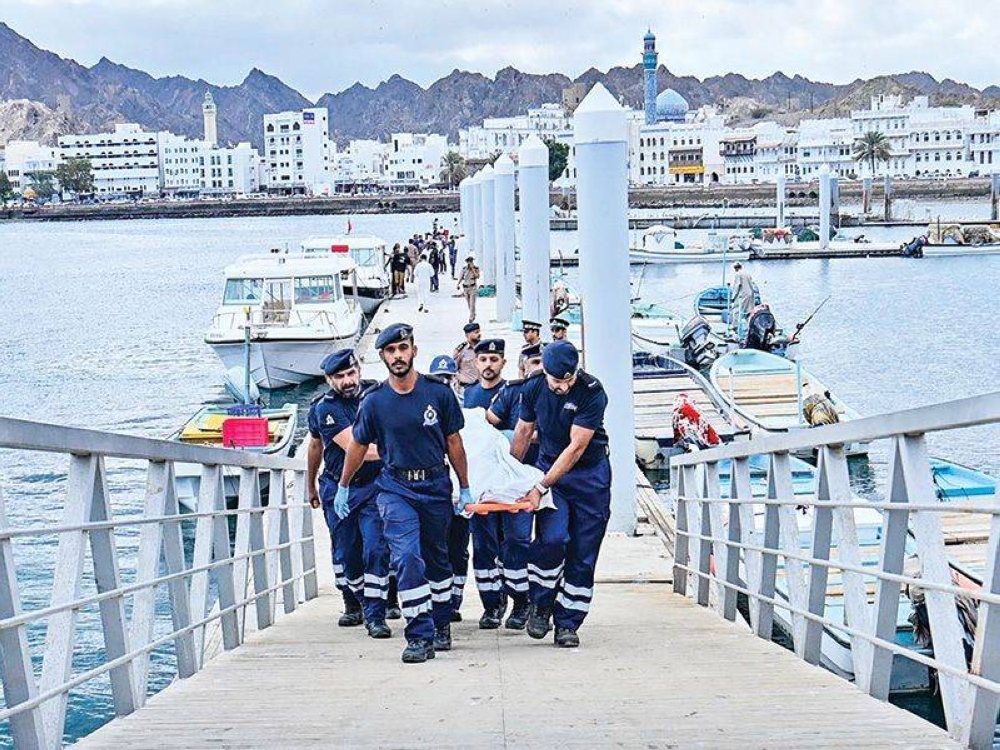
Three French tourists were killed and two others injured after a boat carrying a group of visitors overturned off the coast of Oman near the capital, Muscat, underscoring safety concerns as the Gulf nation pushes to expand its tourism industry, authorities and international media said.
The vessel capsized Tuesday about 2.5 nautical miles, or roughly 4.6 kilometers, from Sultan Qaboos Port in the Gulf of Oman, the Royal Oman Police announced in a statement shared on social media. The boat was transporting 25 French tourists along with a tour guide and a captain when it tipped over in coastal waters east of the Arabian Peninsula.
Emergency responders recovered three bodies at the scene, while two injured tourists were taken for medical treatment, police said. The remaining passengers were rescued without serious harm. Officials described the injuries as minor but did not provide further details on the victims or the conditions that led to the incident.
Authorities said an investigation has been opened to establish what caused the boat to overturn. “Investigations are still ongoing to determine the circumstances of the incident,” the Royal Oman Police said, signaling that weather, mechanical issues or operational factors had not yet been ruled out.
International media confirmed the deaths. Reuters cited Omani police as saying three French tourists were killed when the boat capsized off the coast of Oman, noting that the vessel was carrying a group of French visitors, a tour guide and the captain at the time of the accident. Al Jazeera also reported that at least three French tourists drowned in the Gulf of Oman near Muscat, echoing police accounts that two others suffered minor injuries.
French newspaper Le Monde reported that the vessel overturned while en route from Muscat, carrying a tour group that included 25 French tourists, a guide and the captain. The outlet cited Omani authorities as confirming the location of the incident and the number of casualties, adding that the tragedy unfolded a short distance from the capital’s main port.
Local media outlets in Oman said the boat was believed to be heading toward the Daymaniyat Islands, a popular diving destination northwest of Muscat known for coral reefs, clear waters and marine biodiversity. The islands are a protected nature reserve and a frequent stop for tour operators offering snorkeling and diving excursions to international visitors.
France’s Ministry for Europe and Foreign Affairs had not issued an immediate public statement on the deaths. It was not clear whether consular officials had traveled to Oman to assist families of the victims or coordinate with local authorities.
The incident comes as Oman continues to promote itself as a growing hub for international tourism, particularly among travelers seeking outdoor activities such as diving, hiking and coastal exploration. The sultanate, located on the southeastern edge of the Arabian Peninsula, has invested heavily in tourism infrastructure as part of its broader economic diversification strategy.
Government figures show Oman welcomed nearly four million visitors in 2024, a sharp increase compared with previous years. Officials have said they aim to triple annual tourist arrivals by 2040, with an emphasis on sustainable tourism that balances economic growth with environmental protection. The Daymaniyat Islands and other marine areas have been central to that strategy, drawing visitors interested in ecotourism and underwater experiences.
While boating accidents involving tourists are relatively rare in Oman, the tragedy highlights the inherent risks associated with marine tourism, particularly in regions where weather and sea conditions can change rapidly. The Gulf of Oman is known for strong currents and seasonal winds, factors that can pose challenges for smaller vessels if not carefully managed.
Safety standards for tourist boats vary widely across the region, and enforcement often depends on local operators and port authorities. Analysts say that as Oman expands its tourism sector, scrutiny of safety regulations, vessel maintenance and crew training is likely to intensify, particularly following incidents involving foreign nationals.
International tourism experts note that accidents involving visitors can have outsized effects on a country’s reputation, even when they are isolated events. European travelers, including those from France, make up a significant portion of Oman’s long-haul tourism market, especially during the winter months when milder temperatures attract visitors from colder climates.
“This kind of incident places pressure on authorities to demonstrate transparency and accountability,” said a regional tourism analyst familiar with Gulf travel trends, speaking generally about maritime safety issues. “Investigations and clear communication are critical, not just for families but for maintaining confidence among future travelers.”
The Gulf of Oman sits along major shipping lanes connecting the Arabian Sea with the Strait of Hormuz, one of the world’s most strategically significant waterways. While commercial maritime traffic dominates the region, coastal tourism has grown steadily, particularly around Muscat and nearby island chains.
Oman has generally been viewed as a stable and safe destination compared with other parts of the Middle East, and its tourism push has been framed as a pillar of long-term economic planning that reduces reliance on oil revenues. The government’s focus on sustainability has included limits on visitor numbers in sensitive marine areas and conservation measures designed to protect coral reefs and wildlife.
Still, the deaths of the French tourists are likely to prompt renewed discussion about oversight of tour operators and emergency preparedness at sea. Investigators are expected to examine whether the vessel met safety requirements, including life jackets and passenger capacity limits, as well as whether weather advisories were in effect at the time of the trip.
For now, authorities have not indicated whether criminal charges or regulatory penalties could follow, saying only that the inquiry is continuing.
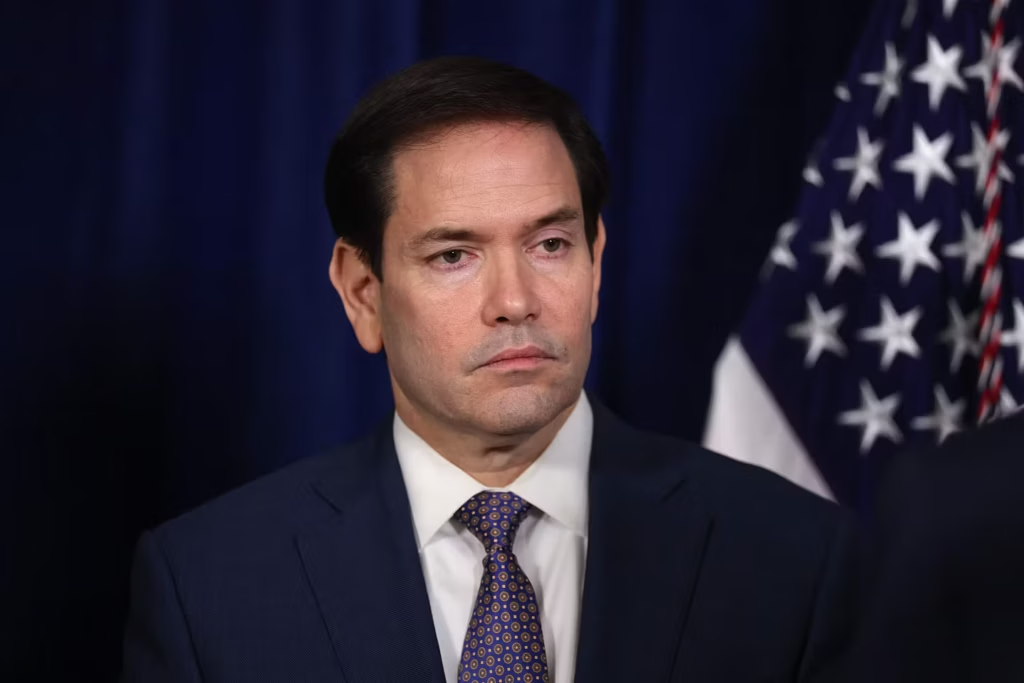
U.S. Secretary of State Marco Rubio used a Senate Foreign Relations Committee hearing Wednesday to deliver a stark warning to Venezuela’s acting leader, suggesting that Delcy Rodríguez could share the fate of her predecessor, Nicolás Maduro, if she does not align Caracas with U.S. objectives — a confrontation rooted in one of the most dramatic chapters of recent Latin American history.
Rubio, whose prepared testimony was made available ahead of the session, framed Washington’s expectations in stark terms, asserting that Rodríguez, who now serves as Venezuela’s acting president, is fully conscious of what happened to Maduro. Maduro was removed from power and taken into U.S. custody during a military operation early in January.
“We believe her own self-interest aligns with advancing our key objectives,” Rubio told lawmakers, emphasizing that the United States is prepared to escalate measures if diplomacy and pressure fail to secure desired cooperation from Venezuelan authorities. He cited the strong message implicit in Maduro’s experience as an example of consequences for non-compliance. Maduro and his wife, Cilia Flores, were seized by U.S. forces and transported to New York to face drug-related charges, which they deny.
Rubio’s comments reflect escalating tensions between Washington and Caracas after the extraordinary early-January operation that resulted in Maduro’s detention. That operation, which involved U.S. special forces, was lauded by the Trump administration as a law enforcement action aimed at narco-trafficking networks but drew widespread shock internationally and raised significant questions about U.S. military authority and regional stability.
U.S. Presence and Policy Post-Maduro
In his testimony, Rubio reiterated that the United States is not engaged in a traditional war against Venezuela, even as pressure mounts for Caracas to transform its political and economic structures in line with Washington’s interests. He noted that the U.S. is exerting influence not through ground occupation but by leveraging strategic assets — including an oil embargo and enforcement of sanctions — to push for a new direction in Venezuelan governance.
Rubio’s remarks come amid a broader debate in Washington over the legal and constitutional limits of U.S. military and diplomatic actions. Congressional Democrats have repeatedly questioned whether the executive branch overstepped its authority in Venezuela, particularly after a war-powers resolution aimed at restricting military involvement narrowly failed in the House of Representatives last week by a 215-215 tie.
Rodríguez’s Complex Position
Delcy Rodríguez, who was Venezuela’s vice president under Maduro, was sworn in as acting president by the country’s Supreme Tribunal of Justice after the U.S. raid, a move that has been accepted by the Venezuelan military but rejected by some international actors, including the European Union, which does not recognize her legitimacy.
Since assuming leadership, Rodríguez has navigated a precarious political landscape: balancing a need to maintain internal legitimacy, particularly among Maduro loyalists, with external expectations from Washington for cooperation on issues including oil production, political reforms and the release of detainees held under the previous regime. Independent observers note that she has publicly expressed both a desire to work with the United States and a rebuke of perceived foreign interference in Venezuela’s internal affairs.
At times, Rodríguez has explicitly pushed back against Washington’s influence. In recent speeches, she declared that Venezuela must resolve its own political conflicts without foreign “orders,” a tone that underscores her attempt to bolster nationalist credentials even as she engages with U.S. officials.
In response to Rubio’s warning, some analysts suggest Rodríguez’s position is strategically constrained by her dual role: she must reassure Venezuelans wary of U.S. intentions while simultaneously seeking pragmatic cooperation to stabilize the economy, particularly around the oil sector. The Trump administration has publicly tied its expectations for Rodríguez to benefiting American oil companies by reopening and expanding U.S. involvement in Venezuela’s state-run energy industry.
Maduro’s Legal Status and International Implications
Meanwhile, Maduro has pleaded not guilty to narcotics and terrorism-related charges in a New York federal court, publicly maintaining that he remains Venezuela’s legitimate president and describing his detention as coercive. His assertions resonate with factions in Venezuela and abroad who view the U.S. operation as a breach of sovereignty.
The legal proceedings against Maduro and Flores — combined with Rubio’s hard line — indicate that U.S. policy toward Venezuela remains rooted in a mix of law enforcement narratives and geopolitical priorities, including counter-narcotics and energy security. However, the unfolding dynamics have also sparked debate in Washington over the separation of powers, with some lawmakers arguing that Congress should have a more definitive role in authorizing military involvements abroad, even those framed as narrowly targeted judicial enforcement actions.
What Comes Next?
Rubio’s testimony underscores the Trump administration’s determination to push for sweeping changes in Venezuela, even as opponents warn that such pressure could deepen domestic polarization or fuel anti-American sentiment within the country. Whether Rodríguez ultimately aligns fully with U.S. demands — or seeks to assert greater autonomy in the face of external pressure — remains a key question for policymakers and analysts alike as the situation continues to evolve.
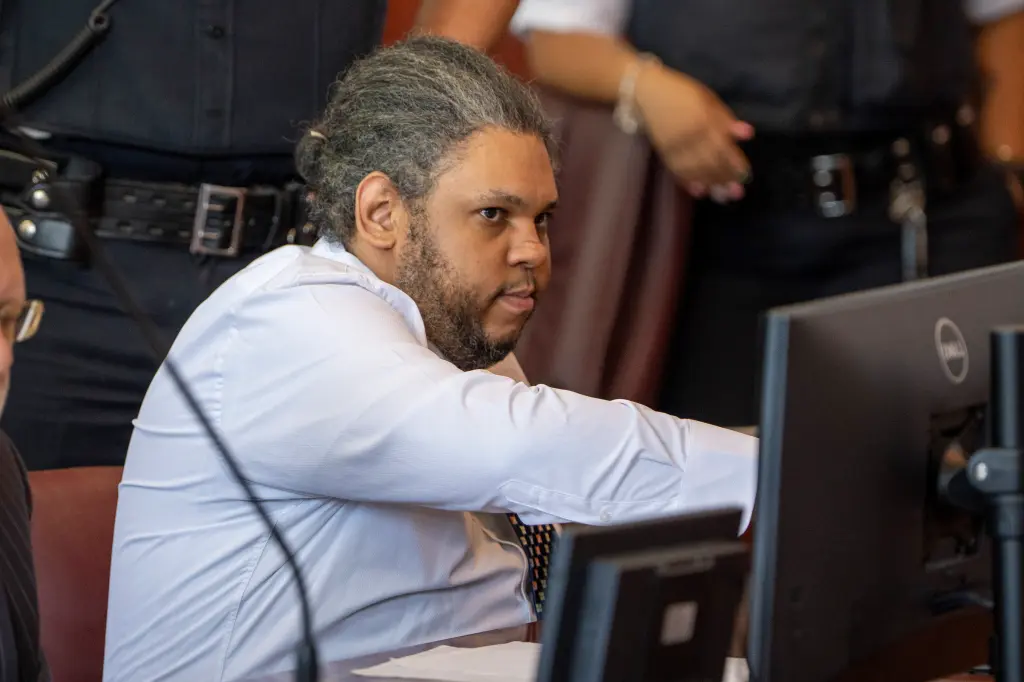
Defense attorneys launched a psychiatric defense strategy Tuesday for a man accused of brutally killing four homeless men in Manhattan, arguing that untreated schizophrenia and commanding auditory hallucinations drove their client to commit the 2019 murders he admits carrying out.
Randy Santos, now 31, heard voices instructing him to “kill 40 people” or face his own death, compelling the predawn rampage that left four vulnerable men dead and two others injured across Manhattan’s Chinatown and Chelsea neighborhoods, his attorney contended during opening statements in Manhattan Supreme Court.
The trial finally commenced nearly seven years after the October 5, 2019 attacks, where prosecutors allege Santos used a scavenged four-foot metal bar to systematically bash the skulls of sleeping homeless men in a methodical killing spree that terrorized the city’s unsheltered population. The defendant faces life imprisonment without possibility of parole if convicted on first-degree murder charges in a proceeding expected to continue for two weeks.
Defense attorney Marnie Zien of the Legal Aid Society acknowledged that her client committed the acts prosecutors describe but argued Santos cannot be held criminally responsible due to his severely compromised mental state at the time. “It was real to Randy,” Zien told jurors as Santos sat beside her with one earbud partially off his head. “He needed the voices to stop; he needed to save his life and didn’t see another way out because of the schizophrenia.”
The defense strategy centers on demonstrating that Santos operated under a “disoriented diseased mind” that prevented him from understanding the nature or wrongfulness of his actions—the legal standard for establishing an insanity defense under New York law. Zien emphasized this approach from the outset: “The defense does not dispute what happened in this case. We dispute what was in his mind at the time of the crime.”
Santos has cycled through psychiatric facilities repeatedly since his arrest, underscoring the severity of his mental health challenges. His attorney maintains he was not taking prescribed schizophrenia medication when the auditory hallucinations became overwhelming, creating a psychotic break that transformed delusional thoughts into violent action.
Manhattan Assistant District Attorney Alfred Peterson presented a starkly different narrative, methodically detailing each attack in a presentation that included surveillance footage showing Santos wielding the metal bar and striking victims. “A stick in one instance, a metal bar in another, directly down in one place on their body—their head,” Peterson told jurors, emphasizing the deliberate and targeted nature of the assaults.
Prosecutors contend Santos demonstrated clear intentionality and awareness of consequences throughout the crime sequence. “(He) knew exactly what he was doing and exactly the consequences of what he was doing and that he was killing these men,” Peterson asserted, directly challenging the psychiatric defense theory that Santos lacked criminal capacity.
The chronology prosecutors outlined reveals escalating violence beginning weeks before the fatal attacks. In late September 2019, Santos allegedly assaulted Kyle Leonard, a homeless man, with a stick near 12th Avenue in Chelsea. Leonard survived the encounter, which Peterson characterized as a “trial run” preceding Santos’ “big day” on October 5.
The fatal rampage began shortly before 2 a.m. when Santos approached two men sleeping on cardboard at the intersection of Bowery and Doyers streets in Chinatown. After striking both victims in the head with the metal bar, Santos initially departed but subsequently returned to the scene, Peterson explained, because he feared he “didn’t complete the job.”
This return to verify his victims’ conditions, prosecutors argue, demonstrates rational thought processes inconsistent with complete psychotic detachment from reality. The decision to seek out additional targets further suggests methodical planning rather than chaotic behavior driven purely by hallucinations.
Following his return to the initial crime scene, Santos traveled to East Broadway where he attacked three additional sleeping men with the same metal weapon. The systematic progression across geographic locations, prosecutors contend, reflects deliberate decision-making that undermines claims of insanity.
Four victims ultimately perished from their injuries: Nazario Vasquez Villegas, Chuen Kwok, Anthony Manson and Florencio Moran Camano. One individual miraculously survived despite severe head trauma. The concentrated targeting of homeless individuals sleeping on the streets highlighted the extreme vulnerability of New York’s unsheltered population to violent predators.
Eyewitnesses who observed Santos delivering fatal blows to victim Kwok immediately contacted emergency services. Patrol officers subsequently spotted the defendant carrying the metal bar over his shoulder, the weapon visibly speckled with patches of hair and blood. Upon arrest, Santos allegedly confessed to the attacks and identified himself in surveillance footage capturing the final murder.
Peterson detailed an additional earlier assault for which Santos faces attempted murder charges. On September 27, the defendant allegedly used an object to strike a sleeping homeless man in Chelsea before “attempted to throw that individual in the Hudson River,” demonstrating both the violent impulses and failed murder attempt that preceded the successful killings.
The prosecution’s case rests substantially on physical evidence, video documentation and Santos’ own admissions. The extensive surveillance footage from multiple locations provides visual confirmation of the defendant’s movements and actions throughout the night. The recovered metal bar, forensically linked to the victims through blood and tissue evidence, establishes the murder weapon definitively.
Santos’ documented history of violent, random attacks prior to the killing spree strengthens the prosecution’s argument that he poses ongoing danger requiring permanent incarceration. Law enforcement records indicate a pattern of unprovoked aggression against vulnerable targets, suggesting predatory tendencies rather than isolated psychotic episodes.
The insanity defense faces substantial legal and evidentiary hurdles under New York jurisprudence. Defendants must prove by a preponderance of evidence—more likely than not—that mental disease or defect rendered them incapable of knowing or appreciating either the nature and consequences of their conduct or that such conduct was wrong. Schizophrenia diagnosis alone does not automatically satisfy this standard; the defense must demonstrate the specific psychotic symptoms at the moment of each crime prevented rational judgment.
Prosecutors will likely challenge whether auditory hallucinations, even if genuine, necessarily eliminate criminal responsibility. Many individuals with schizophrenia experience command hallucinations yet retain sufficient reality testing to resist violent urges. The question becomes whether Santos possessed residual capacity to choose lawful behavior despite his mental illness.
The defendant’s ability to identify vulnerable victims in isolated locations, return to crime scenes to verify results, and attempt disposing of evidence by throwing a victim into the Hudson River all suggest preserved cognitive functioning and goal-directed behavior. These actions demonstrate planning, evaluation and adaptation—mental processes that contradict claims of complete psychotic dissociation.
Defense psychiatrists will presumably testify regarding Santos’ mental state during psychiatric examinations and their professional opinions about his capacity for criminal intent on October 5, 2019. Prosecution mental health experts will offer competing assessments, likely arguing that schizophrenia does not preclude the specific intent required for first-degree murder convictions.
Santos currently remains held without bail at Bellevue Hospital, receiving psychiatric treatment while awaiting trial’s conclusion. Defense attorney Arnold Levine declined to provide comment beyond courtroom arguments.
Manhattan District Attorney Cyrus Vance Jr. issued a statement emphasizing the particular vulnerability of the victims. “There is perhaps no population more vulnerable to violence than the growing number of unsheltered New Yorkers who lack a safe place to sleep,” Vance said. “I offer my heartfelt condolences to the victims’ loved ones as our community begins to heal.”
The statement acknowledges broader societal failures that leave homeless individuals exposed to violence while sleeping in public spaces. The 2019 murders spotlighted urgent needs for both expanded mental health services and safe shelter options that could prevent similar tragedies.
The trial’s outcome carries implications extending beyond Santos’ individual case. A successful insanity defense could establish precedent for future cases involving defendants with severe mental illness, potentially influencing how courts balance public safety concerns against recognition of psychiatric impairment. Conversely, conviction despite acknowledged schizophrenia would reinforce that mental illness does not automatically excuse criminal responsibility when defendants retain sufficient capacity to form criminal intent.
Jurors face the challenging task of reconstructing Santos’ subjective mental experience during the attacks based on competing expert testimony, behavioral evidence and their own evaluation of the defendant’s credibility. They must determine whether the voices Santos claims to have heard constituted genuine psychotic symptoms that overwhelmed his volitional control or whether he retained sufficient rational faculties to be held accountable for choosing to kill.
The families of Nazario Vasquez Villegas, Chuen Kwok, Anthony Manson and Florencio Moran Camano await justice nearly seven years after losing their loved ones to brutal violence. The extended delay between crime and trial—though partly attributable to Santos’ psychiatric hospitalizations and legal complexities—has prolonged their suffering and uncertainty.
As testimony proceeds over the coming weeks, the fundamental question remains whether Santos’ schizophrenia genuinely prevented him from understanding his actions’ wrongfulness or whether he committed calculated murders despite his mental illness. The answer will determine whether he spends life imprisoned as a convicted murderer or committed to a psychiatric facility as a patient requiring treatment rather than punishment.
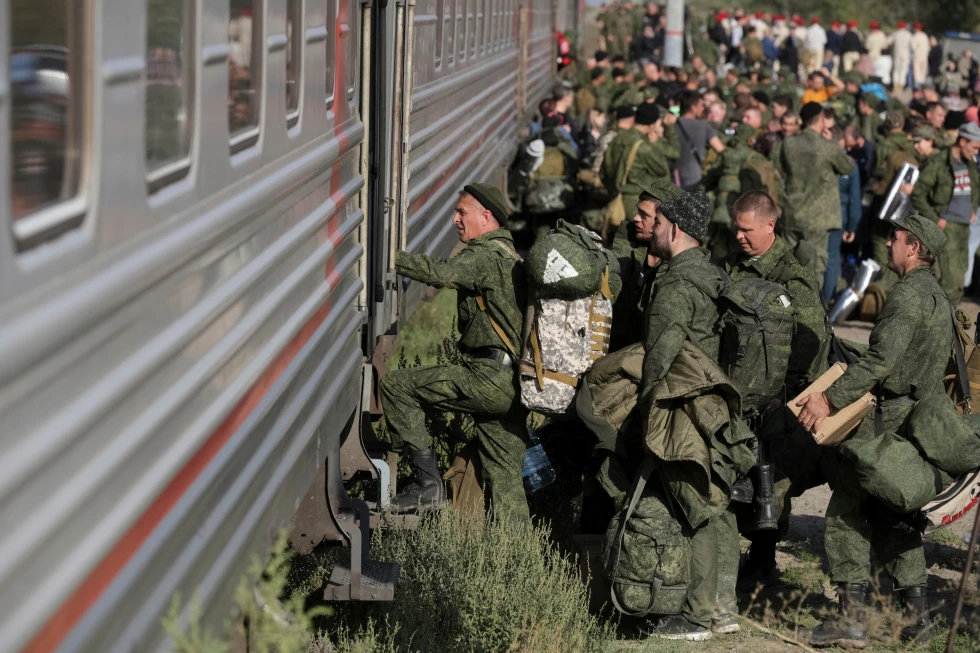
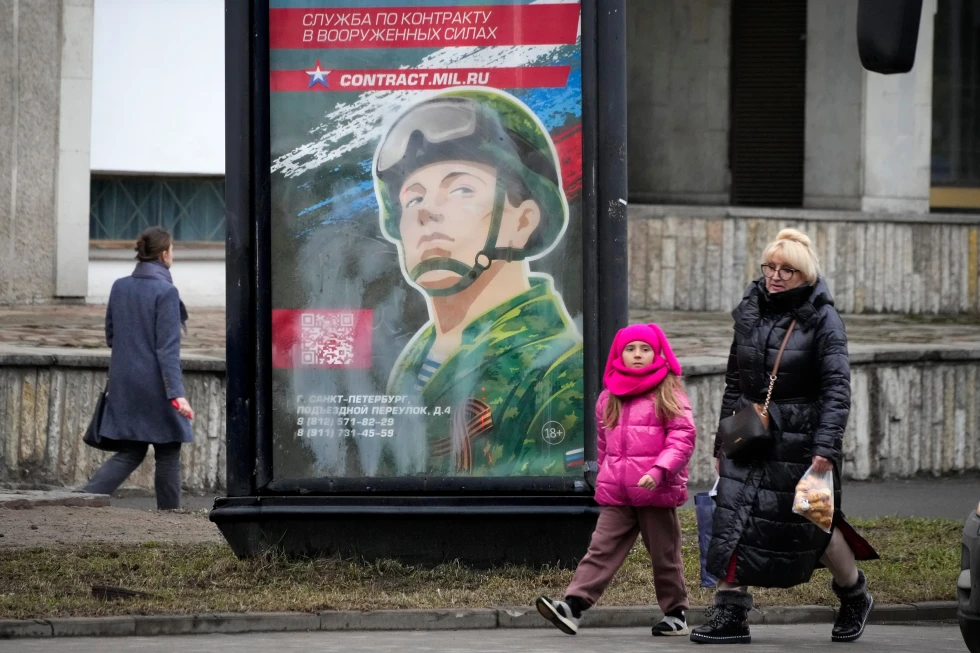
Russia has implemented an unprecedented multi-faceted recruitment strategy to sustain its military operations in Ukraine, offering substantial financial incentives to domestic volunteers, releasing convicts from penal institutions, and aggressively recruiting foreign nationals through schemes that range from legitimate contracts to alleged deception and fraud.
As the conflict approaches its fourth year, the Kremlin faces mounting pressure to replenish depleted forces without triggering politically dangerous nationwide conscription that could galvanize domestic opposition. The resulting recruitment apparatus represents one of the most comprehensive military manpower mobilization efforts undertaken by a major power in recent decades, drawing combatants from across Russia’s socioeconomic spectrum and extending recruitment networks across multiple continents.
For ordinary Russian wage earners, military service contracts offer financial compensation that dramatically exceeds typical civilian income. The monetary incentives include substantial signing bonuses, elevated monthly salaries and additional regional supplements that collectively can amount to several years’ worth of average Russian earnings. This economic calculus has proven particularly attractive in Russia’s less prosperous regions, where employment opportunities remain limited and wages stagnate far below Moscow and St. Petersburg standards.
The financial component of Russia’s recruitment drive reflects the country’s economic constraints and strategic calculations. By offering compensation packages that rival or exceed civilian alternatives, military planners aim to attract sufficient volunteers to avoid compulsory mobilization that sparked widespread protests and prompted hundreds of thousands of military-age men to flee the country when partial mobilization was announced in September 2022. The current approach allows the Kremlin to maintain the fiction of a “special military operation” rather than acknowledging full-scale war requiring total societal mobilization.
Russia’s prison population has emerged as another critical manpower source. Inmates facing harsh conditions and systemic abuse within the country’s penal system receive opportunities for conditional release in exchange for combat service. This prisoner recruitment program, which gained prominence when the Wagner Group mercenary organization initially pioneered the approach, offers convicts a path to freedom that circumvents traditional parole processes and judicial review.
The use of prisoners as frontline combatants raises profound ethical and legal questions about coercion, consent and the appropriateness of placing individuals with criminal backgrounds in positions where they exercise lethal force against enemy combatants and potentially interact with civilian populations. Human rights organizations have documented cases where prisoners were provided minimal training before deployment to the most dangerous sectors of the front lines, effectively functioning as expendable assault troops in high-casualty operations.
For foreign nationals, particularly immigrants and migrant workers already residing in Russia, military service contracts offer a dramatically simplified pathway to Russian citizenship. Standard naturalization processes typically require years of legal residence, language proficiency demonstrations, and extensive documentation. By contrast, foreigners who sign military contracts can obtain citizenship with significantly reduced bureaucratic obstacles, creating powerful incentives for individuals from former Soviet republics and developing nations who seek the economic and legal benefits of Russian nationality.
The international dimension of Russia’s recruitment efforts has generated diplomatic friction and revealed troubling patterns of exploitation. Following the June 2024 signing of a mutual defense treaty between Moscow and Pyongyang, North Korea deployed thousands of soldiers to Russian territory, marking one of the most significant international troop commitments to the Ukraine conflict. These North Korean forces were specifically assigned to help Russian military units defend the Kursk region after Ukrainian forces launched a surprise cross-border incursion in August 2024, seizing portions of Russian territory in a dramatic escalation that caught Moscow’s military leadership off guard.
The North Korean deployment represents a significant strategic development with implications extending beyond immediate battlefield dynamics. The presence of foreign troops defending Russian sovereign territory underscores the manpower challenges facing Moscow’s military planners and suggests that domestic recruitment efforts, despite their breadth and financial generosity, have proven insufficient to meet operational requirements. Additionally, the arrangement provides North Korea with opportunities to gain modern combat experience, test weapons systems under battlefield conditions, and strengthen its geopolitical alignment with Russia against Western interests.
The recruitment of foreign fighters from South Asian nations has followed a markedly different and more troubling pattern characterized by allegations of fraud and deception. Men from India, Nepal and Bangladesh have come forward with complaints that recruiters misrepresented the nature of their employment, promising civilian jobs in construction, security services or other non-combat roles while actually directing them toward military contracts that obligate combat service in Ukraine.
These cases highlight a darker aspect of Russia’s manpower strategy, where desperation to find recruits intersects with criminal exploitation of vulnerable populations. Young men from economically disadvantaged backgrounds in South Asian countries, seeking better opportunities abroad, fall victim to sophisticated recruitment schemes that exploit their limited understanding of Russian legal frameworks and military obligations. Once in Russia, language barriers, confiscation of travel documents, and threats of legal consequences if they refuse to fulfill contracts effectively trap these individuals in circumstances they never intended to accept.
The pattern extends beyond South Asia. Officials in Kenya, South Africa and Iraq have confirmed that citizens from their respective countries experienced similar deception, lured to Russia under false pretenses only to find themselves pressed into military service. These revelations have prompted diplomatic protests and demands for repatriation, straining Russia’s relationships with nations whose citizens have been affected.
The Kenya government specifically issued warnings to its citizens about fraudulent recruitment schemes after multiple Kenyans reported being trapped in situations where they were forced to serve in the Russian military. South African authorities similarly raised concerns after discovering that nationals had been recruited through questionable channels, with some families learning of their relatives’ situations only after casualties occurred or when desperate communications reached home.
The Iraqi government faced particularly sensitive circumstances given the complex political dynamics within the country and the presence of various armed groups with varying degrees of autonomy. Iraqi officials acknowledged that recruitment had occurred but struggled to provide comprehensive accounting of how many citizens had traveled to Russia or under what specific circumstances.
The diversity of recruitment sources and methods reveals the comprehensive nature of Russia’s approach to the manpower challenge. By simultaneously targeting domestic working-class citizens with financial incentives, releasing prisoners in exchange for military service, offering simplified citizenship to immigrants, securing formal troop commitments from allied nations like North Korea, and tolerating or potentially facilitating questionable recruitment operations targeting vulnerable foreign nationals, Moscow has constructed a recruitment apparatus designed to sustain prolonged high-casualty operations without triggering the domestic political backlash that comprehensive mobilization would generate.
This strategy carries significant implications for the trajectory of the Ukraine conflict. The ability to continuously feed reinforcements into the theater of operations, regardless of casualty rates, enables Russian military commanders to pursue attritional strategies that might otherwise be unsustainable. The willingness to accept high losses among certain categories of troops—particularly prisoners and foreign nationals with limited political constituencies within Russia—provides flexibility in tactical decision-making that would be constrained if public opinion responded more directly to casualty figures.
The economic sustainability of the financial incentive component remains uncertain. The substantial signing bonuses and elevated salaries represent significant fiscal commitments that accumulate as more individuals sign contracts. While Russia’s defense budget has expanded dramatically and energy revenues provide funding sources, the long-term viability of maintaining recruitment levels through purely monetary incentives may face constraints, particularly if the conflict extends multiple additional years and casualty replacement needs continue at current levels.
The human cost of these recruitment strategies extends far beyond battlefield casualties. Families in rural Russian regions send breadwinners to war zones motivated by economic desperation rather than patriotic fervor. Prisoners who survive their service face uncertain prospects for social reintegration, carrying both combat trauma and criminal backgrounds that limit employment opportunities. Foreign nationals who discover they’ve been deceived face language barriers, legal complexities and potential danger if they attempt to refuse service or escape their obligations.
International legal frameworks governing the use of foreign fighters, mercenaries and the treatment of prisoners in armed conflicts face stress tests as Russia’s recruitment practices push boundaries of established norms. The distinction between legitimate foreign volunteers, military alliance commitments like the North Korean deployment, and exploitative recruitment of deceived civilians creates classification challenges with legal and ethical ramifications.
The Ukrainian government and its Western supporters have seized upon these recruitment patterns as evidence of Russia’s deteriorating military position and the unsustainability of its operational approach. They argue that reliance on prisoners, coerced foreigners and ever-larger financial incentives demonstrates that Russian society lacks genuine support for the war and that Moscow cannot sustain current casualty rates through conventional mobilization methods without risking regime stability.
Russian officials counter that diversified recruitment reflects modern military professionalism and appropriate use of volunteer contract service rather than conscription. They emphasize that signing bonuses and elevated pay merely recognize the significance of military service and ensure adequate compensation for those who defend national interests. Regarding foreign recruitment, Moscow maintains that individuals signing contracts do so voluntarily and that any claims of deception reflect individual recruiting irregularities rather than systematic policy.
As the war grinds toward its fourth year with no clear resolution in sight, Russia’s multifaceted recruitment strategy represents both an adaptation to military realities and a gamble on the sustainability of grinding attritional warfare. The approach has succeeded in avoiding another mass mobilization that could threaten domestic stability, but it has done so by creating a complex web of financial obligations, diplomatic complications and ethical compromises that carry their own long-term costs and consequences. Whether this recruitment model can sustain Russian military operations indefinitely, or whether diminishing returns and mounting complications will eventually force strategic recalculations, remains among the most significant unanswered questions shaping the conflict’s trajectory.
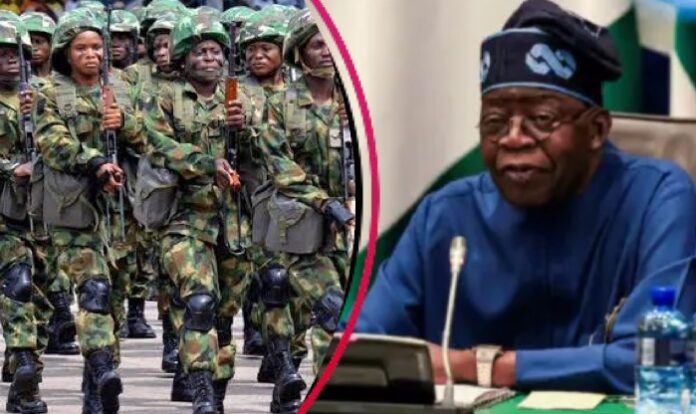
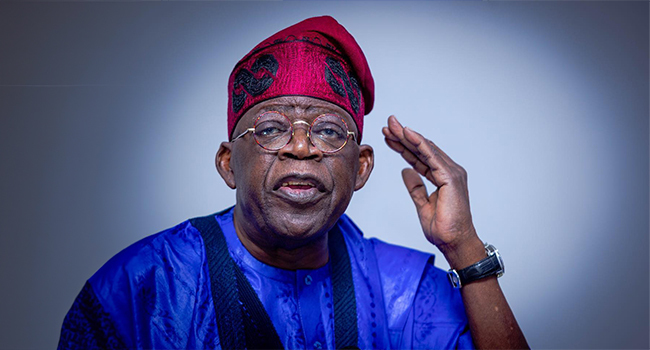
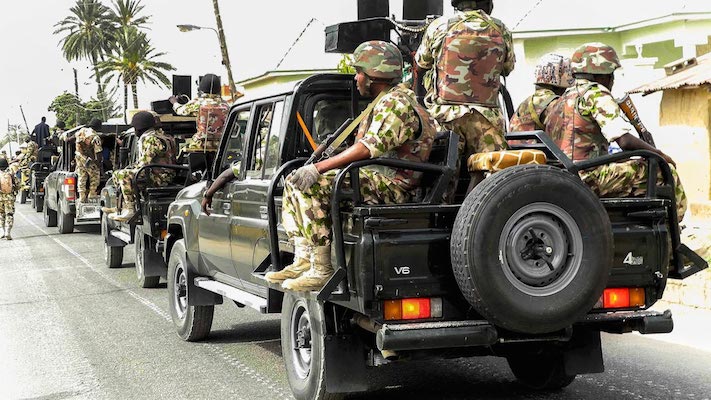
ABUJA, Nigeria — Nigeria’s military has confirmed that several officers arrested last year will face trial before a military judicial panel for allegedly plotting to overthrow President Bola Tinubu’s government, a revelation that exposes potentially the most serious threat to the nation’s quarter-century experiment with democratic governance since civilian rule resumed in 1999.
The Defence Headquarters disclosed Monday through spokesperson Major-General Samaila Uba that investigations into 16 officers detained in October have concluded, with findings identifying a number of the accused with allegations of orchestrating a government overthrow scheme. Those determined to have cases requiring adjudication will be formally arraigned before appropriate military judicial panels to face trial, though no timeline for proceedings has been established.
The announcement represents a dramatic reversal from the government’s initial position. When authorities first detained the officers in October, official statements characterized the arrests as involving “issues of indiscipline” and perceived career stagnation, with no mention of treasonous conspiracy. Despite these denials, sources across the Nigerian government and military confirmed to AFP at the time that the detention stemmed from a coup plot—information the administration vehemently disputed even as it undertook a sweeping reorganization of military leadership.
Reuters documentation indicates the military’s investigative findings uncovered firm cases against several officers, including specific allegations of plotting governmental overthrow, though the statement provided no details regarding the conspiracy’s scope, timeline or how many of the 16 detained personnel actually participated in the alleged scheme. Legal experts consulted by multiple news organizations emphasized that officers convicted of treason face the death penalty under Nigerian military law, raising stakes that transform the proceedings into potential capital cases.
The gravity of the accusations cannot be overstated given Nigeria’s tumultuous political history. The west African nation experienced numerous military takeovers following independence from Britain and spent much of the 20th century under junta rule before transitioning to civilian governance in 1999. The country has maintained democratic institutions for 26 years—the longest uninterrupted period of elected government in Nigerian history. A successful coup would have terminated this democratic continuity and potentially returned Africa’s most populous nation to authoritarian military control.
The composition of the detained officers suggests a conspiracy extending across multiple service branches and military specializations, potentially indicating broader institutional vulnerabilities than authorities initially acknowledged. Investigation details exclusively obtained by Premium Times reveal that 14 of the 16 detained officers serve in the Nigerian Army, with the remaining two drawn from the Navy and Air Force. Among the army personnel, 12 belong to the Infantry Corps—the army’s frontline combat unit whose troops primarily engage in ground battles—while one officer serves in the Signals Corps managing military communications and another in the Ordnance Corps responsible for procuring, storing and maintaining weapons, ammunition, vehicles and essential hardware.
The alleged conspirators’ ranks span from brigadier general down through lieutenant, encompassing a colonel, four lieutenant colonels, five majors, two captains and a lieutenant. The naval officer holds the rank of lieutenant commander—equivalent to major—while the Air Force participant serves as squadron leader, carrying identical rank equivalence. This distribution across rank structures raises troubling questions about how deeply dissatisfaction penetrates military hierarchy and whether senior leadership possessed adequate awareness of subordinate attitudes and potential disloyalty.
Among the alleged coup plotters
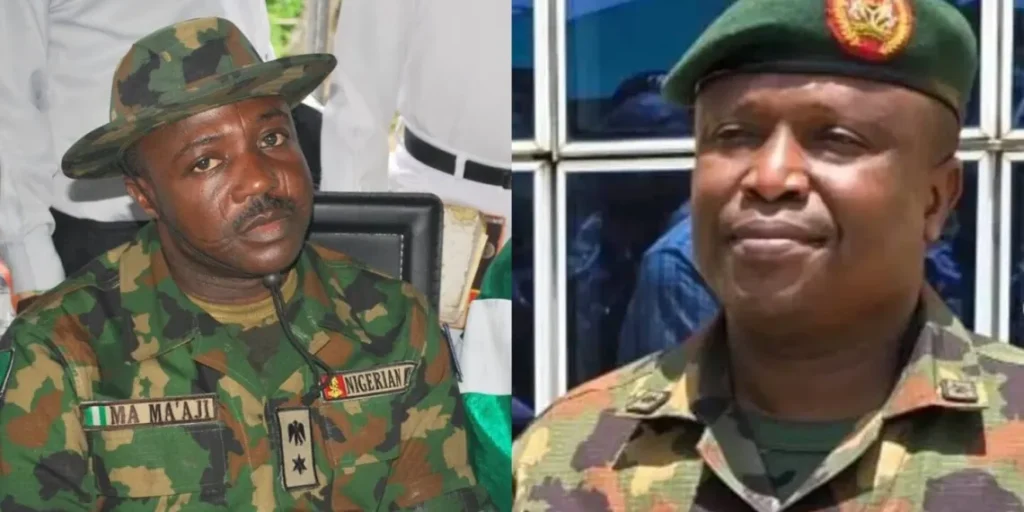
Investigators suspect Brigadier General Musa Abubakar Sadiq led the conspiracy. Born January 3, 1974, Sadiq carries service number N/10321 and trained as a Nigerian Defence Academy cadet between August 14, 1992 and September 20, 1997 as a member of Regular Course 44. The Nasarawa State native rose through ranks over decades of service, becoming colonel in 2015 and brigadier four years later. This represents not Sadiq’s first encounter with allegations of gross misconduct—in October 2024, he was reportedly detained for alleged diversion of rice palliatives and selling military equipment including generator sets and operational vehicles to scrap yards. Among various postings throughout his career, Sadiq served as Commander of the 3rd Brigade in Kano and Garrison Commander of the 81 Division of the Army in Lagos, positions conferring substantial authority and access to military resources.
Colonel M.A. Ma’aji, service number N/10668, allegedly functioned as a key strategist for the plot, though Premium Times could not independently verify that specific claim. Born March 1, 1976, the Nupe native from Niger State trained between August 18, 1995 and September 16, 2000 as a member of the 47 Regular Course. The infantry corps officer earned promotion to lieutenant colonel in 2013, advancing to full colonel four years later. The 49-year-old previously commanded the 19 Battalion of the Nigerian Army based in Okitipupa, Ondo State, and participated in Operation Crocodile Smile II, a 2017 military exercise addressing security challenges in the Niger Delta and portions of the South-west. He also served at Depot, Nigerian Army and later as Commander, Operation Delta Safe.
The alleged conspiracy’s timing coincided with mounting pressures on Nigeria’s military establishment from multiple directions. The armed forces continue fighting a long-running insurgency against Boko Haram and Islamic State West Africa Province in the northeast. While violence has diminished from its peak a decade ago, attacks persist—including deadly assaults on military bases—with no resolution apparent. Analysts warned of violence escalation in 2025, while troops have periodically disclosed unpaid wages and substandard conditions that erode morale and effectiveness.
Military resources are stretched dangerously thin across additional fronts, including combating armed gangs known as “bandits” in the northwest that kidnap for ransom, and confronting separatists in the southeast. This multi-theater operational tempo creates conditions where personnel become exhausted, equipment degrades without adequate maintenance, and strategic coherence becomes difficult to maintain. Such circumstances historically provide fertile ground for coup plotting, as disgruntled officers perceive civilian leadership as incompetent or insufficiently supportive of military needs.
Shortly after denying the alleged coup plot’s existence, President Tinubu executed a sweeping shake-up of military leadership in October aimed at bolstering security as the country confronts these multiple armed threats. General Christopher Musa was removed as chief of defence staff in the reorganization, though he subsequently returned in the defence minister role. A senior administration official told AFP at the time that such leadership changes typically indicate intelligence gaps, noting that no leader would accept such failures in threat detection and prevention.
The official’s comment reveals the delicate political calculation involved in acknowledging coup conspiracies. Admitting that senior military officers plotted governmental overthrow inherently suggests intelligence and security failures at the highest levels. It raises questions about loyalty screening procedures, counterintelligence capabilities, and whether civilian leadership maintains adequate awareness of military sentiment. These are uncomfortable admissions for any administration, particularly one already facing criticism over security challenges and economic hardship.
Hints of the affair first emerged publicly when Nigeria’s Defence Headquarters issued a statement October 4 announcing the arrest of 16 officers for what authorities characterized as indiscipline cases and perceived career stagnation. Reports of a foiled coup subsequently appeared in Nigerian press outlets, though the government maintained firm denials. News surrounding the alleged plot faded from prominence amid strong official pushback and as the country became consumed by diplomatic crisis when U.S. President Donald Trump criticized Nigeria for allegedly insufficient efforts protecting Christians from violence.
This diplomatic confrontation likely provided convenient cover for authorities seeking to deflect attention from domestic military instability. International disputes typically dominate news cycles and public discourse, allowing governments to avoid sustained scrutiny of internal vulnerabilities. The timing may have been coincidental or it may reflect deliberate strategic communication designed to change the subject from coup plotting to international relations.
The United States has since launched joint strikes against Islamic State Sahel Province militants in the northwest and pledged increased intelligence sharing to help Nigeria conduct air strikes across the north. This cooperation suggests American confidence in the Nigerian government’s stability despite the coup allegations, or alternatively reflects U.S. strategic interests in maintaining functional security partnerships regardless of internal Nigerian political turbulence.
The 12 remaining detained officers whose details are less comprehensively documented include Lieutenant Colonel S. Bappah from Bauchi State, a 41-year-old Signals Corps member born June 21, 1984 who trained between September 27, 2004 and October 4, 2008 as part of the 56 Regular Course. Lieutenant Colonel A.A. Hayatu from Kaduna State, born August 13, 1983, underwent identical training dates as an infantry corps officer also from the 56 Regular Course. Lieutenant Colonel P. Dangnap from Plateau State, born April 1, 1986, previously faced court-martial in 2015 alongside 29 others for offences related to fighting Boko Haram, suggesting prior disciplinary issues that may have contributed to alleged participation in conspiracy.
Lieutenant Colonel M. Almakura from Nasarawa State, Major A.J. Ibrahim from Gombe State, Major M.M. Jiddah from Katsina State, Major M.A. Usman from the Federal Capital Territory, and Major D. Yusuf from Gombe State all trained at the Nigerian Defence Academy during overlapping periods in the mid-2000s. Major I. Dauda from Jigawa joined through Direct Short Service Commissions, training between June 5, 2009 and March 27, 2010. Captain Ibrahim Bello and Captain A.A. Yusuf, Lieutenant S.S. Felix, Lieutenant Commander D.B. Abdullahi from the Navy, and Squadron Leader S.B. Adamu from the Air Force complete the roster, though details about these five officers remain sketchy.
The concentration of multiple officers from the 56 Regular Course raises intriguing questions about whether shared training experiences, institutional grievances formed during academy years, or personal relationships developed during that period contributed to conspiracy formation. Military academies create intense bonds among classmates who endure rigorous training together, and these connections often persist throughout careers. Investigators will likely explore whether the Regular Course 56 cohort harbored collective dissatisfactions that metastasized into treasonous planning.
The military’s decision to proceed with formal trials rather than administrative punishments or quiet dismissals signals the government’s determination to make an example of alleged conspirators. Public trials serve multiple functions: they demonstrate that coup plotting carries severe consequences, they potentially reveal details that allow security services to identify additional conspirators or sympathizers, and they provide transparent accountability that democratic governance theoretically requires. However, military tribunals also carry risks of appearing as show trials designed to intimidate potential dissidents rather than deliver justice.
The absence of announced trial dates leaves uncertainty about when proceedings will commence and how transparent they will be. Military judicial panels in Nigeria have historically operated with less public scrutiny than civilian courts, raising concerns among human rights organizations about due process protections and whether accused officers will receive fair hearings. International observers will likely monitor these proceedings closely given their implications for Nigerian democratic stability and civil-military relations.
The conspiracy’s apparent failure demonstrates that Nigeria’s democratic institutions retain sufficient resilience to detect and disrupt coup attempts, at least in this instance. However, the mere existence of such plotting among mid-to-senior rank officers indicates dangerous fissures within the military establishment that civilian leadership must address through improved conditions, better communication and perhaps structural reforms that reduce coup incentives.
Meteorologists warn that a second substantial winter storm could strike the Gulf Coast and Eastern Seaboard this weekend, threatening regions still recovering from a devastating system that claimed at least 13 lives and left more than 800,000 customers without electricity across the southern and eastern United States.
The National Weather Service Weather Prediction Center cautioned Monday that increasing potential exists for another significant winter weather event that could deliver heavy snow to the eastern United States beginning Friday, though forecasters emphasized substantial uncertainty remains regarding the system’s ultimate track, intensity and precipitation type. Officials urged residents to monitor evolving forecasts throughout the week as atmospheric conditions crystallize.
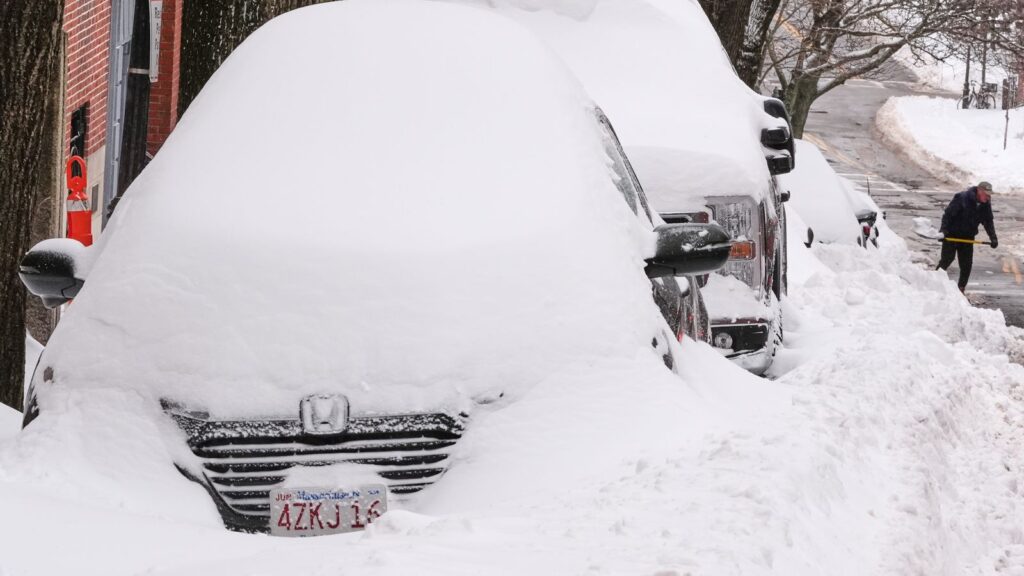
The developing storm emerges as communities struggle to recover from a colossal winter event that deposited more than a foot of snow across a 1,300-mile corridor stretching from Arkansas to New England, PBS documented. The most severely affected locations received up to two feet of accumulation, paralyzing transportation networks and triggering widespread school closures Monday. Deep snow halted traffic, grounded flights and overwhelmed municipal snow removal operations already strained by sustained subfreezing temperatures.
AccuWeather Long Range Expert Paul Pastelok explained that late this week a storm system is anticipated to intensify along a stalled frontal boundary near the Gulf Coast, creating conditions favorable for rain and wintry precipitation across the Southeast. The atmospheric setup bears concerning similarities to the recently departed system, though crucial differences in timing and storm evolution could produce dramatically different outcomes ranging from minimal coastal rain to a potentially destructive nor’easter.
Precipitation could commence as early as Friday along the Gulf Coast, with rain most probable south of Interstate 10 from Louisiana to Florida. The critical variable involves exactly when the system strengthens, which will determine whether snow mixes with rain from Interstate 10 northward across portions of Louisiana, Mississippi, Alabama and Georgia. While these areas already endured snow or ice from the previous storm, preliminary indications suggest the most intense precipitation would largely bypass regions experiencing widespread power outages farther north.
As the storm progresses eastward late Friday through Saturday, precipitation is forecast to migrate northward as well, bringing rain to Florida and potentially wintry weather to the Carolinas. Pastelok emphasized that the rate at which the storm intensifies will prove decisive in determining its final trajectory and whether it advances up the Eastern Seaboard.
Two distinct scenarios exist based on storm development speed. If the system remains weaker or strengthens more gradually, it will likely ride along the Gulf coast and move farther over the Atlantic before turning northward. Under this scenario, snow would concentrate in the Carolinas and New England, with widespread heavy accumulation less probable. The possibility exists that the storm could pivot northward too late, leaving the entire Northeast dry.
Conversely, a rapidly intensifying storm presents higher probability of turning northward sooner, substantially elevating snow risk across the entire Eastern Seaboard. The quickly strengthening system could transform into a nor’easter and generate widespread heavy snow from the mid-Atlantic to New England, accompanied by stronger winds than the previous storm, particularly along coastal areas. A storm that strengthens exceptionally rapidly could track sufficiently westward to deliver snow as far inland as the Appalachians from North Carolina to Pennsylvania.
FOX Weather meteorologists identified two atmospheric patterns that heighten concern about this developing system. The first involves what forecasters characterize as an atmospheric traffic jam over Greenland that can force storms into paths that meander along the coast, creating multi-day weather hazards. The second element consists of an impressive ridge in the Intermountain West that, while producing above-average temperatures in that region, provides a clear pathway for the jet stream to transport systems out of Canada, across the Plains, and exiting somewhere along the Atlantic seaboard. This pattern also ensures continued arctic air funneling into the eastern half of the nation.
Computer forecast models exhibited considerable disagreement Monday regarding the system’s likely evolution. FOX Weather Meteorologists Bob Van Dillen and Jane Minar noted that both the traditional European model and the AI-driven European forecast model indicated greater impacts for the Mid-Atlantic coast, while the American GFS forecast model projected less significant consequences. With several days of data collection remaining, substantial uncertainty persists among various modeling systems regarding this system’s ultimate behavior.
By Thursday, forecasters anticipate a high-altitude disturbance will plunge out of Canada and deepen across the eastern United States by Saturday, generating a robust surface low-pressure system that will interact with the entrenched cold air mass. The collision between these atmospheric elements will produce heavy precipitation, though whether it falls as rain, snow or mixed precipitation depends entirely on factors that remain undetermined as of Monday afternoon.
The placement, strength and timing of the disturbance descending from Canada constitute unknown variables that will govern the storm’s character. Similarly, the timing, track and intensity of the surface low pressure system will dictate whether communities experience rain, snow or mixed precipitation, along with determining how much precipitation occurs over the eastern United States before the storm moves offshore. Impacts to travel and infrastructure from potential snow and wind remain too uncertain for reliable assessment.
The previous storm’s catastrophic toll continues mounting as authorities compile comprehensive damage assessments. At least 13 weather-related fatalities have been confirmed across multiple states, with circumstances varying from hypothermia to traffic accidents to incidents involving snow removal equipment.
New York City Mayor Zohran Mamdani disclosed that at least five individuals who perished were discovered outdoors as temperatures plummeted Saturday, though investigators have not yet determined definitive causes of death. Louisiana’s state health department confirmed two men from Caddo Parish died from hypothermia attributable to the storm.
In Massachusetts, police documented that a snowplow operator backed into a couple walking in a Massachusetts Bay Transportation Authority parking lot in Norwood on Sunday. A 51-year-old woman was killed and her 47-year-old husband hospitalized with injuries. The tragedy underscores how snow removal operations themselves can generate fatal hazards even as they work to restore safe conditions.
Two teenagers lost their lives in separate sledding accidents—a 17-year-old boy in Arkansas and a 16-year-old girl in Texas, authorities confirmed. Tennessee officials announced three additional weather-related deaths, though specific details remained unavailable Monday. The youth fatalities highlight how recreational activities during winter storms, while seemingly innocuous, carry genuine mortality risks particularly on terrain made hazardous by ice and uncontrolled descent speeds.
Power infrastructure suffered extensive damage during the weekend assault. More than 800,000 customers remained without electricity Monday morning, with the majority concentrated in southern states that received substantial sleet and freezing rain, data from poweroutage.com showed. The region’s unfamiliarity with severe winter weather and infrastructure not designed for ice loading on power lines contributed to widespread failures that left communities vulnerable to dangerous cold without heating systems.
Mississippi Governor Tate Reeves characterized the event as the state’s worst ice storm since 1994, noting it prompted the largest-ever deployment of ice-melting chemicals—200,000 gallons—plus salt and sand to treat treacherous roadways. Despite precipitation ending, Reeves warned during a Sunday news conference that danger persists. “That doesn’t mean the danger is behind us,” he emphasized, urging residents to avoid driving unless absolutely necessary and to check on friends and family members who might require assistance.
Freezing rain that created glass-like road surfaces and brought trees and branches crashing onto roads and power lines represented the primary peril across southern states over the weekend. In Corinth, Mississippi, heavy machinery manufacturer Caterpillar instructed employees at its remanufacturing facility to remain home Monday and Tuesday as conditions remained too hazardous for safe commuting.
Transportation networks experienced comprehensive disruption. More than 4,400 flights suffered delays or cancellations nationwide Monday, according to flight tracking website FlightAware.com. Sunday witnessed even more severe aviation impacts, with approximately 12,000 flights canceled and nearly 20,000 delayed. The cascading effects of these cancellations stranded tens of thousands of travelers throughout the nation’s airport system, creating accommodation and rebooking challenges that persisted for days.
At peak intensity Sunday morning, roughly 213 million people lived under some form of winter weather warning, authorities disclosed. The staggering geographic scope of the storm—affecting areas from Montana to the Florida Panhandle—created simultaneous emergencies across multiple time zones that strained emergency management resources and complicated coordination among federal, state and local agencies.
Bitter cold followed in the storm’s wake, establishing conditions that will persist through the upcoming weekend and potentially beyond. Parts of Minnesota recorded temperatures plunging to minus 40 degrees Fahrenheit on Sunday. Numerous communities across the Midwest, South and Northeast awakened Monday to subzero readings. The entire Lower 48 states were forecast to experience their coldest average low temperature of minus 9.8 degrees Fahrenheit since January 2014, former National Oceanic and Atmospheric Administration chief scientist Ryan Maue calculated based on National Weather Service data.
Only record warmth in Florida prevented that national average from dropping even colder, Maue noted. From Montana to the Florida Panhandle, the weather service posted cold weather advisories and extreme cold warnings as temperatures in many locations dipped to zero or below. Wind chill factors made conditions substantially more dangerous, while overnight cold refroze roadways early Monday in what communities experienced as a cruel reprise of the weekend’s treacherous travel conditions.
Frigid temperatures will continue blanketing the eastern half of the United States into next week, forecasters warned. Locations in the Ohio Valley, Northeast and Midwest are projected to remain below freezing throughout the entire week. Even in Texas, the Mississippi River Valley and the Southeast, temperatures are expected to dip below freezing nightly, creating sustained hardship for populations unaccustomed to prolonged arctic conditions.
A reinforced wave of cold air will likely follow the weekend storm system, keeping temperatures locked well below historical averages for at least the first few days of February. Pastelok cautioned that subfreezing temperatures may plunge as far south as central Florida, generating potential for damaging freezes affecting citrus crops in the region. Such agricultural impacts could produce economic consequences extending well beyond immediate weather event costs, particularly if developing fruit suffers freeze damage that reduces yields or quality.
The combination of extreme cold preceding the storm, moisture from the developing system, and arctic air mass persistence creates atmospheric conditions conducive to significant winter weather impacts regardless of the storm’s precise track. Even if the system follows a trajectory that minimizes snowfall in major population centers, the prolonged cold ensures that any precipitation that does fall will create hazardous conditions that linger for extended periods.
In Falmouth, Massachusetts, located approximately an hour’s drive south of Boston, snow fell in sheets Sunday and effectively closed the town. Resident Nell Fields described having to shovel just to let her dog outside after seven inches of accumulation. “I feel that the universe just put a big, huge pause on us with all the snow,” Fields reflected, articulating the disruptive impact winter storms impose on daily routines and normal activities.
On Manhattan’s Upper East Side, January Cotrel expressed enthusiasm for fresh snow on a block that traditionally closes during snowstorms to allow residents to sled, engage in snowball fights and build snowmen. “I pray for two feet every time we get a snowstorm. I want as much as we can get,” she stated. “Let the city just shut down for a day and it’s beautiful, and then we can get back to life.” The contrasting perspectives illustrate how winter storms generate vastly different responses depending on individual circumstances, with some viewing heavy snow as inconvenience and others as welcome respite from urban routines.
The prospect of a second major storm arriving before communities fully recover from the first creates compounding challenges. Snow removal equipment already operating continuously for days will require maintenance. Salt and chemical supplies depleted during the initial response may prove inadequate if the second storm materializes with significant intensity. Power restoration crews working to reconnect hundreds of thousands of customers could face renewed outages if the forecasted system delivers the stronger winds that meteorologists identify as possible under certain development scenarios.
Emergency management officials face the difficult task of maintaining public vigilance for a storm whose characteristics remain uncertain while avoiding alarm fatigue that could cause residents to dismiss warnings if the system ultimately produces minimal impacts. The communication challenge becomes particularly acute when forecast models disagree substantially about likely outcomes, as clear messaging requires confidence that current data cannot yet provide.
The National Weather Service’s emphasis on encouraging the public to monitor forecasts throughout the week reflects this uncertainty while establishing appropriate situational awareness. As atmospheric patterns evolve and computer models ingest additional observational data, forecast confidence will improve, allowing meteorologists to provide increasingly specific guidance about timing, precipitation types and accumulation amounts.
NEW YORK — Hip-hop artist Kanye West has taken the extraordinary step of purchasing a full-page advertisement in The Wall Street Journal to apologize for antisemitic statements while revealing he suffered an undiagnosed traumatic brain injury more than two decades ago that he claims triggered bipolar disorder and contributed to his controversial behavior.
The January 26 print edition advertisement, funded by West’s Yeezy company and headlined “To Those I Hurt,” represents the 48-year-old musician’s most comprehensive public accounting for inflammatory remarks that cost him lucrative business partnerships and sparked widespread condemnation. The statement attributes his conduct to mental illness stemming from a 2002 automobile accident that West contends caused neurological damage that went undetected for twenty-one years.
West alleges he sustained injury to the right frontal lobe of his brain during the collision, which occurred following a late-night recording session in Los Angeles, music publication Spin previously documented. While medical personnel at the time focused on visible trauma including a fractured jaw and facial swelling, West maintains that deeper neurological damage escaped notice. He claims comprehensive scans were not performed, neurological examinations remained limited, and the possibility of frontal-lobe injury was never raised by treating physicians.
The rapper asserts this “medical oversight” went unrecognized until 2023, when proper diagnosis finally occurred. West characterizes the intervening years as marked by escalating mental health deterioration that culminated in a bipolar type-1 diagnosis, a condition he contends directly contributed to behavior he now describes as detached from his authentic self.
“Bipolar disorder comes with its own defense system. Denial,” West wrote in the advertisement. “When you’re manic, you don’t think you’re sick. You think everyone else is overreacting. You feel like you’re seeing the world more clearly than ever, when in reality you’re losing your grip entirely.”
The statement provides disturbing insight into the severity of bipolar disorder, citing World Health Organization and Cambridge University data indicating that individuals with the condition face life expectancy reductions of ten to fifteen years on average, with mortality rates two to three times higher than the general population. West compares this prognosis to severe heart disease, type-1 diabetes, HIV and cancer, characterizing all as potentially lethal if left untreated.
West describes experiencing a four-month manic episode in early 2025 characterized by psychotic, paranoid and impulsive behavior that he claims destroyed his life and left him at times no longer wanting to exist. He credits his wife, Bianca Censori, with encouraging him to seek treatment after he hit what he terms “rock bottom” several months ago.
The advertisement directly addresses West’s use of Nazi imagery and antisemitic rhetoric, acknowledging he gravitated toward “the most destructive symbol I could find, the swastika” and even sold t-shirts bearing the Nazi emblem. He characterizes these actions as occurring during a fractured mental state marked by disconnected moments he claims not to fully recall, describing the experience as feeling like being outside his own body.
“I regret and am deeply mortified by my actions in that state, and am committed to accountability, treatment, and meaningful change,” West wrote. “It does not excuse what I did, though. I am not a Nazi or antisemite. I love Jewish people.”
The apology extends beyond the Jewish community to Black Americans, whom West describes as the “unquestionable foundation” of his identity. “The black community is, unquestionably, the foundation of who I am. I am so sorry to have let you down. I love us,” he wrote.
The Anti-Defamation League, an organization dedicated to combating antisemitism in the United States, responded to West’s statement with measured acknowledgment while emphasizing that genuine accountability requires sustained behavioral change. A spokesman told the Daily Mail that West’s apology arrives long overdue and cannot automatically erase his extensive history of antisemitic conduct, including the antisemitic “Heil Hitler” song he created, hundreds of inflammatory tweets, swastika imagery and numerous Holocaust references that caused profound hurt and betrayal.
“The truest apology would be for him to not engage in antisemitic behavior in the future. We wish him well on the road to recovery,” the ADL spokesman stated.
West’s antisemitic remarks began surfacing publicly in late 2022, when he posted on social media that he planned to go “death con 3 On JEWISH PEOPLE.” He subsequently embraced conspiracy theories alleging Jewish control of media, the music industry and financial systems, declaring at one point that “Jewish media blocked me out. This is not hate speech, this is the truth.” He also expressed praise for Adolf Hitler and Nazis more broadly.
The fallout proved swift and financially devastating. Major corporate partners including Adidas, Balenciaga and talent agency CAA terminated business relationships with West in 2022, severing revenue streams worth hundreds of millions of dollars. Most recently, the artist released a song entitled “Heil Hitler,” demonstrating that inflammatory rhetoric continued even as business consequences mounted.
West’s current attribution of his behavior to bipolar disorder represents a significant shift in his evolving public narrative about his mental health. For years he acknowledged struggling with bipolar disorder until asserting last winter that he had been misdiagnosed and actually has autism instead. The Wall Street Journal advertisement returns to the bipolar diagnosis while adding the traumatic brain injury element as a previously undisclosed contributing factor.
The connection between traumatic brain injuries and subsequent mental illness has substantial scientific support. A 2013 study by Danish researchers found that individuals who suffered traumatic brain injuries—including concussions—were four times more likely to develop mental illness compared to those without such injuries, Psychology Today documented. Specifically, the study determined that TBI survivors were 28 percent more likely to develop bipolar disorder, suggesting a plausible physiological mechanism linking West’s 2002 accident to his later psychiatric diagnosis.
West publicly confirmed his bipolar diagnosis through his 2018 album “Ye,” where he rapped in the song “Yikes” that “That’s my bipolar shit, nia, what? That’s my superpower, nia. Ain’t no disability. I’m a superhero! I’m a superhero!” This characterization of the condition as empowering rather than debilitating stands in stark contrast to his current framing of bipolar disorder as a serious, potentially fatal disease requiring sustained treatment.
The rapper has not historically shied away from discussing his mental health publicly. In his 2025 documentary “In Whose Name?” West commented that “You know the best thing about being an artist and bipolar? Anything you do and say is an art piece.” This casual treatment of a serious psychiatric condition illustrates the denial mechanism West now describes as intrinsic to manic episodes.
West’s mental health struggles significantly impacted his marriage to reality television personality Kim Kardashian, with whom he shares four children: daughters North, 12, and Chicago, seven, and sons Saint, nine, and Psalm, six. Kardashian publicly addressed West’s bipolar diagnosis in a 2020 statement following one of his social media outbursts, writing that “Anyone who has this or has a loved one in their life who does, knows how incredibly complicated and painful it is to understand.”
During an October 2025 appearance on the “Call Her Daddy” podcast, Kardashian disclosed that West had not contacted their children for “a couple months,” though TMZ later documented a family reunion over Christmas. The extended periods of absence suggest the extent to which West’s mental health episodes have disrupted family relationships and parental responsibilities.
The Wall Street Journal advertisement reveals that West found unexpected comfort through Reddit forums during his recent crisis, where he encountered others describing manic and depressive episodes similar to his own experiences. He describes reading their stories and realizing isolation was an illusion, finding validation that extended beyond what he characterizes as inadequate medical guidance from “so-called best doctors in the world” who he claims told him he was not bipolar but merely experiencing “symptoms of autism.”
This assertion raises troubling questions about the quality of psychiatric care available even to individuals with substantial financial resources. If West’s account is accurate, multiple highly credentialed physicians either misdiagnosed his condition or minimized its severity, potentially contributing to years of inadequate treatment. The revelation underscores how even wealth and access to elite medical professionals cannot guarantee accurate diagnosis or effective intervention for complex psychiatric conditions.
West indicates he has now established what he terms “my new baseline and new center through an effective regime of medication, therapy, exercise and clean living,” resulting in clarity he describes as newfound and much-needed. He pledges to channel energy toward positive endeavors including music, clothing, design and other initiatives intended to benefit society.
The statement concludes with West explicitly stating he seeks neither sympathy nor absolution, though he aspires to earn forgiveness. “I write today simply to ask for your patience and understanding as I find my way home,” he wrote, signing off with notation that the advertisement was “Paid for by Yeezy” along with contact information for the company’s chief financial officer.
The public nature of West’s apology—choosing a full-page newspaper advertisement rather than social media or press conference—carries symbolic significance. The Wall Street Journal reaches business leaders, policymakers and cultural influencers who constitute the demographic most relevant to West’s commercial rehabilitation efforts. The format also prevents the immediate feedback loop and potential volatility of social media platforms, allowing West to control messaging without risk of impulsive responses to criticism.
Whether this apology translates into sustained behavioral change remains to be determined. West’s history includes previous expressions of regret for controversial statements followed by renewed provocations, establishing a pattern that undermines confidence in lasting transformation. The test of sincerity will come through consistent conduct over extended periods rather than any single statement, regardless of how comprehensive or seemingly heartfelt.
The advertisement also raises broader questions about the intersection of mental illness, personal accountability and public forgiveness. While psychiatric conditions undeniably influence behavior and judgment, the extent to which they absolve individuals of responsibility for harmful actions remains philosophically and ethically contested. West’s acknowledgment that his diagnosis “does not excuse what I did” suggests recognition of this tension, though the practical implications for how society should respond to his conduct remain ambiguous.
The 2002 car accident that allegedly triggered West’s neurological damage occurred at a pivotal moment in his career trajectory. Hospitalized with his jaw wired shut, West reportedly wrote the song “Through the Wire” during recovery, creating the artistic breakthrough that transformed him from producer to performer. The injury that West now claims unleashed decades of mental health struggles simultaneously catalyzed his emergence as one of hip-hop’s most influential artists, illustrating the complex relationship between trauma, creativity and psychiatric illness.
As West attempts to rebuild professional relationships and public credibility, the antisemitic statements he apologizes for continue reverberating through communities directly targeted by his rhetoric. Jewish organizations and individuals who experienced his hateful language as threats to their safety and dignity now face the difficult question of whether to accept his contrition and support his recovery or maintain consequences for conduct they view as unforgivable regardless of underlying mental health factors.