LONDON (BN24) — Gabriel Martinelli came off the bench to score a stoppage-time equalizer as Arsenal held Manchester City to a 1-1 draw in a tightly contested Premier League match at Emirates Stadium on Sunday.
The Brazilian forward’s late finish marked his second impactful appearance as a substitute in a week, following his goal and assist against Athletic Club in the Champions League on Tuesday. Arsenal manager Mikel Arteta had praised his bench players following that victory, calling his “finishers” potentially more important than the starting lineup, a belief vindicated once again as Martinelli struck in the 93rd minute.
Manchester City had taken an early lead through Erling Haaland, who capped a swift counter-attack in the ninth minute by rolling a shot past goalkeeper David Raya. The Norwegian striker, who now leads the Premier League with six goals in five matches, initiated the move from his own half and finished after linking up with Tijjani Reijnders.
City pressed aggressively in the opening period and nearly doubled their lead when Reijnders forced a strong save from Raya. Arsenal, meanwhile, struggled for creativity before halftime, with Martin Zubimendi, Declan Rice, and Mikel Merino forming a static midfield that failed to break down City’s defense. Home supporters grew restless, despite promising moments from Noni Madueke, who was Arsenal’s most threatening player in the first half.
Changes at halftime proved crucial. Arteta introduced Eberechi Eze and Bukayo Saka who was returning from a hamstring injury—and Arsenal’s tempo improved immediately. Zubimendi shot narrowly over, and Eze tested Gianluigi Donnarumma with a low effort as the Gunners pushed for an equalizer.
City remained dangerous on the counter, particularly through Jeremy Doku, and Pep Guardiola responded to Arsenal’s second-half pressure by shifting to a back five. He also substituted Haaland for holding midfielder Nico Gonzalez, hoping to protect the narrow lead.
But Martinelli’s late goal, a dinked finish after latching onto Eze’s through ball, ensured Arsenal came away with a point. It was a moment of joy for the Emirates crowd. However, both sides were ultimately left unsatisfied, especially as league leaders Liverpool extended their advantage at the top to five points after just five games.
Arteta, who remains the only manager to avoid defeat in five consecutive meetings against Guardiola, faces increasing scrutiny over his team selections in big matches. The midfield trio of Zubimendi, Rice, and Merino also started in the 1-0 defeat to Liverpool and has drawn criticism for its lack of attacking output.
For Martinelli, it capped a resurgent week following a difficult spell in his career. The 22-year-old’s decisive goals in both European and domestic competitions may give Arteta more to think about ahead of future fixtures.
ABUJA, Nigeria (BN24) — The Nigeria Police Force has confirmed the deaths of three officers and the disappearance of seven others following a deadly ambush on its Tactical Teams in Benue State. The attack occurred on Friday, September 19, 2025, at the Agu Centre in the Katsina-Ala/Ukum Local Government Area.
In a statement issued Sunday by Force Public Relations Officer CSP Benjamin Hundeyin, the police blamed the ambush on “suspected armed herdsmen and local militias.” Six suspects have been arrested and are currently assisting investigators with information, the statement said.
The Commissioner of Police for Benue State, CP Innocent Ifeanyi Emenari, is leading the ongoing operation aimed at rescuing the missing officers and tracking down the attackers. Authorities described the response as a “manhunt and rescue mission.”
Meanwhile, Inspector-General of Police Kayode Egbetokun condemned the attack, calling it “cruel, unwarranted, and an affront on the good people of Benue State.” He ordered the deployment of additional tactical assets to the region and vowed that no effort would be spared in restoring peace.
“The arrested suspects are in custody and assisting with useful information,” Hundeyin said. “The IGP has directed the deployment of additional tactical assets to the area and assured that no stone will be left unturned in restoring peace and security in Benue State.”
The attack is the latest in a series of violent incidents targeting security personnel in Nigeria’s Middle Belt. A similar ambush occurred on September 10 in Egbe, a town in Kogi State near the Kwara border, where three officers were killed at a security checkpoint. Kogi State Police Spokesperson William Aya confirmed those fatalities, while Commissioner of Police Miller Dantawaye said a tactical team had been deployed in response.
The Police Force has called on the public to remain calm and vigilant as efforts continue to rescue the missing officers and dismantle criminal networks operating in the region.
SUNDERLAND, England (BN24) — Aston Villa’s winless start to the Premier League season continued Sunday after they failed to hold on to both a one-goal and one-man advantage in a 1-1 draw against Sunderland. Meanwhile, Newcastle were left frustrated once again in front of goal as they played out a goalless draw at Bournemouth.
Unai Emery’s side, who have enjoyed a steady rise in recent seasons, remain in the bottom three with just three points from their opening five matches. Villa were given a major opportunity to break their poor run when Sunderland’s Reinildo Mandava was shown a red card in the 33rd minute for violent conduct, kicking out at Matty Cash.
Having failed to score in their previous four league games, Villa finally ended their goal drought when Cash’s powerful long-range strike deceived Sunderland goalkeeper Robin Roefs in the first half. But the lead lasted only eight minutes as Wilson Isidor capitalized on Granit Xhaka’s header forward to score his third goal in as many matches at the Stadium of Light.
Ollie Watkins, still searching for his first goal of the campaign, missed two late chances to seal all three points for Villa. Sunderland, in contrast, continued their strong start to life back in the Premier League. The Black Cats now sit seventh in the table and have lost just once in five outings, bucking the recent trend of promoted teams suffering immediate relegation.
In Bournemouth, Newcastle were once again left without a goal on the road. Eddie Howe’s side, still adjusting to the departure of striker Alexander Isak, have now drawn all three of their away fixtures this season 0-0. The Magpies appeared content with a point at the Vitality Stadium after a tight turnaround from Thursday’s 2-1 Champions League defeat to Barcelona.
Howe rotated heavily, making seven changes to the starting lineup, including a recall for club-record signing Nick Woltemade. But the match offered little in the way of clear chances, with Bournemouth coming closest in stoppage time through a Justin Kluivert free kick that Nick Pope well saved.
The point moved Bournemouth briefly into third place on the table, though their position was set to change depending on results later in the day. Arsenal had a chance to leapfrog them and move second if they could defeat defending champions Manchester City at the Emirates Stadium.
Liverpool entered Sunday six points clear of Arsenal and nine ahead of City, maintaining a perfect record through five matches.
LOMÉ, Togo (BN24) — Former Togo Defence Minister Marguerite Gnakadé, the sister-in-law of President Faure Gnassingbé and one of the most prominent critics within the ruling family, has been arrested after publicly urging the military to side with the people and bring an end to more than half a century of dynastic rule.
Former Togo Defence Minister Marguerite Gnakadé, the sister-in-law of President Faure Gnassingbé
Security sources confirmed Thursday that Gnakadé was detained at her home in Lomé by security forces who accused her of “serious acts,” including inciting the armed forces to rebellion. Local media reported that she was taken into custody on Wednesday evening and is currently being interrogated by authorities.
Family ties and defiance
Gnakadé is the widow of Ernest Gnassingbé, the late elder brother of the president, and served as Togo’s defence minister from 2020 to 2022, becoming one of the first women to hold the post. Her calls for her brother-in-law’s resignation, published in recent articles and repeated at public gatherings, represent a rare fracture within the powerful ruling family.
In recent months, she has demanded a “peaceful, inclusive and national transition” to replace Gnassingbé’s leadership. She also supported youth-led demonstrations calling for democratic reforms.
Dynasty under strain
President Faure Gnassingbé
Gnassingbé, in power since 2005, inherited the presidency from his father, Gnassingbé Éyadéma, who ruled Togo for 38 years. Together, the family has maintained a grip on power for nearly six decades.
The president was sworn in earlier this year as head of a newly created Council of Ministers, a constitutional shift that critics say allows him to extend his dominance indefinitely. The move sparked protests across the country, with demonstrators demanding his resignation and the release of political prisoners.
Civil rights groups say at least seven people were killed in June after security forces cracked down on protests. Authorities have denied that the deaths were linked to demonstrations.
Protest groups demand release
The arrest of Gnakadé has galvanized opposition parties and civil society organizations. Touche Pas A Ma Constitution, a prominent rights group, condemned what it described as a “hooded” abduction carried out without a warrant.
“Once again, this is an abuse of power that characterises the regime’s retrograde practices. The aim is to silence a dissenting voice,” the group said in a statement, demanding her immediate release.
M66, a youth-led movement, issued a 72-hour ultimatum to authorities, warning that mass protests would erupt if Gnakadé is not freed. “Togolese people are fed up with arrests of dissident voices,” said Mokonzi, one of the group’s leaders. “What is worse is that she is a former defence minister and the Togolese armed forces are doing nothing.”
Tense reaction within the military
While officials accuse Gnakadé of trying to destabilize the armed forces through alleged contacts with exiled opposition figures, some security sources admitted discomfort over her detention.
“There is general unease in the barracks, because she had improved working and living conditions for soldiers when she was defence minister,” one source told the BBC.
If formally charged, Gnakadé could face 10 to 20 years in prison under laws against undermining state security.
The coming days are expected to bring clarity on the charges, but her detention has already become a flashpoint in Togo’s escalating political crisis.
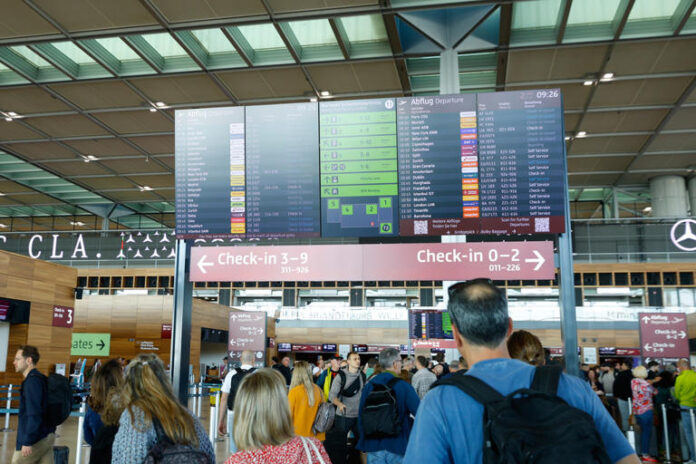
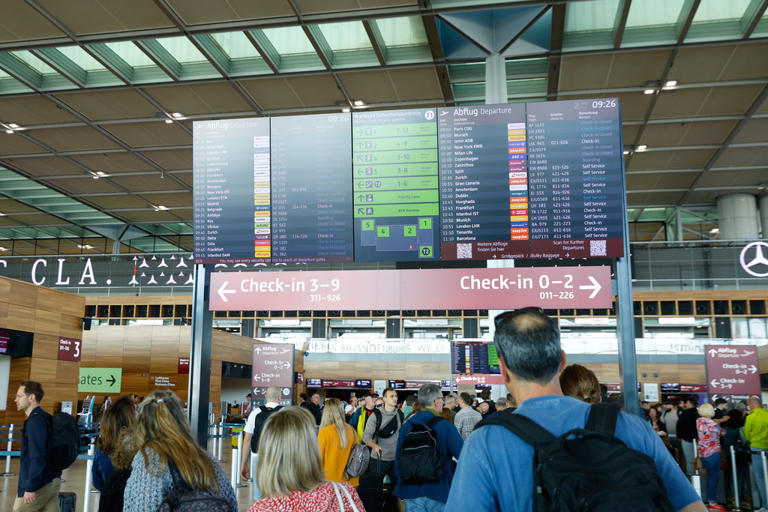
LONDON (BN24) — A cyberattack targeting the check-in and boarding systems at several major European airports disrupted air traffic on Saturday, highlighting vulnerabilities in the aviation sector’s digital infrastructure.
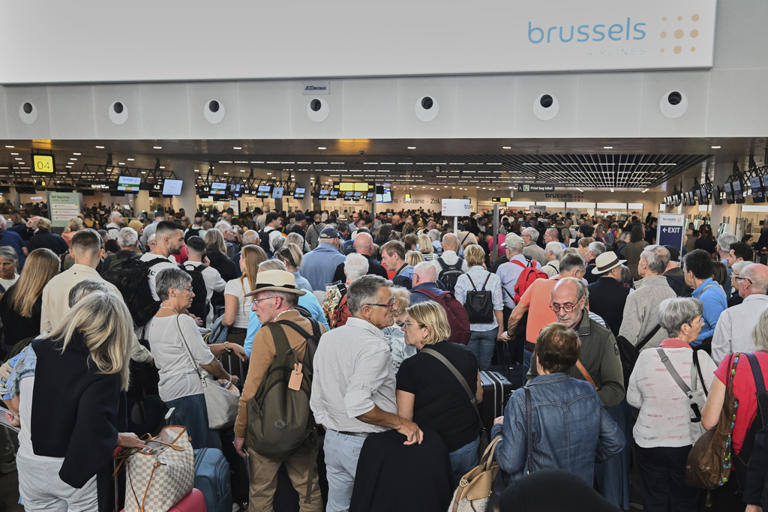
Brussels Airport first reported a “large impact” on flight schedules following the Friday night attack, which affected systems used by multiple airports across Europe, including Berlin’s Brandenburg Airport and London’s Heathrow. The disruption left airports temporarily reliant on manual check-in and baggage procedures, causing delays but relatively few cancellations.
The affected systems are operated by Collins Aerospace, a subsidiary of RTX Corp. (formerly Raytheon Technologies), whose MUSE (Multi-User System Environment) platform enables self-service check-ins, boarding pass printing, and baggage dispatch. Collins confirmed a “cyber-related disruption” and said it was working to restore full functionality, emphasizing that the issue was confined to electronic check-in systems.
Although no group has claimed responsibility for the breach, cybersecurity experts said the attack may have originated from criminal networks, hacker collectives, or even state-sponsored actors. They warned that the aviation industry has become an increasingly attractive target due to its dependence on interconnected digital platforms.
Paul Charles, a veteran travel analyst, described the breach as “deeply worrying,” noting it targeted the core system used by multiple airlines across various European airports simultaneously. “Surprisingly, a company with such a resilient reputation was affected,” he told Sky News.
The scope of disruption varied by location. Brussels Airport reported nine canceled flights, four diversions, and 15 delays exceeding an hour by mid-morning. In Berlin, airport officials severed links to the compromised systems as a precaution. At Heathrow, Europe’s busiest airport, the impact was described as “minimal,” though travelers experienced long wait times and limited staffed counters.
Maria Casey, a traveler flying to Thailand from Heathrow’s Terminal 4, said her airline had to process luggage due to the outage manually. “They had to write our baggage tags by hand,” she said, adding that just two desks were open.
Airport operators stressed that the cyberattack affected third-party systems and not the airports or airlines directly. Nevertheless, the incident underscored wider concerns about digital resilience in air travel.
Charlotte Wilson, head of enterprise at cybersecurity firm Check Point, said attackers are increasingly targeting supply chain vendors. “A single compromised vendor can trigger ripple effects across the continent,” she said.
Experts remain cautious in attributing the attack, but some suggest the motive appeared disruptive rather than financial. “This feels more like vandalism than extortion at this stage,” said James Davenport, professor of information technology at the University of Bath.
Airports advised passengers to monitor flight updates and apologized for delays as operations gradually resumed normal function by Saturday afternoon.
NAIROBI, Kenya (BN24) — A Kenyan court issued an arrest warrant for former British soldier Robert James Purkiss, accused of murdering 21-year-old Kenyan mother Agnes Wanjiru, whose body was discovered in a septic tank more than a decade ago in a case that could result in the first extradition of a British serviceman to face trial abroad for killing a civilian.
High Court Judge Alexander Muteti ruled that sufficient evidence existed to compel Purkiss to appear before the court. The 38-year-old former combat medic and infantryman served in the Duke of Lancaster Regiment between 2006 and 2016 and was stationed at the British army training camp in Nanyuki when Wanjiru disappeared in March 2012.
Wanjiru was last seen alive after an evening at the Lion’s Court Hotel with British soldiers. Days later, her mutilated body, bearing stab wounds and broken bones and stripped down to her bra, was found dumped in a septic tank on the hotel grounds just yards from rooms rented to British troops.
The extradition, if approved, would mark an unprecedented legal milestone in British military accountability abroad. “The government has begun to act, although it has taken a long time,” said Esther Njoki, speaking on behalf of Wanjiru’s family. “We have a ray of hope that now the family will be served justice.”
The arrest warrant follows more than 13 years of persistent advocacy by Wanjiru’s family and mounting evidence of potential cover-ups within military ranks. A 2019 inquest by a Kenyan court concluded that Wanjiru had been murdered by one or more British soldiers.
In 2021, The Sunday Times reported that a soldier had confessed to fellow troops about the killing, even showing them Wanjiru’s body, but the alleged crime went unreported to police. The revelations intensified calls for accountability and raised questions about the British military’s handling of the case.
Wanjiru, who came from a poor background, had a five-month-old daughter named Stacey at the time of her death. According to testimony heard during the inquest, she was supporting herself through sex work when she encountered the British soldiers at the hotel.
The family’s long campaign for justice gained momentum following meetings with UK Defence Secretary John Healey in April, where they pressed London to cooperate with Nairobi’s investigation. Healey pledged full British support to Kenyan authorities pursuing the case.
“We will continue to do everything we can to help the family secure the justice they deserve,” Healey said during the meeting, signaling a shift in the British government’s approach to the decade-old case.
Kenyan prosecutors have formally charged Purkiss with murder, and authorities in both countries are now preparing extradition proceedings. A draft timeline for the legal process is expected in October, according to court officials familiar with the case.
UK government officials confirmed they are aware of the arrest warrant and ongoing legal proceedings. “Our thoughts remain with the family of Agnes Wanjiru and we remain absolutely committed to helping them secure justice,” a UK government spokeswoman said.
Purkiss, who now lives near Salisbury and works in computer support, has not responded publicly to the allegations against him. His potential extradition would set a significant precedent for holding British military personnel accountable for alleged crimes committed while serving overseas.
Kenyan detectives have traveled to the United Kingdom multiple times to interview soldiers and veterans who were stationed in Nanyuki at the time of the murder. Witnesses based in Britain are expected to testify if the case proceeds to trial in Kenya.
The case underscores ongoing tensions surrounding Britain’s military presence in Kenya, which dates back to the colonial era and continues through a long-standing defense partnership. The Nanyuki training facility has hosted British forces for decades as part of bilateral security cooperation agreements.
The potential extradition carries significant implications for future military accountability cases. If Purkiss is successfully transferred to Kenya for trial, he would become the first British soldier to face prosecution in a foreign court for the killing of a civilian, potentially establishing new precedents for international military justice.
The legal proceedings have been closely watched by human rights organizations and military justice experts who see the case as a test of whether developed nations will hold their military personnel accountable for alleged crimes committed in developing countries.
The Duke of Lancaster Regiment, where Purkiss served, has not commented specifically on the case but has previously stated that it cooperates fully with law enforcement investigations. The British Army has faced increased scrutiny over its handling of alleged misconduct by personnel serving overseas.
The arrest warrant represents a significant development in a case that has strained UK-Kenyan relations and highlighted questions about military accountability in international deployments. The outcome could influence how similar cases are handled in the future and affect the legal protections available to military personnel serving abroad.
For Wanjiru’s family, the arrest warrant provides the first concrete step toward potential justice after more than a decade of advocacy. The case has become symbolic of broader issues surrounding the treatment of local populations by foreign military forces and the challenges of pursuing accountability across international borders.
The extradition process, if it proceeds, will involve complex legal procedures in both Kenya and the United Kingdom. British law requires careful review of extradition requests to ensure they meet established legal standards and that defendants will receive fair treatment in foreign judicial systems.
The timeline for resolving the case remains uncertain, with legal experts noting that international extradition proceedings can extend for months or years depending on various factors including appeals and diplomatic considerations between the involved governments.
TOKYO (BN24) — Kenya’s Lilian Odira produced a stunning late surge to claim women’s 800 meters world championship gold Sunday, smashing her personal best by nearly two seconds and breaking a 42-year-old championship record in one of the most dramatic finishes in recent world championship history.
Odira appeared out of contention with 30 meters remaining but stormed past two British runners leading the race to win in one minute, 54.62 seconds, erasing the mark set by Czech Jarmila Kratochvilova at the first world championships in 1983. The performance represented a massive breakthrough for the 26-year-old Kenyan, who had never previously won a global medal.
Georgia Hunter-Bell squeezed past her British compatriot Keely Hodgkinson in the final meters to claim silver in a personal best 1:54.90, while the Olympic champion Hodgkinson had to settle for bronze in 1:54.91 after appearing certain of victory just five meters from the finish line.
The race unfolded at an electrifying pace from the opening gun, with defending champion Mary Moraa of Kenya hitting the bell in 55.7 seconds. The blistering early tempo set the stage for the dramatic conclusion that saw four of the top five finishers achieve personal best times.
Hodgkinson entered the race as the overwhelming favorite despite having limited track time following her return from a series of hamstring injuries. The 23-year-old had been sidelined for months after winning Olympic gold in Paris and only returned to competition six weeks before the world championships.
The British runner found herself boxed in early in the race as Switzerland’s Audrey Werro moved past her, but Hodgkinson battled her way down the inside lane to remain in contention. She engaged in a 150-meter duel with Moraa for the inside position, eventually emerging victorious to take the lead on the final bend.
With 200 meters remaining, Hodgkinson finally overtook Moraa on the inside as the field began to separate. Hunter-Bell followed closely behind her British teammate, and with 40 meters to run, it appeared certain that Britain would capture the top two positions on the podium.
However, Odira had reserved her most explosive effort for the final straight. The Kenyan unleashed a devastating finishing kick that carried her past both British runners in the closing meters, stunning the capacity crowd at Tokyo’s National Stadium.
“This is my first world championships and I am really grateful to be leaving it as the world champion,” Odira said after her victory. “It has been a long time coming. The 800m is always very tactical. The first lap today was very fast. I knew I had to push on the second one. It was so quick.”
Odira credited her tactical awareness and patience for the victory. “I was paying attention to what was happening with other runners. I was just following the pace of the race. I managed to have the most powerful finish and I got lucky to be going home with a gold medal.”
The victory represents Odira’s first global medal after a career highlighted by consistent improvement. She had only made the semifinals at the Paris Olympics and won silver at the African Games last year. Her previous personal best of 1:56.52 was set just last month when she finished second to Hodgkinson at the Silesia Diamond League meet.
Hunter-Bell, the 2024 Olympic bronze medallist over 1,500 meters, had made a strategic decision to compete in the 800m at these championships, believing she had a better chance of medaling in the shorter distance. The gamble paid off spectacularly as she claimed her first world championship medal.
“I feel really happy. The race went kind of how I thought it would go,” Hunter-Bell said. “I knew it would get out very hard, and it did, and my plan was try and just hang and hang on. My coaches said, ‘Do not go on the rails’ and I found myself on the rail with, like, 150 to go. So I had to get out of that, but I felt really good.”
Hodgkinson appeared stunned as she crossed the finish line, having appeared certain of victory in the final meters. The Olympic champion quickly recovered to embrace her teammate and training partner, demonstrating the sportsmanship that has characterized her career.
“It got away from me once again,” Hodgkinson said, referencing her previous world championship silver medals. “I went out and gave my best. I will go back and see what I could have done differently. I wanted gold so I am a bit disappointed. I think if someone told me back in June, ‘You are going to run, get a bronze medal’, I would have taken it. But I came here as a favorite and I wanted to fulfill that.”
Despite the disappointment, Hodgkinson expressed satisfaction with her return from injury. “This season, coming back from an injury showed me how strong I am. It doesn’t matter what happened. It’s awesome being here.”
The championship record performance highlighted the exceptional depth and quality of women’s middle-distance running. Kratochvilova’s previous mark of 1:54.68, set 42 years ago in Helsinki, had stood as one of the most enduring records in track and field before Odira’s breakthrough performance.
The race marked the continuation of Kenya’s dominance in middle-distance events at major championships. Odira’s victory added to her country’s rich tradition in the 800 meters, though her triumph came at the expense of defending champion Moraa, who finished outside the medal positions.
For British athletics, the race represented both triumph and disappointment. Hunter-Bell’s silver medal provided a breakthrough performance, while Hodgkinson’s bronze, though adding to her collection of world championship medals, fell short of the gold she had targeted as the pre-race favorite.
The dramatic finish showcased the unpredictable nature of championship racing, where tactical positioning, race management, and finishing speed can overcome pre-competition rankings and seasonal performances. Odira’s victory serves as a reminder that world championships often produce the most memorable moments through unexpected outcomes.
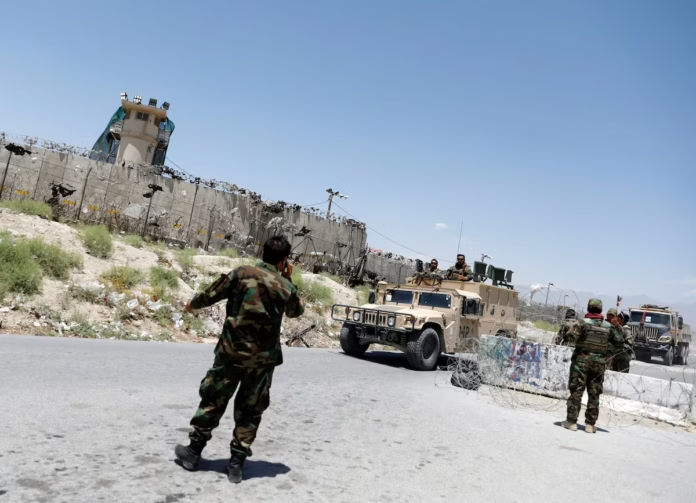
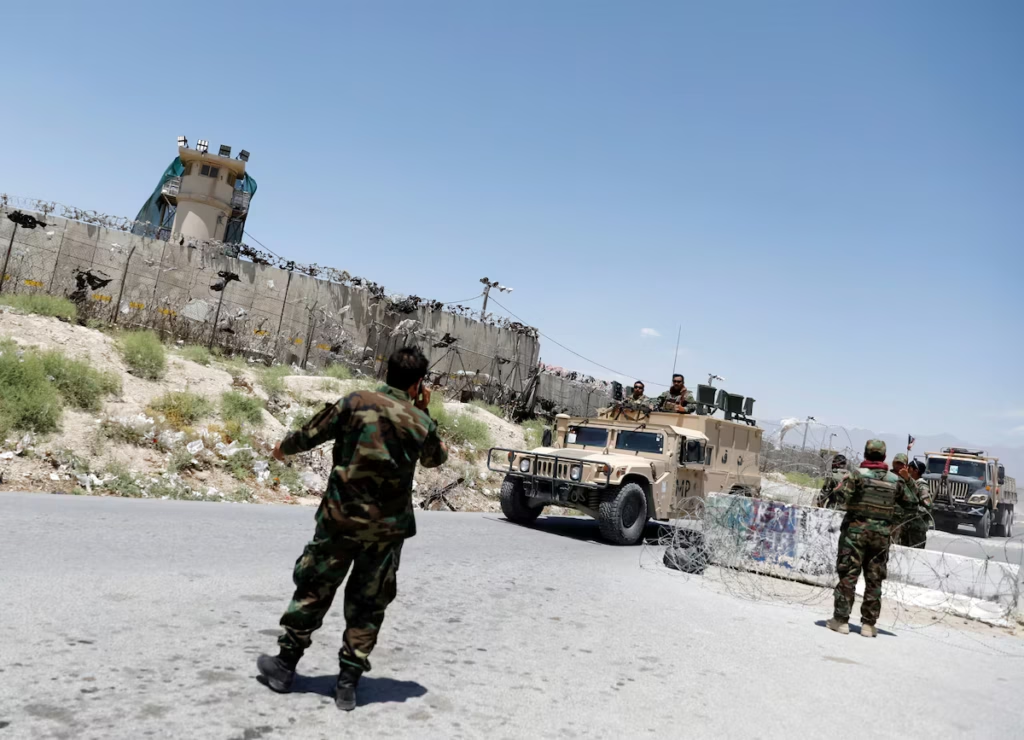
WASHINGTON (BN24) — President Donald Trump warned Saturday that Afghanistan would face “bad things” if it did not return control of the Bagram air base to the United States, raising the possibility of new American military involvement nearly four years after U.S. troops withdrew.
“If Afghanistan doesn’t give Bagram Airbase back to those that built it, the United States of America, BAD THINGS ARE GOING TO HAPPEN,” Trump wrote in a Truth Social post.
The Bagram facility, once the hub of U.S. military operations during the two-decade war following the Sept. 11, 2001, attacks, fell under Taliban control after the U.S. withdrawal in 2021. Afghan officials have since rejected the idea of allowing a revived American presence.
Trump signals possible military move
Speaking to reporters at the White House on Saturday, Trump stopped short of confirming whether U.S. troops might return to Afghanistan to reclaim the base.
“We’re talking now to Afghanistan and we want it back, and we want it back soon, right away,” he said. “And if they don’t do it—you’re going to find out what I’m gonna do.”
Pressed on whether that could mean sending in American forces, Trump declined to answer directly, instead warning that the consequences for Afghanistan could be severe.
On Thursday, Trump disclosed that the U.S. had formally sought to regain control of the base. He reiterated Friday that discussions with Afghanistan were ongoing.
Strategic and symbolic weight of Bagram
The sprawling airfield north of Kabul was once America’s largest military installation in Afghanistan, complete with fast-food outlets like Burger King and Pizza Hut serving troops, shops selling electronics and Afghan rugs, and a vast prison complex.
Experts say regaining control of the base would require significant manpower and security measures. U.S. officials estimate that more than 10,000 troops and advanced air defense systems would be needed to reestablish and protect the facility, raising fears of a drawn-out re-engagement that could resemble a re-invasion.
Even with Taliban cooperation, analysts warn the base would remain vulnerable to attacks from Islamic State and al Qaeda militants, as well as potential missile strikes from Iran, which targeted a U.S. air base in Qatar in June after American strikes on Iranian nuclear facilities.
Long-standing Trump interest
Trump has repeatedly expressed interest in acquiring or reclaiming strategic territories and assets abroad, ranging from the Panama Canal to Greenland. Bagram, however, has been a particular focus since the chaotic withdrawal of U.S. forces in 2021, which left the airfield and billions of dollars’ worth of equipment under Taliban control.
While the Taliban government in Kabul has dismissed the idea of renewed U.S. military control, Trump’s remarks suggest the issue is likely to remain a flashpoint in U.S.-Afghan relations.
LONDON (BN24) — Britain formally recognized a Palestinian state Sunday after Israel failed to meet conditions set in a July ultimatum, including establishing a ceasefire in the nearly two-year Gaza war, marking a significant shift in British Middle East policy.
Prime Minister Keir Starmer announced the decision on X, stating that the recognition aimed to “revive the hope of peace for the Palestinians and Israelis, and a two-state solution.” The move aligns Britain with more than 140 other nations that have previously recognized Palestinian statehood.
The decision carries particular symbolic weight given Britain’s historic role in Israel’s creation as a modern nation following World War Two and its long-standing alliance with the Jewish state. The recognition is expected to strain relations with both Israel and the United States, Britain’s closest ally.
Canada and Australia also recognized Palestinian statehood Sunday, with additional countries expected to follow suit during this week’s United Nations General Assembly sessions in New York. The coordinated timing suggests diplomatic coordination among Western nations regarding Palestinian recognition.
Britain had issued Israel an ultimatum in July, warning it would recognize a Palestinian state unless Israel took specific steps to end what officials called the “appalling situation” in Gaza. The conditions included reaching a ceasefire with Hamas militants, allowing increased humanitarian aid into Gaza, clearly stating there would be no West Bank annexation, and committing to a peace process delivering a two-state solution.
Foreign Secretary David Lammy indicated that Israel had failed to meet these benchmarks. “Since that announcement in July, in fact, with the attack on Qatar, a ceasefire at this point lays in tatters, and the prospects are bleak,” Lammy said, noting that Israel had also advanced settlement expansion plans.
Husam Zomlot, head of the Palestinian Mission in London, welcomed the recognition as “long-overdue” and emphasized that the decision represents “not about Palestine, but about Britain’s fulfillment of a solemn responsibility.” He characterized the move as “an irreversible step towards justice, peace, and the correction of historic wrongs.”
The recognition puts Starmer’s government at odds with President Donald Trump’s administration, which has strongly supported Israeli positions in the conflict. The diplomatic divide reflects broader international disagreements over approaches to resolving the Israeli-Palestinian conflict.
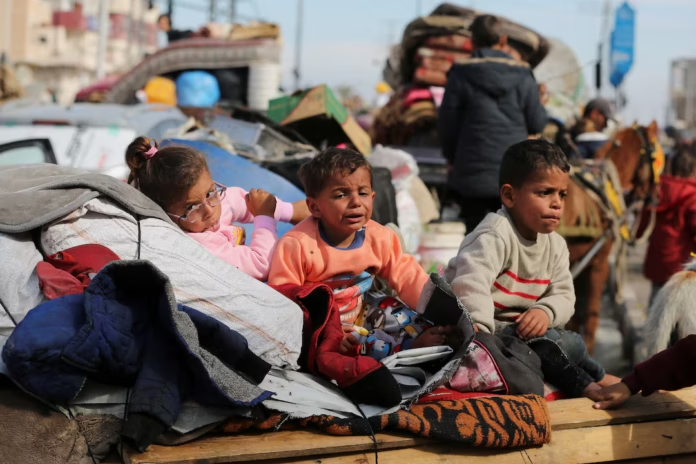
Starmer has faced mounting pressure from Labour Party lawmakers angered by rising death tolls in Gaza and widespread images of civilian suffering, particularly involving children. The internal political pressure contributed to the government’s decision to follow through on its ultimatum threat.
Israeli Prime Minister Benjamin Netanyahu has repeatedly stated that there will never be a Palestinian state and has accused countries recognizing Palestinian statehood of “rewarding Hamas’s monstrous terrorism.” Netanyahu’s position reflects his government’s hardline stance against Palestinian statehood negotiations.
London residents expressed mixed reactions to the government’s decision. Michael Angus, a 56-year-old charity director, supported the move, saying “peace needs to come to that region” and describing recognition as “the first step in actually acknowledging that those people have a right to have somewhere to call home.”
However, retiree Stephen, who declined to provide his surname, criticized the government’s approach despite acknowledging good intentions. “They are sort of abandoning Israel and with Hamas, they are almost sort of supporting them,” he said.
Lammy has previously emphasized Britain’s historic responsibility to facilitate a two-state solution, dating to the 1917 Balfour Declaration, which pledged that creating a Jewish state would not infringe on Arab rights. British forces captured Jerusalem from the Ottoman Empire in 1917, and the League of Nations awarded Britain a mandate to administer Palestine in 1922 during post-war territorial reorganization.
Victor Kattan, a public international law professor and adviser to the “Britain Owes Palestine” campaign, welcomed the recognition while arguing for additional measures. “While a welcome step, Britain owes Palestine far more than recognition,” Kattan said, advocating for an official apology and reparations for what he characterized as engineering violent divisions.
The recognition may result in upgrading the Palestinian Mission in London to embassy status, providing Palestinians with enhanced diplomatic representation in Britain. The decision could also lead to restrictions on products originating from Israeli settlements in occupied Palestinian territories.
British involvement in Palestinian affairs spans over a century, beginning with the World War One-era Balfour Declaration and continuing through the League of Nations mandate period. This historical involvement has created what many observers consider a special British responsibility for resolving the Israeli-Palestinian conflict.
The timing of the recognition coincides with ongoing international efforts to revive Middle East peace processes that have remained stalled for years. The coordinated recognition by multiple Western nations suggests a renewed diplomatic push for Palestinian statehood despite Israeli opposition.
The decision represents a significant departure from previous British policy that emphasized recognizing Palestinian statehood only as part of a negotiated settlement with Israel. The unilateral recognition reflects frustration with the lack of progress in peace negotiations and continued expansion of Israeli settlements.
International reactions to Britain’s decision are expected to divide along established lines, with Palestinian supporters welcoming the move while Israeli allies expressing concern about rewarding what they characterize as Palestinian intransigence and terrorism.
The recognition adds momentum to Palestinian diplomatic efforts to achieve international legitimacy and statehood recognition without direct negotiations with Israel, a strategy that Israeli officials have consistently opposed as undermining peace process requirements for mutual agreement.
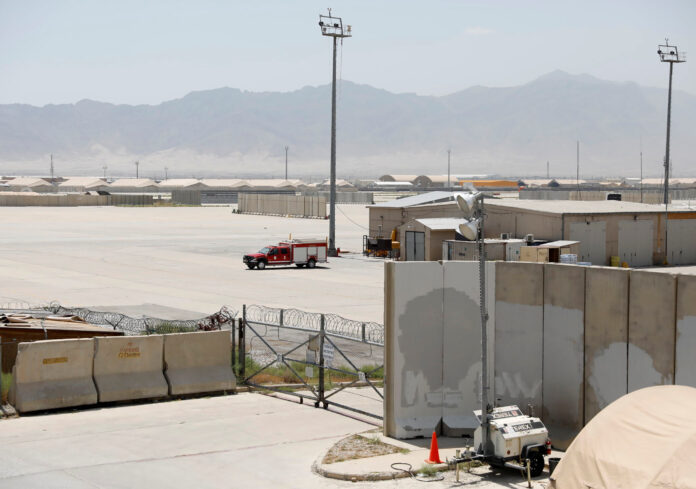
FILE PHOTO: A firefighter vehicle is seen in Bagram U.S. air base, after American troops vacated it, in Parwan province, Afghanistan July 5, 2021. REUTERS/Mohammad Ismail/File Photo
KABUL, Afghanistan (BN24) — The Taliban government Sunday firmly rejected President Donald Trump’s proposal to retake Bagram Air Base, four years after America’s chaotic withdrawal from Afghanistan left the sprawling military facility under Taliban control.
FILE PHOTO: A firefighter vehicle is seen in Bagram U.S. air base, after American troops vacated it, in Parwan province, Afghanistan July 5, 2021. REUTERS/Mohammad Ismail/File Photo
Chief Taliban spokesman Zabihullah Mujahid dismissed Trump’s assertions and urged the United States to adopt a policy of “realism and rationality” regarding Afghanistan. The rejection came one day after Trump renewed his call to reestablish an American presence at the strategic air base.
Afghanistan maintains an economy-oriented foreign policy and seeks constructive relations with all states based on mutual and shared interests, Mujahid posted on X. He emphasized that Afghanistan’s independence and territorial integrity remain of utmost importance, principles that have been consistently communicated to the United States in all bilateral negotiations.
Trump on Saturday had suggested ongoing discussions with Afghanistan about reclaiming the base, though he provided no details about the purported conversations. When asked by reporters if he would consider deploying U.S. troops to retake the facility, Trump declined to elaborate on potential military action.
“We won’t talk about that,” Trump said. “We want it back, and we want it back right away. If they don’t do it, you’re going to find out what I’m going to do.”
The president first floated the proposal Thursday during a press conference with British Prime Minister Keir Starmer as he concluded a state visit to the United Kingdom. Trump tied his desire to return to Bagram to the need for America to counter its primary rival, China.
“We’re trying to get it back,” Trump said during the press conference, describing the initiative as “breaking news” though he has previously raised similar ideas. The White House has not responded to questions about whether it or the Pentagon has conducted planning regarding returning to the air base that was central to America’s longest war.
Trump has consistently seized on the U.S. withdrawal under President Joe Biden as evidence of failed leadership. During his first presidency, Trump negotiated the initial agreement with the Taliban that set terms for American departure from Afghanistan.
The 20-year conflict concluded in August 2021 under Biden in chaotic fashion. The U.S.-backed Afghan government collapsed, a devastating bombing killed 13 American troops and 170 others, and thousands of desperate Afghans flooded Kabul’s airport seeking evacuation before the final U.S. aircraft departed.
Trump has repeatedly criticized Biden’s handling of the withdrawal, claiming last week that the Afghanistan debacle emboldened Russian President Vladimir Putin to invade Ukraine in February 2022. “He would have never done what he did, except that he didn’t respect the leadership of the United States,” Trump said of Putin.
The president described Bagram’s strategic value in terms of runway strength and capacity. “It’s one of the most powerful bases in the world in terms of runway strength and length,” Trump said aboard Air Force One. “You can land anything on there. You can land a planet on top of it.”
Trump has specifically highlighted Bagram’s proximity to China as a key factor in his desire to regain access. “One of the reasons we want that base is, as you know, it’s an hour away from where China makes its nuclear weapons,” Trump said Thursday.
The president suggested that the Taliban, who have struggled with economic crisis, international legitimacy issues, internal divisions and rival militant groups since returning to power in 2021, might be receptive to allowing American military presence. “We’re trying to get it back because they need things from us,” Trump said.
However, Taliban Foreign Ministry official Zakir Jalaly dismissed the possibility late Thursday. “Afghanistan and the U.S. need to interact with each other and can have economic and political relations based on mutual respect and common interests,” Jalaly posted on X.
Jalaly emphasized Afghanistan’s historical resistance to foreign military presence. “The Afghans have not accepted a military presence in history, and this possibility was completely rejected during the Doha talks and agreement, but the door is open for further interaction.”
Despite the absence of formal diplomatic ties, the United States and Taliban have maintained limited engagement primarily focused on hostage negotiations. An American tourist abducted more than two years ago while traveling through Afghanistan was released by the Taliban in March.
Last week, the Taliban announced reaching an agreement with U.S. envoys on a prisoner exchange as part of efforts to normalize relations between the countries. The Taliban provided no details about the detainee swap, and the White House declined to comment on the Kabul meeting or the results described in Taliban statements.
Taliban officials released photographs from recent talks showing their foreign minister, Amir Khan Muttaqi, meeting with Trump’s special envoy for hostage response, Adam Boehler, indicating ongoing diplomatic contact despite the military base dispute.
U.S. Central Command officials and Pentagon representatives, including Defense Secretary Pete Hegseth’s office, have referred questions about reestablishing presence at Bagram to the White House, suggesting no immediate military planning for such operations.
The Taliban’s firm rejection of Trump’s proposal reflects their emphasis on sovereignty and independence since regaining control of Afghanistan. The group has consistently maintained that foreign military presence remains unacceptable while expressing openness to economic and diplomatic engagement.
Bagram Air Base served as the primary hub for U.S. and NATO operations throughout the two-decade conflict in Afghanistan. The facility’s strategic location and extensive infrastructure made it crucial for military operations across the region before its abandonment during the 2021 withdrawal.
The current standoff over Bagram illustrates continuing tensions between American strategic interests and Taliban governance priorities in Afghanistan. While both sides have indicated willingness for limited engagement on specific issues, fundamental disagreements over military presence appear to persist.