Home Blog Page 205

Trump announces steep import tariffs on pharmaceuticals, furniture, cabinets and trucks

0

Washington (BN24) – President Donald Trump said Thursday that his administration will impose sweeping new import taxes beginning October 1, targeting industries ranging from medicine to heavy vehicles.

In a series of posts on his social media platform, Trump announced that pharmaceutical drugs imported into the United States will face tariffs of 100 percent, kitchen cabinets and bathroom vanities will face 50 percent, upholstered furniture 30 percent, and heavy trucks 25 percent.

The announcement marks an expansion of the tariff strategy Trump revived in August, underscoring his belief that higher import taxes can shrink the federal deficit while bolstering domestic manufacturing. He claimed that duties on items such as cabinets and sofas were necessary for “national security and other reasons,” although he did not cite a specific legal basis for the measures.

The Commerce Department earlier this year launched national security reviews under Section 232 of the Trade Expansion Act of 1962 into pharmaceuticals and truck imports. A separate review into timber and lumber began in March, raising questions about whether furniture imports fall under the same authority.

Economists warn that the tariffs could worsen inflation and raise costs for American households. Federal Reserve Chair Jerome Powell said recently that goods prices were already driving most of the year’s inflation increases, and he cautioned that higher import costs could further strain consumers. Trump has pressured Powell to cut interest rates, arguing inflation is no longer a threat, but the Fed has resisted due to tariff-related uncertainty.

The new taxes are expected to have far-reaching effects. The United States imported nearly $233 billion in pharmaceutical products last year, and doubling the cost of some medicines could significantly raise health care expenses for households, insurers, and government programs such as Medicare and Medicaid.

Trump said that companies building manufacturing facilities in the U.S. will be exempt, but it was unclear how the tariffs would apply to firms already producing domestically. He previously suggested tariffs on pharmaceuticals would be phased in gradually, but Thursday’s announcement sets immediate 100 percent levies.

Industry groups and international officials reacted sharply. Pascal Chan of the Canadian Chamber of Commerce warned the policy could lead to medicine shortages, insurance strain, and patient rationing. Homebuilders, already facing high mortgage rates and limited supply, could also see costs rise with the tariffs on cabinets.

Truck tariffs, Trump said, are intended to shield U.S. manufacturers such as Peterbilt, Kenworth, Freightliner, and Mack from foreign competition. “Large Truck Company Manufacturers … will be protected from the onslaught of outside interruptions,” he wrote.

Critics note that Trump’s earlier use of emergency economic powers under a 1977 law to justify broad tariffs is still under legal challenge. Two federal courts ruled that he exceeded his authority, and the Supreme Court is expected to review the case in November.

Despite rising prices, Trump maintains tariffs will spur factory construction and job creation. Since April, however, federal labor data shows U.S. manufacturers have cut more than 42,000 jobs and builders have eliminated 8,000 positions.

“There’s no inflation,” Trump insisted to reporters Thursday, calling his strategy a success. Still, he acknowledged that American farmers had suffered from retaliatory measures, and he promised to use tariff revenue to support them, as he did during his first term.

Source: AP

Construction workers feared trapped as three-storey building collapses in Nigeria’s Anambra State

0

AWKA, Nigeria (Sept. 25, 2025, BN24) — A three-storey building under construction collapsed Thursday morning in Anambra State’s capital, leaving rescue teams scrambling amid fears that construction workers may have been trapped in the rubble.

The structure, which had four suspended floors and was nearing completion at the roofing stage, was located behind the Anambra State House of Assembly, near Ekwueme Square in Okpuno Awka. Witnesses said the building suddenly gave way around 11:40 a.m., sending residents and passersby fleeing in panic.

Eyewitnesses told reporters that artisans were working on the roof when the building began making loud cracking noises before caving in entirely. “No one can say the cause of the collapse for now,” one resident said, adding that emergency responders were still waiting for excavators and other heavy equipment to begin rescue operations.

Officials from the Council for the Regulation of Engineering in Nigeria (COREN) and the state’s material testing department quickly arrived at the scene. COREN’s state chairman, Sir Victor Meju, said preliminary investigations indicated a total vertical collapse caused by poor concrete mixtures and possible foundation defects.

“The building had just been roofed last Thursday. Our on-site review suggests structural weaknesses linked to substandard concrete and foundation problems,” Meju said.

The collapse sparked confusion as conflicting accounts emerged about possible casualties. Some residents feared construction workers were buried under the debris, while the Awka Capital Territory Development Authority (ACTDA) issued a statement saying no one was trapped.

“While preliminary checks are ongoing, our officers on the ground have so far found no evidence to suggest that anyone was trapped,” ACTDA spokesperson Ukpa Ewa said. “We urge the public to remain calm and refrain from spreading unverified information, as such actions create unnecessary panic.”

Anambra police spokesperson SP Tochukwu Ikenga said he was not immediately aware of the incident but promised further updates. Meanwhile, bystanders attempted improvised rescue efforts before authorities cordoned off the site.

The collapse adds to Nigeria’s troubling record of building failures, many of which have been linked to poor construction practices, weak regulatory enforcement, and substandard materials. Authorities said a full investigation would be conducted while search-and-rescue teams continued to monitor the site.

Source: punchng.com

Former FBI Director James Comey indicted on two federal counts amid Trump push against critics

0

WASHINGTON (BN24) — Former FBI Director James Comey was indicted Thursday on two federal counts, marking the most dramatic step yet in President Donald Trump’s effort to wield the Justice Department against his longtime political adversaries.

A U.S. official confirmed to CBS News that Comey faces one count of making false statements and one count of obstruction of justice. The indictment was handed down in the Eastern District of Virginia just days before the statute of limitations on the case was set to expire.

Attorney General Pam Bondi announced the charges in a post on X, writing: “No one is above the law. Today’s indictment reflects this Department of Justice’s commitment to holding those who abuse positions of power accountable for misleading the American people. We will follow the facts in this case.”

FBI Director Kash Patel echoed the sentiment, accusing past Bureau leaders of corrupting federal law enforcement. “For far too long, previous corrupt leadership and their enablers weaponized federal law enforcement, damaging once proud institutions and severely eroding public trust,” Patel wrote on X.

The indictment stems from Comey’s 2020 testimony before the Senate Judiciary Committee regarding the FBI’s 2016 “Crossfire Hurricane” investigation into Russian interference in the presidential election. During questioning by Sen. Ted Cruz, R-Texas, Comey insisted he stood by his earlier 2017 testimony that he never authorized anyone to serve as an anonymous source for press reports about investigations involving Trump or Hillary Clinton.

But the Justice Department’s inspector general later concluded that then–Deputy Director Andrew McCabe authorized disclosures to The Wall Street Journal with Comey’s knowledge, raising doubts about Comey’s sworn statements.

The charges arrive as Trump intensifies pressure on federal prosecutors to pursue his critics. Last week, Trump named his former defense lawyer and White House aide, Lindsey Halligan, as interim U.S. attorney in the Eastern District of Virginia. Halligan, who has no prosecutorial experience, replaced Erik Siebert after his sudden resignation amid concerns from prosecutors that the president was demanding politically motivated cases.

Trump has long pushed for prosecutions of Comey, New York Attorney General Letitia James, and Rep. Adam Schiff, D-Calif., among others. On social media, he complained the lack of charges was “killing our reputation and credibility,” while pointing to his own impeachments and multiple indictments. “JUSTICE MUST BE SERVED, NOW!!!” he wrote on Truth Social.

Comey and Trump’s feud dates back to 2017, when Trump fired him as FBI director, a decision that led to Robert Mueller’s special counsel probe into Russian election interference. Since then, Comey has been a vocal critic of Trump, once calling him “morally unfit” for the presidency.

Earlier this year, Comey came under scrutiny from the Trump administration after posting an image on social media that officials claimed was a call for violence against the president. Secret Service agents interviewed him for over an hour, though Comey denied any wrongdoing. Trump later told Fox News that he believed Comey’s post was “loud and clear” in calling for his assassination.

The indictment of the former FBI chief underscores how Trump has leveraged his second term to target opponents, stripping security clearances from high-profile Democrats including Joe Biden, Kamala Harris, and Hillary Clinton, as well as ending Secret Service protection for figures such as Harris, John Bolton, and Biden’s children, Hunter and Ashley.

Comey is expected to appear in court in the coming days as the Justice Department pursues a case that could deepen already bitter political divisions over the administration’s use of federal power.

Trump signs executive order paving way for TikTok deal with U.S. investors

0

WASHINGTON (BN24) — President Donald Trump on Thursday signed an executive order that lays the groundwork for a TikTok deal expected to shift majority ownership of the popular video app into American hands, a move designed to resolve longstanding national security concerns over its Chinese parent company ByteDance.

The agreement, still pending final legal and financial adjustments, would reduce ByteDance’s stake to less than 20% while transferring 80% ownership to American investors. Trump said Oracle and its co-founder Larry Ellison would play a central role in the new structure, alongside tech entrepreneur Michael Dell and media mogul Rupert Murdoch. Vice President JD Vance confirmed that additional details about the investors will be disclosed in the coming weeks.

“This is going to be American-operated all the way,” Trump said at the signing ceremony. He credited Chinese President Xi Jinping for approving the framework, adding that cooperation from Beijing was essential to finalize the arrangement.

The deal also grants American investors control of TikTok’s prized recommendation algorithm, the technology behind the app’s influential For You page that transformed online content and advertising. Asked whether he hoped the algorithm would promote more MAGA-related content, Trump said he favored it but emphasized that the platform would remain open to “every group, every philosophy, every policy.”

TikTok did not immediately comment on the order.

The agreement follows years of scrutiny from U.S. officials who accused ByteDance of posing risks by potentially sharing user data with Beijing or allowing Chinese influence over the app’s content feeds. In May, TikTok was fined €530 million by Ireland’s Data Protection Commissioner for mishandling user data, further intensifying global concerns.

TikTok’s future in the United States has been uncertain since President Joe Biden signed a bipartisan law requiring ByteDance to divest or face a nationwide ban. Although the law was upheld by the Supreme Court and initially slated to take effect in January, enforcement was repeatedly delayed as Trump used executive actions to push back the deadline. The latest order extends the grace period another 120 days, until Jan. 23, to allow time for the divestiture to be completed.

Trump acknowledged that his decision was influenced by small business owners who rely on TikTok for advertising. “Small businesses have become very successful because of TikTok, and we didn’t think of that,” he said.

The platform, estimated to have 170 million U.S. users, has drawn bipartisan criticism in past years. But lawmakers who once championed a ban shifted course after widespread public opposition. Trump himself has also reversed positions, initially attempting to block TikTok during his first term before later embracing it in his 2024 campaign, even joining the platform to reach younger voters.

The executive order marks a significant turning point in the ongoing battle over TikTok’s ownership and could chart the company’s future in the American market.

Kenya police arrest teen after viral video of national flag desecration at Nyayo Stadium

0

NAIROBI, Kenya (BN24)— Detectives with Kenya’s Directorate of Criminal Investigations (DCI) have arrested a 17-year-old boy filmed desecrating the Kenyan national flag during a football match at Nyayo Stadium, an act that has ignited nationwide outrage and condemnation.

The viral video, which has circulated widely on social media, shows the teenager throwing the flag to the ground. In a second video, another supporter wearing a traditional Somali sarong is seen approaching a Kenya Police FC fan, seizing the flag, and tossing it aside in what appeared to be a deliberate provocation.

The incident occurred during a Sept. 20 match between Mogadishu City Club and Police FC, according to a DCI statement released Thursday. Officials described the act as both unlawful and offensive to Kenya’s national values.

“The incident took place at Nyayo Stadium where two individuals were captured on camera disrespecting the national flag—an act that is both unlawful and deeply offensive to the values we uphold as a nation,” the DCI said.

Kenya’s National Flag, Emblems and Names Act, Cap 99, makes it a criminal offense to show disrespect toward national symbols, including the flag and anthem. Offenders are liable to prosecution.

Authorities confirmed that efforts are underway to apprehend the second individual seen in the video, who is believed to still be in the country.

Interior Cabinet Secretary Kipchumba Murkomen condemned the actions, ordering the immediate arrest, prosecution, and deportation of the culprits. Somalia’s Ambassador to Kenya, Jabril Ibrahim Abdulle, also denounced the acts.

“Hatutakubali mtu yeyote, iwe Mkenya ama mgeni, kucheza na uhuru wetu and our symbols of national unity, including our national flag. So, bwana IG, take the necessary legal action. Let the law take its course,” Murkomen said, stressing that Kenya must protect its national symbols.

Inspector General of Police Douglas Kanja echoed the directive, instructing the DCI to move swiftly in apprehending the suspects. “Bendera yetu lazima iheshimiwe,” he said, insisting that the Kenyan flag, a symbol won through the struggle for independence, must never be disrespected.

The DCI confirmed it is acting under direct instructions from the Inspector General to bring the remaining suspect before a court of law.

Source: citizen.digital.com

French Navy seizes nearly 10 tonnes of cocaine off West African coast

0

DAKAR, Senegal (BN24) — The French navy has seized nearly 10 tonnes of cocaine off the coast of West Africa, authorities said Tuesday, in one of the region’s largest maritime drug interceptions this year.

Acting on intelligence from French and international anti-narcotics agencies, including the British National Crime Agency, two French naval vessels intercepted an unflagged fishing boat on Monday in the Gulf of Guinea. The operation, conducted as part of France’s long-running Operation Corymbe, uncovered approximately 9.6 tonnes of cocaine with an estimated street value of $610 million (€570 million).

French naval officials said the seizure highlights the increasing role of the Gulf of Guinea as a major transit corridor for South American cocaine en route to Europe. The French Atlantic Maritime Prefecture described the operation as a “remarkable seizure” made possible through “seamless cooperation by national and international actors.”

Since the beginning of the year, roughly 54 tonnes of drugs have been seized in the region, reflecting a surge in global trafficking activity and the strategic use of West African waters by international drug cartels.

The intercepted vessel was reportedly operating without a flag, a tactic frequently employed by traffickers to avoid detection. French authorities have not yet disclosed the number of arrests or the nationality of those aboard.

The seizure comes as the Gulf of Guinea remains a focal point for maritime security operations. While the area was previously known for piracy, once surpassing Somalia as the world’s most dangerous maritime zone, increased international naval presence has shifted focus to combating organized crime, particularly drug smuggling.

The record for the largest cocaine seizure in the region remains the 10.7 tonnes confiscated by French forces in March 2024. However, this latest bust underscores the persistent and growing challenge of intercepting narcotics in increasingly complex smuggling networks across West African waters.

Operation Corymbe has maintained a near-continuous French naval presence in the Gulf of Guinea since 1990. Its mission, initially aimed at deterring piracy, now plays a central role in joint international efforts to curtail maritime drug trafficking routes from Latin America to Europe.

French authorities reaffirmed their commitment to securing maritime trade routes and intensifying cooperation with regional and international partners in the fight against global narcotics trafficking.

Former French President Sarkozy sentenced to 5 years over Libya funding case

0

PARIS (BN24) — Former French President Nicolas Sarkozy has been sentenced to five years in prison after being found guilty of criminal conspiracy in a long-running investigation into alleged illicit campaign financing from Libya’s late leader, Muammar Gaddafi.

A Paris criminal court ruled Thursday that Sarkozy, 70, conspired with associates to solicit millions of euros from the Gaddafi regime to fund his successful 2007 presidential campaign. The court acquitted him of passive corruption and illegal campaign financing but found sufficient evidence to convict him of criminal conspiracy, handing down a custodial sentence and a €100,000 ($117,000) fine.

Sarkozy, who served as president from 2007 to 2012, has consistently denied wrongdoing and denounced the charges as politically motivated. Following the verdict, he called the ruling “extremely serious for the rule of law” and confirmed plans to appeal. However, under French law, the five-year sentence remains enforceable during the appeal process, meaning Sarkozy could soon become the first former president in modern French history to serve jail time.

“If they absolutely want me to sleep in jail, I will sleep in jail, but with my head held high,” Sarkozy said outside the courthouse.

The dramatic conclusion to the high-profile trial marks a stunning reversal for the former president, once seen as a dominant figure in French and European politics. During the hearing, presiding judge Nathalie Gavarino said Sarkozy knowingly allowed key aides to establish contact with Libyan officials to secure financial backing. However, the court did not find enough evidence proving that Sarkozy directly received or benefited from the funds.

The case stems from allegations first raised in 2011 by Saif al-Islam Gaddafi, son of the former Libyan dictator. He accused Sarkozy of accepting millions in undeclared cash to fund his presidential bid. A year later, Franco-Lebanese businessman Ziad Takieddine, long linked to arms deals and Franco-Arab ties, claimed he had documentary evidence of €50 million in payments from Tripoli to Sarkozy’s campaign — claims that sparked a decade-long investigation.

While Sarkozy avoided conviction on the campaign finance charge, two of his former cabinet members were not spared. Claude Guéant, Sarkozy’s former interior minister and close confidant, was found guilty of corruption. Another former minister, Brice Hortefeux, was convicted of criminal conspiracy.

Sarkozy’s legal woes extend beyond the Libya case. In February 2024, he was found guilty of overspending in his 2012 re-election campaign and using a public relations firm to cover it up. He received a one-year sentence, with six months suspended. In 2021, he became the first former French president convicted of attempting to bribe a judge and was allowed to serve that sentence under house arrest with an electronic tag.

Adding to the legal drama, his wife, Italian-born singer and former model Carla Bruni-Sarkozy, was charged in 2024 with concealing evidence and associating with individuals involved in the Gaddafi case. She has denied all charges.

While Sarkozy’s lawyers prepare their appeal, the court’s ruling has already sent shockwaves through France’s political landscape, marking another chapter in the fall of a once-powerful figure now facing the reality of incarceration.

Palestinian president says ready to work with Trump for two-state peace plan

0

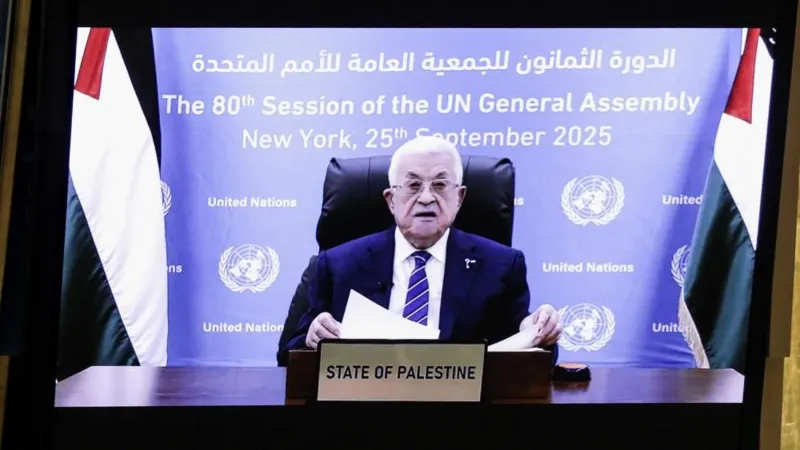
UNITED NATIONS (BN24) — Palestinian President Mahmoud Abbas said he is prepared to cooperate with U.S. President Donald Trump and international powers to implement a two-state peace initiative announced by France, reiterating a vision for Palestinian statehood amid ongoing war in Gaza.

In a video address to the United Nations General Assembly, Abbas voiced strong support for the French-led proposal that includes a ceasefire in Gaza, the release of hostages held by Hamas, and the establishment of a demilitarized Palestinian state governed by the Palestinian Authority (PA), excluding Hamas. He welcomed the initiative as a “path toward a just peace and comprehensive regional cooperation,” calling on international actors, including Saudi Arabia, France, and the UN, to help realize the plan.

Though he emphasized readiness to work with Trump, the United States has so far rejected the plan, citing concerns over Hamas’s role in the October 7, 2023, attack on Israel that killed approximately 1,200 people and triggered the war. The U.S. State Department recently revoked visas for Abbas and 80 other Palestinian officials, accusing them of undermining peace efforts and seeking “unilateral recognition of a conjectural Palestinian state.”

Abbas, 89, was thus barred from traveling to New York and appeared via video from Ramallah. Despite his limited physical presence, Abbas used the platform to press for full UN membership for Palestine and urged countries that have yet to recognize Palestinian statehood to follow the recent lead of nations including Canada, Australia, the UK, Portugal, France, Belgium, and Denmark.

While condemning Israel’s ongoing military campaign in Gaza as “one of the most horrific humanitarian tragedies of the 20th and 21st Centuries,” Abbas also rejected Hamas’ actions, including its cross-border assault on Israel last year. Gaza’s Hamas-run health ministry reports more than 65,000 Palestinians have died in Israeli attacks since the conflict began, with approximately half being women and children.

The French peace framework, announced at a summit co-chaired by French President Emmanuel Macron and Saudi Arabia, proposes a phased resolution: an immediate ceasefire, the release of hostages, a transitional administration led by the PA, and the eventual establishment of an independent Palestinian state. Neither Israel nor the United States have endorsed the plan.

Despite that, Abbas pledged full Palestinian Authority responsibility for post-war governance in Gaza and called for the strip’s reintegration with the West Bank under a unified state. He also promised institutional reforms, vowing to hold presidential and parliamentary elections within one year of the war’s end, polls not seen since Hamas won legislative elections in 2006.

“We want a democratic, modern state committed to international law, rule of law, pluralism, peaceful transfer of power, and the empowerment of women and youth,” Abbas stated.

The remarks underscore growing diplomatic momentum behind Palestinian statehood, even as the conflict shows little sign of abating and internal Palestinian divisions continue. Hamas violently ousted Abbas’s Fatah party from Gaza in 2007, creating a deep political rift that still complicates prospects for unity and peace.

While key Western powers remain divided on the path forward, Abbas’s address signals a renewed push from Ramallah to position the Palestinian Authority—and not Hamas—as the legitimate interlocutor in any future resolution.

Amazon agrees to pay $2.5bn over claims it tricked Prime customers

0

SEATTLE (BN24) — Amazon has agreed to pay $2.5 billion to settle claims from the U.S. Federal Trade Commission that the tech giant deceived millions of customers into signing up for its Prime membership and created barriers that made canceling the service unnecessarily difficult.

The settlement, announced as a federal jury trial was already underway in Seattle, includes $1.5 billion in customer refunds and represents the largest civil penalty ever secured by the FTC. The agency alleged that Amazon used manipulative online interfaces—commonly referred to as “dark patterns” to push consumers toward unwanted Prime subscriptions during checkout, often without clearly presenting terms or offering a transparent option to decline.

FTC Chairman Andrew Ferguson called the decision a significant step in holding tech firms accountable. “The evidence showed that Amazon used sophisticated subscription traps designed to manipulate consumers into enrolling in Prime, and then made it exceedingly hard for consumers to end their subscription,” Ferguson said. “Today, we are putting billions of dollars back into Americans’ pockets and making sure Amazon never does this again.”

Amazon, which did not admit wrongdoing as part of the agreement, has not yet publicly responded to the settlement. Under the terms, the company will be required to end practices that mislead users into thinking they are declining a service, such as presenting buttons labeled “No, I don’t want free shipping” when they are actually consenting to a Prime trial.

Prime, which offers benefits including free shipping and access to streaming content, currently costs $139 per year or $14.99 monthly in the U.S. and £95 annually in the U.K. According to the FTC, misleading tactics led millions to enroll in the service without informed consent. Consumers who used Prime benefits fewer than three times within a year will be automatically refunded. Those who used it fewer than ten times may still be eligible for a refund by filing a claim.

An estimated 35 million U.S. consumers affected between June 2019 and June 2025 may qualify for refunds of up to $51, based on FTC estimates.

Internal Amazon communications cited in the case revealed that company executives and staff were aware of the questionable nature of their subscription practices, with one document quoting an employee referring to “subscription driving” as “a bit of a shady world.”

The case, originally brought under the Biden administration during FTC Chair Lina Khan’s tenure, was seen as part of a broader push to regulate Big Tech. Ferguson, appointed earlier this year by President Donald Trump, has also taken a firm stance on tech industry practices.

As part of the agreement, Amazon will implement new systems to simplify the Prime cancellation process, removing misleading language and requiring clearer disclosures in its checkout design.

The settlement underscores the FTC’s increasing scrutiny of subscription-based services and highlights the legal risks facing major technology companies accused of undermining consumer rights through manipulative design.

UEFA faces pressure as calls grow to ban Israel from international soccer

0

LONDON (BN24) — Top-level discussions are underway within European football over whether Israel should be banned from international competitions, amid intensifying pressure on governing bodies UEFA and FIFA. The talks come as global scrutiny mounts over Israel’s military actions in Gaza, which a United Nations inquiry has labeled as genocide — a claim the Israeli government strongly denies.

Sky News has learned that although no formal decision has been made, deliberations are active at UEFA regarding the future participation of Israel’s national and club teams. The debate has been fueled by a growing number of appeals from international human rights advocates, UN officials, and segments of the football community demanding sporting sanctions against Israel.

The latest push follows a report from a United Nations commission of inquiry accusing Israel of committing genocide during its military campaign in Gaza, nearly two years after the Hamas-led attacks on October 7, 2023. Alexandra Xanthaki, the UN Special Rapporteur for Cultural Rights, argued that national teams representing states accused of genocide cross a “red line” and should be subject to suspension from international competition.

UEFA and FIFA have previously resisted such demands but have yet to respond to the most recent calls, which include a plea from a group of UN advisory experts. Public sentiment is also surfacing at football grounds across Europe. During a Europa League match this week between Greek side PAOK and Maccabi Tel Aviv, fans unfurled Palestinian flags and a banner reading “Show Israel the red card.” The match ended 0-0, but protests before and during the game led to several arrests in Thessaloniki, where Israeli fans were kept behind a police barrier and Maccabi’s team bus was escorted under heavy security.

In the UK, calls for action have extended to Premier League side Aston Villa, which is due to host Maccabi Tel Aviv in November. Ayoub Khan, the independent MP for Birmingham Hall Green, urged Villa to “take the high moral ground” and boycott the fixture, citing both ethical concerns and potential security risks for local communities.

“It’s not just about football,” Khan told Sky News. “It’s about the safety of local businesses, the community, and the risk of clashes between pro-Palestinian and pro-Israel activists.”

The issue has become deeply divisive. While activists and political figures press for Israel’s exclusion, legal advocates defending Israel’s participation argue that football teams should not be penalized for the actions of a state during wartime. Jonathan Turner, CEO of UK Lawyers for Israel, warned against what he called discriminatory treatment. “Unfortunately, there is destruction during a war,” he said. “But the Israeli Football Association and Maccabi Tel Aviv are not responsible for that destruction.”

Turner also drew a historical parallel, stating that many Jews perceive the push for sporting boycotts as reminiscent of Nazi-era boycotts of Jews.

The situation echoes UEFA’s decision in 2022 to ban Russia from international competition following its full-scale invasion of Ukraine. This precedent has intensified debate around whether football should adopt a moral stance on state actions in war.

UEFA has shown signs of acknowledging the humanitarian toll in Gaza, including a “Stop Killing Children” banner displayed at the UEFA Super Cup in August. Yet the question of whether football can or should take a definitive stand against Israel remains legally and politically fraught.

It is understood that some European clubs have privately raised concerns about playing Israeli teams, and UEFA is now weighing not just public and political pressure, but also the potential security risks and broader implications for the game.

Credit: Sky News