LOS ANGELES (BN24) — Rapper Soulja Boy was arrested early Saturday in Los Angeles after police discovered a firearm during a traffic stop, marking the latest legal trouble for the entertainer this year.
The 34-year-old rapper, whose legal name is DeAndre Cortez Way, was taken into custody around 2:30 a.m. following a traffic stop along Melrose Avenue, according to NBC Los Angeles. Authorities said Soulja Boy was a passenger in the vehicle and was booked on suspicion of being a felon in possession of a firearm. Details surrounding what prompted the stop or the identity of the driver have not been publicly released.
The arrest adds to a growing list of legal challenges for the rapper in 2025. In April, a Los Angeles jury ordered Soulja Boy to pay $4.25 million in damages to a woman who accused him of sexual battery and assault stemming from incidents that allegedly occurred in 2021, when she worked as his personal assistant. An additional $250,000 in punitive damages was also awarded to the plaintiff, bringing the total judgment to $4.5 million.
Following the verdict, Soulja Boy issued a public statement criticizing the outcome and questioning the fairness of the trial. “Today, I stand before you, deeply disappointed in the verdict delivered in my case,” he said. “I firmly believe that the decision made in court was not based on facts or substantial evidence but rather on factors that were outside of my control.”
He further claimed that the trial was biased, citing what he described as an “unequal playing field” because the plaintiff was permitted to remain anonymous under the name “Jane Doe,” while he faced “public scrutiny.”
“The truth was overshadowed by the involvement of individuals such as the jury who are not present during the events in question,” he added, saying he would appeal the decision and continue to fight for what he called the truth.
As of Sunday, no formal charges had been filed in the latest arrest, and the Los Angeles Police Department has not disclosed whether additional arrests were made during the stop.
KYIV, Aug 2 (BN24) — Ukraine’s anti-corruption authorities have uncovered a large-scale embezzlement scheme involving the procurement of military drones and signal jamming systems, officials announced Saturday, just two days after a major public outcry led to the restoration of their operational independence.
The National Anti-Corruption Bureau of Ukraine (NABU) and the Specialised Anti-Corruption Prosecutor’s Office (SAPO) said in a joint statement that several individuals — including a current lawmaker, two local officials, and unnamed members of the National Guard — were implicated in inflating prices on state defense contracts and pocketing illicit kickbacks.
According to investigators, the scheme involved signing contracts with select supplier companies at grossly inflated prices. The accused allegedly received kickbacks amounting to as much as 30% of each contract’s total cost. Four suspects have been arrested so far, though authorities have not yet released their identities.
“The essence of the scheme was to conclude state contracts with supplier companies at deliberately inflated prices,” the agencies said in a statement posted to social media.
President Volodymyr Zelenskiy, who has wielded sweeping executive powers since Russia’s 2022 invasion, responded swiftly to the revelations, stressing the need for accountability. “There can only be zero tolerance for corruption, clear teamwork to expose corruption and, as a result, a just sentence,” Zelenskiy wrote on Telegram.
The high-profile corruption bust follows a week of intense political pressure on Zelenskiy, whose administration faced its largest protests since the war began. Demonstrations erupted after a controversial move in parliament to bring NABU and SAPO under the control of the prosecutor-general — a shift widely seen as compromising their independence.
Reacting to public backlash, Zelenskiy reversed course, submitting a bill to reinstate the agencies’ autonomy. Parliament passed the legislation on Thursday, restoring the credibility of Ukraine’s key anti-corruption bodies and assuaging concerns from Kyiv’s Western partners.
European Union officials had warned that undermining NABU and SAPO could derail Ukraine’s ambitions to join the EU. The integrity of anti-corruption mechanisms is a core requirement for membership talks, and international watchdogs had expressed alarm over the initial attempt to weaken the agencies’ independence.
In a follow-up statement after meeting with the heads of NABU and SAPO, Zelenskiy reaffirmed the state’s commitment to anti-corruption efforts. “It is important that anti-corruption institutions operate independently, and the law adopted on Thursday guarantees them every opportunity for a real fight against corruption,” he said.
The drone procurement case is the latest in a string of high-profile investigations involving Ukraine’s defense sector, which has seen a surge in spending amid the ongoing war with Russia. Western donors and domestic watchdogs have repeatedly called for stronger safeguards to ensure that wartime funding is not siphoned off through fraudulent contracting.
As Kyiv presses forward with military and diplomatic efforts against Russia’s invasion, the renewed resolve to confront internal corruption is being closely watched both at home and abroad. The exposure of the drone procurement fraud — coming just days after political reforms — serves as a litmus test for Ukraine’s ability to maintain transparency under the strain of war.
SINGAPORE (BN24) — Canadian swimming sensation Summer McIntosh is positioned to secure her fourth gold medal at the World Aquatics Championships after posting the fastest time in the women’s 400 metres individual medley heats on Sunday, the final day of competition in Singapore.
McIntosh delivered a composed and dominant performance in her heat, touching in 4:35.56 — well off her blistering 4:23.65 world record set at the Canadian trials in June, but more than enough to advance as the top seed into the evening final.
While McIntosh’s qualification was expected, it was 12-year-old Chinese swimmer Yu Zidi who stole the spotlight. The schoolgirl stunned the field by winning her heat and qualifying third overall in 4:36.49, a mere fraction behind her personal best of 4:35.53 that won her the Chinese national title in May.
On the men’s side, Olympic champion and world record holder Leon Marchand narrowly escaped elimination in the 400m individual medley. The French star led early in his heat but eased up too much in the breaststroke and freestyle segments, finishing seventh overall with a time that placed him just inside the qualifying cutoff for the evening final.
Japan’s Tomoyuki Matsushita led the men’s heats and enters the final as the top seed, nearly three seconds ahead of Marchand. Despite the shaky prelim, Marchand, who already claimed the 200m IM title with a world-record swim earlier this week, remains a strong contender for a third consecutive 400m world title.
The men’s field was notably weakened by the withdrawal of American Carson Foster, an Olympic bronze medallist, who pulled out of the 400m medley heats due to an ankle injury. For the first time in over five decades of world championships, the United States failed to qualify a swimmer for the men’s 400m medley final.
New Zealand’s Lewis Clareburt, the defending world champion in the event, also failed to make it out of the heats, further reshaping the competitive landscape heading into the final session.
In the team events, the U.S. men secured the top qualifying time for the 4×100 medley relay final, anchored by Paris Olympic silver medallist Jack Alexy. But the reigning Olympic champions from China fell short, placing ninth and missing the final alongside 11th-ranked Australia.
The U.S. women also dominated their relay heats, qualifying first in 3:54.49 — one second clear of Australia, with Germany rounding out the top three qualifiers.
Sunday’s finals promise high drama with eight gold medals on the line. Germany’s Florian Wellbrock is aiming to add the 1,500m freestyle title to his already impressive medal haul after sweeping the open water events earlier in the week.
Lithuanian swimmer Ruta Meilutyte is also eyeing history in the women’s 50m breaststroke. The world record holder is bidding for her fourth straight world title in the event since returning to elite competition in 2021 following a two-year ban for anti-doping rule violations.
With standout performances across multiple events and a surge of rising young stars like Yu Zidi, the final night in Singapore is set to cap off a dramatic and transformative world championship meet.
WASHINGTON (BN24) — President Donald Trump has imposed devastating 50% tariffs on Brazilian imports, including nearly one-third of America’s daily coffee supply, marking an unprecedented escalation that abandons traditional trade justifications in favor of purely political retaliation over Brazil’s prosecution of former strongman Jair Bolsonaro.
The punishing tariffs, which took effect Friday and represent the highest rate imposed on any country worldwide, target Brazilian products not because of trade imbalances or economic disputes, but because Trump views Brazil’s legal proceedings against his political ally as an “international disgrace” that constitutes a “witch hunt.”
The extraordinary move breaks with Trump’s typical tariff rhetoric, which usually focuses on trade deficits and claims that foreign nations exploit American markets. In Brazil’s case, the United States actually maintains a trade surplus worth hundreds of billions of dollars over more than a decade, making the economic justification nonexistent.
Trump’s tariff announcement coincided with harsh sanctions imposed this week against Brazilian Supreme Court Justice Alexandre de Moraes under the Magnitsky Act, legislation originally designed to punish Russian President Vladimir Putin and his allies. Secretary of State Marco Rubio declared the sanctions were imposed “for serious human rights abuses.”
The alleged abuses center on de Moraes overseeing the criminal case against Bolsonaro, who faces coup conspiracy charges alongside approximately thirty co-defendants, including Brazil’s former navy commander, defense minister, and intelligence chief. Prosecutors allege the group attempted to prevent current President Luiz Inácio Lula da Silva from taking office after defeating Bolsonaro in Brazil’s 2022 election.
Brazil’s Supreme Federal Court has ordered Bolsonaro to wear an ankle monitor while prohibiting him from using social media, contacting foreign leaders, or leaving the country pending trial. Brazilian officials revealed to NBC News that these restrictions were imposed after Bolsonaro’s son, Congressman Eduardo Bolsonaro, enlisted Steve Bannon and other MAGA allies during a U.S. visit to lobby Trump for intervention in his father’s case.
De Moraes has also clashed with Trump’s business interests directly. The justice ordered a month-long ban on Elon Musk’s X platform in Brazil last year after the company refused to appoint local legal representation or comply with court orders removing accounts spreading election misinformation. Additionally, Trump Media has sued de Moraes over suspension orders affecting Rumble, the video hosting service powering Trump’s Truth Social platform.
Trump explicitly connected Bolsonaro’s prosecution to his tariff decision in a scathing letter sent to Brazilian President Lula and posted on Truth Social. “The way that Brazil has treated former President Bolsonaro, a Highly Respected Leader throughout the World during his Term, including by the United States, is an international disgrace. This Trial should not be taking place. It is a Witch Hunt that should end IMMEDIATELY,” Trump declared.
The president directly linked Brazilian legal proceedings to his tariff retaliation, stating the measures were imposed “due in part to Brazil’s insidious attacks on Free Elections, and the fundamental Free Speech Rights of Americans.” Trump accused Brazil’s Supreme Court of issuing “hundreds of SECRET and UNLAWFUL Censorship Orders to U.S. Social Media platforms, threatening them with Millions of Dollars in Fines and Eviction from the Brazilian Social Media market.”
The tariffs impact major Brazilian exports including coffee, beef, aircraft, iron, and steel, though Trump’s executive order excluded oranges, oil, and fertilizers. The coffee tariff alone affects nearly one-third of American daily consumption, potentially driving up prices for millions of consumers.
Brazil, recognized as the world’s fourth-largest democracy, has seen the unprecedented American pressure unite opposing political factions. A bipartisan Brazilian delegation including both Bolsonaro supporters and former opposition cabinet members met with Democratic senators on the Foreign Relations Committee and Republican Senator Thom Tillis this week seeking resolution.
Brazilian Foreign Minister Mauro Vieira flew to Washington for emergency discussions with Rubio on Wednesday, while Commerce Secretary Howard Lutnick held phone conversations with his Brazilian counterpart. Brazilian officials described those talks as unsuccessful, according to NBC News sources.
President Lula has not announced whether Brazil will impose retaliatory measures against American imports, though diplomatic sources suggest various options remain under consideration.
The tariff authority faces significant legal challenges, with a federal appeals court panel hearing arguments Thursday from businesses and state attorneys general questioning Trump’s constitutional authority to impose duties through executive order. Critics argue the White House has failed to establish the national emergency justification required to bypass congressional tariff authority.
Federal judges pressed Justice Department lawyers on Trump’s use of a 1977 economic emergency law that does not specifically mention tariffs, noting no previous president has attempted such an interpretation. The case appears destined for Supreme Court review given its constitutional implications.
The Brazil dispute represents a dramatic departure from traditional American foreign policy, with personal political loyalty to Bolsonaro apparently superseding broader diplomatic and economic interests. The targeting of a major democratic ally over domestic legal proceedings marks an escalation in Trump’s willingness to weaponize trade policy for political objectives.
For American consumers, the tariffs mean higher prices on popular Brazilian imports, particularly coffee and beef, while potentially damaging longstanding commercial relationships between the two largest economies in the Americas. The move also signals to other nations that their domestic legal systems could become targets for American economic retaliation if they conflict with Trump’s political preferences.
TEL AVIV (BN24) — Tens of thousands of Israelis flooded the streets of Tel Aviv Saturday evening in an emotional mass demonstration demanding the immediate release of hostages still held in Gaza, after militant groups released devastating propaganda videos showing two Israeli captives in severely emaciated condition.
The powerful rally erupted following the distribution of disturbing footage by Hamas and Palestinian Islamic Jihad this week, depicting Israeli hostages Evyatar David and Rom Braslavski in visibly deteriorated physical states that shocked families and ignited public outrage across Israel.
In one particularly harrowing video, David appears extremely gaunt while digging what he describes as his own grave, footage that was projected onto a large screen during the demonstration after his family granted permission for public viewing. The crowd, holding placards reading “Stop the war” and “Leave no one behind,” watched in stunned silence as the propaganda material played.
The videos showcase two of approximately fifty hostages remaining in Gaza territory, with at least twenty believed to still be alive. The militant groups appear to have strategically released the footage as ceasefire negotiations remain stalled and Palestinians face escalating starvation conditions in the enclave.
Gaza health officials reported thirteen people died from malnutrition in the previous forty-eight hours, including one child, bringing the total starvation death toll since the conflict began in 2023 to 175 people. The timing suggests militants are attempting to leverage humanitarian pressure on Israeli authorities to advance negotiations.
At the emotionally charged rally, Ofir Braslavski, father of hostage Rom Braslavski, delivered a desperate plea that captured the anguish of families watching their loved ones deteriorate in captivity. “My Rom is hungry for bread, thirsty for water, sick, physically broken and mentally shattered. My child is dying,” he declared to the crowd.
Addressing Israeli Prime Minister Benjamin Netanyahu directly, Braslavski demanded immediate action. “Enough! The phased approach to deals has failed. Make the decision already – end the war and bring everyone here. The hostages, the fallen soldiers, the fighters, the reservists, and those displaced from their homes. We want to rehabilitate, to return to life, to breathe.”
The demonstration coincided with significant diplomatic activity, as Steve Witkoff, the United States special envoy to the Middle East, attended Tel Aviv’s “Hostage Square” amid the protests. Witkoff had visited a controversial US-backed aid distribution site in Gaza just one day earlier.
According to sources present, Witkoff conducted a highly emotional three-hour meeting with approximately forty representatives of hostage families. During the session, the US envoy reportedly advocated for an “all or nothing” approach to ceasefire negotiations, demanding the simultaneous return of all fifty remaining hostages rather than incremental releases.
“The plan is not to expand the war, but to end it. We think the negotiations should be changed to all or nothing. End the war and bring all fifty hostages home at the same time – that’s the only way,” Witkoff told family representatives, according to the Hostages and Missing Families Forum.
The hostage families, who have consistently warned that ongoing Gaza fighting endangers their captured relatives, issued a unified call for comprehensive action. “Against the backdrop of horrifying footage and harsh reports about the hostages’ condition – hostage families will cry out this morning in the heart of Tel Aviv,” their statement declared. “We appeal to the Israeli government and the US administration – look our loved ones – and us – in the eyes.”
Prime Minister Netanyahu responded to the crisis Saturday evening by speaking directly with hostage families, expressing what his office described as “profound shock” over the militants’ disturbing imagery. Netanyahu assured families that “efforts to return all our hostages are ongoing, and will continue constantly and relentlessly.”
The propaganda campaign began Friday when Hamas’s armed wing released undated footage showing twenty-four-year-old David, captured at the Nova music festival on October 7, 2023, confined in a narrow cell. The militants juxtaposed images of the deteriorating Israeli hostage with footage of starving Palestinian children, creating a deliberate narrative linking the fates of both populations.
Hamas followed Saturday with an extended version of David’s video, while Palestinian Islamic Jihad had previously released similar footage Thursday showing Braslavski in equally frail condition. Islamic Jihad claimed their video represented the final footage of Braslavski before losing contact with his captors in July.
The releases occurred as international humanitarian agencies issued increasingly dire warnings about Gaza conditions. A UN-backed food security agency declared this week that “the worst case scenario of famine” is unfolding in Gaza, representing their starkest alert yet as Israel faces mounting international pressure to facilitate increased food access.
Gaza’s overwhelmed hospital system reflects the territory’s deteriorating conditions, with bed occupancy exceeding two hundred percent at several facilities according to the enclave’s health ministry. Medical staff are placing beds in corridors and on floors to accommodate surging patient numbers and casualties.
Palestinian health officials reported at least thirty-nine people killed and more than eight hundred injured during a twenty-four-hour period while waiting for aid distribution across different areas of the territory.
The dramatic scenes in Tel Aviv demonstrate how the hostage crisis continues generating intense domestic pressure on Israeli leadership, while the militants’ propaganda strategy appears designed to exploit humanitarian concerns on both sides of the conflict to advance their negotiating position.
WASHINGTON (BN24) — President Donald Trump described Sean “Diddy” Combs as “sort of half-innocent” despite his federal conviction but acknowledged that the music mogul’s past inflammatory comments about “banishing” white men have made a presidential pardon significantly more challenging to justify.
Speaking during a Friday evening interview on Newsmax, Trump offered his most detailed assessment yet of potential clemency for the hip-hop entrepreneur, revealing how personal grievances from their fractured friendship continue influencing his executive decision-making process.
“He was essentially, I guess, sort of half-innocent,” Trump told Newsmax host Rob Finnerty, referencing Combs’s mixed verdict in federal court. “He was celebrating a victory, but I guess it wasn’t as good of a victory.”
Combs was convicted on July 2 of two counts of transportation to engage in prostitution, with each charge carrying potential 10-year prison sentences. However, he secured acquittals on more serious sex-trafficking and racketeering conspiracy charges that could have resulted in life imprisonment.
The president’s comments came amid widespread media reports that he has been seriously considering a pardon for Combs, with whom he previously enjoyed a highly publicized friendship marked by joint appearances at celebrity parties and mutual declarations of respect before Trump entered politics.
Trump has established a pattern of pardoning convicted political supporters, widely interpreted as pushback against a justice system that found him guilty of criminally falsifying business records months before his 2024 electoral victory. However, Combs appears to have complicated his clemency prospects through years of increasingly hostile public statements.
The relationship began deteriorating in 2017 when Combs told the Daily Beast he did not “really give a fuck about Trump.” The hostility escalated dramatically in 2020 when Combs, speaking to radio host Charlamagne tha God, declared that “white men like Trump need to be banished” and identified removing Trump from office as his “number one priority.”
Trump appeared to reference these comments directly during his Newsmax interview when asked about pardoning the Bad Boy Records founder. “When I ran for office, he was very hostile,” Trump said. “It’s hard, you know? We’re human beings. And we don’t like to have things cloud our judgment, right? But when you knew someone and you were fine, and then you run for office, and he made some terrible statements.”
The president’s frank admission that personal emotions influence his clemency decisions provides rare insight into how historical relationships affect presidential mercy considerations. “So I don’t know. It makes it more difficult to do,” Trump concluded regarding the potential pardon.
Combs was convicted of orchestrating a scheme involving flying people across the country, including male sex workers and girlfriends, for sexual encounters. The music executive is tentatively scheduled for sentencing on October 3 and has requested release on a $50 million bond while awaiting that hearing.
At the time of Trump’s interview, Combs remained housed at New York City’s only federal lockup, the same facility system that previously held disgraced financier Jeffrey Epstein before his 2019 death while awaiting federal trial. Epstein’s case has drawn renewed attention after Trump’s Justice Department announced it would not release additional documents from that investigation despite earlier pledges from the president and Attorney General Pam Bondi.
The Epstein controversy has also generated questions about potential clemency for Ghislaine Maxwell, who is serving a 20-year sentence for conspiring with Epstein to sexually traffic and abuse minors. Maxwell was recently transferred from a federal prison in Florida to a lower-security facility in Texas.
“Well, I’m allowed to give her a pardon,” Trump said regarding Maxwell during recent questioning. “But right now, it would be inappropriate to talk about it.”
Trump’s handling of the Combs pardon consideration reflects broader tensions between his personal relationships and presidential responsibilities. The case demonstrates how celebrity friendships can become political liabilities when former associates become vocal critics, particularly on racially charged issues.
Legal experts have noted that presidential pardons traditionally consider factors including legal merit, rehabilitation evidence, and public interest rather than personal loyalty to the president. Trump’s acknowledgment that hostile comments make clemency “more difficult” suggests his approach prioritizes personal relationships over conventional legal considerations.
The Combs case also highlights questions about celebrity justice and equal treatment under the law. Critics argue that potential pardons for high-profile figures based on past friendships, while denying clemency to others lacking personal connections, undermines principles of fair justice administration.
As Combs awaits sentencing, Trump’s latest comments suggest that political criticism can have lasting consequences for those seeking presidential mercy. The case serves as a cautionary example of how public statements can influence not only political relationships but also potential access to executive clemency.
For Trump, the Combs situation represents another test of balancing personal grievances against presidential prerogatives, with the music mogul’s “banishment” comments apparently proving too inflammatory to overlook despite their previous friendship and Combs’s partial legal victory.
WASHINGTON (BN24) — President Donald Trump lashed out at Senate Majority Leader Chuck Schumer on Saturday, telling the Democrat to “go to hell” in a fiery social media post as bipartisan talks over confirming a slate of presidential nominees crumbled and the Senate left Washington without a deal.
The impasse came after days of intense negotiations involving Senate Republican Leader John Thune, Schumer and White House officials aimed at resolving a standoff that had delayed confirmation of Trump’s nominees and threatened to derail the Senate’s August recess. Despite the flurry of backchannel talks, senators ultimately left Capitol Hill without action on key appointments, deepening partisan tensions.
Schumer had pushed for a series of concessions from the White House, including the release of frozen federal funds for programs like the National Institutes of Health and foreign aid, as well as a commitment from Trump to shelve any further attempts to pass so-called “rescission” packages that cut billions in previously approved funding. A $9 billion rescission plan had already been codified earlier this summer.
But Trump flatly rejected those conditions in a post on Truth Social, calling Schumer’s demands “egregious and unprecedented” and urging Republicans to reject any deal.
“Tell Schumer, who is under tremendous political pressure from within his own party, the Radical Left Lunatics, to GO TO HELL!” Trump wrote. “Do not accept the offer, go home and explain to your constituents what bad people the Democrats are, and what a great job the Republicans are doing, and have done, for our Country. Have a great RECESS.”
On the Senate floor Saturday evening, Thune sought unanimous consent to vote on a select group of nominees before breaking for the monthlong recess. But Democrats, who had been deliberately slowing down confirmation of Trump’s lower-level appointees, continued to wield procedural power to delay votes — frustrating Republicans hoping to clear the backlog.
Speaking at a news conference later that night, Schumer accused Trump of sabotaging progress just as both sides were nearing an agreement.
“In a fit of rage, Trump threw in the towel, sent Republicans home, and was unable to do the basic work of negotiating,” Schumer said, mocking the former president’s famed book with the remark, “Is this the ‘Art of the Deal’?”
Schumer declined to elaborate on the specifics of the stalled negotiations but said both parties had been closing in on several key points before Trump’s social media outburst upended the process.
“Donald Trump just pulled the rug out from under people,” Schumer said.
The White House and Thune’s office did not immediately respond to requests for comment.
The failed negotiations mark the latest flashpoint in the strained relationship between the Trump administration and Senate Democrats, with critical nominations and government funding hanging in the balance as the summer recess begins.
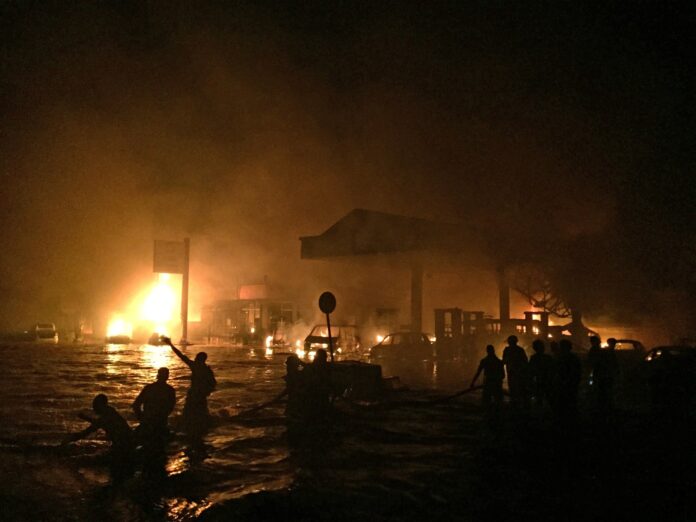
SOCHI, Russia (BN24) — A Ukrainian drone strike ignited a fire at an oil depot in the Russian resort city of Sochi early Sunday, prompting a massive emergency response, according to regional authorities.
More than 120 firefighters were deployed to combat the blaze, which broke out at a fuel storage facility in Sochi’s Adler district, said Krasnodar regional Governor Veniamin Kondratyev on Telegram. The fire erupted after a drone, reportedly launched by Ukraine, struck a tank containing up to 2,000 cubic meters (roughly 70,000 cubic feet) of fuel, Russia’s RIA news agency reported, citing emergency officials.
The Russian Ministry of Defense said its air defenses shot down 93 Ukrainian drones overnight, including one in the Krasnodar region and 60 over the Black Sea. However, the ministry did not provide an estimate of how many drones Ukraine had launched.
The attack led to a temporary suspension of flights at Sochi International Airport, as Russia’s civil aviation authority, Rosaviatsia, halted operations to ensure safety. Flights resumed by 0200 GMT, the agency said.
Ukraine has not commented publicly on the strike, and Reuters noted it could not independently verify the Russian accounts.
The Adler district, where the depot is located, had previously been the site of a deadly drone attack in June that killed one woman. Sochi, host of the 2014 Winter Olympics and a key Black Sea port city, has remained largely untouched by the conflict since Russia launched its full-scale invasion of Ukraine in February 2022. However, the Krasnodar region has seen escalating drone strikes, particularly on the Ilsky refinery near Krasnodar city, a critical target in Ukraine’s campaign to degrade Russia’s fuel infrastructure.
In a separate incident Sunday, the governor of Russia’s Voronezh region reported that four people were injured in a Ukrainian drone strike that sparked several fires. Meanwhile, Kyiv authorities said the Ukrainian capital came under Russian missile attack, although there were no immediate details on damage or casualties.
The intensifying air and drone campaigns on both sides underscore the deepening use of long-range strikes far from the front lines, as each side targets infrastructure deemed vital to the other’s war effort.
BOGOTÁ, Colombia (BN24) — Former Colombian President Álvaro Uribe was sentenced to 12 years of house arrest Friday after being found guilty of procedural fraud and witness bribery, marking a historic first as the country’s initial former head of state to receive a criminal conviction. The verdict was issued by Judge Sandra Heredia of Bogotá’s 44th Criminal Court, following a legal process that captivated Colombia for over a decade.
(FILES) Colombian former President Alvaro Uribe gestures as he speaks to the press outside a court complex at the end of his trial in Bogota on February 10, 2025. A Colombian court on August 1, 2025, sentenced still-powerful former president Alvaro Uribe to 12 years of house arrest after he was found guilty of witness tampering, a legal source told AFP. The sentence, which is due to be publicly announced later on Friday, marks the first time in Colombia’s history that a former president has been convicted of a crime and sentenced. Uribe, now 73-years old, insists he is innocent and is expected to appeal the ruling. (Photo by Raul ARBOLEDA / AFP)
Uribe, 73, who served two presidential terms from 2002 to 2010, has consistently denied all charges. His legal team announced plans to appeal the ruling, emphasizing Uribe’s innocence amid intense political division. The court acquitted Uribe on a separate bribery charge involving a prosecutor.
The case originated in 2012 when Uribe accused opposition Senator Iván Cepeda of attempting to falsely link him to the establishment of paramilitary groups. Cepeda vehemently denied the allegations. In a significant turn, the Colombian Supreme Court initiated an investigation into Uribe in 2018 over allegations of witness tampering, escalating the high-profile dispute.
After years of investigation and courtroom proceedings, the Colombian Prosecutor’s Office formally charged Uribe in May 2024 with procedural fraud and bribery related to judicial processes. His trial spanned 67 days and concluded this week with the landmark sentence.
Political reactions have been sharply divided. Supporters of Uribe, including former President Iván Duque and other opposition leaders, decried the conviction as politically motivated. In contrast, members aligned with the current Colombian government praised the verdict as a critical advancement for justice and the rule of law.
Senator Iván Cepeda, central to the case, welcomed the court’s decision but cautioned that “there is still a long way to go” as legal proceedings continue.
OMUTNINSKY DISTRICT, Russia (BN24) — An 88-year-old Russian inventor and aviation enthusiast died Thursday after his homemade helicopter fell apart during an attempted take-off in the Kirov Region of western Russia, officials confirmed. The tragic accident occurred as the self-built aircraft’s main rotor blades detached while the engine was powering up on the ground.
According to the Volga Region Transport Prosecutor’s Office, the incident happened in the Omutninsky district when the rotor blades came off, causing serious injuries to the man identified as Vladimir Trapeznikov. Emergency responders rushed Trapeznikov, born in 1937, to Omutninsky District Hospital, where he died several hours later.
Local authorities revealed that the unregistered helicopter began to disintegrate during engine startup, preventing any actual flight. An investigation into the crash is ongoing to determine the precise causes and safety violations surrounding the homemade aircraft.
Trapeznikov, a self-taught inventor with a lifelong passion for aviation, had built five aircraft over several decades. Although he worked professionally as a logging truck driver, his inventive spirit earned him local fame. In 1985, he was featured in a short film and newsreel after successfully flying a homemade airplane, capturing the admiration of his community.
This fatal accident occurred as Trapeznikov attempted to launch his latest aircraft, a dream project that tragically ended in disaster.
Worldwide, amateur aviation enthusiasts have gained attention for their DIY flying machines. In the United Kingdom, a man built an aircraft in his garden during the COVID-19 pandemic, while in Ethiopia, an individual spent ten years constructing a homemade plane to fly to his wedding in 2015.