Home Blog Page 389

Catholics Begin Paying Final Respects to Pope Francis as Thousands Gather for Public Viewing at the Vatican

0

VATICAN CITY — Tens of thousands of Catholics are descending on St. Peter’s Basilica to pay tribute to Pope Francis, as the Vatican opened three days of public viewing on Wednesday, following the pontiff’s death earlier this week at the age of 88.
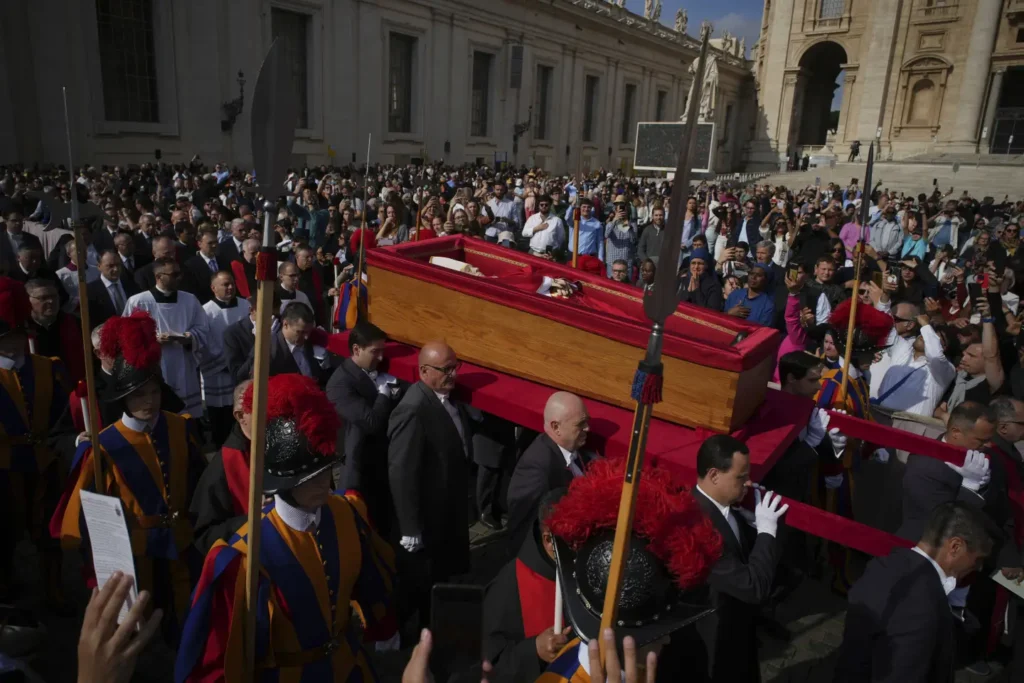
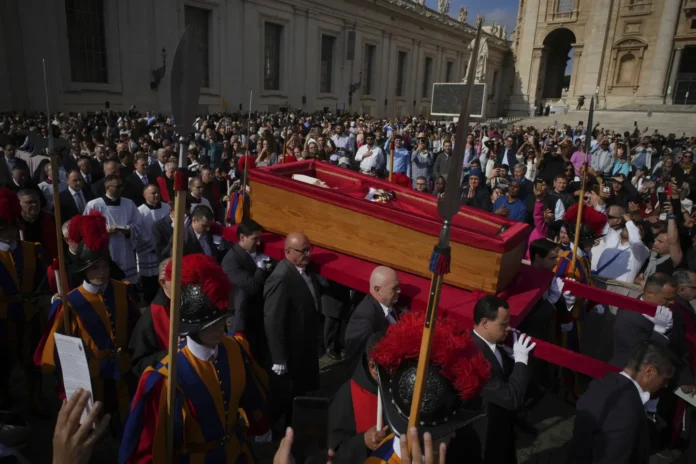
The late pope’s wooden casket was placed at the main altar of the 16th-century basilica, where a stream of mourners filed past in reverent silence, many snapping photographs or clasping rosaries in prayer. Francis, dressed in traditional red papal vestments and a bishop’s miter, lay in repose with a rosary entwined in his folded hands.

Swiss Guards stood solemnly at attention, flanking the casket as the faithful quietly made their way down the aisle. In the first eight and a half hours of the viewing, the Vatican reported that 19,430 people had paid their respects — a turnout so significant that Vatican officials are considering extending viewing hours.

“It gave me chills,” said Ivenes Bianco, who traveled from Brindisi in southern Italy for medical treatment but made sure to come pay homage to the late pontiff. “He was important to me because he brought people together. He encouraged coexistence.”

Pope Francis, who led the Catholic Church for more than a decade, had requested a modest farewell. In line with his wishes, the casket was not elevated on a bier, as was tradition for previous popes, but placed on a sloped platform facing the pews — a gesture reflecting his belief that the pope should be seen primarily as a pastor, not a global political figure.

His body first lay in state at the Vatican guesthouse where he lived throughout his pontificate, allowing members of the papal household and Vatican staff a private moment of farewell. Public viewing commenced after his body was transferred in a solemn morning procession through St. Peter’s Square.
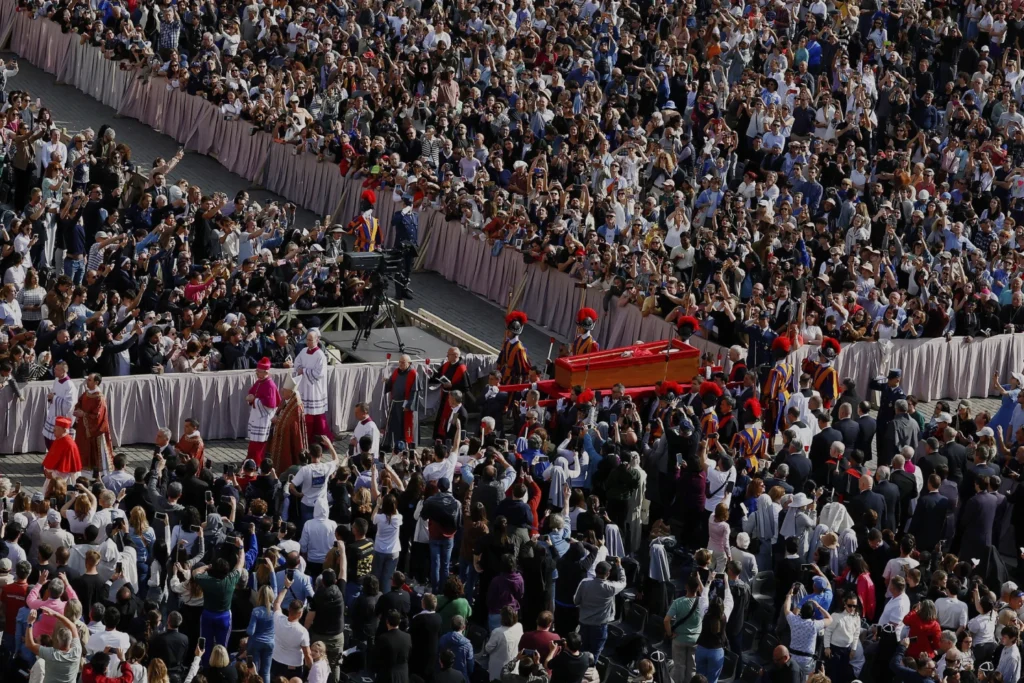
The tolling of bells marked the arrival of the casket, as Cardinal Kevin Farrell — currently overseeing Vatican operations during the sede vacante — led the procession with clouds of incense and the singing of the Litany of the Saints. Cardinals followed in pairs, bowing before the casket and making the sign of the cross, with bishops, priests, nuns, and ushers proceeding behind.

As the basilica opened to the public, the atmosphere grew reverent and subdued. The squeaking of shoes on marble, whispered prayers, and the sound of children’s voices echoed under the soaring dome.

“It felt like losing a family member,” said Rosa Morghen of Naples. “He was like a father, a grandfather — someone close to us all.”

Public viewing will continue through Friday at 7 p.m. local time. Francis’ casket will then be sealed in preparation for his funeral, which is set to take place Saturday at 10 a.m. in St. Peter’s Square.

World leaders are expected to attend the funeral, including U.S. President Donald Trump and Ukrainian President Volodymyr Zelenskyy, underscoring Francis’ influence on global affairs and his enduring calls for peace, interfaith dialogue, and care for the poor.

The funeral rites, designed by Francis before his death, will be more understated than those of his predecessors. Still, the event will be steeped in tradition and is expected to draw a massive international audience both in person and via global broadcast.

Francis died Monday following complications related to pneumonia and prolonged hospitalization. His 12-year papacy was marked by an emphasis on mercy, social justice, and outreach to the marginalized — a tenure both praised for its compassion and criticized by some conservative factions for its progressive tone.

Following the funeral, the Catholic Church enters a sacred period of transition as the College of Cardinals prepares to elect a new pope in a secret conclave inside the Sistine Chapel. Vatican officials confirmed that 133 cardinals under the age of 80 are eligible to vote, though two have stepped back due to health reasons. The conclave is not expected to begin before May 5.

“There’s uncertainty, of course,” said South Korean Cardinal Lazarus You Heung-sik, who leads the Vatican’s office for clergy. “But we’ll see what the Holy Spirit says.” Asked whether the next pontiff could come from Asia, he replied: “For the Lord, there’s no East or West.”

Cardinal John Ribat of Papua New Guinea, the nation’s first and only cardinal, is en route to Rome to take part in the papal election. “To represent the South Pacific in the conclave is a great responsibility,” he told Australia’s ABC network. “We hope for a pope who will speak truth and unite the Church.”

Italian police have intensified security measures in and around Vatican City, with increased foot patrols and officers on horseback as the crowd of mourners and pilgrims continues to grow. Many are also in Rome for the Holy Year celebrations, which Pope Francis inaugurated in December.

“The death of a pope is not a small thing,” said Julio Henrique, a pilgrim from Brazil. “We’ve lost our leader. But now, we wait for a new one. That’s the beauty of our Church — it goes on. Hope remains.”

As Saturday’s funeral approaches, the Catholic faithful are mourning not just the loss of a pope, but a man who many saw as a shepherd to the modern world — one who challenged conventions while upholding faith.


Fehmarnbelt Tunnel: Record-Breaking Undersea Link Between Denmark and Germany Nears Completion

0

LOLLAND, Denmark — A massive infrastructure project is reshaping connectivity between Scandinavia and mainland Europe as construction progresses on the Fehmarnbelt Tunnel — set to become the world’s longest immersed road and rail tunnel once completed beneath the Baltic Sea.

Stretching 18 kilometers (11 miles) between Rødbyhavn in southern Denmark and Puttgarden in northern Germany, the Fehmarnbelt Fixed Link will dramatically slash travel times and offer a faster, greener alternative to ferry services, while also representing a landmark achievement in civil engineering.

Built using pre-fabricated tunnel sections, the structure is being assembled segment-by-segment directly on the seafloor. The project, which began major construction in 2020, is scheduled to open in 2029.

“This is a huge undertaking,” said Henrik Vincentsen, CEO of Femern A/S, the Danish state-owned company leading the project. “We’re breaking records with this tunnel. Immersed tunnels have been built before, but never on this scale.”

Unlike most underwater tunnels that bore through bedrock, the Fehmarnbelt will consist of 90 massive tunnel segments — each 217 meters long and 42 meters wide — that are cast in reinforced concrete and then floated out to sea from a nearby construction harbor before being lowered into a seabed trench.

Each segment weighs more than 73,000 tonnes and is equipped with ballast tanks and watertight seals to ensure they are safely maneuvered and precisely aligned using GPS and underwater cameras.

“This is not just about construction,” said senior construction manager Anders Gert Wede, walking through one of the hollow segments on the Danish side. “It’s about millimeter-level precision — we’re aligning these 40 meters below sea level with only 15mm of tolerance.”

The tunnel includes five tubes: two for road traffic (each with two lanes), two for trains, and one for emergencies and maintenance.

The total project cost is estimated at €7.4 billion ($8.1 billion), with the vast majority financed by Denmark and €1.3 billion contributed by the European Commission as part of the EU’s broader infrastructure initiative to reduce carbon emissions and improve connectivity across the continent.

Once operational, the tunnel will cut car travel between Denmark and Germany from 45 minutes by ferry to just 10 minutes. Rail travel between Copenhagen and Hamburg will be halved — from five hours to 2.5 — enhancing both passenger and freight transport routes across Europe.

“This is more than a tunnel,” said Vincentsen. “It’s a direct corridor linking Scandinavia to the heart of Europe. Everybody wins — from commuters to the climate.”

The project faced strong resistance in Germany, where ferry operators and environmental groups, including NABU (Nature and Biodiversity Conservation Union), challenged the plan, citing risks to local marine life like harbor porpoises. However, in 2020, a German federal court ruled in favor of construction, allowing the project to proceed.

In response to environmental concerns, developers created a 300-hectare wetland and recreation area using materials dredged from the seabed, part of a larger effort to mitigate ecological disruption.

“We’ve done extensive work to minimize environmental impact,” Vincentsen said. “This tunnel is designed not just for speed and access, but for sustainability.”

The Fehmarnbelt project is also expected to revitalize the economy of Denmark’s Lolland region, one of the country’s most impoverished areas. The tunnel site — covering 500 hectares — includes Europe’s largest construction harbor and a specialized factory producing the tunnel elements.

“The locals have waited decades for this,” said Wede, a native of the region. “This project is bringing jobs, infrastructure, and new opportunities for business and tourism.”

More than 12,000 vehicles and 100 trains are expected to use the tunnel daily. Toll revenues will be used to repay the state-backed construction loans over approximately 40 years.

“Ultimately, the users will pay for the tunnel,” Vincentsen said. “But the benefits — economic, environmental, and social — will last for generations.”

bbc.com

Notorious Leader of Philadelphia’s ‘10th and O Crew’ Sentenced to Six Years in Opioid Trafficking Conspiracy

0

NEWARK, N.J. — A key figure in South Philadelphia’s infamous “10th and O Crew” was sentenced to six years in federal prison on Monday for orchestrating a large-scale oxycodone distribution ring, federal prosecutors announced.

Michael Procopio, 50, admitted to leading a criminal conspiracy from January 2022 through February 2024 to illegally distribute prescription opioids, primarily oxycodone, throughout the Philadelphia region. His sentencing took place in the U.S. District Court for the District of New Jersey following his June 2024 guilty plea to conspiracy to distribute controlled substances.

According to court records, Procopio sourced prescription pills from local medical practices and coordinated their illicit distribution through a network of intermediaries across South Philadelphia. Federal investigators say he concealed quantities of oxycodone, Adderall, and other drugs in a hidden safe inside a hollowed-out dictionary at his residence, which was raided by law enforcement in February 2024.

During the execution of the search warrant, Procopio reportedly acknowledged his role in the criminal enterprise, stating, “Take me to jail,” and, “I f***ed up.”

Using federal sentencing guidelines, authorities determined that the 14,925 milligrams of oxycodone Procopio admitted to distributing equated to 80 to 100 kilograms of converted drug weight — a significant volume that underscores the scope of the conspiracy. Under these guidelines, one gram of actual oxycodone is treated as equivalent to 6,700 grams of converted drug weight due to its potency.

Prosecutors described Procopio as a leader within the “10th and O Crew,” a South Philadelphia-based criminal organization known for its long history of violent and drug-related activity. In addition to the drug charges, Procopio has a prior felony conviction for sexual assault in Pennsylvania, court documents revealed.

“This defendant led a criminal crew that funneled dangerous prescription drugs from doctors’ offices to the streets of Philadelphia,” said Matthew R. Galeotti, who leads the Justice Department’s Criminal Division. “Whether it’s fentanyl or prescription oxycodone, the unlawful sale of opioids is devastating communities, and the Department of Justice remains committed to dismantling these networks.”

The investigation into Procopio’s drug trafficking operation was led jointly by the Federal Bureau of Investigation’s Philadelphia Field Office and the Drug Enforcement Administration’s New Jersey Field Division. The Pennsylvania Office of Attorney General’s Medicaid Fraud Control Unit also played a key role in the case.

Trial Attorneys Paul J. Koob and Nicholas K. Peone of the Justice Department’s Criminal Division prosecuted the case under the Health Care Fraud Strike Force Program — an initiative launched in 2007 to crack down on complex fraud schemes that exploit public health programs.

Since its inception, the Strike Force has charged more than 5,800 defendants across 27 federal districts with crimes related to over $30 billion in fraudulent claims to federal and private health insurers.

The Centers for Medicare & Medicaid Services, working with the Department of Health and Human Services’ Office of Inspector General, continues to implement measures to identify and penalize healthcare providers complicit in illegal drug distribution and related fraud.

Burkina Faso Military Junta Says It Foiled Major Coup Plot Against Captain Ibrahim Traoré

0

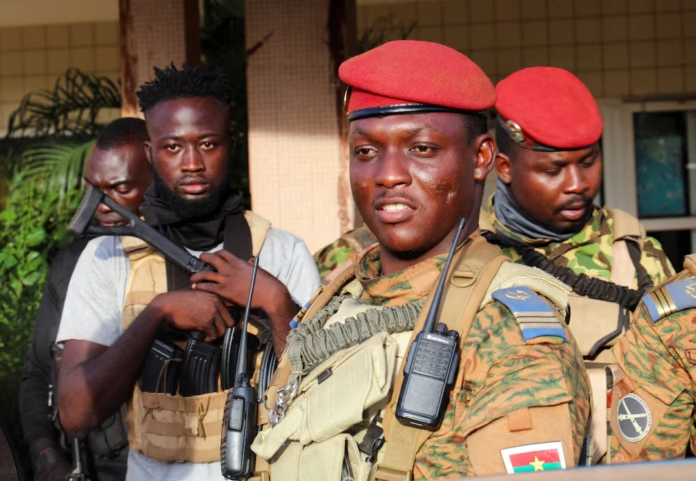
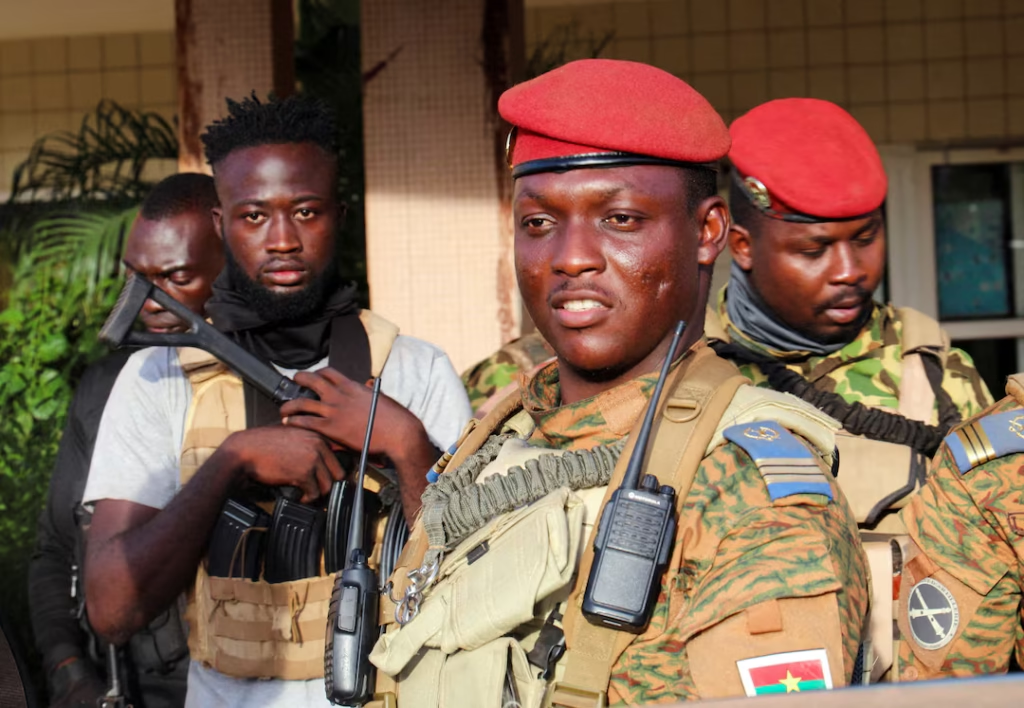
OUAGADOUGOU, Burkina Faso — Burkina Faso’s ruling military government claimed Monday that it has thwarted a major coup attempt aimed at ousting junta leader Captain Ibrahim Traoré, just days after authorities arrested several military officers accused of plotting to destabilize the regime.

According to Security Minister Mahamadou Sana, the government intercepted communications between a senior Burkinabé military officer and jihadist leaders that revealed a coordinated plan to storm the presidential palace and depose Traoré on April 16. Sana made the announcement during a nationally televised address on state broadcaster RTB.

He said the foiled coup involved both active and former members of the armed forces, as well as terrorist elements, in what he described as an unprecedented internal and external threat to national sovereignty.

Among the named conspirators is Captain René David Ouédraogo, who allegedly played a key role in orchestrating the plot. Authorities say Ouédraogo is currently on the run and remains at large. Sana added that the scheme’s objective was to “sow total chaos” and bring the West African nation under the influence of a foreign organization, though he did not specify which.

This latest coup attempt marks the second such plot in under a year targeting Captain Traoré, who rose to power in a 2022 coup that unseated Lt. Col. Paul-Henri Sandaogo Damiba. The junta had already claimed to have dismantled another destabilization effort in September 2024.

Despite pledges to restore stability and combat terrorism, Traoré’s military leadership continues to face threats from both internal dissenters and jihadist insurgents. According to the 2025 Global Terrorism Index, Burkina Faso recorded the highest number of terrorism-related deaths worldwide in 2024, with 1,532 fatalities.

Government forces have struggled to regain control over territory in the north and east, where insurgent groups affiliated with al-Qaida and the Islamic State maintain a strong presence. As of early 2025, approximately 40% of Burkina Faso remains under jihadist control.

Sana further alleged that key figures involved in the coup conspiracy are currently operating from Ivory Coast, reviving tensions between the two neighboring countries. Ivorian officials have not responded to the accusations.

In September 2024, Burkina Faso’s junta similarly accused Ivory Coast of harboring exiled coup plotters, raising diplomatic concerns across the region.

The latest allegations come amid a sweeping security crackdown. Last week, authorities detained multiple members of the military, including several officers, on suspicion of planning subversive activities against the state. Sana did not disclose the total number of arrests or provide details about their legal status.

Under Captain Traoré, Burkina Faso has increasingly distanced itself from traditional Western partners and sought support from Russia in its counterterrorism strategy. The country exited the French-led G5 Sahel alliance in 2023 and has formed closer ties with Mali and Niger, fellow military-led neighbors who have also turned toward Moscow for security cooperation.

Despite these shifts, Burkina Faso’s security situation remains precarious, and Traoré’s hold on power appears increasingly vulnerable to both armed insurgency and internal political rivalry.

Treasury Secretary Scott Bessent Says Prolonged Trade War With China ‘Not Sustainable,’ Signals Potential Shift in U.S. Tariff Strategy

0

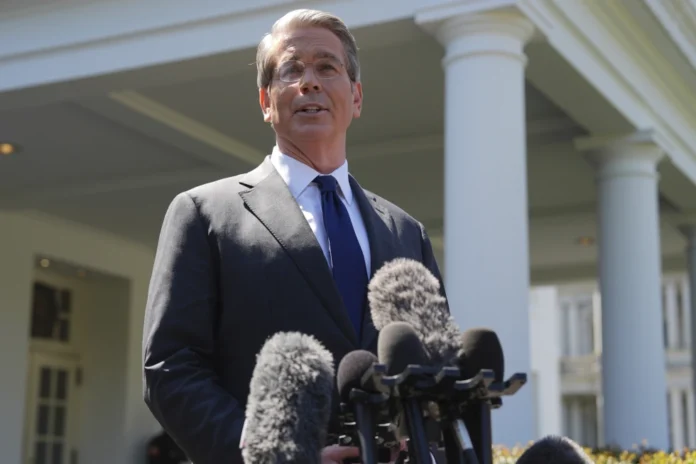
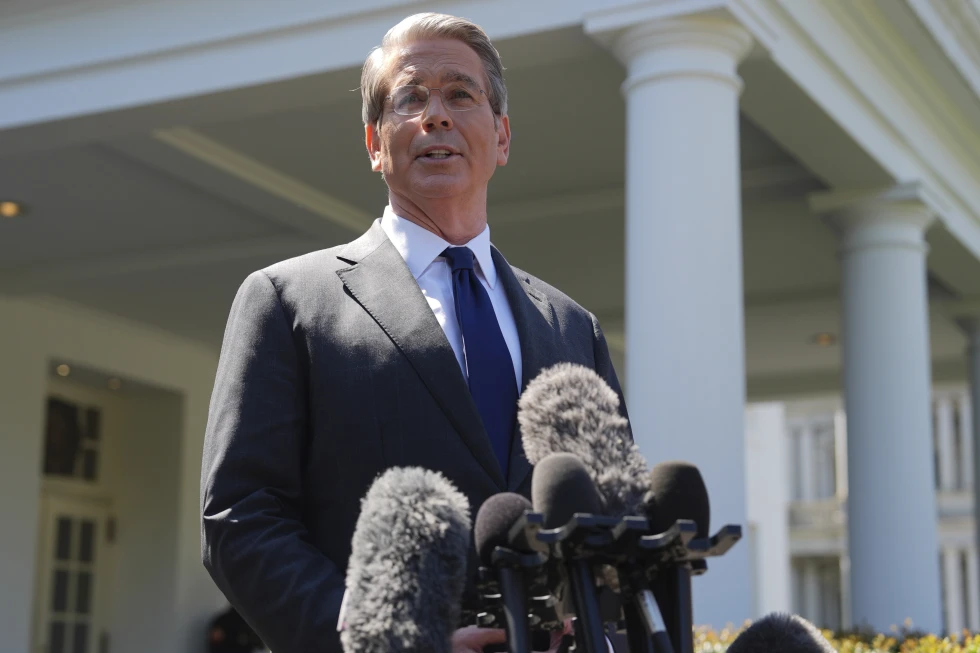
WASHINGTON — U.S. Treasury Secretary Scott Bessent warned Tuesday that the ongoing trade war between the United States and China is “not sustainable,” signaling a possible shift in Washington’s tough stance on tariffs under President Donald Trump’s administration.

Speaking in a closed-door address to executives at JPMorgan Chase in Washington, Bessent suggested that while no formal negotiations with China have begun, both sides recognize that the current tariff standoff cannot continue indefinitely.

“I do say China is going to be a slog in terms of the negotiations,” Bessent said, according to a transcript obtained by The Associated Press. “Neither side thinks the status quo is sustainable.”

Bessent’s remarks, confirmed by two individuals familiar with the speech who spoke on the condition of anonymity, come amid escalating economic tensions between the world’s two largest economies. President Trump has imposed sweeping tariffs of up to 145% on Chinese imports, prompting Beijing to retaliate with 125% tariffs on American goods.

Following initial reports from Bloomberg News detailing Bessent’s comments, the S&P 500 stock index climbed, as investors interpreted the remarks as a sign of potential easing in one of the most volatile fronts in U.S. foreign policy.

Despite growing concerns from business leaders and economists, Trump has shown no public intention of removing his baseline 10% tariffs, which apply to dozens of countries beyond China, including U.S. allies such as Japan, Canada, the European Union, and Mexico.

Trump administration officials maintain that the aggressive tariff strategy is part of a broader push to eliminate trade barriers and boost American exports. White House Press Secretary Karoline Leavitt told reporters Tuesday that the president expressed optimism about a potential deal with China.

“President Trump told me directly, ‘We’re doing very well’ regarding a potential trade deal with China,” Leavitt said during a briefing.

However, Bessent’s behind-the-scenes remarks suggest growing internal recognition that prolonged tariffs could damage the U.S. economy, contributing to higher inflation, increased borrowing costs, and mounting uncertainty in financial markets.

China’s Ministry of Commerce issued a sharp warning Monday to countries considering new trade agreements with Washington, saying Beijing would firmly oppose any deal that undermines its interests.

“China firmly opposes any party reaching a deal at the expense of China’s interests,” the ministry said in a statement.

That message comes as the Trump administration claims it has received 18 formal trade proposals from foreign governments looking to negotiate bilateral agreements with the United States. While the White House is touting that interest as a win, trade experts note that many countries remain wary of making long-term commitments amid volatile U.S. policy shifts.

The trade war’s effects are also reverberating through monetary policy. President Trump has publicly criticized the Federal Reserve for maintaining its benchmark interest rate, arguing that a rate cut is necessary to offset tariff-related economic pressures.

Trump has even suggested he could fire Fed Chair Jerome Powell, though such a move would break longstanding precedent and raise legal questions.

Leavitt reiterated the president’s frustration, stating, “The Fed is holding rates steady in the name of politics, rather than what’s right for the American economy.”

Despite Bessent’s calls for de-escalation, no official U.S.-China trade talks have been scheduled. The Treasury secretary acknowledged that negotiations with Beijing would likely be protracted and complex.

Still, his assessment marked one of the clearest signals yet from within the Trump administration that the current hardline trade stance may need to evolve.

Militant Ambush in Indian Kashmir Kills Five Tourists, Injures Eight in Deadliest Civilian Attack in a Year

0

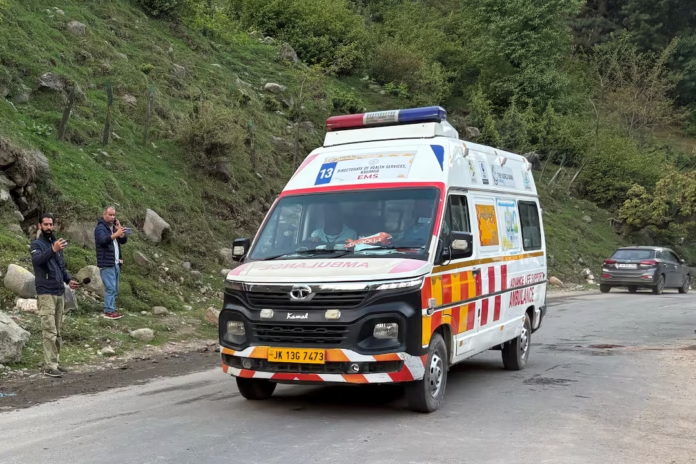
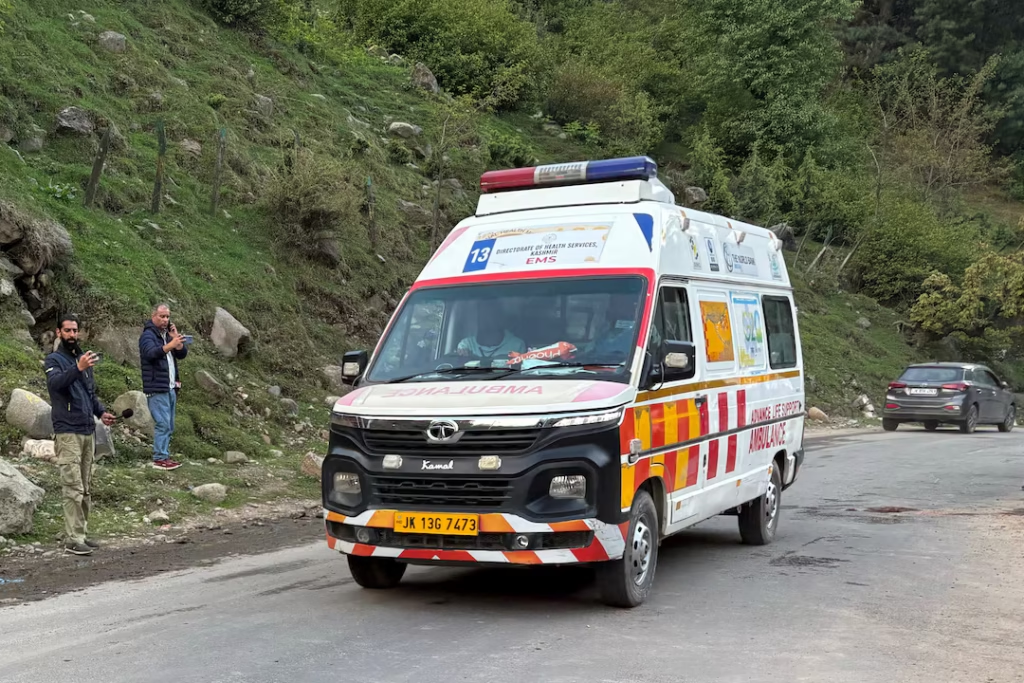
PAHALGAM, India — Suspected militants opened fire on a group of tourists in the picturesque town of Pahalgam in Indian-administered Kashmir on Tuesday, killing at least five people and wounding eight others in the region’s deadliest civilian attack in nearly a year, a senior police official told Reuters.

The attack occurred in the early evening hours near the popular tourist town nestled in the southern Anantnag district. The victims, who were visiting the region during peak summer travel, were caught in a sudden burst of gunfire, officials said. The wounded were quickly transported to a nearby hospital for emergency treatment.

Speaking on condition of anonymity due to lack of authorization to brief the media, a police source confirmed the casualties but noted that the final death toll may rise.

“This is a brutal act of terror targeting innocent civilians,” said Jammu and Kashmir Chief Minister Omar Abdullah in a post on X, formerly Twitter. “The scale of this attack is far greater than anything we’ve seen against civilians in recent years.”

A little-known militant group calling itself the “Kashmir Resistance” claimed responsibility for the shooting in a post on social media. The group accused the Indian government of orchestrating a demographic shift in the Muslim-majority territory by settling thousands of outsiders.

“Over 85,000 non-local settlers have been given domicile rights,” the message claimed, warning that future violence would target those attempting to “illegally change the identity of Kashmir.”

The authenticity of the post could not be independently verified by Reuters, and Indian authorities have not commented on the group’s claim.

Earlier this month, the Jammu and Kashmir administration told lawmakers that nearly 84,000 non-local residents had been granted domicile status in the last two years, a move that enables them to purchase property and apply for government jobs in the region.

Indian Prime Minister Narendra Modi strongly condemned the attack and promised swift action against those responsible.

“Those behind this heinous act will be brought to justice. They will not be spared!” Modi wrote on X. “Their evil agenda will never succeed. Our resolve to fight terrorism is unshakable and will only grow stronger.”

Security forces have launched a manhunt in the surrounding forests and valleys near Pahalgam, an area popular with Indian and foreign tourists alike for its hiking trails and scenic beauty.

Tuesday’s ambush is the most severe attack targeting civilians since June of last year, when a militant assault caused a bus carrying Hindu pilgrims to crash into a gorge, killing nine people and injuring 33 others.

Although violent attacks in Kashmir have declined in frequency over the past decade, recent months have seen a spike in militant activity, particularly in areas previously regarded as secure. The uptick has coincided with heightened tensions between India and Pakistan and renewed local resistance to India’s controversial 2019 decision to revoke the region’s autonomy.

That move allowed New Delhi to reorganize the former state into two federally governed territories—Jammu and Kashmir, and Ladakh—and extended property and employment rights to non-residents. Critics of the policy say it is part of a broader effort to dilute the region’s Muslim majority and shift its cultural landscape.

The dispute over Kashmir, which both India and Pakistan claim in full, has fueled decades of armed conflict and three full-scale wars between the nuclear-armed neighbors. Pakistan continues to reject India’s sovereignty over the region, and diplomatic relations between the two countries remain strained.

Indian security analysts noted the timing of the latest attack, which occurred just one day after U.S. Vice President JD Vance began a four-day visit to India. While Vance’s visit was described as primarily personal, past militant attacks in Kashmir have often coincided with the visits of high-profile international dignitaries—moves seen as attempts to draw global attention to the unresolved conflict.

As of late Tuesday, no new travel advisories had been issued, but security has been heightened across the Kashmir Valley, particularly in areas frequented by tourists.

New Ceasefire Plan Proposed in Israel-Gaza Conflict, Hamas Source Confirms

0

CAIRO — A new ceasefire proposal aimed at ending the war in Gaza has been submitted to Hamas by Qatari and Egyptian mediators, according to a senior Palestinian official involved in the negotiations. The proposal includes a long-term truce, the release of all hostages, and a complete Israeli withdrawal from the Gaza Strip, the official told the BBC on Tuesday.

The latest diplomatic initiative envisions a ceasefire lasting between five and seven years, during which both sides would be expected to uphold peace terms. The proposed agreement calls for the release of all Israeli hostages held in Gaza in exchange for Palestinian prisoners in Israeli custody. It also includes a formal declaration to end the war and the full withdrawal of Israeli troops from Gaza.

A high-ranking Hamas delegation, led by political chief Mohammed Darwish and senior negotiator Khalil al-Hayya, is expected to arrive in Cairo for critical talks with mediators in the coming days. These negotiations follow a failed attempt at brokering a truce last month, when Israel resumed its bombing campaign, and both parties accused the other of violating the ceasefire terms.

The Israeli government has yet to issue a formal response to the latest proposal. However, the talks come amid escalating violence across Gaza.

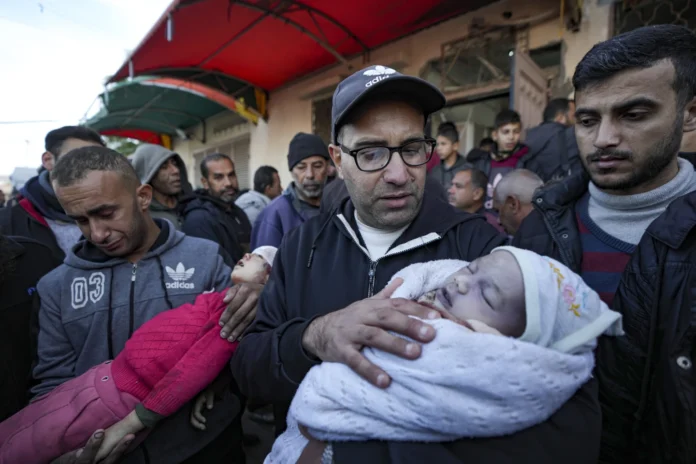
Since Monday evening, at least 22 Palestinians have been killed in Israeli airstrikes across multiple areas of the Gaza Strip, according to a health official from the Hamas-run health ministry. The strikes reportedly hit locations in Khan Younis, Jabalia, Beit Lahia, and Gaza City, injuring another 45 people.

Local witnesses described the airstrikes as “extremely intense,” with several neighborhoods heavily damaged. The attacks reportedly destroyed dozens of bulldozers and heavy equipment used by municipal crews to clear rubble, reopen blocked roads, and rescue people trapped under collapsed buildings.

In southern Gaza, tanks were seen maneuvering near Rafah, raising concerns about an expanded ground offensive in the densely populated area.

As talks resume, Hamas has reportedly expressed a willingness to relinquish administrative control over Gaza to a mutually agreed Palestinian body. According to the official familiar with the mediation efforts, the militant group is open to governance by the West Bank-based Palestinian Authority or another unified Palestinian body determined through national and regional consensus.

This stance represents a significant shift, as Hamas has ruled Gaza since 2007. Still, Israeli Prime Minister Benjamin Netanyahu has publicly rejected any role for the Palestinian Authority in the future governance of Gaza, deepening the uncertainty around any potential postwar political arrangement.

Netanyahu reiterated on Saturday that he would not end the war until Hamas is dismantled and all Israeli hostages are returned. Hamas, on the other hand, insists that no hostages will be freed until Israel agrees to halt its military campaign.

The Palestinian source involved in the negotiations characterized the current mediation efforts as serious and noted that Hamas had demonstrated “unprecedented flexibility.” However, the outcome remains uncertain, and no timeline has been announced for a potential agreement.

Hamas initiated the current conflict with a surprise attack on southern Israel on Oct. 7, 2023, killing approximately 1,200 people—mostly civilians—and taking 251 hostages back into Gaza. In response, Israel launched a wide-scale military operation that has killed at least 51,240 Palestinians, the majority of them civilians, according to figures released Monday by Gaza’s Hamas-run health ministry.

Meanwhile, the Palestinian Embassy in Cairo has ordered its staff and their families to relocate from the capital to the northern Egyptian city of Arish, near the Rafah border crossing. The embassy personnel had been coordinating medical evacuations from Gaza and facilitating the delivery of humanitarian aid. The relocation underscores growing concerns over security and logistical challenges in continuing relief operations as the conflict intensifies.

Russian Army Retakes Historic Monastery in Final Ukrainian-Held Kursk Village, State Media Reports

0

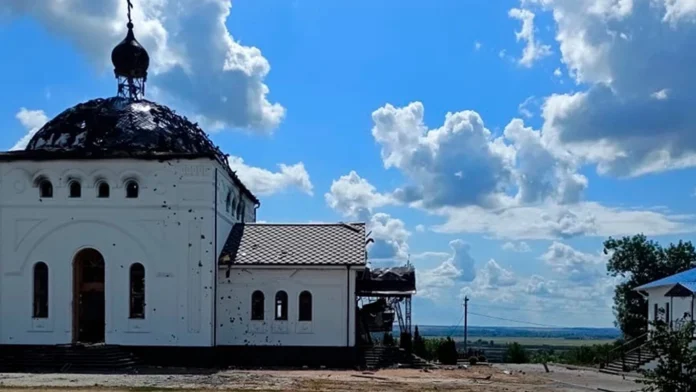
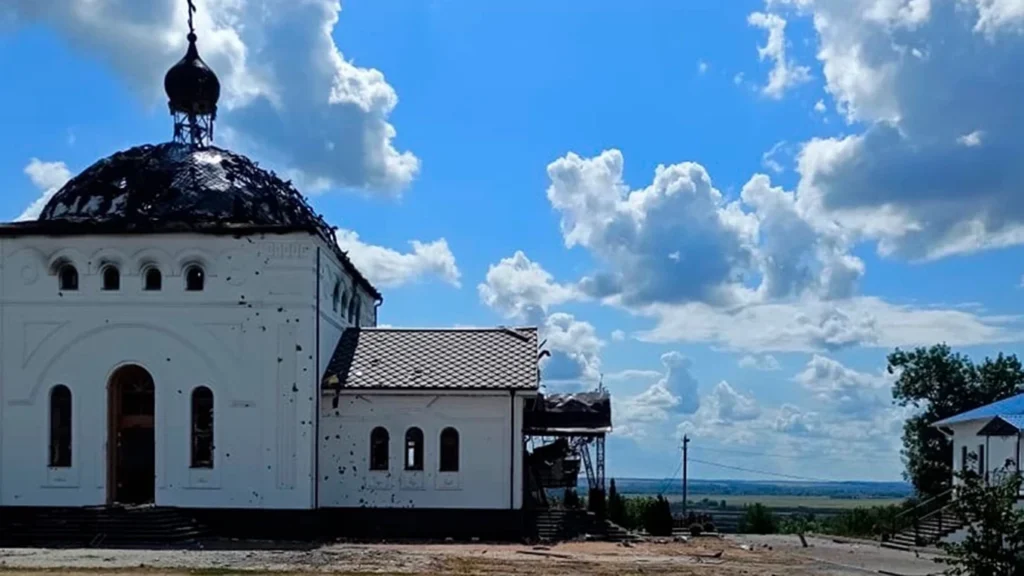
MOSCOW — Russian troops have regained control of a centuries-old monastery in the last Ukrainian-held village in the Kursk region, marking a significant territorial development in the months-long counteroffensive, according to Russian state media reports on Tuesday.

The St. Nicholas Belogorsky Monastery, located on the outskirts of the village of Gornal, was recaptured after more than a week of fighting, an anonymous Russian security source told the state-run TASS news agency. The 17th-century religious site, situated less than 30 kilometers (18.5 miles) from the Ukrainian border city of Sumy, had reportedly been fortified and used as a strategic position by Ukrainian forces.

“Our soldiers liberated the St. Nicholas Belogorsky Monastery in Gornal during fighting,” the source told TASS, claiming that Ukrainian troops had converted the site into a military outpost. “The resistance of the Ukrainian Armed Forces has been broken.”

While the report remains unverified by independent sources, the alleged retaking of the monastery signals a potential end to Ukrainian presence in the southwestern Kursk region, which lies adjacent to the active northeastern front line in Ukraine’s Sumy and Kharkiv regions. Russia’s Defense Ministry had not officially commented on the operation as of Tuesday morning.

Saturday marked another key milestone when Russia’s Defense Ministry announced the recapture of Oleshnya, the second-to-last village in the Kursk region that remained under Ukrainian control. The two villages—Oleshnya and Gornal—had been under Ukrainian occupation since Kyiv launched a surprise incursion across the Russian border several months ago, in what became the largest ground offensive on Russian soil since the Second World War.

Over the past few weeks, Russian forces have methodically reclaimed swaths of territory once held by Ukrainian units, which penetrated deep into Russian territory last year during a sudden and audacious offensive. According to battlefield monitoring platform DeepState, Ukrainian troops still hold approximately 31 square kilometers (20 square miles) of territory inside the Kursk region, down from a peak of over 1,376 square kilometers (531 square miles) seized in the initial incursion.

Russia’s Chief of the General Staff Valery Gerasimov briefed President Vladimir Putin on Saturday, stating that 99.5% of the Kursk region had been “liberated,” and that operations to fully expel Ukrainian forces from the area were ongoing. Gerasimov’s update signals the Kremlin’s desire to solidify battlefield gains before engaging in potential ceasefire negotiations.

Political analyst and Nezavisimaya Gazeta editor Konstantin Remchukov, writing in a Sunday editorial, said Putin appears determined to reclaim every inch of Russian territory in the Kursk region before considering a U.S.-mediated truce.

“President Putin is obviously seeking the full liberation of the Kursk region before entering any negotiations,” Remchukov wrote, citing unnamed government sources. “As soon as the last 0.5% is liberated, then the troops can stop where this news finds them.”

His remarks echo growing speculation that Russia is positioning itself militarily to avoid being forced into territorial concessions under any peace deal, particularly one brokered by the United States and its allies.