Home Blog Page 413

2 Killed in Small Plane Collision at Arizona’s Marana Regional Airport

A midair collision between two small planes at Marana Regional Airport in southern Arizona killed two people Wednesday morning, authorities said. 

Federal aviation officials reported that each plane carried two occupants when they collided over the airport, located on the outskirts of Tucson. One aircraft landed safely, while the other crashed near a runway and caught fire, according to the National Transportation Safety Board (NTSB), which is leading the investigation. 

Marana Police Department officials confirmed that the two people who died were aboard the aircraft that crashed. Emergency responders did not have the opportunity to provide medical treatment. Sgt. Vincent Rizzi stated that the two occupants of the other plane were unharmed. 

The Marana Fire Department assisted in extinguishing the flames, authorities said. 

Neither of the planes involved—the Lancair and Cessna 172—were based at the airport, according to a statement from the town of Marana. 

The collision comes just over a week after a fatal plane crash in Scottsdale, Arizona, killed one of two pilots aboard a private jet owned by Mötley Crüe singer Vince Neil. That aircraft veered off a runway and struck a business jet. 

The accident also follows multiple recent aviation disasters across North America. Among them, a Delta Air Lines jet flipped onto its roof while landing in Toronto, and a commuter plane crashed in Alaska, resulting in fatalities. 

In late January, a midair collision over Washington, D.C., between an American Airlines passenger jet and a U.S. Army helicopter killed 67 people, marking the deadliest aviation disaster in the United States since 2001. The following day, a medical transport jet carrying a child patient, her mother, and four others crashed into a Philadelphia neighborhood, igniting a fire that engulfed multiple homes. Seven people were killed, and 19 others were injured. 

Marana Regional Airport has two intersecting runways but operates without an air traffic control tower. A multimillion-dollar project to construct a control tower has been delayed due to the COVID-19 pandemic, officials said. 

The airport handles tens of thousands of flights annually. Most general aviation airports in the U.S. do not have control towers, relying instead on pilots to communicate using a common traffic advisory frequency. 

“Pilots are responsible for broadcasting their positions and intentions over the radio and visually avoiding collisions,” said Jeff Guzzetti, a former Federal Aviation Administration (FAA) and NTSB investigator. “The absence of a control tower does not inherently make an airport unsafe.” 

US Declares Latin American Drug Cartels, Criminal Gangs as Global Terrorist Organizations

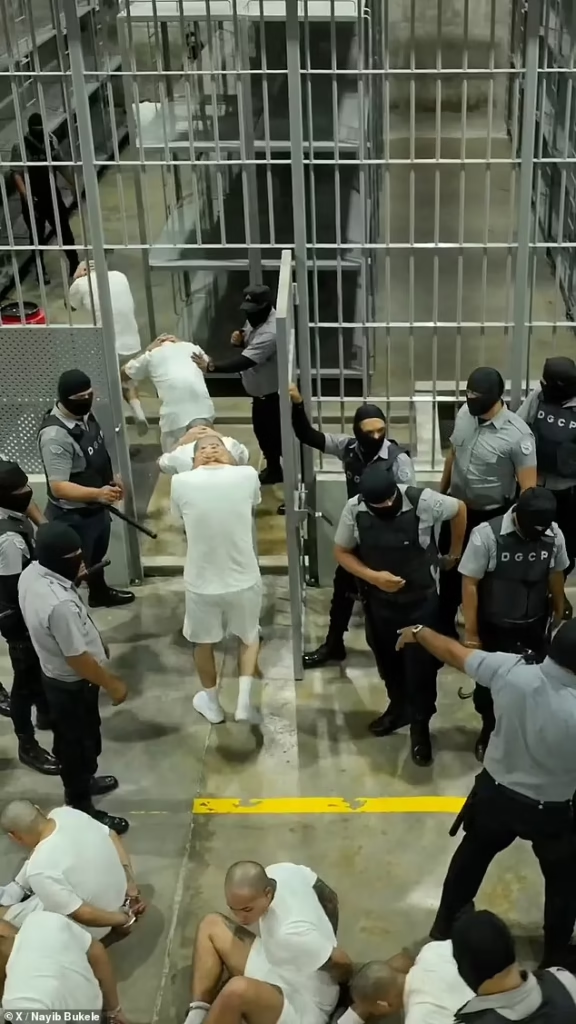
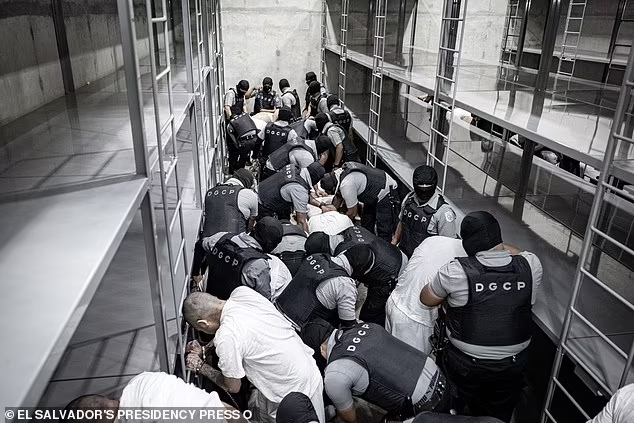
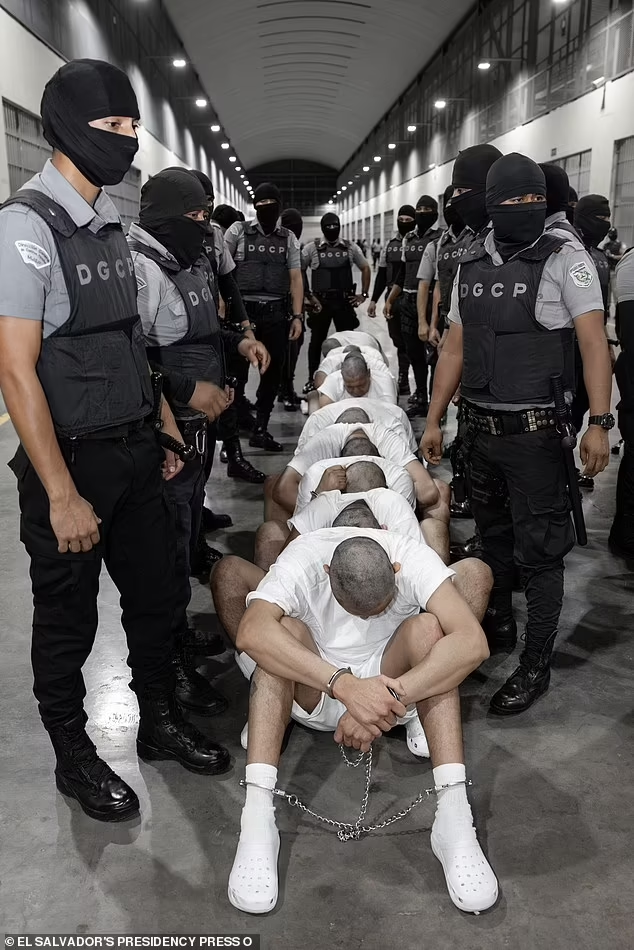
The United States has officially designated eight Latin American criminal and drug-trafficking organizations as global terrorist organizations, a move that escalates President Donald Trump’s rhetoric on immigration and national security. 

In a Federal Register notice issued Wednesday, Secretary of State Marco Rubio stated that the designated groups have committed or pose a risk of committing acts of terrorism that threaten the security of United States nationals or the national security, foreign policy, or economy of the United States. However, Rubio did not provide specific details regarding the groups’ alleged terrorist activities. 

The broad classification has raised concerns among experts who argue that it could be used to expand presidential powers, including potential military action on Mexican territory or policies that restrict migrants’ legal rights. 

The eight groups listed in the designation include Tren de Aragua, Mara Salvatrucha (MS-13), Cartel de Sinaloa, Cartel de Jalisco Nueva Generacion, Carteles Unidos, Cartel de Noreste, Cartel del Golfo, and La Nueva Familia Michoacana. 

While these groups are widely known for engaging in violence and exploitation, analysts emphasize that their motives are primarily financial rather than ideological, distinguishing them from traditional terrorist organizations. 

The US already takes significant actions against these groups through surveillance, sanctions, and criminal prosecutions. This designation won’t drastically change enforcement tools, said Stephanie Brewer, director of the Mexico program at the Washington Office on Latin America. 

Brewer also noted that the decision comes amid heightened political rhetoric linking migration, crime, and terrorism. 

The White House has frequently framed irregular migration as a national security threat, using the term invasion to justify stringent immigration measures. Many migrants traveling through Latin America face extortion and demands for protection fees from criminal groups, a reality that administration officials could use to argue that migrants are inadvertently funding terrorist organizations. 

Will Freeman, a fellow for Latin America studies at the Council on Foreign Relations, warned that the designation could be misused to criminalize migrants. 

You could accuse anyone—from a migrant paying a smuggler to a Mexican business forced to pay cartel extortion fees—of providing material support to a terrorist organization, Freeman said. 

He also pointed out that Brazil’s First Capital Command, one of the region’s most powerful criminal organizations, was not included in the designation. 

The common link here seems to be that many of these groups operate along migration routes, Freeman added. 

The Trump administration has previously floated the idea of using the Alien Enemies Act of 1798, which allows for the immediate deportation of foreign nationals from enemy countries during wartime, as a legal basis for mass deportations. 

Additionally, Trump has cited steep tariffs on Mexico, Canada, and China as a necessary response to what he describes as a national emergency driven by gang members, smugglers, human traffickers, and illegal drugs entering the US. 

The terrorist designations have reignited fears that the US could justify military operations on Mexican soil under the guise of combating terrorism. 

Trump has previously claimed that the Mexican government has an intolerable alliance with the cartels, said Brewer. Does this mean the US now considers Mexico complicit in terrorism? 

Following the announcement, billionaire entrepreneur Elon Musk, a Trump ally, speculated on social media that the designation could make the groups eligible for drone strikes. 

However, both Brewer and Freeman caution that tackling organized crime in Latin America requires more than military force. 

To dismantle these groups, the US must target their financial networks, arms suppliers, and corrupt government connections, Freeman explained. Picking fights with Latin American governments could ultimately hinder those efforts. 

Trump Calls Ukraine’s Zelenskyy a ‘Dictator,’ Escalating Dispute Amid U.S.-Russia Talks

President Donald Trump on Wednesday called Ukrainian President Volodymyr Zelenskyy a “dictator” following Zelenskyy’s remarks accusing him of being influenced by Russian disinformation. The exchange has further strained relations between the two leaders as the U.S. administration explores diplomatic efforts to end the war in Ukraine. 

Trump’s post on Truth Social, which contained multiple inaccuracies—including the assertion that Zelenskyy was not elected—coincided with high-level talks between U.S. and Russian officials on a possible resolution to the conflict. The dispute comes at a critical moment for Ukraine, which is facing difficulties securing continued Western support as Russian forces occupy approximately 20% of its territory. 

In his post, Trump criticized Zelenskyy, calling him a “modestly successful comedian” who convinced the U.S. to send $350 billion in aid to Ukraine. He also claimed that without American assistance, Zelenskyy would be unable to reach a settlement with Russia. Trump suggested that Ukraine’s leader was clinging to power, writing, “A dictator without elections, Zelenskyy better move fast or he is not going to have a country left.” 

The remarks sparked mixed reactions from Republican lawmakers. Vice President JD Vance labeled Zelenskyy’s criticism of Trump “disgraceful,” arguing that it would not influence the president’s policy decisions. Some GOP senators distanced themselves from Trump’s comments but refrained from outright condemnation. Sen. Susan Collins (R-Maine) said she did not agree with Trump’s statement, while Sen. John Kennedy (R-La.) emphasized that Russian President Vladimir Putin, not Ukraine, initiated the war. 

White House National Security Adviser Mike Waltz defended Trump’s approach, stating that his administration was actively seeking a diplomatic resolution. Waltz also pointed to the resistance from some officials regarding U.S. investment in Ukrainian infrastructure and access to rare earth minerals as part of post-war negotiations. 

Zelenskyy responded to Trump’s claims by reaffirming that Ukraine’s war effort relies heavily on American military aid and warning against diplomatic decisions made without Ukrainian input. He dismissed Trump’s assertion that his approval rating stood at 4%, citing a Kyiv International Institute of Sociology poll showing that 57% of Ukrainians trust him. 

Ordinary Ukrainians expressed unease over Trump’s remarks and his administration’s outreach to Moscow. “I don’t like Trump’s flirting with Putin,” said Fedir Logvynenko, a 49-year-old Kyiv resident. Another Ukrainian, real estate agent Yuliya Antonyuk, emphasized the necessity of U.S. support, stating, “We couldn’t cope without American weapons and aid.” 

The dispute follows a meeting between Secretary of State Marco Rubio and Russian Foreign Minister Sergey Lavrov in Saudi Arabia, where the two discussed potential pathways to end the war. The talks, which did not include Ukrainian representatives, have raised concerns among Kyiv officials and European allies. 

Trump has framed his administration’s negotiations as an effort to bring a swift end to the war, asserting that Zelenskyy “probably wants to keep the ‘gravy train’ going.” The Kremlin responded positively to the shift in U.S. foreign policy, with Lavrov praising Trump as the first Western leader to acknowledge that NATO expansion contributed to tensions in Ukraine. 

As the U.S. redefines its approach to the war, the ongoing clash between Trump and Zelenskyy underscores the geopolitical stakes, with implications for both American foreign policy and Ukraine’s future. 

Trump Now Most Powerful U.S. President, Expands Presidential Power with Sweeping Executive Order

President Donald Trump has signed a sweeping executive order that significantly expands presidential authority, bringing independent federal agencies under White House control and limiting congressional and judicial oversight. The move, based on the unitary executive theory, aims to centralize decision-making power within the executive branch. 

The order reclassifies several independent agencies—including the Federal Communications Commission (FCC), the Federal Trade Commission (FTC), and the Securities and Exchange Commission (SEC)—under direct presidential oversight. It grants the White House authority to set policy priorities, review agency budgets, and establish performance standards for agency heads. 

Russell Vought, former director of the Office of Management and Budget, has been tasked with overseeing agency compliance with the executive order. The directive also authorizes Vought to assess agency efficiency and ensure alignment with presidential objectives. Trump has dismissed the heads of the National Labor Relations Board and the Office of Government Ethics as part of this restructuring. 

The order further mandates that agency employees follow legal interpretations set by the president and attorney general, sidelining independent legal analysis. Trump stated the measure is intended to make the government “truly accountable to the American people.” However, critics argue that the move could weaken the system of checks and balances. 

Trump has issued numerous executive directives in recent weeks, many of which face potential legal challenges. The latest order is expected to be contested over concerns about its impact on the separation of powers. 

Elon Musk has emerged as a central figure in Trump’s government efficiency efforts. He is leading the newly created Department of Government Efficiency (DOGE), tasked with reducing federal spending, eliminating waste, and streamlining operations. The initiative has already canceled billions in contracts tied to diversity, equity, and inclusion programs while prioritizing immigration law enforcement. 

During a joint interview with Trump, Musk downplayed his role in the administration, calling himself “tech support” and emphasizing that his focus is on implementing Trump’s policies efficiently. Trump praised Musk’s ability to bypass bureaucratic hurdles, stating that he had been seeking a highly competent partner to expedite government operations. 

The executive order represents a significant shift in federal governance, raising debate over its constitutional implications and potential long-term effects on U.S. government institutions. 

Source: DailyMail

EU Expands Sanctions on Russia, Targeting Shadow Fleet and Foreign Suppliers

The European Union has announced a new wave of sanctions against Russia, expanding its measures to include dozens of officials and entities linked to Moscow’s war effort in Ukraine. Among those targeted are two senior North Korean defense officials, a Russian military unit accused of striking a Kyiv children’s hospital, and key figures in the energy sector. 

A major focus of the latest sanctions is Russia’s vast shadow fleet, a network of vessels used to bypass restrictions on oil and gas transportation or smuggle stolen Ukrainian grain. The EU has blacklisted 52 additional ships, barring them from European ports and cutting off their access to critical services. 

“This package of sanctions is part of our response to weaken Russia’s war machine and those who are enabling this war, including Chinese companies,” said EU foreign policy chief Kaja Kallas. “We will stand by the Ukrainian people on all fronts: humanitarian, economic, political, diplomatic, and military.” 

The latest measures freeze the assets of 54 individuals and 30 entities, which include companies, government agencies, and ministries involved in supporting Russia’s war. Travel bans were also imposed on numerous officials. 

Since Russia’s full-scale invasion of Ukraine in February 2022, the EU has enacted multiple rounds of sanctions, now impacting more than 2,300 individuals and entities. 

Among the latest targets is North Korean Defense Minister No Kwang Chol, accused of directly overseeing military cooperation with Russia, including the deployment of thousands of North Korean troops. Also sanctioned is Kim Yong Bok, Deputy Chief of the armed forces’ General Staff, who reportedly traveled to Russia to supervise troop operations. 

The sanctions extend beyond individuals to major industries aiding Russia’s war machine. Affected entities include Russian defense firms supplying arms and military equipment, a Russian chemical plant suspected of producing war-related materials, and a Russian airline allegedly providing logistical support to the military. Chinese suppliers accused of sending drone components and electronic equipment to Russia were also targeted. 

Additionally, companies and individuals in China, India, Iran, Serbia, and the United Arab Emirates were sanctioned for allegedly helping Russia evade EU restrictions, particularly by supplying materials used in drones and missiles. 

The move marks yet another escalation in the EU’s ongoing efforts to disrupt Russia’s ability to sustain its war in Ukraine while widening pressure on nations and entities supporting Moscow.

‘You Should Have Never Started It’: Trump Suggests Ukraine to Blame for War 

United States President Donald Trump has indicated he will “probably” meet Russian President Vladimir Putin this month, while making comments that appeared to blame Ukrainian President Volodymyr Zelenskyy for Moscow’s invasion of Ukraine. 

Republican presidential nominee and former U.S. President Donald Trump speaks as he participates in a town hall presented by Spanish-language network Univision, in Doral, Florida, U.S., October 16, 2024. REUTERS/Marco Bello

Speaking to reporters following US-Russia negotiations in Saudi Arabia, Trump dismissed concerns that Kyiv had been excluded from the talks, suggesting Ukraine should have already resolved the conflict. 

“I think I have the power to end this war, and I think it’s going very well. But today, I heard, ‘Oh, well, we weren’t invited.’ Well, you’ve been there for three years. You should have ended it…,” Trump said during a news conference at his Mar-a-Lago estate in Palm Beach, Florida. 

“You should have never started it. You could have made a deal. I could have made a deal for Ukraine.” 

Trump expressed confidence in achieving a resolution following discussions in Riyadh, which were led by US Secretary of State Marco Rubio and Russian Foreign Minister Sergey Lavrov. 

“They were very good. Russia wants to do something, they want to stop the savage barbarism,” Trump said. 

When asked whether his administration would support Russia’s calls for elections in Ukraine as part of a peace settlement, Trump alleged—without evidence—that Zelenskyy’s approval rating was as low as 4 percent. He pointed out that elections in Ukraine have been postponed under martial law. 

“Yeah, I would say that, you know, when you want a seat at the table… wouldn’t the people of Ukraine have to say like, ‘It’s been a long time since we’ve had an election?’” Trump stated. 

“That’s not a Russia thing, that’s something coming from me, and coming from many other countries also.” 

His remarks came as Zelenskyy reiterated that any agreement to end the war must include Ukraine’s participation. 

“No decision can be made without Ukraine on how to end the war in Ukraine,” Zelenskyy said during a press conference in Turkiye, where he met with Turkish President Recep Tayyip Erdogan. 

Following the talks in Riyadh, Rubio and Lavrov reportedly agreed to establish high-level teams to work toward ending the conflict “as soon as possible,” according to the US State Department. 

US National Security Advisor Mike Waltz acknowledged that negotiations would involve discussions about territorial adjustments and post-war security guarantees. 

European leaders have reacted cautiously to the developments, wary of potential concessions to Moscow. UK Prime Minister Keir Starmer stated he would consider deploying peacekeeping troops to Ukraine, while French President Emmanuel Macron signaled openness to sending forces—but only to non-combat zones. 

German Chancellor Olaf Scholz, however, dismissed discussions of a post-war security force as “highly inappropriate” at this stage. Meanwhile, Polish Prime Minister Donald Tusk ruled out sending Polish troops to Ukraine. 

With European leaders struggling to find a unified response, France is set to host further discussions on Wednesday after an emergency summit earlier this week failed to produce a clear consensus. 

At his Mar-a-Lago press conference, Trump endorsed the idea of European peacekeepers but suggested US troops would not be involved. 

“If they want to do that, that’s great, I’m all for it,” Trump said. “I’m all for it if they want to do that.” 

Anxiety Rises in DR Congo Capital as M23 Rebels Advance in East

0

*As M23 rebels push deeper into eastern DR Congo, fears of instability are mounting in Kinshasa, where President Félix Tshisekedi’s refusal to negotiate with the group has fueled political uncertainty.* 

Burundi’s minister of public security Alain Guillaume Bunyoni (C) visits with other officials Ruhagarika village where 26 people were killed by the armed group in northwestern Burundi bordering with the Democratic Republic of Congo (DRC) on May 12, 2018, just days before the constitutional referendum that may allow the President Pierre Nkurunziza to remain in power until 2034. (Photo by STR / AFP)

The recent advance of M23 rebels in North Kivu has heightened anxiety in the Congolese capital, where concerns over the government’s ability to contain the crisis are growing. As fighting escalates around Goma and Bukavu, the population in Kinshasa watches nervously, fearing the broader implications of the conflict. 

While regional leaders have urged dialogue, Tshisekedi has taken a hardline stance, refusing to negotiate with M23, which he describes as a proxy force for Rwanda. “It’s not a bad thing to refuse dialogue with an armed group like M23. The M23 is Rwanda,” a lawmaker close to the president stated, questioning why Western nations have not imposed harsher measures on Kigali. 

Despite growing concerns, Tshisekedi has skipped two critical African-led meetings this month—the joint summit of Southern and Eastern African leaders in Dar es Salaam and the African Union summit in Addis Ababa. Instead, he attended the Munich Security Conference, where he accused his predecessor Joseph Kabila of backing M23’s campaign—an allegation Kabila’s allies have denied. 

His absence from African diplomatic efforts has fueled criticism from political figures in Kinshasa. “The fact that an African president snubs the African Union summit and instead prefers a security conference in Europe is indicative of who sustains him,” said a former senior official, implying foreign influence over Tshisekedi’s leadership. 

Amid M23’s rapid territorial gains, opposition leaders are predicting heightened political instability in Kinshasa. “His lack of legitimacy is now proven, making him less and less listened to and more and more rejected by the population every day,” said Olivier Kamitatu, a former minister and spokesperson for opposition leader Moise Katumbi. 

Martin Fayulu, the runner-up in the contested 2018 election, was even more critical: “Tshisekedi did not understand the issues of the country and the region. He did not have enough intellectual heft to lead Congo.” 

Political analysts warn that the situation in eastern Congo could have ripple effects in the capital, where uncertainty over the government’s stability is growing. “With the capture of Goma and Bukavu, no one is sure of Tshisekedi’s ability to control the security and political situation,” said Bob Kabamba of the University of Liege. 

As M23 forces advance and regional tensions rise, the growing unease in Kinshasa underscores the fragile political landscape facing Tshisekedi’s government. With fears of further escalation, anxiety grips the capital as the conflict in the east shows no signs of slowing. 

Sudan’s RSF Attacks Kill Over 200 as Group Delays Political Charter Signing

0

“More than 200 people have been killed in Sudan’s White Nile state as the paramilitary Rapid Support Forces (RSF) intensify attacks while postponing a political charter that could solidify control over contested territories.” 

Sudan’s RSF has killed over 200 people in a series of attacks over the past three days, activists reported Tuesday. The attacks, concentrated in villages near al-Gitaina, come as the paramilitary force delays signing a political charter that could establish a breakaway government. 

The ongoing conflict between Sudan’s army and the RSF, now nearing its second year, has left the RSF in control of western Sudan and parts of Khartoum. However, the army has been regaining ground in central regions, including White Nile state, which has become a critical battleground. 

Emergency Lawyers, a group tracking civilian casualties, detailed the scale of the latest violence. “The RSF attacked on Sunday morning with heavy weapons, firing indiscriminately. Dozens were killed instantly, and many more were injured,” an eyewitness told Reuters. The group also accused RSF forces of shooting civilians attempting to flee across the Nile, causing them to drown. 

The United Nations has classified Sudan’s war as the world’s largest humanitarian crisis. Both the RSF and the Sudanese army face allegations of severe human rights abuses. The United States has officially determined that RSF forces have committed genocide in areas under their control. 

The surge in violence coincides with an RSF-led initiative in Nairobi, Kenya, where the group has gathered allied politicians and armed factions to draft a “Government of Peace and Unity.” This charter would formalize RSF governance over territories it controls, marking a potential turning point in the war. 

However, the signing was postponed to ensure broader representation, including input from rebel leader Abdelaziz al-Hilu’s Sudan People’s Liberation Movement-North (SPLM-N). The SPLM-N, a major secular armed faction in famine-hit South Kordofan, had previously remained neutral in the RSF-army conflict.   

Aligning with SPLM-N could significantly bolster RSF forces, increasing both manpower and territorial control. “We aim to build a new state—one that rejects the corruption, discrimination, and hatred of old Sudan,” said al-Hilu. 

Government officials, however, criticized the move. Spokesman Khalid Aleisir accused external forces of influencing SPLM-N’s decision, referencing long-standing allegations that the United Arab Emirates backs the RSF, a claim the UAE denies. 

“In every region under their occupation, the local population outright rejects RSF rule or their vision of a so-called ‘New Sudan,’” Aleisir stated. 

With White Nile state emerging as a flashpoint in Sudan’s war and political negotiations ongoing, the situation remains volatile. The delay in signing the RSF-backed charter adds further uncertainty as both sides prepare for the next phase of the conflict. 

Israel, Hamas to Begin Second Phase of Gaza Ceasefire Talks as More Hostage Releases Planned

Israel will begin negotiations this week on the second phase of the Gaza ceasefire deal, Foreign Minister Gideon Saar announced Tuesday, as Hamas prepares to release more hostages, including the bodies of two children from the Bibas family.

FILE – Israel’s Prime Minister Benjamin Netanyahu addresses lawmakers in the Knesset, Israel’s parliament, in Jerusalem. Monday Nov. 18, 2024. (AP Photo/Ohad Zwigenberg, File)

Khalil al-Hayya, Hamas leader in Gaza, said four deceased hostages would be returned Thursday, followed by six living captives on Saturday. Israeli Prime Minister Benjamin Netanyahu’s office confirmed the arrangement but withheld names pending identification of remains.

“We will not accept the continued presence of Hamas or any other terrorist organization in Gaza,” Saar told reporters in Jerusalem, adding that Israel would extend the ceasefire if negotiations showed promise. “If we will see there is a constructive dialogue with a possible horizon of getting to an agreement, we will make this time-frame work longer.”

The Bibas family, whose infant son Kfir and 4-year-old Ariel became symbols of the hostage crisis, issued a statement saying they were “in turmoil” following Hamas’ announcement. “Until we receive definitive confirmation, our journey is not over,” the family said. Hamas claimed in late 2023 that the children and their mother Shiri had died in Israeli bombardments, but Israel has not confirmed their deaths.

The six living hostages scheduled for release Saturday include Eliyah Cohen, 27, Tal Shoham, 40, Omer Shem Tov, 22, and Omer Wenkert, 23, all captured during the October 7 attack. Two others – Hisham Al-Sayed, 36, and Avera Mengistu, 39 – entered Gaza independently about a decade ago.

The initial 42-day truce, which began January 19, has largely held despite setbacks. So far, 19 Israeli hostages have been exchanged for hundreds of Palestinian prisoners. If this week’s transfers proceed as planned, four more hostages believed to be deceased would remain in Gaza.

An Israeli official said the government will begin allowing mobile homes into Gaza for Palestinians displaced by 15 months of bombardment that has killed more than 48,000 people, according to Palestinian health officials. Hamas had threatened to delay hostage releases until this humanitarian issue was resolved.

The ceasefire negotiations continue against the backdrop of U.S. President Donald Trump’s controversial suggestion that Palestinians be relocated and Gaza developed as a waterfront property under American control. Arab states and Western allies have rejected the proposal as tantamount to ethnic cleansing.

Israeli Defense Minister Israel Katz announced Monday he would establish a ministry unit dedicated to helping Gaza residents who wish to relocate to third countries.

The October 7, 2023, Hamas-led attack killed approximately 1,200 people in southern Israel, according to Israeli tallies.

Trump Announces 25% Tariffs on Autos, Pharmaceuticals, and Semiconductors

President Donald Trump announced Tuesday his intent to impose a 25% tariff on imported automobiles, pharmaceuticals, and semiconductor chips, escalating trade tensions with major U.S. partners. The proposed duties mark the latest effort in his administration’s push to reshape global trade policies.

Trump stated that tariffs on automobiles could be implemented as early as April 2, following the completion of reports from his cabinet outlining options for adjusting import duties. The president has consistently criticized what he views as the unfair treatment of U.S. auto exports, particularly in European markets.

The European Union currently imposes a 10% duty on vehicle imports, four times higher than the 2.5% U.S. tariff on passenger cars. However, the U.S. levies a 25% tariff on imported pickup trucks from countries other than Mexico and Canada, making these vehicles highly profitable for American automakers.

EU trade chief Maros Sefcovic is scheduled to meet with U.S. officials, including Commerce Secretary Howard Lutnick, U.S. Trade Representative nominee Jamieson Greer, and National Economic Council Director Kevin Hassett, to discuss the administration’s tariff plans. Trump claimed the EU has signaled willingness to lower tariffs on U.S. vehicles to match American rates, though European lawmakers have denied making such commitments.

During a press briefing at his Mar-a-Lago estate in Florida, Trump confirmed that pharmaceuticals and semiconductor chips would also be subject to a 25% or higher tariff. He suggested these duties could increase over the next year to encourage companies to relocate production to the U.S.

While he did not specify a timeline for implementing the tariffs, he stated that manufacturers would be given time to establish domestic operations before the duties take effect.

Since taking office, Trump has implemented a series of aggressive trade measures. His administration recently imposed a 10% tariff on all imports from China, citing the country’s failure to curb fentanyl trafficking. Additionally, he set a March 12 start date for 25% tariffs on imported steel and aluminum, eliminating exemptions previously granted to Canada, Mexico, and the European Union.

Last week, Trump directed his economic team to formulate a strategy for imposing reciprocal tariffs, ensuring that U.S. duties match those of trading partners on a product-by-product basis.

The proposed auto tariffs signal a renewed effort to overhaul trade policies impacting the global automotive industry. A similar proposal emerged during Trump’s first term when the Commerce Department concluded in a 2018 national security investigation that auto imports weakened the U.S. industrial base. Although Trump had threatened a 25% tariff at the time, no action was taken, and the authority from the investigation expired.

Analysts speculate that findings from the 2018 probe could be revisited or updated to justify the new tariff push.