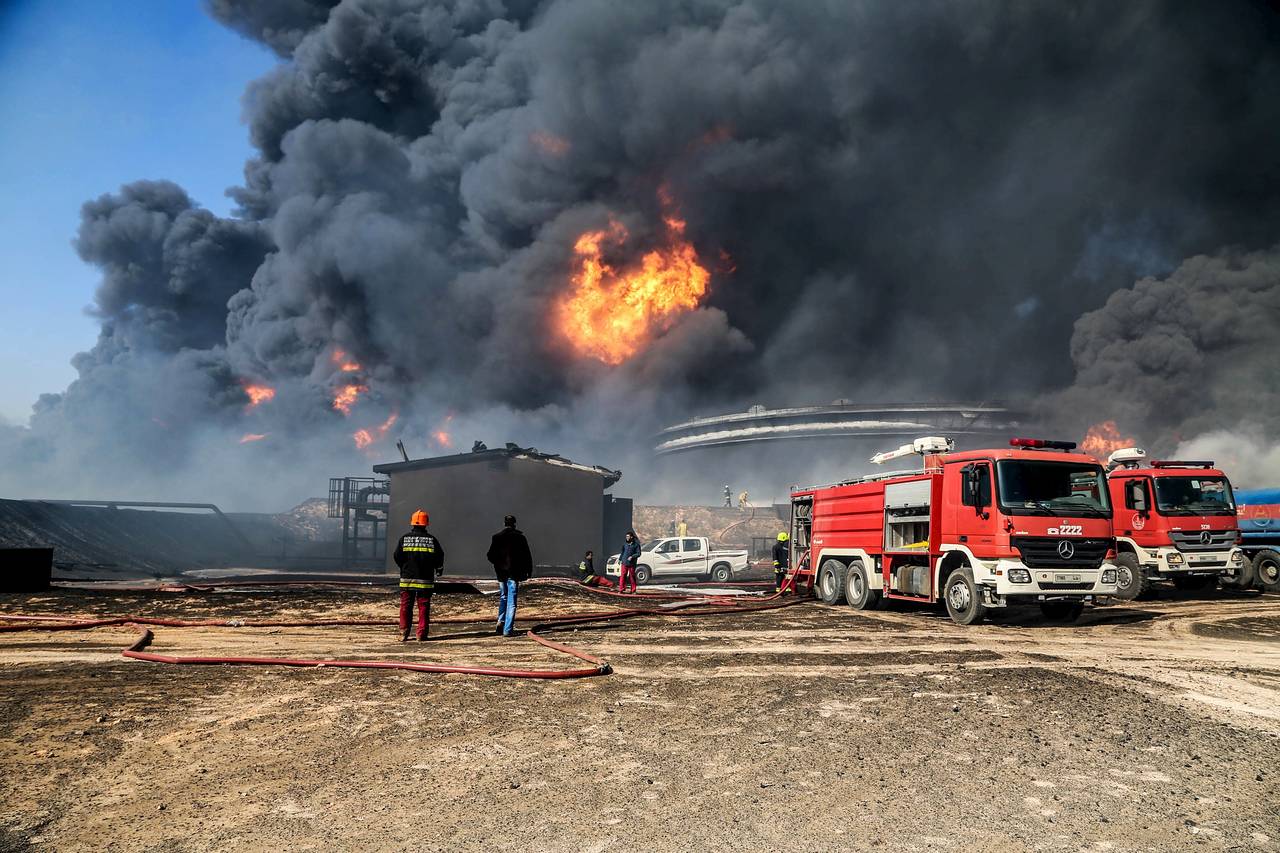
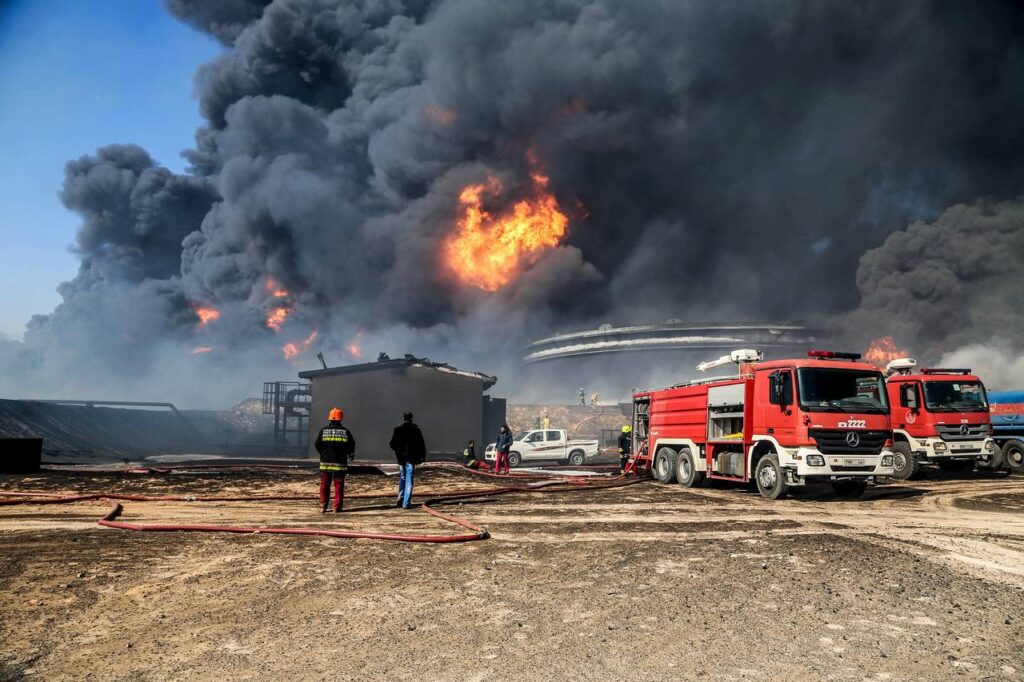
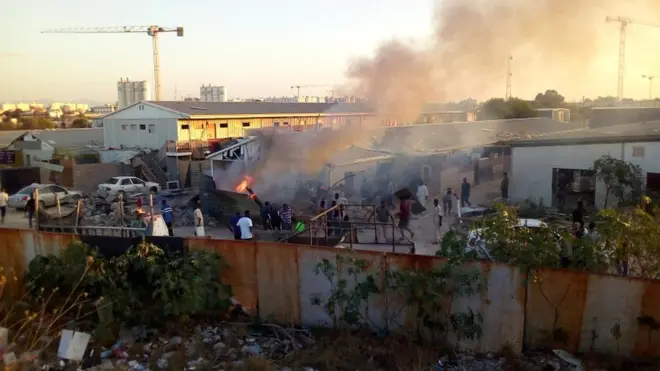
Violent clashes erupted Sunday between rival armed groups in Libya’s western city of Zawiya, resulting in fires at the nation’s second-largest oil refinery and trapping civilians in their homes. The conflict pits Shurafaa tribal forces against fighters loyal to UN-sanctioned warlord Mohamed Kushlaf.
The National Oil Corporation declared force majeure after gunfire damaged storage tanks at the Zawiya refinery, causing “dangerous” fires and gas leaks. Firefighters battled blazes amid ongoing violence around the facility, highlighting the persistent threat to Libya’s critical oil infrastructure.
The violence, which closed major coastal routes and suspended local education, exemplifies the continuing instability in western Libya, where militias aligned with Prime Minister Abdul Hamid Dbeibah’s government maintain substantial control. Residents report widespread gunfire in residential areas, creating panic among civilians.
The incident underscores Libya’s persistent division between rival administrations in Tripoli and the east, a split that has defined the nation since Moammar Gadhafi’s overthrow in 2011. The country’s western region, in particular, has become dominated by powerful militias who have accumulated significant wealth and influence.
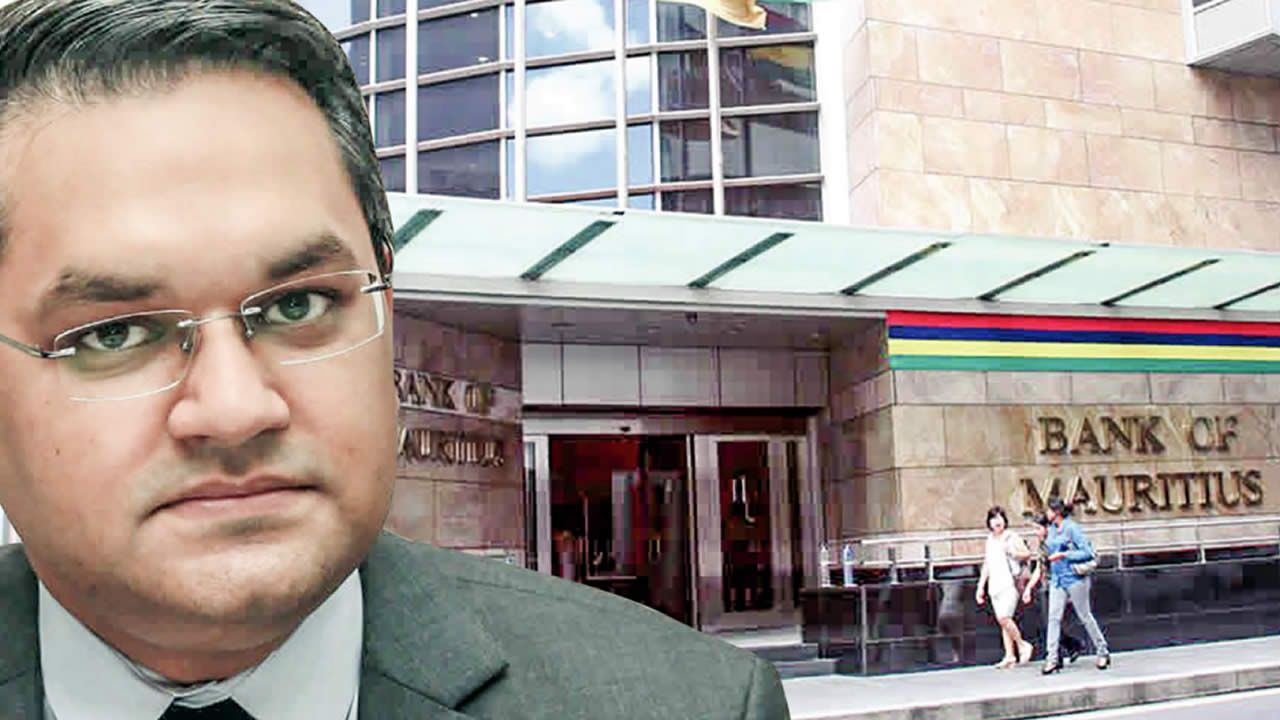
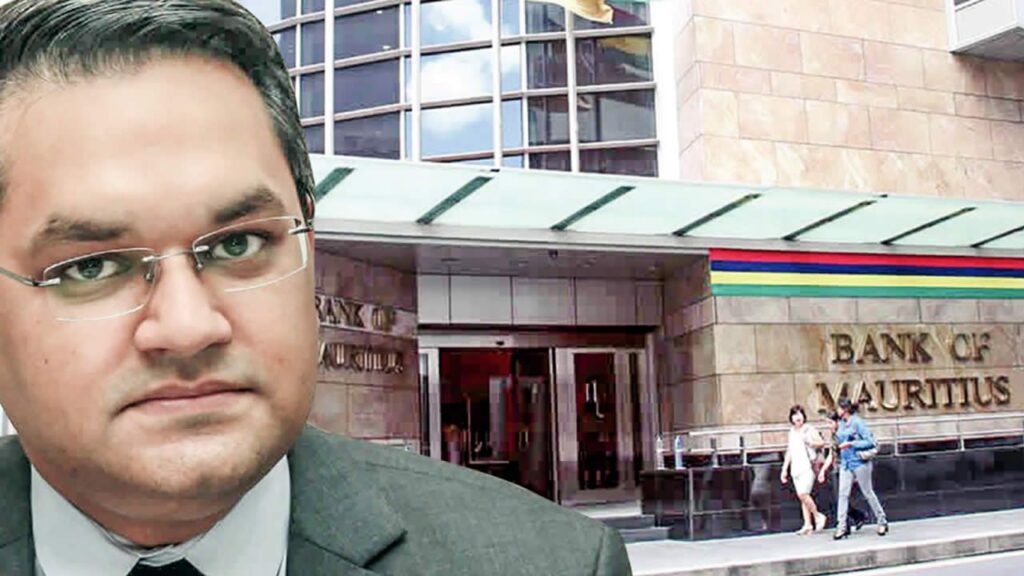
Mauritius police have issued an arrest warrant for former central bank governor Harvesh Kumar Seegolam as part of a conspiracy to defraud investigation, marking the first major action by Prime Minister Navin Ramgoolam’s new administration in addressing alleged financial misconduct.
The arrest order, issued by the police anti-money laundering unit, follows Ramgoolam’s recent revelations that the previous government systematically falsified key economic indicators, including GDP, budget deficit, and public debt figures over multiple years.
A parliamentary report has also accused the central bank of improperly printing money to fund the Mauritius Investment Corporation (MIC), established in 2020 as a COVID-19 business support mechanism. The report criticizes this action as “irresponsible,” noting it should have been funded through official foreign exchange reserves instead.
Police authorities confirmed Seegolam is currently outside the country and will face arrest upon return to Mauritius. The former governor has not responded to requests for comment on the allegations or arrest order.
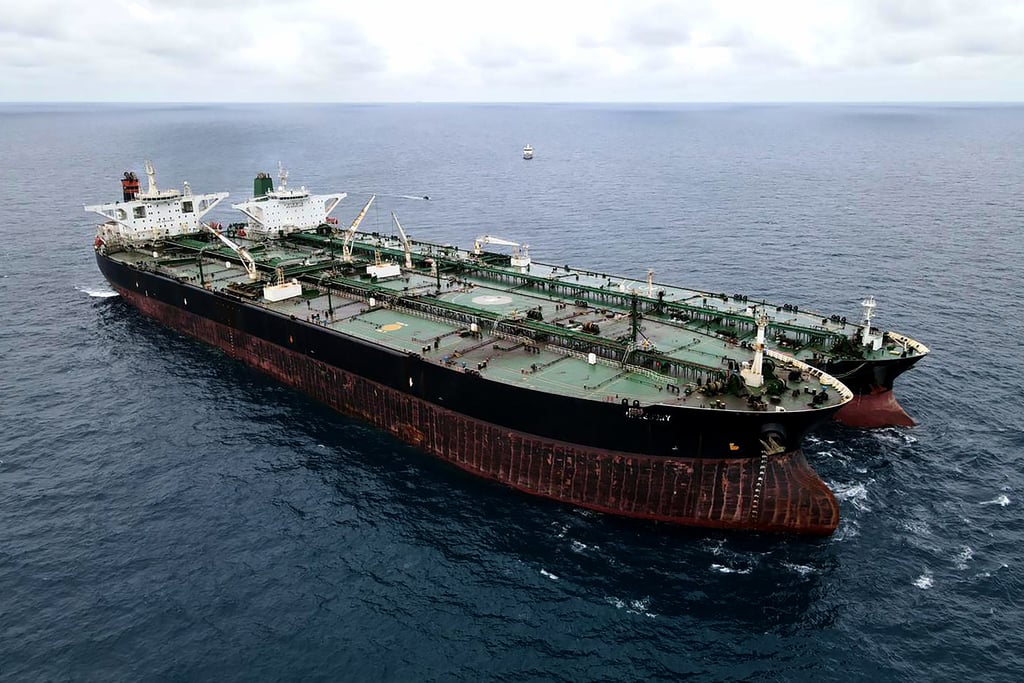
A Russian oil tanker carrying thousands of tons of oil products split apart during a violent storm on Sunday, spilling oil into the Kerch Strait and leaving at least one person dead, Russian officials said.
The 136-meter Volgoneft 212 tanker, built in 1969 and flagged in Russia, broke in half, with its bow sinking as waves battered its deck, according to footage shared by state media. Officials said the tanker had run aground and confirmed a spill of petroleum products.
A second Russian-flagged tanker, the Volgoneft 239, also sustained damage and was drifting in distress, the Russian Emergency Ministry reported. The 132-meter vessel, built in 1973, has a crew of 14 and a loading capacity of approximately 4,200 tons of oil products.
The incident occurred in the Kerch Strait, a critical waterway connecting the Black Sea and the Sea of Azov between mainland Russia and Crimea, which was annexed by Russia in 2014. Both vessels issued distress signals during the storm.
Russia’s water transport agency, Rosmorrechflot, said emergency crews, including Mi-8 helicopters and rescue tugboats, were deployed to the scene, involving more than 50 personnel.
The Russian newspaper *Kommersant* reported that the Volgoneft 212 tanker was carrying approximately 4,300 tons of fuel oil at the time of the incident. Official statements did not specify the extent of the oil spill or the cause of the severe damage to the vessel.
Unverified footage shared on Telegram showed blackened waters and a partially submerged tanker amid rough seas.
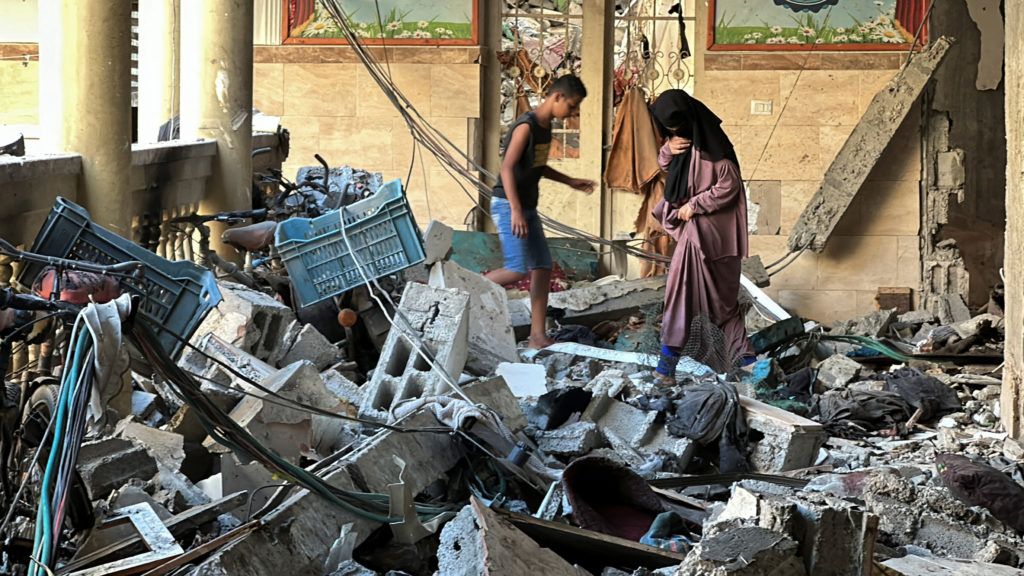
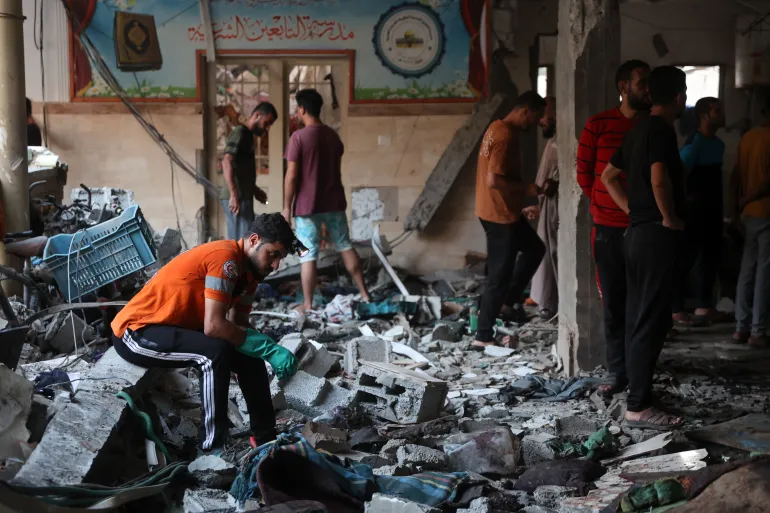
Palestinians inspect the site of an Israeli strike on a school sheltering displaced people, amid the Israel-Hamas conflict, in Gaza City, August 10, 2024. REUTERS/Abed Sabah
Israeli airstrikes and ground attacks in the northern Gaza Strip killed at least 20 Palestinians on Sunday, including those at a school sheltering displaced residents, according to medics and local residents.
At least 11 victims were killed in three separate airstrikes targeting homes in Gaza City, while others died in the towns of Beit Lahiya, Beit Hanoun, and Jabalia camp, medical sources said.
Residents reported clusters of homes were bombed and some set on fire in the ongoing Israeli operations, which have persisted for over two months. In Beit Hanoun, Israeli forces stormed the Khalil Aweida school, where displaced families had taken shelter, and ordered them to evacuate toward Gaza City, witnesses said. Several casualties were reported during the raid, but the exact death toll remains unclear.
The Israeli army did not immediately comment on the incidents.
Palestinian officials accused Israel of ethnic cleansing aimed at depopulating northern Gaza to establish a buffer zone. Israel has denied the claims, stating its actions target Hamas militants to prevent their regrouping.
The conflict escalated on Oct. 7, 2023, when Hamas militants launched an attack on Israel, killing 1,200 people, mostly civilians, and taking over 250 hostages into Gaza, according to Israeli authorities. In response, Israel launched extensive air, land, and sea offensives, resulting in nearly 45,000 deaths in Gaza, mostly civilians, as reported by the Hamas-led Gaza Health Ministry. The military campaign has displaced almost the entire population and left much of Gaza in ruins.
Efforts by Egypt, Qatar, and the United States to broker a ceasefire have gained traction in recent weeks, though no breakthrough has been reported.
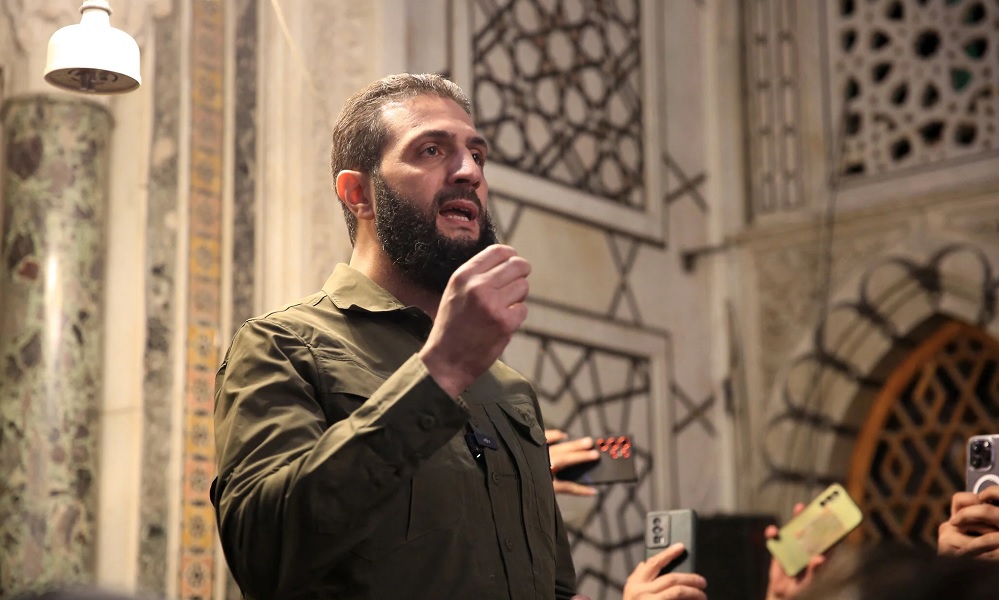
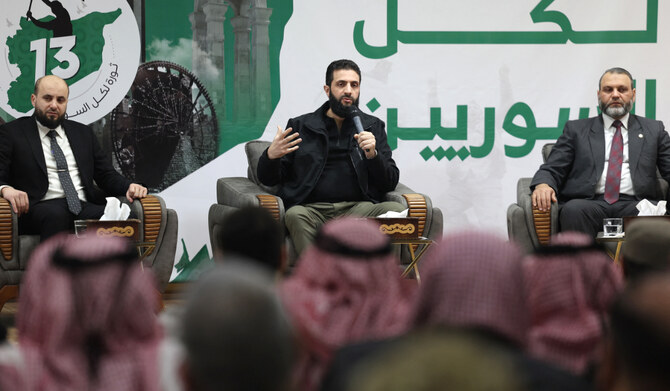
Syria’s de facto leader, Ahmad al-Sharaa, on Saturday accused Israel of using false pretexts to justify its recent attacks on Syrian territory. However, he emphasized that Syria is not seeking new conflicts as the nation prioritizes reconstruction after the end of Bashar al-Assad’s five-decade rule.
Al-Sharaa, also known as Abu Mohammed al-Golani, leads the Hayat Tahrir al-Sham (HTS) group, which ousted Assad’s regime last week. The group’s takeover marked a significant shift in Syria’s political landscape.
Israeli forces recently moved into a demilitarized zone inside Syria, established following the 1973 Arab-Israeli war. The area includes the Syrian side of Mount Hermon, a strategic site overlooking Damascus, where Israel occupied an abandoned Syrian military post. Israel has stated that the incursion is a temporary measure to ensure border security and does not intend to stay. Additionally, Israeli airstrikes have targeted Syria’s strategic weapons stockpiles.
Arab nations, including Saudi Arabia, the United Arab Emirates, and Jordan, condemned Israel’s actions, labeling the buffer zone seizure in the Golan Heights as a violation of international norms.
“Israeli arguments have become weak and no longer justify their recent violations,” Al-Sharaa said in an interview published by Syria TV, a pro-opposition outlet. “The Israelis have clearly crossed the lines of engagement in Syria, posing a threat of unwarranted escalation in the region.”
He underscored that Syria’s current focus is on rebuilding after years of conflict. “Syria’s war-weary condition does not allow for new confrontations. The priority at this stage is reconstruction and stability, not disputes that could lead to further destruction,” Al-Sharaa said.
Addressing international relations, Al-Sharaa called for diplomatic solutions to ensure security and stability, rejecting “uncalculated military adventures.”
On Russia, which provided military support to Assad’s regime and recently granted him asylum, Al-Sharaa said future relations should serve mutual interests. “The current stage requires careful management of international relations,” he added.
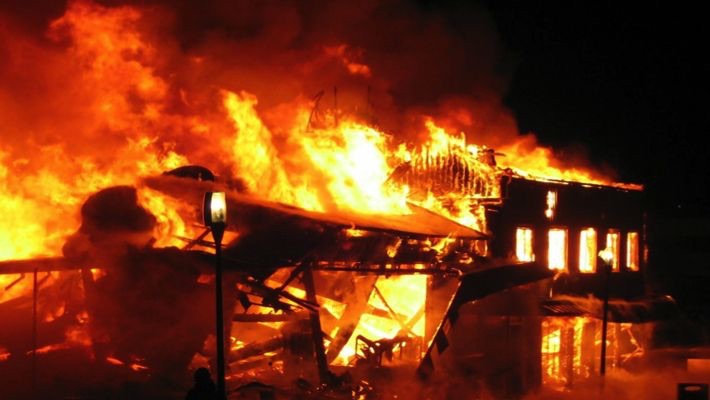
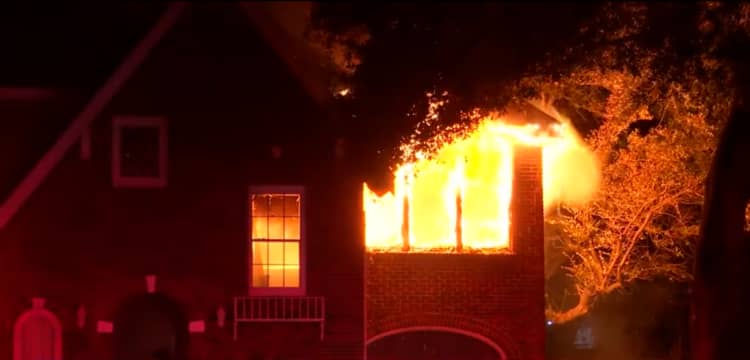
Tragedy struck on Friday night as a raging fire gutted the Christ Apostolic Church in Ibadan, Oyo State, Nigeria, during a vigil service, reportedly trapping several worshippers inside.
The incident occurred around 9:30 p.m. at Wisdom Estate, Road 1G, Olohunda Road, in the Lagelu Local Government Area. Eyewitnesses recounted that the fire broke out while some members of the congregation had dozed off in preparation for the night vigil.
“The fire started when some worshippers had already fallen asleep to rest before the vigil began,” one source shared. Another witness described a heart-wrenching scene, adding, “An elderly woman who could barely walk was still inside the church when the fire was raging.”
The General Manager of Oyo State Fire Services, Akinyemi Akinyinka, confirmed the incident, stating that their team responded swiftly after being alerted by a resident, identified as Kunle Junaid. “Our men were there based on the information received,” he said, adding that investigations into the cause of the fire are ongoing.
Details about casualties or the full extent of the damage remain unclear as of the time of reporting.
Efforts to reach some of the church members revealed the panic and confusion surrounding the incident. A worshipper, who wished to remain anonymous, said, “People were still inside the church during the fire. I will get back to you later, please.”
This tragic event has left the local community in shock, with authorities promising further updates as investigations continue.
Actor Jamie Foxx was injured during his 57th birthday celebration on Friday night after an altercation at a Beverly Hills restaurant. The Oscar-winning actor required stitches following the incident, which occurred at Mr. Chow, a renowned dining hotspot.
Foxx, accompanied by his daughters Corinne (30) and Anelise (16), as well as his ex-partner Kristin Grannis, who is Anelise’s mother, was celebrating when a glass was reportedly thrown at him from another table.
“Jamie Foxx was at his birthday dinner when someone from another table threw a glass that hit him in the mouth,” a spokesperson for Foxx confirmed to DailyMail.com. “He had to get stitches and is recovering. The police were called, and the matter is now in law enforcement’s hands.”
Authorities arrived at the restaurant around 10 p.m., but Foxx had already left the premises. An assault report was filed, with Foxx listed as one of the involved parties.
This shocking incident comes in the wake of a tumultuous year for the actor. In April 2023, Foxx was hospitalized after suffering a serious and mysterious medical complication. He later revealed that the health scare involved a brain bleed, leaving him unable to walk or remember 20 days of his life.
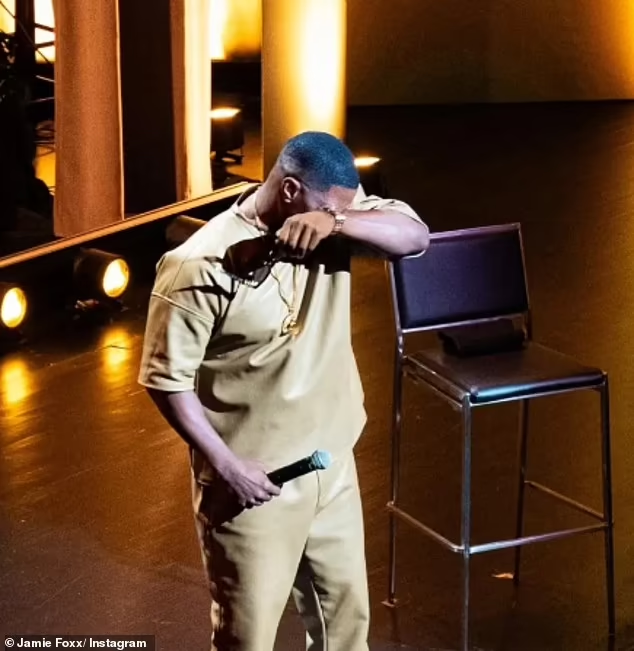
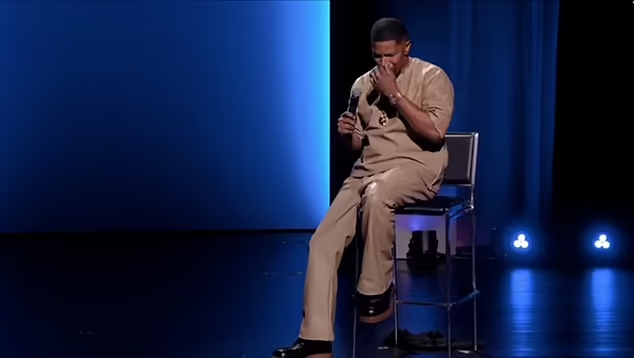
Foxx recounted the ordeal in his Netflix comedy special, What Had Happened Was…, where he became emotional discussing his near-death experience and the long recovery process. “I don’t remember 20 days,” he said tearfully, adding, “You don’t know how good it feels to be back.”
Foxx credited his sister, Deidra Dixon, with saving his life by driving him to the hospital in Atlanta, where he underwent a life-saving procedure. Despite his recovery, Foxx admitted that the cause of his stroke remains a mystery.
The actor shared that his family chose to keep his health struggles private to protect him from public scrutiny during his vulnerable state. “My family thought everyone would ‘meme the f***’ out of me,” Foxx joked during his special.
Following months of recovery, Foxx returned to the stage for the Netflix event, describing it as a cathartic experience. “If I can stay funny, I can stay alive,” he quipped in the show, which also included heartfelt reflections on his journey.
On social media, Foxx expressed gratitude for the support he received during his recovery. “I hope the jokes make you laugh, and I hope the story inspires you,” he wrote.
In addition to his comedy special, Foxx is set to star alongside Cameron Diaz in the Netflix spy comedy *Back in Action*, marking her return to acting after a long hiatus. The film, which faced delays during Foxx’s health crisis, is slated for release in January 2025.
Despite challenges both personal and professional, Foxx remains resilient, telling fans, “I’m here on Earth because of some great people, and because of God. I’m on my way back.”
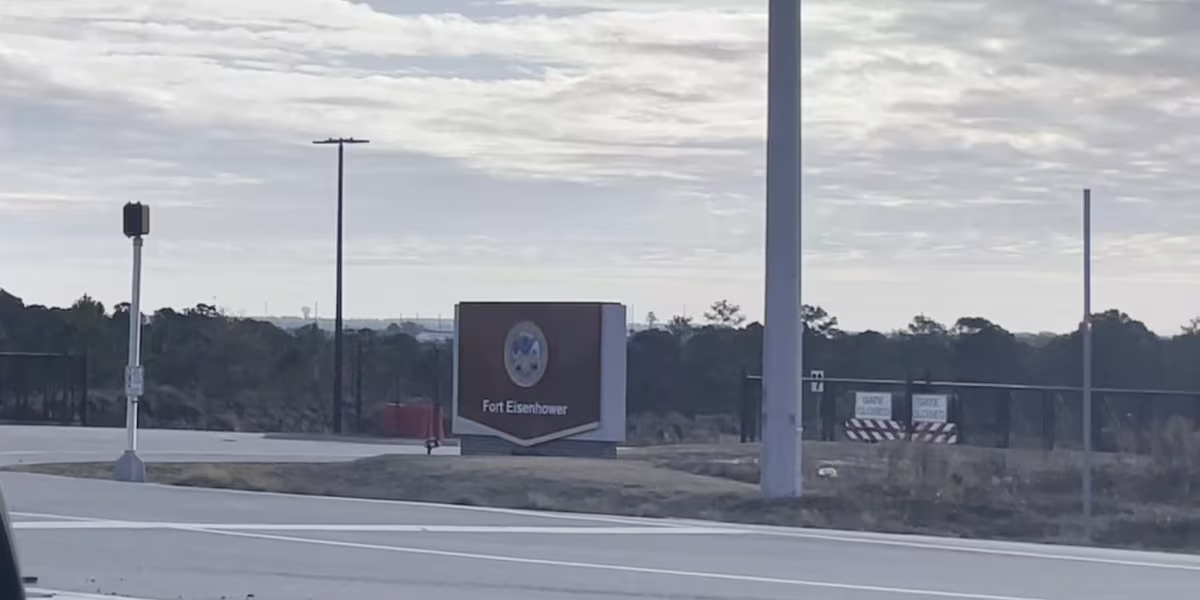
One person was fatally shot Saturday at Fort Eisenhower in Georgia, prompting a temporary lockdown of the U.S. Army installation before authorities apprehended the shooter in what they described as an isolated incident.
The shooting occurred in base housing at the installation outside Augusta, with base operations issuing an immediate lockdown alert through social media. Military authorities lifted the lockdown approximately two hours later after taking the suspect into custody and declaring an “all clear.”
The Department of the Army Criminal Investigation Division has taken lead on the investigation, while base officials have delayed releasing victim information pending family notification. Fort Eisenhower officials confirmed they are providing support to the victim’s family and others affected by the incident.
The base, home to the United States Army Cyber Command and formerly known as Fort Gordon, canceled planned activities related to the Army-Navy football game following the incident. Normal operations resumed after the threat was contained, though base authorities emphasized the isolated nature of the incident.
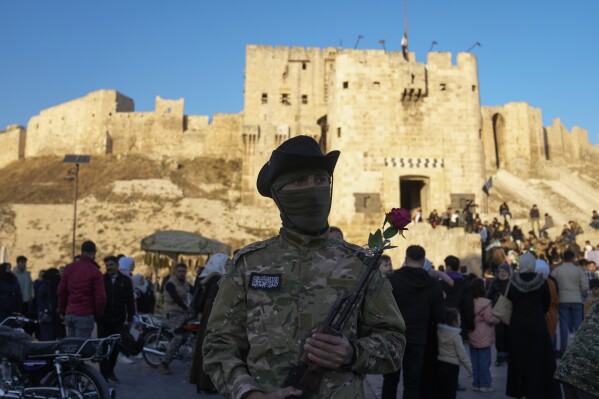
Rebel fighters holds weapons at the Citadel of Aleppo, after Syrian rebels announced that they have ousted Bashar al-Assad, in Aleppo, Syria, December 9, 2024. REUTERS/Karam al-Masri
The United States has confirmed direct communication with Hayat Tahrir al-Sham (HTS), the Syrian rebel group that now controls much of the country following the recent overthrow of Bashar al-Assad. This marks the first public acknowledgment of U.S. contact with HTS, which remains designated as a terrorist organization by Washington.
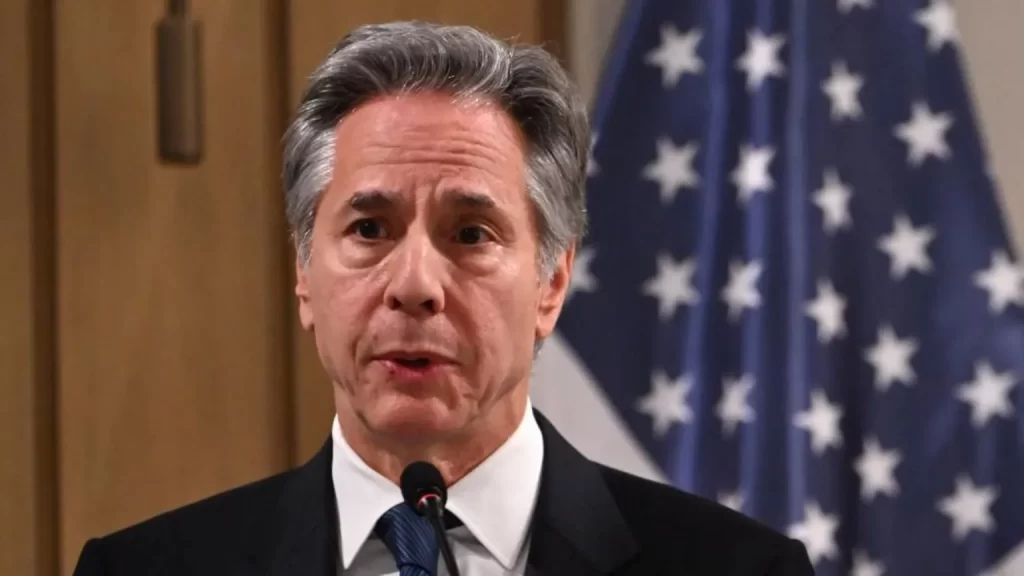
Secretary of State Antony Blinken, speaking in Jordan after a summit with regional and international leaders, revealed that discussions with HTS have included matters such as the fate of Austin Tice, a missing American journalist. “We’ve been in contact with HTS and other parties,” Blinken told reporters, signaling a shift in U.S. engagement with Syria’s evolving political landscape.
The meeting in Amman, attended by representatives from Arab nations, Turkey, and Europe, focused on Syria’s post-Assad future and emphasized the importance of a peaceful transition. Jordanian Foreign Minister Ayman Safadi underlined the need to avoid further chaos, while a joint communiqué called for the establishment of an inclusive government that safeguards minority rights and denies safe haven to extremist groups.
HTS, the most powerful rebel faction in Syria, has indicated its intent to form an inclusive government. However, its history as a jihadist organization has raised skepticism about its commitment to such promises. HTS leader Ahmed al-Sharaa, formerly known as Abu Mohammed al-Jolani, has appointed Mohammed al-Bashir as interim prime minister, as Syrians and the international community await further developments in governance.
The Syrian uprising reached a climax on December 8, when opposition forces captured Damascus, forcing Assad to flee to Russia. His 24-year rule, preceded by his father Hafez al-Assad’s decades-long grip on power, came to an end after a 13-year civil war that claimed over half a million lives, displaced millions, and drew in international powers and their proxies.
At the summit, Iraqi Foreign Minister Fuad Hussein expressed concerns over Syria’s future, warning against a repeat of Libya’s post-Gaddafi instability. Turkish Foreign Minister Hakan Fidan stressed the importance of preserving and reforming Syria’s institutions during the transition to prevent terrorist groups from exploiting the situation.
Notably absent from the talks were representatives from Syria, along with Iran and Russia, the two countries that had long supported Assad’s regime. The ministers in attendance, however, reaffirmed their commitment to a unified Syria free of sectarian divisions.
As the Syrian people begin to navigate their newfound freedom, the international community is closely watching the formation of a new political order. The next steps will be crucial in determining whether Syria can achieve stability and rebuild after years of conflict.
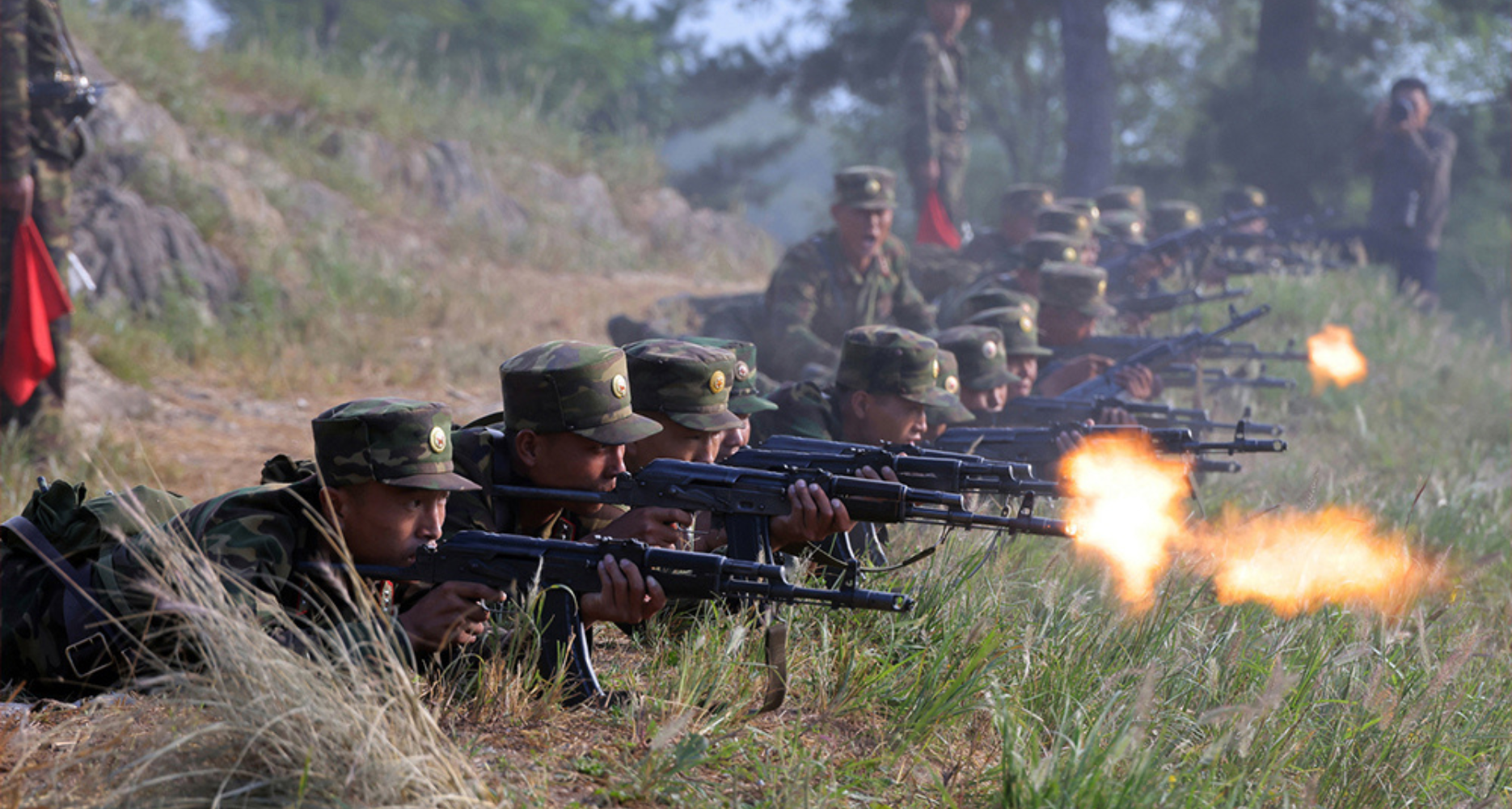
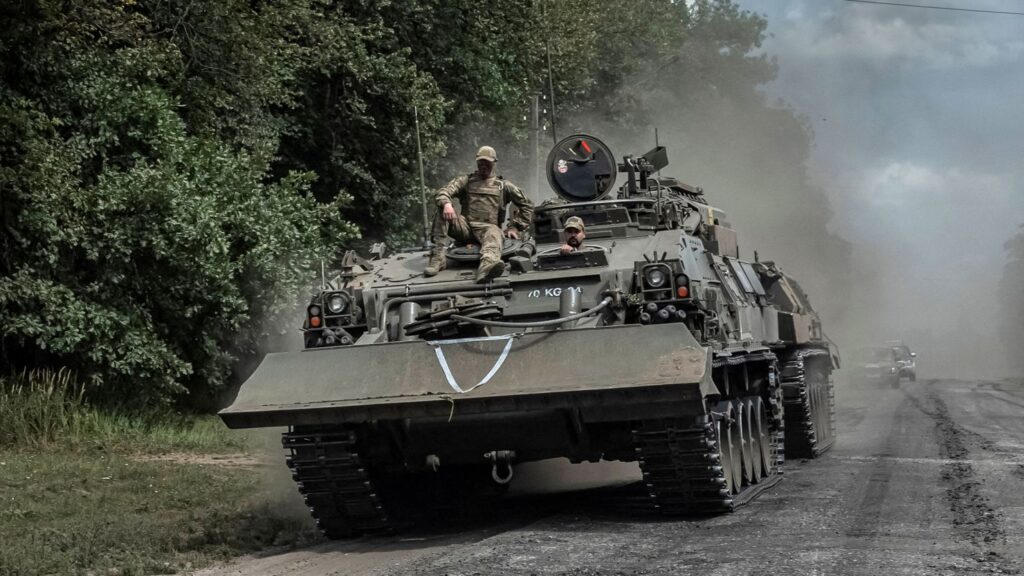
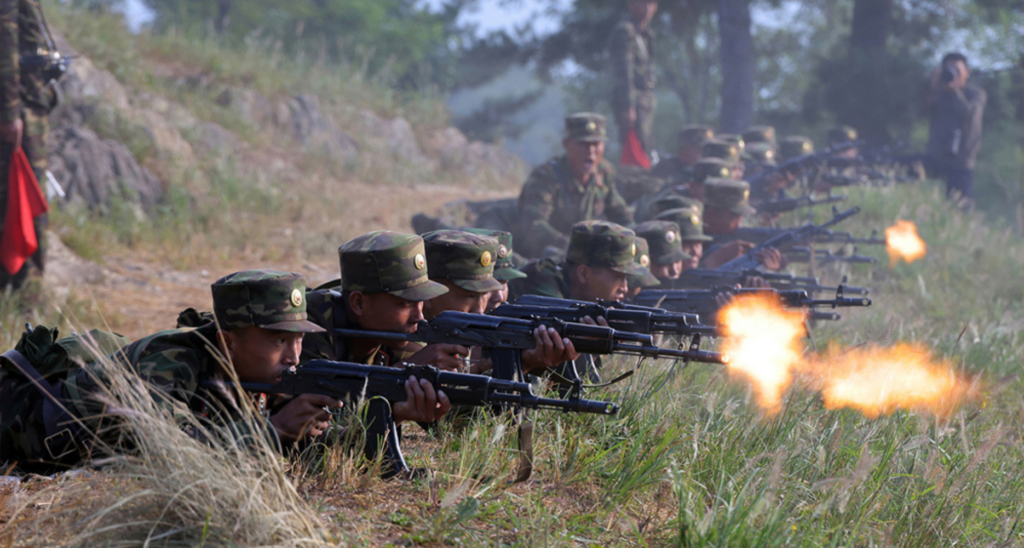
Ukrainian President Volodymyr Zelensky revealed Saturday that Russia has begun deploying North Korean soldiers in combat operations against Ukrainian positions in the Kursk region, marking a significant escalation in foreign military involvement in the conflict.
In his evening address, Zelensky cited preliminary evidence of “noticeable numbers” of North Korean troops participating in Russian assault operations, noting that these forces have already sustained significant casualties. The president indicated that North Korean forces may be operating beyond Kursk along other sections of the front line.
The deployment follows a major defense agreement between Moscow and Pyongyang, with Washington and Seoul estimating more than 10,000 North Korean troops have been sent to support Russian operations. This military cooperation has intensified since Russia’s February 2022 invasion of Ukraine.
Russia has been working to counter Ukraine’s August incursion into the Kursk region, where Ukrainian forces still maintain control of approximately 800 square kilometers, though this represents a reduction from their previous hold of 1,400 square kilometers. The presence of North Korean troops suggests Russia is drawing on new military resources to strengthen its position in the region.