Home Blog Page 533

Libyan Forces Detain 300 Migrants in Desert Operation

0

Libyan military officials announced Monday the detention of more than 300 migrants attempting to cross the Sahara Desert, marking an escalation in efforts to prevent Mediterranean Sea crossings to Europe.

The 444th Brigade, a powerful militia operating under the Libyan army’s authority, released images showing migrants seated in rows before masked, armed fighters. The group posted satellite imagery of desert routes on Facebook, declaring continued patrols to block smuggling operations.

Libya serves as a primary departure point for Middle Eastern and African migrants seeking European shores. UNHCR, the United Nations refugee agency, reports approximately 38,000 people have reached Italy and Malta from Libya this year, many fleeing war or poverty with smugglers’ assistance.

European leaders have pressed North African nations to prevent migrants from reaching the Mediterranean, where overcrowded vessels frequently capsize. However, Libya’s situation differs markedly from neighbors Morocco and Tunisia, as rival governments vie for control, complicating migration enforcement efforts.

While migrant apprehensions rarely make headlines in Libya, the state news agency LANA documented more than 2,000 arrests in July. The country has struggled with instability since a NATO-backed uprising toppled dictator Moammar Gadhafi, leaving it divided between competing eastern and western administrations, each supported by militias and international allies.

The political vacuum has enabled human trafficking networks to flourish. U.N. High Commissioner for Human Rights Volker Türk reported in July that detained migrants face torture, forced labor, and starvation in Libyan facilities.

The 444th Brigade’s latest operation underscores ongoing attempts to control migration flows through Libya’s vast desert regions, even as the country grapples with its own internal divisions and humanitarian concerns.

Universities Urge Foreign Students to Return Before Trump Takes Office

Major American universities are warning international students to return to campus before President-elect Donald Trump’s January inauguration, reflecting growing anxiety over his promised immigration crackdown and potential revival of travel restrictions from his first term.

The University of Massachusetts led a wave of institutions issuing travel advisories, explicitly urging international students and faculty to “strongly consider” returning from winter break before Trump’s January 20 inauguration. The university cited “previous experience with travel bans that were enacted in the first Trump Administration in 2016” as the basis for its cautionary stance.

The warnings come as Trump’s incoming administration signals plans for what could be the largest deportation operation in U.S. history, potentially utilizing military assistance. Officials have discussed constructing extensive holding facilities for undocumented immigrants awaiting deportation, though incoming border chief Tom Homan emphasizes that violent criminals and national security threats will be prioritized.

“All international students are worried right now,” said University of Colorado Denver professor Chloe East. “Students are incredibly overwhelmed and stressed out right now as a result of the uncertainty around immigration. A lot of students have concerns about their visas and whether they’ll be allowed to continue their education.”

The situation particularly affects more than 400,000 undocumented students currently enrolled in U.S. higher education, according to the Higher Ed Immigration Portal. Many are protected under the Deferred Action for Childhood Arrivals (DACA) program, which Trump previously attempted to terminate during his first administration.

Prestigious institutions including the Massachusetts Institute of Technology and Wesleyan University have joined in issuing travel advisories, while Yale University’s Office of International Students and Scholars hosted special webinars addressing student concerns about potential policy shifts.

The warnings evoke memories of Trump’s 2017 executive order that banned nationals from several predominantly Muslim countries, along with North Korea and Venezuela, from entering the United States. During his first term, Trump also proposed restrictions on student visas, adding to current anxieties among international students.
“I am planning to graduate in May 2026, but now that the administration is going to be a little bit more dangerous, I’m less hopeful about things going well,” said Aoi Maeda, a Japanese student at Earlham College in Indiana. “I feel like us international students with a visa might get affected, and it’ll become easier to deport us.”

Universities report particular concern among Chinese students, who represent the largest group of international students in the United States. Professor East noted that these students express “uncertainty” about U.S.-China relations under a second Trump administration.
The advisories highlight the delicate position of American universities, which have become increasingly dependent on international student enrollment for both academic diversity and financial stability. Many institutions remember the chaos that ensued during Trump’s first-term travel ban, when some students and faculty were stranded abroad or unable to return to their studies.

Recent polls show many international students viewing the United States as a less attractive destination for higher education, citing concerns about immigration policies and personal safety. This perception threatens the $39 billion that international students contribute annually to the U.S. economy, according to the Department of Commerce.

The situation has created a complex challenge for university administrators trying to balance student support with institutional obligations. While some schools have taken strong public stances, others are quietly advising students through academic departments and international student offices.

Source: bbc.com

Entire Police Department Resigns in South Carolina Town

The entire police force of McColl, South Carolina, has resigned en masse, leaving the rural town of 2,000 residents dependent on county law enforcement after Police Chief Bob Hale and his four officers quit, citing alleged harassment from a town council member and chronic underfunding.

Hale, who served less than 18 months as chief after his June 2023 appointment, detailed his grievances in a lengthy Facebook post, describing “repeated acts of harassment, personal attacks on my character, and the overall creation of a hostile work environment perpetuated by a specific councilman.” The chief declined to identify the council member in question.

“For months, I have endured unwarranted and malicious behavior aimed at undermining my integrity and leadership,” Hale wrote, adding that budget cuts by the same unnamed council member left “critical needs unmet” in the department.

The exodus unfolded in stages, according to Mayor George Garner. Hale submitted his formal resignation on October 31, accompanied by one officer’s departure the same day. The remaining three officers followed suit on November 14, completely depleting the town’s law enforcement capacity.

Garner expressed surprise at the public nature of Hale’s complaints, acknowledging previous professional disputes between the police department and the councilman but insisting these had been resolved. “We addressed it. We thought that we all came to an agreement to let bygones be bygones. Apologies were made and accepted, and I thought everything was fine,” Garner told The Post and Courier.

The mass resignation highlights deeper institutional challenges within McColl’s law enforcement. The department has experienced remarkable turnover, cycling through six police chiefs in just four years. “It takes a special person to work here in McColl,” Garner noted, pointing to the unique challenges of policing in the small community.

Council member Harry Benjamin expressed shock at the departures, telling local station WBTW News 13 that he was unaware which colleague Hale’s allegations targeted. The remaining five council members have maintained public silence on the situation.

In the interim, the Marlboro Country Sheriff’s Office and State Law Enforcement Division will handle emergency calls for the community. Mayor Garner expressed confidence in filling the vacancies, noting that applications for the chief position are already being accepted at town hall.

The situation in McColl reflects broader challenges facing small-town law enforcement agencies, where limited budgets, political tensions, and recruitment difficulties often intersect. The department’s frequent leadership changes suggest systemic issues that predate the current crisis.

Hale’s lengthy social media statement revealed that much of his tenure was consumed by defending his officers against what he termed “numerous falsehoods.” Despite the acrimonious departure, he expressed hope that McColl would “address these challenges, prioritize ethical leadership, and create an environment where those in public service can perform their duties free from undue interference and hostility.”

The town’s experience mirrors similar situations in other small American communities, where the delicate balance between local government oversight and law enforcement autonomy can quickly unravel, leaving municipalities scrambling to maintain basic public safety services.

Russia Signals Possible Missile Deployment to Asia as Regional Tensions Mount

Russia is prepared to deploy medium and shorter-range missiles to Asia in response to any similar U.S. deployments in the region, Deputy Foreign Minister Sergey Ryabkov announced Monday, escalating tensions in an increasingly militarized Indo-Pacific theater.

The warning comes as U.S. officials reportedly consider placing missiles in Japan’s southwestern islands and the Philippines in anticipation of potential conflict over Taiwan. “The appearance of such U.S. systems in any region of the world will determine our next steps, including in the field of organizing a military and military-technical response,” Ryabkov told Russian state media.

The diplomatic maneuvering coincides with alarming assessments from senior U.S. military leadership about China’s preparations for potential conflict. Admiral Samuel Paparo, commander of U.S. Indo-Pacific Command, reported last week that China conducted its largest-ever military rehearsal for a Taiwan invasion, involving 152 vessels at sea in what he called “the largest rehearsal we’ve seen on an upward trajectory of PLA modernization.”

Ryabkov’s statement specifically addressed Russia’s moratorium on deploying intermediate-range and shorter-range missiles, noting that its continuation depends entirely on U.S. actions. He emphasized that Russia faces no restrictions on deploying its new Oreshnik medium-range ballistic missile, which saw its first combat use against Ukraine’s city of Dnipro last week.

The situation reflects the deteriorating arms control framework between the United States and Russia following the 2019 collapse of the Intermediate-Range Nuclear Forces (INF) Treaty. The landmark Cold War agreement, signed in 1989, had banned missiles with ranges between 500 and 5,500 kilometers (310 and 3,400 miles). The Trump administration withdrew from the treaty citing Russian violations, which Moscow denied.

“We believe that the United States made a mistake by unilaterally destroying the Intermediate-Range Nuclear Forces Treaty in 2019 under a far-fetched pretext,” Ryabkov said, according to TASS news agency. The dissolution of the INF Treaty removed significant restrictions on both nations’ missile deployments, potentially setting the stage for a new arms race in Asia.

The Russian warning signals growing complexity in Indo-Pacific security dynamics, where U.S. efforts to contain China’s military expansion now intersect with Russian strategic interests. Japan and the Philippines, both U.S. allies, find themselves increasingly central to regional military planning as concerns about Taiwan’s security intensify.

Military analysts note that Russia’s potential missile deployment would significantly alter the strategic balance in Northeast Asia, potentially complicating U.S. defense arrangements with regional allies. The move could also affect China’s military calculations regarding Taiwan, as Beijing watches the evolving military landscape along its periphery.

The situation represents a significant shift from Cold War-era security arrangements, when arms control focused primarily on Europe. Today’s multi-polar competition in Asia involves intersecting interests of multiple nuclear powers, making traditional arms control frameworks increasingly difficult to maintain or replace.

Ryabkov emphasized that Russia’s response would be calibrated to match U.S. deployments, suggesting a measured approach rather than immediate escalation. However, he characterized the current moment as “extremely alarming” and “very dangerous,” highlighting Moscow’s concerns about U.S. military expansion in Asia.

Devastating Fire Leaves Thousands Homeless in Manila Shantytown

A devastating fire swept through one of Manila’s largest coastal slums Sunday, destroying approximately 1,000 homes and displacing an estimated 8,000 residents just weeks before Christmas, as authorities scrambled to provide emergency assistance to thousands of suddenly homeless families.

The inferno, which raged for nearly eight hours in Isla Puting Bato, a densely packed area of Manila’s Tondo district, began around 8 a.m. and wasn’t contained until 4 p.m., according to the Manila Fire District. Dramatic drone footage from the Manila Disaster Risk Reduction and Management Office captured orange flames consuming countless stilt houses in the impoverished coastal community.

Tondo, home to roughly 654,220 people, represents Manila’s largest slum area, where residents live in precarious conditions near a bustling commercial port. While authorities haven’t determined the fire’s cause, such disasters in Manila’s informal settlements frequently result from faulty electrical connections or gas cylinder accidents.

“I feel bad because we have no livelihood and no home. Everything is gone. We don’t know how we can eat. We are in a very bad situation, and it’s almost Christmas,” said Elvira Valdemoro, 58, a local shop owner who lost everything in the blaze.

Dramatic scenes unfolded as residents fled the advancing flames on makeshift rafts, while others desperately tried to salvage belongings from their burning homes. The Manila Fire District reported no immediate casualties, though the full extent of the destruction is still being assessed.

Manila Mayor Maria Sheilah “Honey” Lacuna-Pangan visited the devastated community Monday, meeting with survivors who spent the night in temporary shelters. “Please be patient. We will keep coming to deliver help. No one wanted this to happen,” she told displaced residents, urging them to register for assistance and relocate to emergency shelters where food and supplies are being distributed.

The disaster highlights the persistent vulnerabilities of Manila’s urban poor communities, where densely packed informal settlements often lack proper infrastructure and emergency access. The Tondo district, characterized by its maze-like streets and improvised housing structures, has long been recognized as one of the Philippine capital’s most challenging areas for disaster response.

Local officials are now racing against time to provide shelter and basic necessities to the displaced families as Christmas approaches. The mayor’s office has promised ongoing support, though the scale of the destruction presents significant challenges for both immediate relief efforts and long-term rehabilitation.

“We will help all of you. Don’t lose hope. Let’s help each other out ahead of Christmas time, we really hope to get you back to your homes,” Lacuna-Pangan assured residents, though the timeline for rebuilding remains uncertain.

The fire’s impact extends beyond immediate property loss, threatening to disrupt the economic survival of thousands who depend on the area’s proximity to Manila’s port for their livelihoods. Many residents operate small businesses or work as casual laborers in the nearby commercial district.

US, French Leaders Poised to Announce Israel-Hezbollah Truce

U.S. President Joe Biden and French President Emmanuel Macron are on the verge of announcing a ceasefire agreement between Israel and Hezbollah, even as Israeli airstrikes pounded Beirut’s southern suburbs Monday in a stark illustration of the conflict’s ongoing intensity.

The diplomatic breakthrough, confirmed by four senior Lebanese sources, comes amid some of the heaviest fighting since hostilities escalated in October 2023. White House National Security spokesperson John Kirby cautiously noted that while negotiations are “close,” he emphasized that “nothing is done until everything is done.”

The proposed agreement, set for review by Israel’s cabinet on Tuesday, would mark the most significant diplomatic achievement in the region since the outbreak of the Gaza war. The deal would require Israeli military withdrawal from southern Lebanon and deployment of regular Lebanese army troops to the border region within 60 days, according to Lebanon’s Deputy Parliament Speaker Elias Bou Saab.

A key breakthrough came in the past 24 hours with agreement on a five-nation monitoring committee, chaired by the United States and including France, to oversee ceasefire compliance. However, tensions remain over Israel’s insistence on maintaining the right to strike southern Lebanon, a provision Lebanon has historically rejected.

The diplomatic push occurs against a backdrop of escalating violence. Recent Israeli airstrikes killed at least 29 people in central Beirut over the weekend, while Hezbollah responded with one of its largest rocket barrages yet, launching 250 missiles into Israel on Sunday. Lebanon’s health ministry reported 31 additional deaths and 62 wounded from Monday’s Israeli strikes.

The human toll of the year-long conflict has been devastating. Lebanese authorities report over 3,750 deaths and more than one million displaced, though these figures don’t differentiate between civilians and combatants. On the Israeli side, 45 civilians and 73 soldiers have died in northern Israel, the Golan Heights, and southern Lebanon combat zones.

Israel claims significant victories in the conflict, including strikes against Hezbollah’s leadership and infrastructure in areas under the group’s control. The military campaign aims to enable the return of tens of thousands of evacuated Israeli civilians to their homes near the Lebanese border.

U.S. Middle East envoy Brett McGurk heads to Saudi Arabia Tuesday to explore using a potential Lebanon ceasefire as a catalyst for ending hostilities in Gaza, where peace negotiations remain stalled. The Lebanon diplomatic effort focuses on reviving UN Security Council Resolution 1701, which ended the 2006 Israel-Hezbollah war by requiring Hezbollah fighters to withdraw approximately 30 kilometers from the Israeli border.

The pending agreement faces domestic political challenges in Israel, where far-right National Security Minister Itamar Ben-Gvir publicly opposed the deal on social media, urging Prime Minister Benjamin Netanyahu to pursue “absolute victory” instead of a negotiated settlement.

State Department spokesperson Matthew Miller acknowledged that while gaps between parties have “narrowed significantly,” final steps remain. “Oftentimes the very last stages of an agreement are the most difficult because the hardest issues are left to the end,” Miller said.

The French presidency confirmed “significant progress” in ceasefire discussions, while Netanyahu’s office declined to comment on reports that Israel and Lebanon had agreed to the deal’s text. The senior Israeli official who confirmed Tuesday’s cabinet meeting indicated it would focus on approving the agreement’s final version.

The potential breakthrough comes as the Biden administration, entering its final year, emphasizes diplomatic solutions to regional conflicts, even as the parallel war in Gaza continues without clear resolution prospects.

Trump Pledges 25% Tariff Increases on Mexico, Canada, and China on Day One

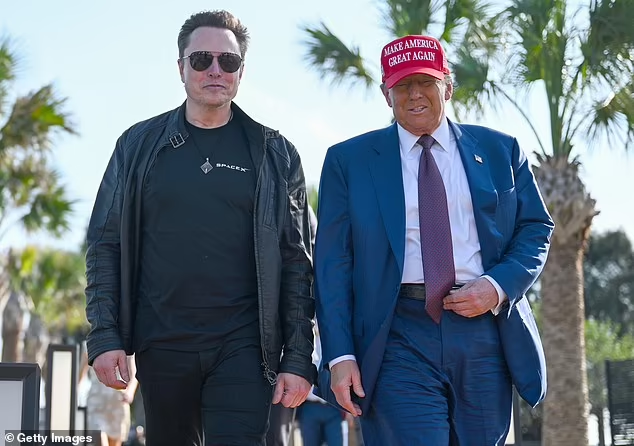
President-elect Donald Trump announced plans Monday to impose substantial new tariffs on goods from Mexico, Canada, and China immediately upon taking office, significantly escalating his stance on international trade and border security.

In a series of posts on his Truth Social platform, Trump declared he would sign executive orders on January 20 implementing a 25% tariff on all Mexican and Canadian imports, while adding 10% to existing tariffs on Chinese goods. The president-elect linked the aggressive trade measures to concerns over illegal immigration, drug trafficking, and what he termed an “Invasion of our Country.”

“On January 20th, as one of my many first Executive Orders, I will sign all necessary documents to charge Mexico and Canada a 25% Tariff on ALL products coming into the United States, and its ridiculous Open Borders,” Trump wrote, indicating the measures would remain until drug trafficking, particularly fentanyl, and illegal immigration are curtailed.

The proposed tariffs would mark an unprecedented shift in U.S. trade relations with its two largest trading partners under the United States-Mexico-Canada Agreement (USMCA), which replaced NAFTA during Trump’s first term. The move could potentially trigger retaliatory measures and legal challenges under international trade agreements.

Regarding China, Trump cited failed negotiations over drug trafficking concerns, particularly fentanyl. He claimed Chinese officials had previously promised to execute drug dealers trafficking substances to the United States but “never followed through.” The additional 10% tariff would compound existing trade tensions between the world’s two largest economies.

The announcement represents a significant expansion of Trump’s first-term trade policies, which included targeted tariffs on specific goods and resulted in prolonged trade disputes, particularly with China. Economic analysts warn the broader tariffs could lead to higher consumer prices and potential supply chain disruptions across North America.

Trump’s linking of trade policy to immigration and drug trafficking signals a more aggressive approach to leveraging economic pressure for national security objectives. The president-elect characterized the situation as a “long simmering problem” that America’s neighbors could “easily solve.”

The proposed measures could face legal challenges both domestically and internationally, as they may conflict with existing trade agreements and World Trade Organization rules. The sweeping nature of the tariffs, particularly their application to all goods rather than specific sectors, represents a departure from traditional trade enforcement measures.

The announcement has already sparked concern among U.S. business groups, who warn that broad-based tariffs could disrupt integrated North American supply chains and increase costs for American consumers. Agricultural sectors, particularly dependent on export markets, could face significant impact from potential retaliatory measures.

Mexico and Canada combined account for approximately $1.4 trillion in annual trade with the United States, while U.S.-China trade exceeds $690 billion despite existing tariffs. The proposed measures could affect everything from automotive parts and agricultural products to consumer goods and industrial supplies.

Trump’s announcement comes as the U.S. continues to grapple with record levels of fentanyl-related deaths and ongoing debates over border security. The president-elect’s approach suggests he plans to use trade policy as a primary tool for addressing these challenges, despite potential economic consequences.

International reaction to Trump’s announcement has been muted, though trading partners typically wait for official policy implementation before responding. The proposed measures could significantly reshape North American trade relations just years after the implementation of the USMCA trade agreement.

REUTERS

2 USA-Based Nigerian Romance Scammers Get 30 Years for Multimillion-Dollar Fraud Schemes

Two Nigerian nationals living in Chicago’s suburbs have been sentenced to a combined 30 years in federal prison for orchestrating sophisticated fraud schemes that netted at least $3.5 million from victims across the United States through romance and inheritance scams.

Anthony Emeka Ibekie, 59, of Oswego, Illinois, received a 20-year sentence Thursday after a federal jury convicted him on all 14 counts, including wire fraud, mail fraud, money laundering, making false statements to a bank, and passport fraud. His accomplice, Samuel Aniukwu, 50, of Romeoville, Illinois, was sentenced to 10 years on November 8 after pleading guilty to wire fraud and money laundering charges.

Federal prosecutors detailed an elaborate web of deception where the defendants, operating under various aliases, targeted victims through multiple schemes. In the inheritance scam, they convinced victims they had received substantial inheritances but needed to send money to claim them. The romance fraud involved building trust through dating websites and social media before manipulating victims into transferring funds.

“These defendants exploited vulnerable individuals seeking companionship and financial opportunity,” U.S. District Judge Steven C. Seeger said during sentencing. The schemes also included sophisticated business email compromise attacks targeting corporate accounts.

The investigation, led by undercover law enforcement operatives, revealed how the duo constructed convincing narratives to manipulate their targets. Victims were methodically groomed through online relationships, with the scammers carefully building trust before executing their financial fraud.

A third defendant, Jennifer Gosha, 52, an American citizen from Oak Park, Illinois, has pleaded guilty to wire fraud and making false statements to a federal agent. Her sentencing is scheduled for December 18, 2024, marking the final chapter in a case that highlights the growing sophistication of international fraud operations targeting U.S. citizens.

The conviction represents a significant victory for federal authorities combating international fraud schemes, particularly those originating from West Africa. Law enforcement officials note that such schemes have become increasingly sophisticated, often combining romantic manipulation with complex financial fraud narratives.

The case has drawn attention to the vulnerability of Americans to online scams, particularly those targeting older adults through dating sites and social media platforms. Prosecutors presented evidence showing how the defendants maintained multiple fake identities and used elaborate stories about inheritances to convince victims to transfer substantial sums of money.

The sentencing coincides with increased efforts by U.S. law enforcement to crack down on international fraud rings operating within American borders. The Federal Bureau of Investigation reports that romance scams alone resulted in losses exceeding $1 billion annually in recent years, with a significant portion traced to organized criminal networks.

Law enforcement officials emphasize that this case represents only a fraction of ongoing sophisticated fraud operations targeting Americans, particularly through online platforms. The investigation revealed how the defendants utilized multiple bank accounts, shell companies, and cryptocurrency to conceal their activities and transfer fraudulent proceeds.

The Department of Justice has indicated that international cooperation was crucial in building the case, highlighting the global nature of modern financial crimes and the challenges faced by law enforcement in combating cross-border fraud schemes.

Judge Dismisses Trump Election Case After DOJ Cites Presidential Immunity Policy

A federal judge on Monday dismissed the criminal case accusing Donald Trump of attempting to overturn his 2020 election defeat, marking a dramatic end to Special Counsel Jack Smith’s prosecution following Trump’s November election victory and the Justice Department’s longstanding policy against prosecuting sitting presidents.

U.S. District Judge Tanya Chutkan’s order effectively halts federal efforts to hold the president-elect accountable for actions leading to the January 6, 2021, Capitol riot, as prosecutors acknowledged an unprecedented legal predicament created by Trump’s return to the presidency.

Special Counsel Smith, in a sweeping legal retreat, moved to dismiss both the election interference case and end attempts to revive a separate prosecution over classified documents retained at Mar-a-Lago. The decision stems from a Justice Department policy dating to the 1970s that holds criminal prosecution of a sitting president would unconstitutionally impede executive function.

“This outcome is not based on the merits or strength of the case against the defendant,” prosecutors emphasized in their filing, specifically noting the dismissal stems purely from procedural requirements before Trump’s January 20 inauguration.

The ruling represents a significant victory for Trump, who faced four separate criminal cases. The federal cases included four charges related to alleged conspiracy to obstruct vote certification following his 2020 loss to Joe Biden, to which he pleaded not guilty in August 2023.

The parallel classified documents case had already encountered setbacks when Florida Judge Aileen Cannon, a Trump appointee, dismissed it in July questioning Smith’s appointment legitimacy. Prosecutors indicated Monday they will continue pursuing appeals against two Trump associates in that case – personal aide Walt Nauta and Mar-a-Lago manager Carlos De Oliveira.

Trump’s legal team had previously signaled plans to seek dismissal based on a Supreme Court ruling from July regarding presidential immunity for official actions. Trump spokesperson Steven Cheung celebrated Monday’s development as “a major victory for the rule of law,” while Trump himself denounced the prosecutions on social media as “a low point in the History of our Country.”

The dismissal leaves Trump’s legal challenges concentrated in state courts. He stands convicted in New York on felony charges related to hush money payments before the 2016 election, though sentencing remains indefinitely postponed. A separate Georgia state case concerning 2020 election interference remains stalled.

Legal experts note prosecutors could theoretically pursue charges after Trump leaves office, though such delayed prosecution would face significant challenges. The Justice Department’s policy shift highlights the complex intersection of presidential power and criminal accountability that has no direct precedent in American history.

Smith’s reversal marks a striking change for the prosecutor who, appointed by Attorney General Merrick Garland in 2022, had aggressively pursued cases alleging threats to both election integrity and national security. Trump, who will oversee the Justice Department upon taking office, had campaigned on promises to terminate Smith’s appointment.

The decision underscores fundamental questions about prosecuting presidents and presidents-elect, particularly as Trump prepares to potentially oversee the very department that sought his prosecution. The case’s dismissal leaves unresolved the broader issue of how the American legal system might hold presidents accountable for actions that prosecutors alleged threatened democratic institutions.

Russian Quran Burning Defendant Gets Additional 13.5 Years on Treason Charges

A Russian court sentenced Nikita Zhuravel to an additional 13 years and six months in prison Monday on treason charges, extending the punishment of the 20-year-old who was already serving time for burning a Quran in a case that has drawn international attention.

The Volgograd Regional Court found Zhuravel guilty of “high treason” for allegedly sharing videos of Russian military equipment and aircraft with Ukraine’s SBU security service in March 2023. The closed-door proceedings, which began November 14, required Zhuravel’s transfer from detention in Chechnya to Volgograd for the hearings.

The new sentence, combined with his existing three-and-a-half-year term for offending religious believers, means Zhuravel will spend 14 years in a maximum-security prison, according to prosecutors. The case has attracted widespread attention not only for its severity but for circumstances surrounding Zhuravel’s detention.

The defendant made headlines in August 2023 when he accused Adam Kadyrov, the 15-year-old son of Chechen leader Ramzan Kadyrov, of assaulting him while in pre-trial detention. The younger Kadyrov later released video footage of the alleged assault, but law enforcement authorities declined to investigate the incident. In a controversial move, several regional authorities subsequently honored the teenage Kadyrov with state awards.

The human rights organization Memorial, which has designated Zhuravel a political prisoner, has raised concerns about the handling of both cases. The treason trial’s closed nature and Zhuravel’s treatment in detention have drawn particular scrutiny from human rights observers.

The original conviction stemmed from Zhuravel burning a Quran in the Volgograd region of southern Russia, an act that resulted in his February sentencing by a Chechen court. Court documents and media reports have not clarified whether Zhuravel entered a plea to the treason charges, and details of the prosecution’s evidence remain sealed.

The case reflects growing tensions in Russia’s judicial handling of religious and political offenses, particularly in cases involving alleged cooperation with Ukrainian authorities during the ongoing conflict. The severity of the combined sentences has raised questions about the intersection of religious freedom, political dissent, and national security in contemporary Russia.

The prosecution’s successful pursuit of treason charges, carrying some of the heaviest penalties in the Russian criminal code, marks a significant escalation from the religious offense case. The total 14-year sentence places Zhuravel among the longest-serving prisoners convicted in cases combining religious and political charges in recent Russian judicial history.

International human rights organizations continue to monitor the case, particularly given Zhuravel’s age and the circumstances of his detention. The conviction adds to growing concerns about Russia’s expanding use of treason charges against young defendants and the handling of cases involving religious sensitivities in the Russian judicial system.