French anti-terrorism prosecutors announced Saturday the arrest of a 22-year-old Afghan man suspected of supporting the Islamic State group. The suspect, apprehended on Tuesday in southwestern France, is reportedly linked to a 27-year-old Afghan man arrested in Oklahoma, USA, who is charged with plotting an attack on election day.
The US suspect allegedly planned to target a football stadium or shopping center. According to a source close to the investigation, the two men are believed to be brothers, though prosecutors have not officially confirmed this relationship.
US officials reported that the Oklahoma suspect had been in contact with an individual identified by the FBI as an Islamic State group recruiter via the Telegram app. This information led to French authorities being alerted, resulting in the arrest of three individuals aged 20 to 31 in southwestern France.
While the main suspect remains in detention, the other two individuals have been released, according to prosecutors. The arrests highlight the ongoing international cooperation in counterterrorism efforts and the persistent threat posed by supporters of extremist groups.
The United Nations Interim Force in Lebanon (UNIFIL) reported that Israeli tanks forcibly entered a peacekeeper base in southern Lebanon, breaching its gate. This incident occurs as tensions escalate between Israel and Hezbollah, with UN Secretary-General Antonio Guterres warning that attacks on peacekeepers could constitute a war crime.
Guterres stated, “UNIFIL personnel and its premises must never be targeted. Attacks against peacekeepers are in breach of international law.” At least five UN peacekeepers have been injured amid the ongoing conflict between Israeli forces and Hezbollah militants in the region.
The situation has been further complicated by Israeli Prime Minister Benjamin Netanyahu’s call for the UN to move UNIFIL forces “out of harm’s way” as Israel continues its offensive in southern Lebanon. This request has raised concerns about the safety of peacekeepers and their ability to fulfill their mandate in the conflict zone.
The breach of the UNIFIL base by Israeli tanks represents a significant escalation in the conflict and a direct challenge to the UN’s peacekeeping mission in the area. It highlights the growing risks faced by international personnel caught between warring parties in the volatile region.
Residents of Karusandara Sub-county and Hima Town Council in Uganda’s Kasese District are facing severe challenges after flood damage to the Nkoko Bridge, the sole connection between these communities. The bridge’s deterioration, ongoing for months, has significantly disrupted access to essential services and commerce.
Local resident Wilfred Thembo highlighted the danger, stating, “We are risking our lives crossing this bridge every day. If nothing is done soon, it will be a death trap.” The bridge’s structure has been severely eroded by water, leaving only a thin layer of soil at one end.
The damage has particularly impacted trade between Karusandara and Hima, with residents unable to easily transport goods across the region. Abel Turyasingura, another local, expressed concern about the potential long-term effects on families’ livelihoods without immediate repairs.
Despite numerous appeals to government authorities, including the district and the Ministry of Works, no repairs have been initiated. Edson Byarugaba, a Karusandara resident, noted, “We have called upon various offices, but so far, no one has come to our aid.”
Erias Byamungu, Chief Administrative Officer of Kasese District, acknowledged the crisis but cited a lack of funds as the primary obstacle. The estimated repair cost exceeds 100 million shillings, surpassing the district’s financial capacity. “We are aware of the situation, but we need external support to handle the repairs,” Byamungu explained.
As the rainy season intensifies, local leaders warn of potential further deterioration, increasing risks for residents. The communities of Karusandara and Hima are urgently calling for government intervention to prevent the bridge’s complete collapse and restore normal daily life.
A deadly drone attack by Hezbollah on an Israeli army base near Binyamina in central Israel killed four soldiers and severely wounded seven others on Sunday, marking the deadliest strike by the militant group since Israel’s ground invasion of Lebanon began two weeks ago. The attack, which injured a total of 61 people according to Israel’s national rescue service, represents a significant escalation in the ongoing conflict.
Hezbollah claimed the attack was retaliation for Israeli strikes on Beirut last Thursday that killed 22 people. The Lebanon-based group said it targeted Israel’s elite Golani brigade, employing a strategy of launching multiple missiles to overwhelm Israeli air defense systems before deploying “squadrons” of drones.
In response to the attack and growing tensions, the United States announced it would send a new air-defense system to Israel, along with troops to operate it. An Israeli army spokesperson declined to provide a timeline for the deployment.
The conflict has expanded beyond the initial Israel-Hamas war in Gaza, with Israel now engaged against both Hamas and Hezbollah, Iran-backed militant groups. Expectations of an Israeli retaliation against Iran for a recent missile attack have further heightened regional tensions.
Amidst the escalating violence, Israeli Prime Minister Benjamin Netanyahu criticized the United Nations Interim Force in Lebanon (UNIFIL), accusing the peacekeepers of “providing a human shield” to Hezbollah. This statement came after UNIFIL reported that Israeli tanks had forcibly entered one of their positions, destroying the main gate, and later fired smoke rounds near peacekeepers, causing skin irritation.
Netanyahu called for UNIFIL to heed Israel’s warnings to evacuate, stating, “We regret the injury to the UNIFIL soldiers, and we are doing everything in our power to prevent this injury. But the simple and obvious way to ensure this is simply to get them out of the danger zone.”
The Israeli military defended its actions, claiming that a tank trying to evacuate wounded soldiers had backed into a UN post while under fire, and that smoke screens were used for cover. Lt. Col. Nadav Shoshani asserted that Israel maintains constant contact with UNIFIL and that any harm to UN forces would be investigated at “the highest level.”
As the conflict intensifies, international criticism of Israel’s actions towards UN peacekeepers has grown. Five peacekeepers have been wounded in attacks on their positions since the start of the ground operation in Lebanon, with most blamed on Israeli forces.
The situation remains volatile, with the potential for further escalation as Israel continues its operations in both Gaza and Lebanon, while also facing the prospect of direct confrontation with Iran.
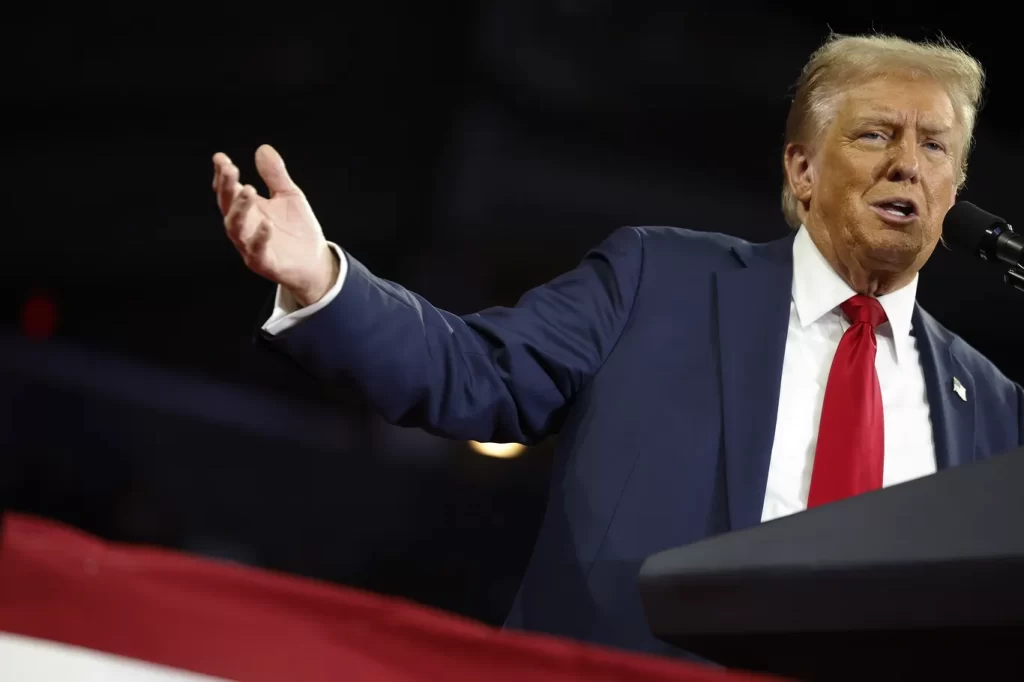
A 49-year-old Nevada man was arrested Saturday night at a security checkpoint outside former President Donald Trump’s rally in Coachella, California, after authorities discovered loaded firearms and ammunition in his vehicle.
The Riverside County Sheriff’s Department reported that deputies assigned to the rally stopped a black SUV driven by the Las Vegas resident. A search of the vehicle revealed a shotgun, a loaded handgun, and ammunition. The suspect was arrested on suspicion of possessing a loaded firearm and a high-capacity magazine.
“This incident did not impact the safety of former President Trump or attendees of the event,” the Sheriff’s Department stated. The suspect was released on $5,000 bail and is scheduled to appear in court on January 2, 2025.
The rally, held in the Southern California desert east of Los Angeles, featured extensive security measures. Media members and VIP ticket holders were routed through multiple law enforcement checkpoints, with vehicles thoroughly searched, including by K-9 units. General ticket holders were bused to the site from a location three miles away.
Riverside County Sheriff Chad Bianco has scheduled a news conference to discuss the arrest further. Trump’s campaign has not yet responded to requests for comment on the incident.
A drone attack in the Binyamina region of northern Israel has left more than 60 people injured, according to medical officials. United Hatzalah, a volunteer emergency response organization, reported that the wounded, whose conditions range from critical to mild, have been transported to five regional hospitals by ambulance and helicopter.
Hezbollah has claimed responsibility for the attack, stating it targeted a training camp of the Israeli Defence Forces’ (IDF) Golani Brigade. The Lebanon-based militant group said the strike, using a “swarm of drones,” was in retaliation for Israeli attacks in southern Lebanon and Beirut on Thursday.
Israeli media reports suggest that 67 people were injured, with four in critical condition and five seriously wounded. Many of the casualties were reportedly in a communal canteen at the time of the attack, caught by surprise. Social media images show an empty mess hall with a hole in the roof.
Due to Israeli censorship rules, exact details of the location and target cannot be disclosed. However, some media outlets report that the attack involved a low-level drone launched from Lebanon, a relatively unsophisticated weapon that apparently did not trigger early warning alarms.
England rebounded from their disappointing 2-1 loss to Greece with a convincing 3-1 victory over Finland in the UEFA Nations League on Sunday at the Helsinki Olympic Stadium.
Lee Carsley’s side displayed a vastly improved performance, dominating possession and creating numerous chances throughout the match. Manchester City star Jack Grealish opened the scoring in the first half with a well-placed shot after a brilliant assist from Angel Gomes.
The Three Lions maintained control in the second half, with Trent Alexander-Arnold doubling the lead through a stunning free-kick. Arsenal’s Declan Rice sealed the win late in the game, converting a low cross from Ollie Watkins.
Finland managed a consolation goal in the final moments when Arttu Hoskonen headed in, denying Dean Henderson a clean sheet on his England debut.
Jack Grealish was named player of the match for his influential performance, showcasing the fluid and balanced play that was missing in England’s previous outing.
The victory marks a positive end to England’s October international break, with the team demonstrating improved chemistry and attacking prowess. Despite a brief lull in the second half, England’s overall performance signaled a return to form for Carsley’s squad.
This result puts England in a strong position in their Nations League group, as they look to build momentum heading into future international fixtures.
Spain’s national team announced on Sunday that forward Lamine Yamal will miss Tuesday’s Nations League Group A4 match against Serbia due to a muscle strain. The decision to withdraw the 17-year-old Barcelona player comes as a precautionary measure to avoid any risk of further injury.
Yamal was substituted in the 93rd minute during Spain’s 1-0 victory over Denmark on Saturday. He was seen limping after the match, having endured several tackles from Danish defenders. An MRI scan in Madrid on Sunday revealed no structural damage, but confirmed a muscle strain.
“Prioritising the player’s health and to avoid any risk of injury ahead of the upcoming match against Serbia, it has been decided to withdraw him from the squad,” the Spanish national team stated.
Spain coach Luis De la Fuente addressed the physical challenges Yamal faced during the Denmark match, saying, “The referee has to protect these talented players, but Lamine has to get used to it.” De la Fuente praised Yamal’s exceptional attitude and contribution to the team.
Yamal, a key player in Spain’s recent European Championship victory, has been in impressive form for Barcelona this season, scoring five goals and providing five assists in 11 appearances across all competitions.
Atletico Madrid’s Rodrigo Riquelme has been called up to replace Yamal for the Serbia match in Cordoba. Spain currently leads Group A4 with seven points from three games, followed by Denmark with six and Serbia with four points.
Giorgio Armani, the 90-year-old founder of his eponymous Italian fashion brand, has revealed plans to retire within the next two to three years. In an interview published Sunday with Italy’s Corriere della Sera newspaper, Armani addressed longstanding questions about succession and the future of his independent luxury empire.
“I can still give myself two or three years as head of the company. Not more, it would be negative,” Armani stated, breaking his usual reticence on the topic. The designer, who founded his company in 1975 and maintains firm control, expressed having restless nights dreaming of a future where he’s no longer the final decision-maker.
Armani acknowledged receiving “slightly more insistent” approaches from potential outside investors but maintained that “for the moment I do not see any openings.” This stance underscores his commitment to maintaining the company’s independence in an industry increasingly dominated by luxury conglomerates like LVMH and Kering.
With no children to inherit the business, speculation has swirled about the long-term future of the Armani empire. The designer mentioned he has “built a kind of structure, a project, a protocol” to govern his succession, though he didn’t provide specific details.
Previous reports have indicated the existence of documents outlining future governing principles for the company’s heirs, expected to include Armani’s sister, three other family members working in the company, long-term collaborator Pantaleo Dell’Orco, and a charitable foundation.
As Armani prepares for his eventual departure, his announcement marks a significant moment for the fashion industry, raising questions about the future of independent luxury brands in a rapidly consolidating market.
Kenya’s Ruth Chepngetich delivered a historic performance at the Chicago Marathon on Sunday, demolishing the women’s marathon world record with an unofficial time of two hours, nine minutes and 56 seconds. Her extraordinary run shaved nearly two minutes off the previous record of 2:11:53, set by Ethiopia’s Tigst Assefa in Berlin last year.
Chepngetich, the 2019 world champion, dominated the race from the start, pulling away from the competition by the halfway mark. She maintained a blistering pace throughout, finishing to thunderous cheers on the final straight as she claimed her third Chicago title.
“This is my dream that has come true,” Chepngetich said after her record-breaking run. Her time was initially recorded as 2:09:57 but was later adjusted to 2:09:56.
Ethiopia’s Sutume Kebede finished second, crossing the line seven minutes and 36 seconds later, while Kenya’s Irine Cheptai took third place with a time of 2:17:51.
In the men’s race, Kenyan John Korir secured victory with a time of 2:02:44, dedicating his performance to compatriot Kelvin Kiptum, who set the men’s world record in Chicago last year and tragically died in a car crash four months later.
Chepngetich’s record-breaking run, which commentators compared to the moon landing in terms of its significance, showcased her exceptional endurance and strategy. She dedicated her performance to Kiptum, stating, “World record was in my mind. Chicago, as I said in the press, is like home.”
This historic achievement not only cements Chepngetich’s place in marathon history but also underscores Kenya’s continued dominance in long-distance running.