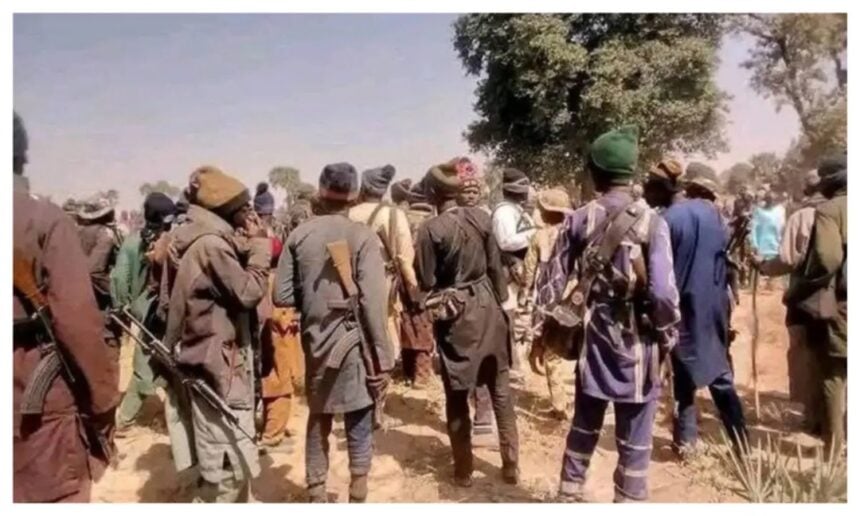
Suspected bandits launched another deadly attack in Nigeria’s Benue State, abducting at least 14 passengers and killing two others during a night-time ambush on a major road, authorities and local officials said Tuesday, as fears mounted over escalating insecurity in the region.
The passengers were traveling from communities in the Igede axis of Oju and Obi local government areas toward southwestern Nigeria when their vehicle was intercepted around 7 p.m. Monday along the Utonkon–Ojapo/Okpoga road in the Okpokwu area of the state, local sources and officials said.
Witness accounts indicated the assailants opened fire after the driver attempted to evade the attackers, triggering panic among those onboard. Two passengers were shot during the confrontation and died at the scene, while the remaining victims were forced off the road and taken into nearby bushland, residents and local officials said.
The latest abduction came less than 48 hours after armed men stormed St. John’s Catholic Church in Ojije, Utonkon, during a night vigil and kidnapped nine worshippers, underscoring what community leaders describe as a deteriorating security situation across central Benue.
A local resident in Makurdi, the state capital, said the vehicle departed Iheijwo Market in Oju Local Government Area early Monday evening before encountering the attackers.
“They left Iheijwo Market around 7 p.m. and passed through the Utonkon-Ojapo/Okpoga road when gunmen stopped them,” the source said by phone. “When the driver tried not to stop, one person was shot dead. The attackers later took the passengers into the bush.”
Another passenger later succumbed to gunshot wounds at the scene, the source added.
The Chairman of Oju Local Government Area, Jackson Ominyi, confirmed the incident, saying he received briefings from security aides shortly after the attack.
“My security officer informed me that some of our people were abducted around the Okpokwu axis,” Ominyi said Tuesday. “I learned that two passengers were killed and the remaining passengers were taken away.”
Ominyi said he had contacted officers of the Department of State Services in the area and was attempting to coordinate with neighboring local government officials to gather more details and support rescue efforts.
Efforts to obtain immediate confirmation from the Benue State Police Command were unsuccessful. The state’s Police Public Relations Officer, Udeme Edet, neither confirmed nor denied the incident when contacted earlier, saying only that she would revert with details. No further response had been received as of publication time.
The attack mirrors details published by Daily Post Nigeria, which also cited local sources describing a coordinated ambush in which the attackers blocked the roadway and fired at the vehicle when the driver attempted to escape.
Benue State, long plagued by communal clashes and criminal violence, has in recent years witnessed a surge in kidnappings along highways, particularly in rural corridors linking local government areas. While such attacks were once sporadic, residents say they have become increasingly frequent and brazen, often occurring in early evening hours when traffic thins and security patrols are scarce.
Security analysts note that the Utonkon–Ojapo/Okpoga corridor has emerged as a recurring hotspot for abductions, due in part to dense vegetation that allows armed groups to retreat quickly after attacks. The road also serves as a critical transit route for travelers moving between central Nigeria and the southwest, making it an attractive target for ransom-seeking gangs.
The recent spate of violence has heightened anxiety among residents, particularly following the abduction of worshippers from a Catholic church — an incident that shattered assumptions that religious spaces offered relative safety.
Community leaders warn that the cumulative effect of repeated attacks is disrupting economic activity and daily life, as residents increasingly avoid night travel and transport operators suspend services on high-risk routes. Some transport unions have reportedly begun advising drivers to travel only in convoys or limit movement after dusk, though enforcement remains inconsistent.
While ransom demands are common in such cases, officials have not disclosed whether contact has been made with the abductors or whether negotiations are underway. Authorities have also not released details on any search or rescue operations, though local officials say security agencies have been alerted.
Beyond the immediate tragedy, the latest incident raises broader questions about the capacity of security forces to secure highways and protect rural communities. Analysts say the persistence of such attacks reflects gaps in intelligence coverage, limited patrol resources, and slow emergency response times in remote areas.
For families of the abducted passengers, the focus remains on survival and safe return. Residents in Oju and surrounding communities said they were bracing for possible ransom demands while urging authorities to act swiftly.
As night attacks continue to ripple across Benue State, the latest ambush adds to growing pressure on security agencies and state leaders to stem a wave of criminal violence that residents fear is becoming the new normal.
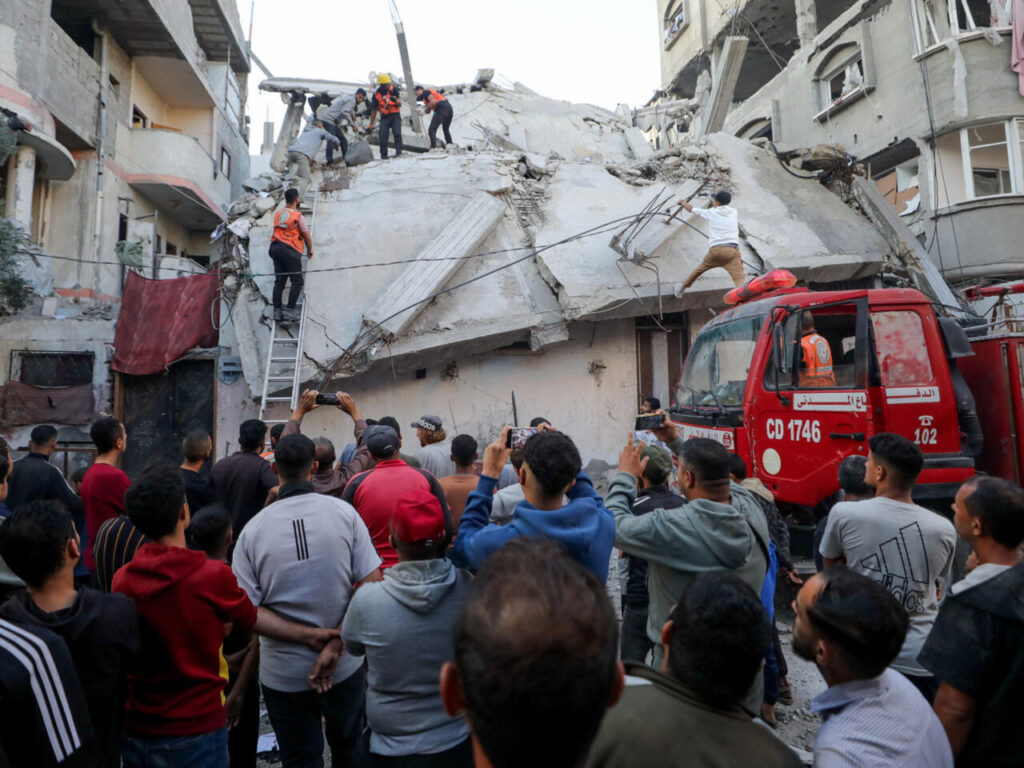
Israeli airstrikes and gunfire killed five Palestinians in Gaza on Tuesday, health officials confirmed, marking the latest violence eroding a four-month-old U.S.-brokered truce in the enclave as both sides repeatedly trade accusations of ceasefire violations threatening the fragile peace agreement.
In Deir Al-Balah in central Gaza, an airstrike killed two individuals riding an electric bike, medics disclosed. Subsequently, Israeli drone fire killed a woman in Deir Al-Balah while troops shot dead a man in Khan Younis in the southern region, medical personnel detailed. Another man perished from Israeli gunfire in Jabalia in northern Gaza, Palestinian medics confirmed.
The Tuesday violence followed a deadly Monday encounter when Israeli forces killed four militants in the southern city of Rafah after they emerged from an underground tunnel and opened fire on troops. Without commenting directly on the four people killed Tuesday, the Israeli military asserted it carried out attacks targeting what it characterized as Hamas militants in response to Monday’s incident in Rafah.
In Gaza City, dozens of Palestinians rallied at funeral services for three people killed by an Israeli airstrike on an apartment building in the area Monday night. One body was draped in a Hamas green flag, while another displayed a green Hamas ribbon on his forehead, signaling that the two were members of the militant organization. Reuters was unable to ascertain the identities of those killed.
Israel and Hamas have repeatedly traded blame for violations of the ceasefire agreement, a cornerstone element of President Donald Trump’s plan to terminate the Gaza war—the deadliest and most destructive conflict in the generations-old Israeli-Palestinian struggle. The mutual accusations of treaty violations threaten to collapse entirely a truce that has proven fragile since its October implementation.
The next phase of Trump’s peace plan requires Hamas disarmament, Israeli troop withdrawal from Gaza territory, and deployment of an international peacekeeping force. Hamas has consistently rejected demands to surrender its weapons, while Israeli officials indicate they are preparing for a return to full-scale warfare should the ceasefire completely disintegrate.
At least 580 Palestinians have been killed by Israeli fire since the October ceasefire deal was finalized, Gaza’s health ministry calculates. Israel maintains that four soldiers have been killed by militants in Gaza over the identical period, highlighting the asymmetric casualty patterns that have characterized the conflict throughout.
The Gaza war commenced with the October 7, 2023 Hamas attack on southern Israel that killed more than 1,200 people, Israeli tallies indicate. Israel’s subsequent air and ground war in Gaza has killed more than 72,000 people since then, Palestinian health ministry data shows—a staggering death toll that underscores the conflict’s catastrophic humanitarian impact.
Arab News disclosed that Israeli military strikes Monday killed three people west of Gaza City, the hospital receiving the casualties confirmed. Shifa Hospital reported the deaths amid the months-old ceasefire that has witnessed continued fighting despite its nominal existence.
The Israeli army asserted Monday it is striking targets in response to Israeli troops coming under fire in Rafah, which it characterized as a ceasefire violation. The army emphasized it is striking targets “in a precise manner,” framing operations as measured responses rather than indiscriminate attacks.
The four-month-old U.S.-backed ceasefire followed stalled negotiations and included Israel and Hamas accepting a 20-point plan proposed by President Trump aimed at ending the war unleashed by Hamas’ October 7, 2023 attack into Israel. At the time, Trump proclaimed it would lead to a “Strong, Durable, and Everlasting Peace”—a characterization that now appears optimistic given persistent violence.
Hamas freed all living hostages it still held at the deal’s outset in exchange for thousands of Palestinian prisoners held by Israel and the remains of others. This prisoner exchange represented the ceasefire’s most tangible achievement, reuniting families separated by the conflict’s brutal dynamics.
However, the larger issues the agreement sought to address—including Gaza’s future governance structure—were met with substantial reservations from both sides, and the United States offered no firm implementation timeline. This ambiguity has enabled both parties to interpret ceasefire terms selectively while continuing military operations they characterize as defensive or responsive.
U.N. Secretary-General Antonio Guterres expressed grave concern Monday about the Israeli security cabinet’s decision to deepen the country’s control over the occupied West Bank. Spokesperson Stéphane Dujarric warned in a statement that the Israeli decision could erode prospects for a two-state solution.
“Such actions, including Israel’s continued presence in the Occupied Palestinian Territory are not only destabilizing but – as recalled by the International Court of Justice – unlawful,” Dujarric declared, invoking international legal frameworks that Israel’s policies allegedly violate.
Israel’s security cabinet on Sunday approved measures aiming to deepen Israeli control over the occupied West Bank and weaken the already limited powers of the Palestinian Authority. Far-right Finance Minister Bezalel Smotrich asserted the measures would facilitate Jewish settlers forcing Palestinians to relinquish land, adding that “we will continue to bury the idea of a Palestinian state.”
Israel captured the West Bank, Gaza and east Jerusalem in the 1967 Middle East war. Palestinians demand all three territories for a future state—a national aspiration that Israeli policies increasingly render impossible through settlement expansion and territorial control measures.
Ali Shaath, head of the National Committee for the Administration of Gaza, told Egypt’s Al-Qahera News Monday that passage through the Rafah crossing with Egypt is beginning to improve after a chaotic first week of reopening marked by confusion, delays and limited crossings. The Palestinian official designated to oversee day-to-day affairs in Gaza disclosed that operations at the crossing were improving, with 88 Palestinians scheduled to travel through Rafah on Monday—more than have crossed in the initial days since reopening.
The European Union border mission at the crossing indicated in a Sunday statement that 284 Palestinians had crossed since reopening. Travelers included people returning after fleeing the war and medical evacuees with their escorts. In total, 53 medical evacuees departed during the first five days of operations.
These figures remain substantially below the negotiated target of 50 medical evacuees exiting and 50 returnees entering daily—quotas established by Israeli, Egyptian, Palestinian and international officials. The shortfall reflects administrative obstacles, security screenings and the overwhelming demand from Gaza residents seeking passage.
Shaath and other committee members remain in Egypt without Israeli authorization to enter the war-battered enclave, limiting their capacity to facilitate operations and address problems as they arise. This administrative limbo reflects broader complications of establishing governance structures in a territory still technically under ceasefire rather than peace agreement.
The Rafah crossing opened last week for the first time since mid-2024, constituting one of the main requirements for the ceasefire between Israel and Hamas. It was closed Friday and Saturday due to confusion around operational procedures—disruptions that stranded travelers and highlighted coordination failures.
Palestinian officials estimate nearly 20,000 people are seeking to leave Gaza for medical care unavailable in its largely destroyed health system. The territory’s healthcare infrastructure sustained catastrophic damage during the conflict, leaving facilities unable to provide complex treatments for conditions including cancer, cardiac problems and trauma requiring specialized surgery.
Palestinians who returned to Gaza in the first days after the crossing reopened described hours-long delays and invasive searches by Israeli authorities and an Israeli-backed Palestinian armed group, Abu Shabab. Israel denied allegations of mistreatment, though multiple testimonies suggest screening processes extend far beyond security necessity into harassment territory.
Gaza’s Health Ministry disclosed Monday that five people were killed over the previous 24 hours, elevating the death toll to 581 since the October ceasefire. The truce led to the return of remaining hostages—both living captives and bodies—from the 251 abducted during the October 7, 2023 attack that triggered the war.
Hamas-led militants killed around 1,200 people, mostly civilians, in the attack. Israel’s military offensive has since killed over 72,000 Palestinians, the ministry calculates—an entity operating under the Hamas-run government and staffed by medical professionals. The United Nations and independent experts consider it the most reliable source on war casualties despite Israeli allegations of inflated figures.
The persistent violence since October’s ceasefire implementation demonstrates that neither side has genuinely committed to peace rather than merely accepting tactical pauses before resumed conflict. Hamas continues maintaining armed presence and capability, while Israel conducts operations it frames as defensive but Palestinians experience as continued occupation and violence.
Trump’s peace plan architecture assumed mutual war-weariness would compel compromise on fundamental issues including governance, security and territorial control. However, both sides appear to view the ceasefire as opportunity to reposition rather than reconcile, preparing for eventual hostilities renewal rather than building sustainable peace foundations.
The international peacekeeping force envisioned in Trump’s plan remains non-existent, with no nation volunteering troops for deployment into a volatile situation where they would face fire from both sides depending on their perceived neutrality. Without external enforcement mechanisms, the ceasefire depends entirely on Israeli and Hamas restraint—a fragile foundation given mutual distrust and incompatible objectives.
As casualties accumulate and ceasefire violations multiply, the question shifts from whether the truce will collapse to when collapse occurs and what triggers the final breakdown. Tuesday’s five deaths represent incremental steps toward that inevitable outcome absent genuine diplomatic breakthrough addressing root causes rather than merely managing symptoms of the Israeli-Palestinian conflict.
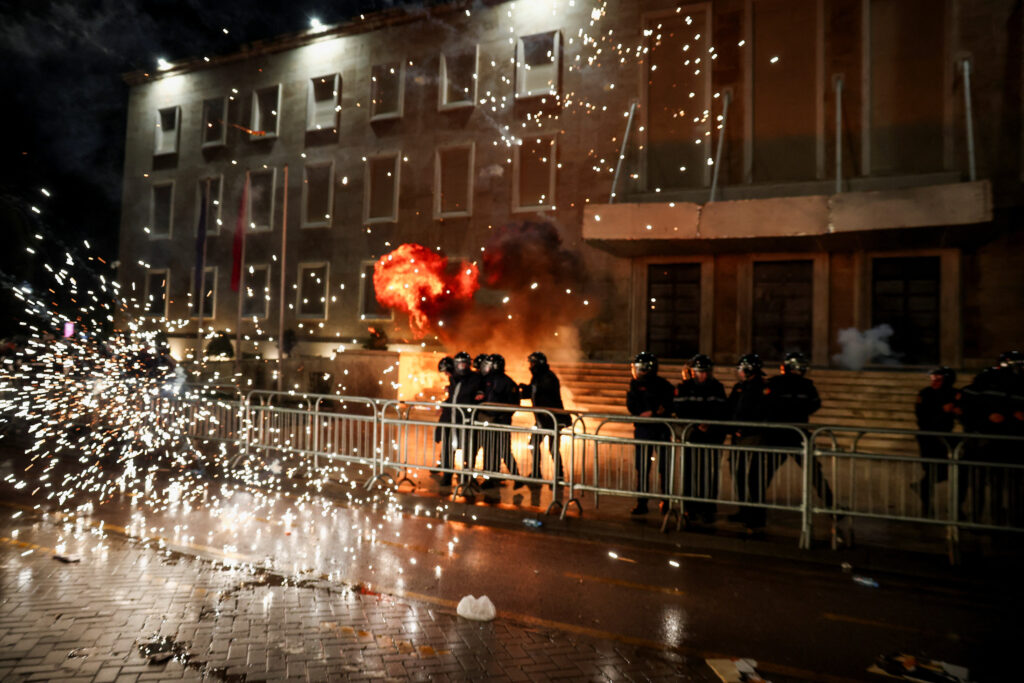
Police members operate during an anti-government protest, triggered by a corruption investigation into Deputy Prime Minister Belinda Balluku, in front of the Prime Minister's office in Tirana, Albania, February 10, 2026. REUTERS/Florion Goga
Thousands of anti-government demonstrators clashed violently with riot police in Albania’s capital Tuesday evening, hurling petrol bombs at governmental buildings and demanding the deputy prime minister’s resignation over corruption allegations that have plunged the nation into political crisis threatening Prime Minister Edi Rama’s thirteen-year grip on power.
Police members operate during an anti-government protest, triggered by a corruption investigation into Deputy Prime Minister Belinda Balluku, in front of the Prime Minister’s office in Tirana, Albania, February 10, 2026. REUTERS/Florion Goga
Protesters flooded streets near Rama’s office, waving national flags and chanting “Rama go home, this corrupted government should resign” as special police forces in riot gear deployed water cannons and tear gas to disperse crowds that had sealed off large portions of central Tirana. The confrontation represents the latest in escalating violent demonstrations that challenge the stability of Rama’s administration, which has governed since 2013 while positioning Albania as a candidate for European Union membership.
Political tensions have intensified dramatically since December when a special prosecution unit indicted Deputy Prime Minister Belinda Balluku for allegedly interfering in public tenders for major infrastructure projects and favoring certain companies in exchange for political or financial benefits. Balluku has categorically denied all wrongdoing, characterizing the accusations as politically motivated attacks.
The Special Prosecution Office—tasked with combating corruption and organized crime—requested that parliament lift Balluku’s immunity this week to enable her arrest and interrogation. However, the timing of any parliamentary vote remains uncertain, and whether legislators will vote at all appears doubtful given that Rama’s ruling Socialist Party controls a majority that could block the immunity removal.
By late evening Tuesday, broken glass, burned debris and abandoned protest banners littered the main square as smoke drifted across central Tirana. Several individuals sustained injuries as violence spread throughout the capital, with hospitals confirming treatment of patients suffering breathing problems from tear gas exposure and minor wounds from projectiles.
Riot police wearing helmets and carrying shields established defensive perimeters around government buildings as demonstrators attempted breaching barricades. Bottles, stones and firecrackers flew from the crowd toward security forces, who responded with coordinated water cannon deployments. Authorities have not released official casualty figures or arrest statistics.
Opposition leader Sali Berisha addressed thousands gathered outside the Prime Minister’s Office, accusing Rama of “declaring war on justice” to protect his inner circle from legal accountability. He alleged the government attempted manipulating courts and prosecutors to shield Balluku from prosecution.
“We were close to a coup within the state,” Berisha told the crowd, claiming popular mobilization prevented authoritarian consolidation. “The people stopped it.” He characterized Rama as “the most dangerous enemy of Albanians” and urged supporters to maintain street demonstrations until “corruption is defeated.”
His speech elicited loud chants and whistles as protesters pledged to continue nightly demonstrations, signaling sustained civil unrest rather than isolated protest events. The commitment to prolonged mobilization threatens governmental stability and potentially undermines Albania’s EU accession negotiations, which require demonstrating rule of law and anti-corruption effectiveness.
While Balluku’s indictment triggered the current protest wave, demonstrators emphasize their grievances extend far beyond one official’s alleged misconduct. Many protesters accuse the government of systemic corruption, misuse of public funds and systematically shielding senior officials from accountability regardless of evidence suggesting criminal conduct.
Opposition leaders contend Rama has repeatedly defended close allies facing legal scrutiny, eroding public trust in governmental institutions and the independence of Albania’s justice system. This pattern allegedly creates an atmosphere of impunity for well-connected officials while ordinary citizens face full legal consequences for infractions.
Protesters claim alleged corruption has contributed directly to high unemployment rates, rising living costs and mass emigration, with thousands of Albanians abandoning the country seeking better economic opportunities abroad. These economic grievances provide explosive fuel for political protests, as citizens attribute their deteriorating living standards to governmental malfeasance rather than global economic forces.
The corruption allegations against Balluku center on claims she interfered in procurement processes for major infrastructure development projects—investments critical to Albania’s modernization and EU integration objectives. Prosecutors allege she steered lucrative contracts toward favored companies, potentially in exchange for kickbacks or political support, corrupting processes designed to ensure competitive bidding and optimal value for public expenditures.
Such infrastructure tender manipulation, if proven, would represent serious violations of procurement regulations and potentially criminal abuse of office. The allegations strike at core governance failures that international institutions including the European Union monitor closely when evaluating candidate countries’ readiness for membership.
Albania has pursued EU accession for years, with the integration process requiring extensive reforms to judicial systems, anti-corruption mechanisms and democratic governance structures. The Balluku scandal and government response test whether Albania has genuinely implemented reforms or merely adopted superficial compliance while preserving corrupt practices beneath institutional facades.
Rama’s government faces a credibility crisis precisely when demonstrating clean governance matters most for EU aspirations. If parliament refuses lifting Balluku’s immunity despite prosecutorial requests backed by evidence, international observers will question Albania’s commitment to fighting high-level corruption regardless of political connections.
The Special Prosecution Office’s willingness to pursue a sitting deputy prime minister represents either genuine institutional independence or sophisticated political theater designed to create accountability appearances while ultimately protecting the accused through parliamentary obstruction. Which interpretation proves accurate will significantly influence Albanian and international perceptions of justice system integrity.
Rama has governed Albania since 2013, establishing himself as a dominant political figure who has presided over economic growth and infrastructure development while critics accuse him of authoritarian tendencies and tolerance for corruption among allies. His longevity in power provides stability that some Albanians value while others view as stagnation preventing necessary leadership renewal.
The prime minister positioned himself as instrumental to Albania’s EU integration efforts, cultivating relationships with European leaders and championing reforms ostensibly aligning Albanian governance with European standards. Tuesday’s violent protests threaten this carefully constructed image by highlighting persistent corruption allegations and public anger that contradicts narratives of successful reform implementation.
The demonstrations also reflect broader patterns across the Balkans where citizens increasingly mobilize against entrenched political elites perceived as corrupt and unresponsive. Similar protests have erupted in Serbia, Montenegro and Bosnia-Herzegovina, suggesting regional trends toward popular challenges of governmental authority when economic conditions deteriorate and corruption perceptions intensify.
For Albania specifically, the protests occur amid economic pressures including inflation affecting food and energy prices, infrastructure deficits despite construction projects, and brain drain as educated young Albanians emigrate seeking opportunities unavailable domestically. These material grievances combine with corruption outrage to fuel sustained mobilization.
The violence Tuesday evening—including petrol bomb attacks on government buildings—represents escalation beyond peaceful demonstration into civil disorder that could justify governmental crackdowns. However, aggressive police responses risk martyring protesters and galvanizing broader public sympathy for anti-government movements.
Rama’s government confronts difficult choices: lifting Balluku’s immunity and allowing prosecution might placate protesters but would sacrifice a close ally and potentially encourage further legal challenges against other officials; maintaining immunity protections validates corruption accusations and fuels continued unrest.
The parliamentary vote, if it occurs, will reveal whether Rama prioritizes protecting his deputy or attempting to defuse political crisis through accountability gestures. His Socialist Party’s majority provides the votes to block immunity removal, but exercising that power amid massive protests carries substantial political costs.
International observers including EU officials will scrutinize how Albania resolves this crisis as indicator of genuine anti-corruption commitment versus continued elite impunity. The outcome influences not only domestic stability but also Albania’s EU accession timeline and regional reputation.
As smoke cleared from Tuesday’s confrontations, the fundamental question remains whether Albanian institutions possess sufficient independence to hold powerful officials accountable or whether political connections provide effective immunity regardless of allegations. The answer will shape Albania’s political trajectory and determine whether current protests represent temporary unrest or the beginning of sustained civic mobilization demanding transformative change.
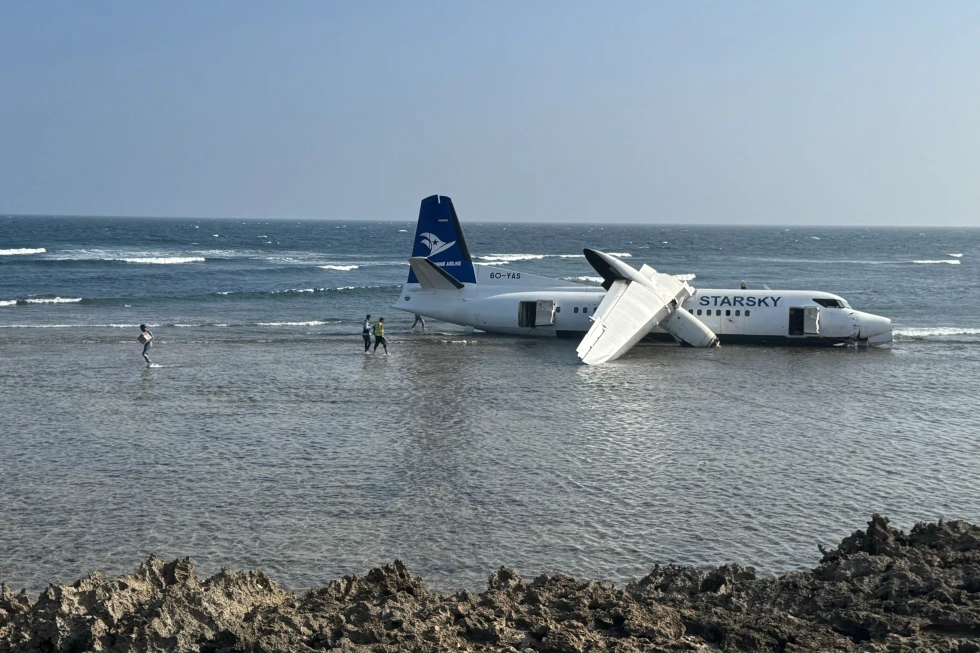
(AP)-A passenger aircraft carrying 55 people overshot the runway at Somalia’s main international airport on Tuesday and came to rest in shallow seawater along the Indian Ocean shoreline after an emergency landing triggered by a technical malfunction shortly after takeoff, Somali authorities and airline officials said. All passengers and crew escaped unharmed.
The Starsky Aviation flight, which had departed Mogadishu’s Aden Abdulle International Airport bound for the northern city of Gaalkacyo, encountered mechanical trouble approximately 15 minutes into the journey, prompting the flight crew to return to the capital, aviation officials said.
During the attempted emergency landing, the aircraft failed to stop within the designated runway area, crossed beyond the paved surface and rolled into shallow water near a public beach adjacent to the airport perimeter, officials confirmed.
“There were no injuries and no fatalities,” Starsky Aviation Chief Executive Officer Ahmed Nur said in a statement, confirming that all 50 passengers and five crew members were safely evacuated from the aircraft. “The aircraft overran the runway and came to rest by the shoreline.”
Somalia’s Minister of Transport and Civil Aviation, Mohamed Farah Nuh, said rescue teams and airport emergency personnel responded immediately, securing the scene and accounting for everyone on board.
“All passengers and crew have been rescued safely, and only the aircraft sustained damage,” Nuh said, adding that authorities have opened a full investigation into the incident to determine the precise cause of the malfunction and runway overrun.
Ahmed Moalim, director of Somalia’s Civil Aviation Authority, said the flight developed technical problems shortly after takeoff, forcing the pilot to abort the journey and attempt a return landing in Mogadishu. As the aircraft touched down, it veered off course and was unable to decelerate in time, ultimately leaving the runway environment.
Airport operations were briefly disrupted as emergency crews worked to evacuate passengers, secure the aircraft and assess potential environmental risks from fuel leakage. Officials said normal flight operations later resumed after safety checks were completed.
While no injuries were reported, the dramatic landing drew attention to aviation safety challenges in Somalia, a country that has worked in recent years to rebuild and modernize its civil aviation sector after decades of conflict and infrastructure damage.
Aden Abdulle International Airport, Somalia’s busiest aviation hub, sits close to the coastline, with limited buffer space between runways and the ocean. Aviation analysts note that this geographic layout can heighten the consequences of runway overruns, particularly during emergency landings or adverse weather conditions.
Tuesday’s incident underscores the critical role of pilot decision-making and emergency response readiness in mitigating potentially catastrophic outcomes. Aviation safety experts say the fact that the aircraft came to rest in shallow water, rather than deeper ocean or densely populated areas, likely contributed to the absence of injuries.
In recent years, Somalia has recorded steady growth in domestic air travel, with regional carriers connecting Mogadishu to cities such as Gaalkacyo, Hargeisa, Kismayo and Baidoa. The expansion has increased scrutiny of aircraft maintenance standards, pilot training and airport infrastructure, especially as passenger volumes rise.
Although Somali aviation authorities have made progress through international partnerships and oversight reforms, incidents like this highlight persistent vulnerabilities, including aging aircraft fleets, limited runway safety areas and constrained emergency resources at some airports.
Transport Minister Nuh said investigators will examine the aircraft’s maintenance records, pilot reports and air traffic communications to establish whether mechanical failure, runway conditions or operational factors played a role in the overrun. Findings from the inquiry are expected to guide any safety recommendations.
Starsky Aviation did not disclose the specific nature of the technical issue but said it is cooperating fully with regulators. The airline also emphasized that emergency procedures were followed and credited the flight crew and first responders for preventing loss of life.
Passengers described moments of fear as the aircraft struggled to stop, followed by relief when evacuation began. Airport staff assisted passengers as they exited the plane and were later transported back to the terminal for medical checks and debriefings.
Globally, runway overruns remain one of the most common types of aviation accidents, according to international aviation safety data. While most result in minor damage, overruns can become deadly when aircraft encounter obstacles, steep drop-offs or water beyond runway limits.
The Mogadishu incident is likely to fuel renewed discussion about runway safety enhancements, such as engineered materials arrestor systems (EMAS), extended safety areas or improved drainage and surface conditions. However, implementing such measures can be costly, particularly in developing aviation markets.
For Somalia, which continues to balance infrastructure development with security and economic recovery, the event serves as both a warning and a testament to progress. Despite the mechanical failure and runway excursion, coordinated emergency response and evacuation procedures prevented what could have been a major aviation disaster.
As investigators work to determine what went wrong, officials reiterated that passenger safety remains the government’s priority.
“We are grateful that no lives were lost,” Nuh said. “The investigation will ensure we understand exactly what happened and take steps to prevent a recurrence.”
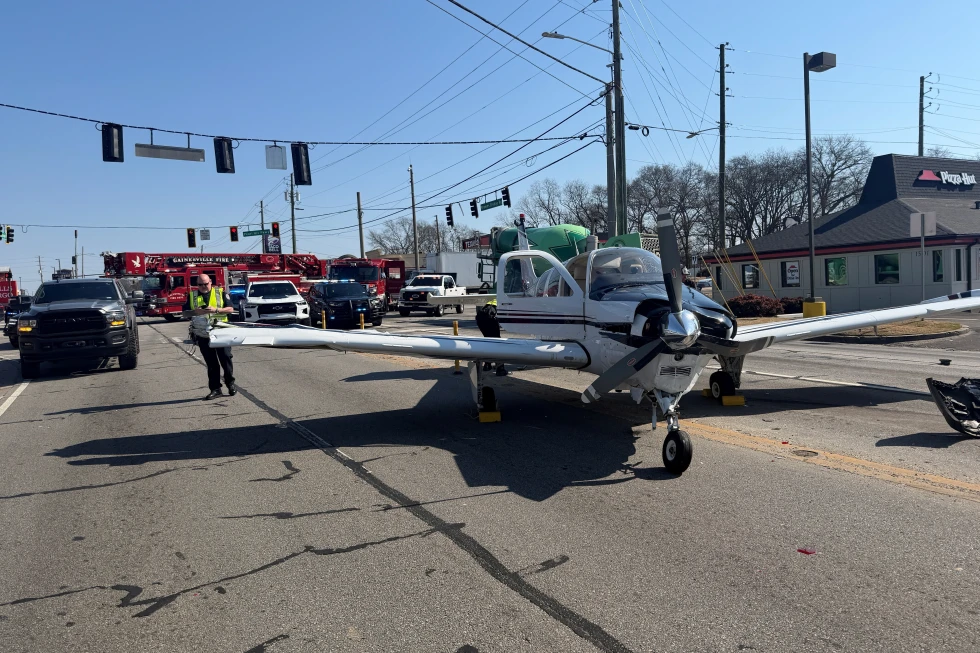
A single-engine aircraft suffering an apparent mechanical failure made a dramatic emergency landing on a heavily traveled roadway in northeast Georgia, colliding with three vehicles but sparing motorists and passengers from serious injury, authorities said.
The Hawker Beechcraft Bonanza went down Monday on Browns Bridge Road in Gainesville, roughly 50 miles northeast of Atlanta, after the pilot determined the plane lacked sufficient power to reach a nearby airport, officials with the National Transportation Safety Board said. Two people were taken to a hospital with minor injuries, while no fatalities were reported.
The incident unfolded shortly after takeoff from Lee Gilmer Memorial Airport in Gainesville. The aircraft had been en route to Cherokee County Regional Airport in Canton when the pilot detected engine trouble moments after departure and attempted to reverse course.
Investigators said the pilot initially tried to glide the aircraft back to the departure airport but soon realized the loss of engine power made that impossible. With altitude rapidly diminishing and no clear runway within reach, the pilot opted to land on Browns Bridge Road, one of the region’s primary traffic corridors.
Air traffic control recordings captured the gravity of the moment. In audio archived by LiveATC.net, the pilot is heard telling controllers that the plane was unlikely to make it safely to an airport and asking them to relay a message of love to his wife and parents.
“I think we’re not going to make it,” the pilot said over the radio. “Please tell my wife, Molly, I love her, and my parents. I love them so much.”
More than 10 minutes later, the tone of the transmission shifted, with the pilot calmly telling controllers, “We’re going to be fine,” after the aircraft had come to rest on the roadway.
The pilot, identified by local media as Thomas Rogers, later described the decision-making process during an interview with WAGA-TV.
“We lost our engine taking off out of Gainesville,” Rogers said. “We tried to glide back, did everything by the book, but realized we weren’t going to make it back with how far out we were, so we came down on the road.”
Police said the plane struck three vehicles as it descended, pushing a fuel tank into one of the cars. Gainesville police Capt. Kevin Holbrook said the impact could have been far worse given the volume of traffic on the road at the time.
“The fact that they were able to land in the middle of hundreds of vehicles and only hit three of them, no power lines, is very remarkable,” Holbrook said. “The fact that no one was seriously injured or killed is just astonishing.”
Emergency responders quickly shut down the roadway as firefighters and police secured the scene and assessed the risk of fuel leaks or fire. Traffic was diverted for several hours while crews removed the aircraft and investigators began documenting the crash site.
The NTSB said it has opened an investigation into the incident, which will focus on the cause of the reported engine failure, the aircraft’s maintenance history and the pilot’s actions during the emergency. Federal Aviation Administration officials are assisting.
While the factual investigation remains ongoing, aviation experts say the outcome underscores how critical pilot training and quick decision-making can be when mechanical failures occur at low altitude.
Engine failures shortly after takeoff are among the most dangerous scenarios for pilots, leaving little time or margin for error. In such situations, pilots are trained to prioritize control of the aircraft and select the safest available landing area, even if that means using unconventional surfaces such as roads or open fields.
In this case, Browns Bridge Road’s straight stretch and relatively open sightlines may have contributed to the pilot’s ability to bring the plane down without catastrophic consequences. Authorities noted that the aircraft avoided power lines, utility poles and dense roadside structures, factors that often turn emergency landings into fatal crashes.
The incident also highlights the risks posed by aging general aviation aircraft. Many single-engine planes operating across the United States are decades old, and while they remain safe when properly maintained, mechanical issues remain a concern. According to federal aviation data, engine failures account for a significant share of emergency landings involving small planes.
At the same time, the outcome is likely to renew discussion about how local infrastructure intersects with aviation safety. As cities and suburbs expand closer to small airports, pilots facing emergencies may have fewer open spaces to choose from, increasing the likelihood that roads or populated areas become last-resort landing zones.
For motorists who witnessed the plane descending onto the roadway, the event was both shocking and surreal. Police said several drivers narrowly avoided being struck, and some stopped immediately to assist those involved until emergency crews arrived.
Officials credited a combination of pilot skill, favorable conditions and luck for preventing a tragedy on what is normally one of northeast Georgia’s busiest thoroughfares.
The aircraft was later removed from the scene, and the road was reopened after authorities determined there was no remaining hazard. Investigators are expected to issue a preliminary report in the coming weeks, though a full NTSB investigation could take months.
As the probe continues, aviation officials emphasized that emergency landings involving small aircraft are rare and that commercial air travel remains statistically safer than most other forms of transportation. Still, the incident serves as a stark reminder of how quickly routine flights can turn into life-or-death situations.
For the pilot and those on the ground, the outcome offered a measure of relief amid the chaos. What began as a routine hop between two Georgia airports ended with twisted metal on asphalt — but also with lives spared, a result authorities described as nothing short of extraordinary.
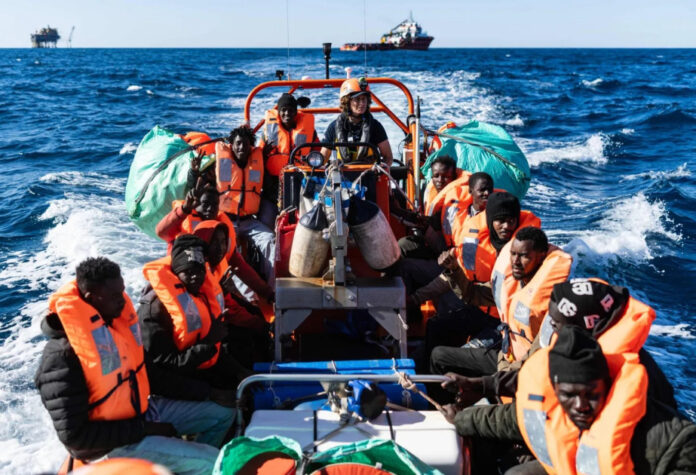
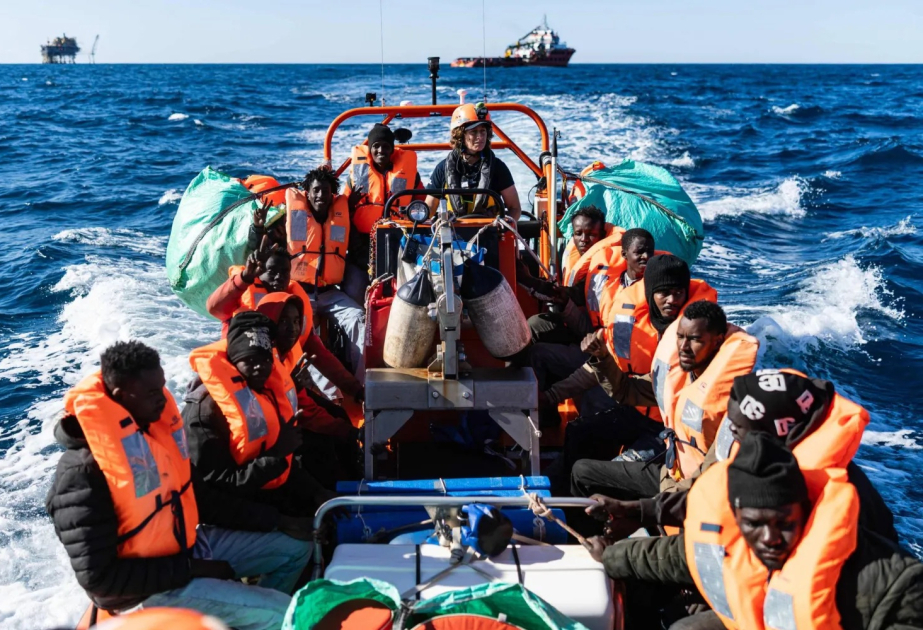
Fifty-three migrants including two infants perished or remain missing after a rubber boat carrying 55 people capsized off the Libyan coast Friday, leaving only two Nigerian women survivors who lost their husbands and children in the latest Mediterranean tragedy, the International Organization for Migration disclosed Monday.
The vessel departed from Zawiya on Thursday evening before overturning north of Zuwara on Friday, the IOM revealed in a statement citing accounts from the rescued women. Zawiya and Zuwara are coastal municipalities west of the Libyan capital Tripoli, serving as frequent departure points for desperate migrants attempting the perilous Central Mediterranean crossing toward Europe.
“Only two Nigerian women were rescued during a search-and-rescue operation by Libyan authorities,” the Geneva-based agency confirmed. “One survivor reported losing her husband, while the other said she lost her two babies in the tragedy,” the organization added, highlighting the catastrophic human toll on the two families.
IOM teams provided the survivors with emergency medical care upon disembarkation from rescue vessels. Survivor testimonies revealed that the boat—transporting migrants and refugees of African nationalities—departed from Al-Zawiya around 11 p.m. on February 5. Approximately six hours into the journey, it capsized after taking on water in conditions that proved fatal for nearly everyone aboard.
“IOM mourns the loss of life in yet another deadly incident along the Central Mediterranean route,” the agency stated, expressing grief over a disaster that has become tragically routine as migration flows continue despite mounting death tolls.
The latest catastrophe elevates the number of migrants confirmed dead or missing on the Central Mediterranean route in 2026 to at least 484, underscoring the relentless human cost of irregular migration across one of the world’s deadliest maritime passages. More than 1,300 migrants have vanished in the Central Mediterranean throughout 2025, the U.N. agency documented.
January alone witnessed at least 375 migrants confirmed dead or missing in the area following multiple “invisible” shipwrecks amid extreme weather conditions, with humanitarian organizations believing hundreds more deaths escaped documentation entirely. These unrecorded casualties reflect the reality that many vessels sink without witnesses, distress signals or survivors to report the disasters.
The Central Mediterranean route connecting North Africa with southern Europe has claimed more than 33,000 migrant lives or resulted in disappearances between the start of 2014 and the end of 2025, the IOM’s Missing Migrants Project calculated. Last year, the organization recorded 1,873 individuals missing or dead in the Mediterranean, including 1,342 on the central route specifically.
Libya has evolved into a primary transit corridor for migrants fleeing conflict and poverty across Africa and the Middle East, seeking passage to Europe via treacherous routes across the Sahara Desert and over the Mediterranean Sea. This migration pattern intensified following the 2011 NATO-backed uprising that toppled longtime dictator Muammar Gaddafi, creating power vacuums and security gaps that criminal networks exploited.
The IOM emphasized that trafficking and smuggling networks systematically exploit migrants along the route from North Africa to southern Europe, profiting from dangerous crossings in unseaworthy vessels while exposing desperate people to “severe abuse.” These criminal enterprises operate with relative impunity amid Libya’s fragmented governance and limited state capacity to control coastal areas.
The agency called for stronger international cooperation to dismantle smuggling networks alongside establishment of safe and regular migration pathways designed to reduce risks and save lives. This appeal reflects recognition that enforcement measures alone cannot eliminate migration driven by war, persecution, poverty and climate disruption in origin countries.
A European Commission spokesperson acknowledged Brussels was attempting to address root causes of irregular migration and promote legal, safe and orderly pathways to the European Union. “These tragic events once again underline the need to intensify joint efforts with our partners, including Libya, to prevent such dangerous journeys and to combat the criminal networks of migrant smugglers that put lives at risk,” the spokesperson told Agence France-Presse.
This diplomatic language acknowledges European Union complicity in migration policies that effectively funnel desperate people toward dangerous irregular routes by restricting legal asylum and labor migration channels. The absence of safe pathways forces migrants into the hands of smugglers operating unseaworthy vessels with minimal safety equipment.
The IOM fears that hundreds of people have died since January attempting Mediterranean crossings amid harsh winter weather conditions that make the inherently dangerous journey even more lethal. Cold temperatures, high waves and storms increase capsizing risks while reducing survival time for those thrown into frigid waters.
The humanitarian crisis in Libya extends beyond maritime disasters to include widespread abuse of migrants detained in official and clandestine facilities. In mid-January, at least 21 bodies of migrants were discovered in a mass grave in eastern Libya, with up to 10 survivors in the group bearing signs of torture before being freed from captivity, two security sources disclosed.
Days afterward, Libyan security authorities liberated more than 200 migrants from what they characterized as a secret prison in the southeastern town of Kufra after captives were held in inhuman conditions, two additional security sources confirmed. These incidents illuminate the systematic violence and exploitation migrants endure while transiting through Libya.
Several nations including Britain, Spain, Norway and Sierra Leone urged Libya at a November U.N. meeting in Geneva to close detention centers where human rights organizations document systematic torture, abuse and killings of migrants and refugees. These facilities operate with minimal oversight and have become synonymous with brutality against vulnerable populations.
The detention centers often serve as extortion sites where smuggling networks and corrupt officials demand additional payments from migrants or their families before releasing them to continue journeys. Those unable to pay face indefinite detention under horrific conditions, forced labor or being sold to other criminal groups.
The February 5 capsizing reflects broader patterns where smugglers overcrowd flimsy rubber boats designed for far fewer passengers, provide inadequate fuel and navigation equipment, and launch vessels regardless of weather forecasts. These calculated decisions maximize smuggler profits while transferring all risks onto migrants who often cannot swim and lack life jackets.
The presence of two infants among the dead underscores how entire families undertake these perilous journeys despite obvious dangers. Parents make agonizing calculations that potential European asylum and economic opportunities outweigh known risks of drowning, suggesting conditions in origin countries or Libyan detention have become unbearable.
The two Nigerian women survivors now face traumatic grief compounded by uncertainty about their immigration status and future prospects. Having lost their families in pursuit of safety and opportunity, they must navigate complex asylum processes while processing catastrophic loss and probable survivor’s guilt.
Nigeria ranks among the top source countries for migrants attempting the Central Mediterranean crossing, driven by factors including economic instability, unemployment, insecurity from Boko Haram and other armed groups, and limited domestic opportunities. Many Nigerians transit through Niger and Libya before attempting sea crossings, enduring multiple dangers across thousands of kilometers.
The IOM’s emergency medical care provision represents immediate humanitarian response, but survivors require extensive psychological support, legal assistance navigating asylum procedures, and potential family reunification or repatriation services. The organization’s capacity to provide comprehensive support faces resource constraints amid overwhelming demand.
European Union migration policies emphasize border enforcement and cooperation with North African transit countries to prevent irregular arrivals, an approach critics characterize as externalizing borders and outsourcing migration management to nations with poor human rights records. These policies arguably increase migrant vulnerability while doing little to address underlying displacement drivers.
The tragedy also exposes limitations of search-and-rescue operations in the Central Mediterranean. Many shipwrecks occur beyond areas where rescue assets patrol regularly, while coordination between Libyan authorities, European coast guards and NGO rescue vessels remains complicated by political tensions and jurisdictional disputes.
Survivors’ accounts of boats capsizing after taking on water suggest structural failures common with overloaded rubber craft that cannot withstand Mediterranean wave action. Smugglers typically provide minimal instruction on boat operation and safety procedures, leaving migrants ill-equipped to respond when emergencies occur.
The disaster’s timing—occurring six hours into the journey—suggests the vessel may have traveled beyond Libyan territorial waters into international waters where rescue coordination becomes more complex. Determining which authority bears responsibility for search-and-rescue operations in specific Mediterranean zones has generated political controversy as European nations seek to limit obligations.
As the two Nigerian survivors begin processing their losses and confronting uncertain futures, the broader migration crisis continues unabated. Without fundamental changes addressing conflict, poverty and climate disruption in origin countries, combined with expanded legal migration pathways and effective dismantling of smuggling networks, the Mediterranean will continue claiming thousands of lives annually in one of the 21st century’s most persistent humanitarian catastrophes.
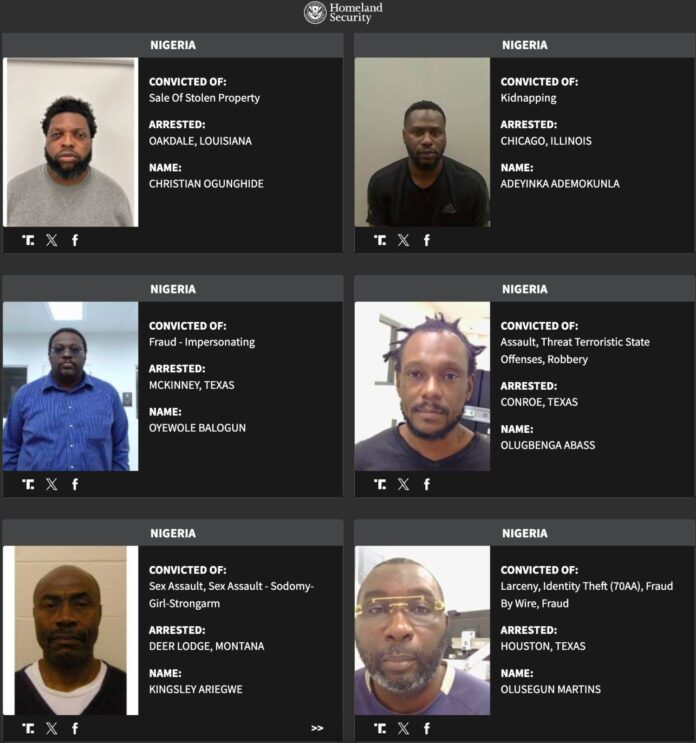
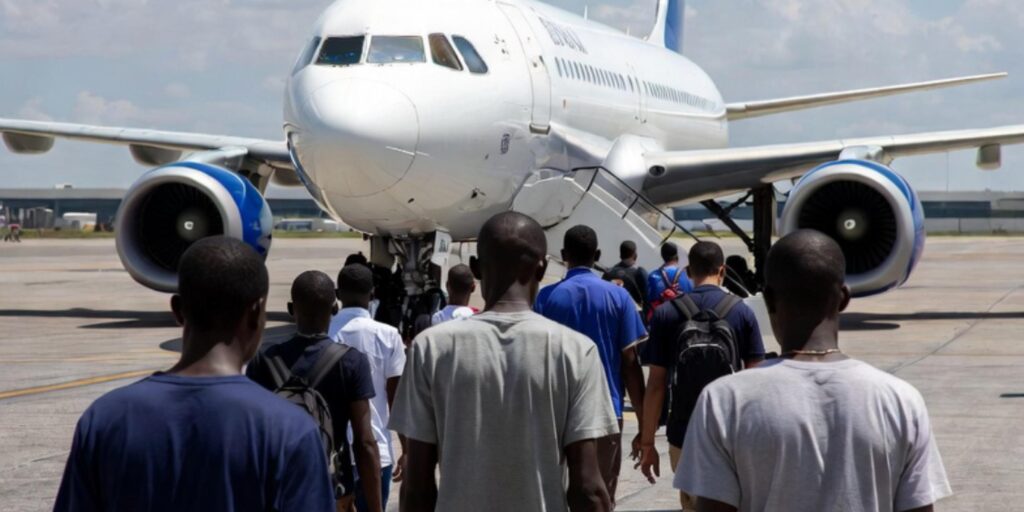
United States immigration authorities have expanded a high-profile deportation operation by adding 18 more Nigerians to a federal list of what officials describe as the “worst of the worst” criminal non-citizens, bringing the total number of Nigerians slated for removal to 97.
The latest update, published on the Department of Homeland Security website and reviewed Monday, comes just days after PUNCH Metro disclosed that 79 Nigerians convicted of various crimes had been earmarked for deportation under an intensified enforcement drive led by U.S. Immigration and Customs Enforcement.
The addition of new names signals a widening of the operation as the administration of President Donald Trump presses ahead with a nationwide crackdown targeting immigrants with criminal records. DHS officials said the enforcement action is ongoing and forms part of a broader strategy to prioritize the arrest and removal of non-citizens convicted of serious offenses.
Federal records show that the newly added individuals were convicted primarily of financial crimes, including wire fraud, mail fraud and identity theft, offenses U.S. authorities say cause significant harm to victims and undermine public trust.
In a statement accompanying the updated list, the department said ICE officers nationwide are acting under directives to focus first on individuals deemed the highest public-safety risk.
“The U.S. Department of Homeland Security is highlighting the worst of the worst criminal aliens arrested by U.S. Immigration and Customs Enforcement,” the statement said. “Under Secretary Noem’s leadership, the hardworking men and women of DHS and ICE are fulfilling President Trump’s promise and carrying out mass deportations, starting with the worst of the worst.”
Among the Nigerians newly listed for removal are Oluwaseyanu Akinola Afolabi, Olugbeminiyi Aderibigbe, Benjamin Ifebajo, Obinwanne Okeke, Kolawole Aminu, Oluwadamilola Olufunsho Ojo and Franklin Ibeabuchi. Others include Alex Afolabi Ogunshakin, Joshua Ineh, Stephen Oseghale, Eghosa Obaretin, Adesina Surajudeen Lasisi, Ibrahim Ijaoba, Azeez Yinusa, Charles Akabuogu, Kelechi Umeh, Lotenna Chisom Umeadi, Donald Ehie and Chukwudi Kingsley Kalu.
Their inclusion raises the overall number of Nigerians identified for deportation to 97, underscoring the scale of the enforcement push and its impact on one of the largest African immigrant communities in the United States.
Earlier this month, DHS data showed that 79 Nigerians had already been designated as “high-priority criminal aliens.” Those individuals were convicted of offenses ranging from fraud and drug trafficking to robbery, assault and manslaughter, according to federal records published online.
Names previously released by U.S. authorities include Boluwaji Akingunsoye, Ejike Asiegbunam, Emmanuel Mayegun Adeola, Bamidele Bolatiwa, Ifeanyi Nwaozomudoh, Aderemi Akefe, Solomon Wilfred, Chibundu Anuebunwa, Joshua Ineh, Usman Momoh, Oluwole Odunowo and Bolarinwa Salau. Others listed earlier are Oriyomi Aloba, Oludayo Adeagbo, Olaniyi Akintuyi, Talatu Dada, Olatunde Oladinni, Jelili Qudus, Abayomi Daramola, Toluwani Adebakin, Olamide Jolayemi, Isaiah Okere, Benji Macaulay and Joseph Ogbara.
Additional names published by DHS and cited by PRNigeria include Olusegun Martins, Kingsley Ariegwe, Olugbenga Abass, Oyewole Balogun, Adeyinka Ademokunla, Christian Ogunghide, Christopher Ojuma, Olamide Adedipe, Patrick Onogwu, Olajide Olateru Olagbegi and Omotayo Akinto. Others listed are Kenneth Unanka, Jeremiah Ehis, Oluwafemi Orimolade, Ayibatonye Bienzigha, Uche Diuno, Akinwale Adaramaja, Boluwatife Afolabi, Chinonso Ochie, Olayinka A. Jones, Theophilus Anwana, Aishatu Umaru and Henry Idiagbonya.
The DHS records further name Bernard Ogie Oretekor, Abiemwense Obanor, Olufemi Olufisayo Olutiola, Chukwuemeka Okorie, Abimbola Esan, Elizabeth Miller, Chima Orji, Adetunji Olofinlade, Abdul Akinsanya, Elizabeth Adeshewo, Dennis Ofuoma, Quazeem Adeyinka, Ifeanyi Okoro, Oluwaseun Kassim, Olumide Bankole Morakinyo, Abraham Ola Osoko, Oluchi Jennifer and Chibuzo Nwaonu.
U.S. officials say the list spans multiple states, reflecting what DHS describes as a coordinated national effort to enforce immigration laws and remove individuals convicted of crimes. The department maintains that the focus is not on nationality but on criminal history and public safety risk.
The stepped-up enforcement has drawn attention within immigrant communities and sparked renewed debate over the administration’s immigration agenda. Advocacy groups say the visibility of the operations, including coordinated arrests and raids, has created fear in several U.S. cities. Reports indicate that some Nigerian nationals have gone into hiding, while others are making plans to leave the country voluntarily amid uncertainty over enforcement actions.
DHS officials, however, argue that the measures are necessary to strengthen national security and uphold the rule of law. They emphasize that those targeted have been convicted of crimes and exhausted legal avenues to remain in the United States.
The expansion of the deportation list also highlights broader diplomatic and social implications for Nigeria, which has seen a steady flow of returnees in recent years as U.S. and European immigration enforcement tightens. Analysts say the latest development could strain family networks, affect remittance flows and raise questions about reintegration support for deported individuals.
At the same time, the Trump administration’s approach reflects a campaign promise to prioritize removals of criminal non-citizens, a policy officials say will continue as ICE officers conduct further investigations and arrests nationwide.
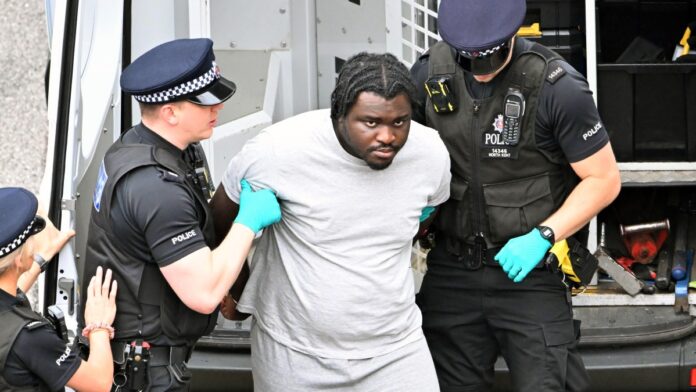
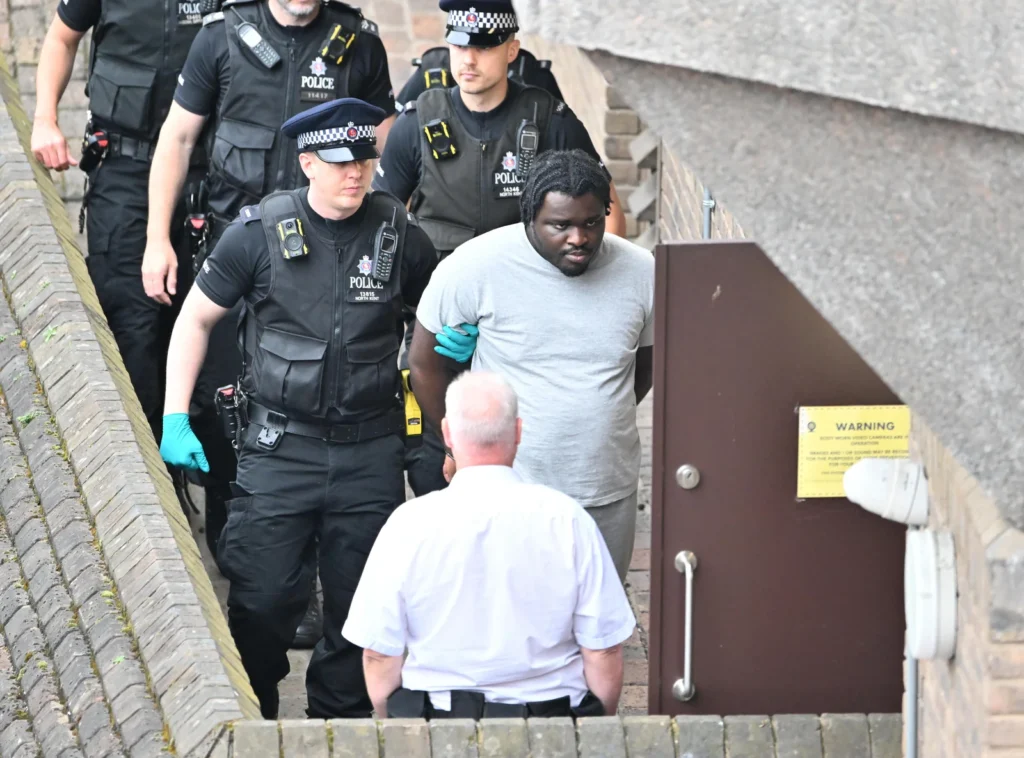
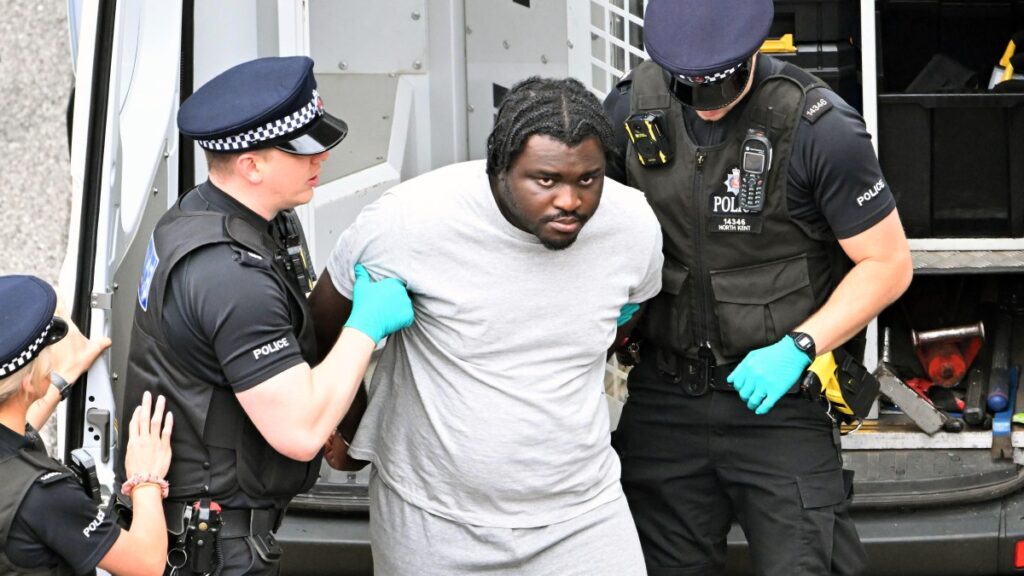
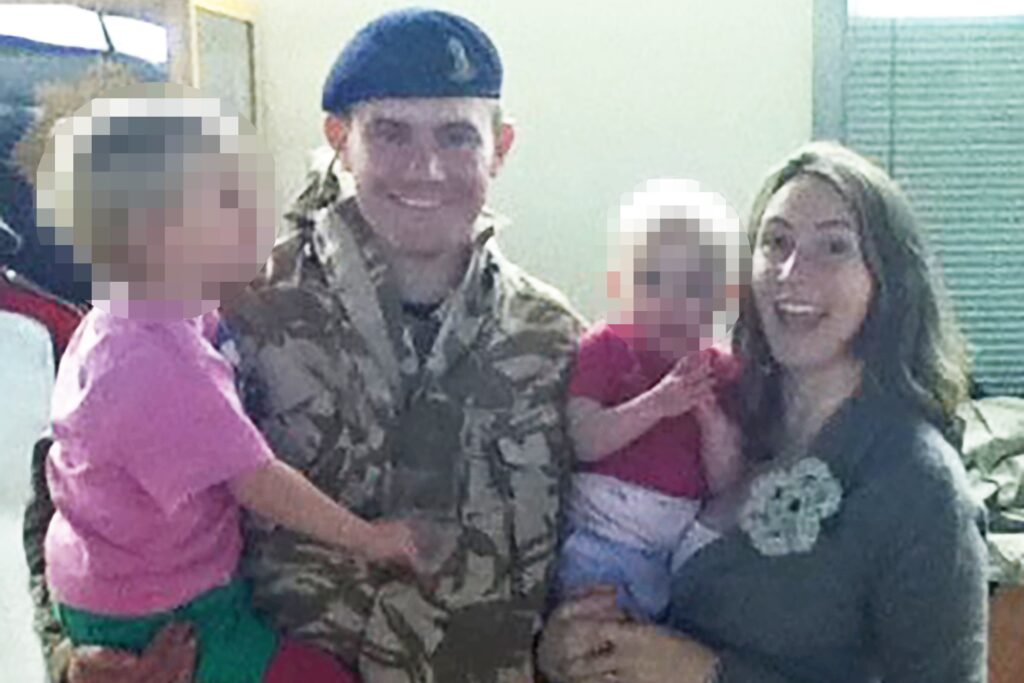
A 25-year-old man admitted guilt Monday to attempted murder charges stemming from a brutal stabbing attack on a uniformed British Army officer outside military barracks in Kent, concluding a case delayed repeatedly due to psychiatric concerns about the defendant’s mental fitness to enter pleas.
Anthony Esan, appearing via video link from the high-security psychiatric hospital Broadmoor in Berkshire while wearing a blue and white jumper, pleaded guilty to stabbing 47-year-old Lieutenant Colonel Mark Teeton in July 2024. The defendant, who immigrated to London from Nigeria in 2009 at age nine, also entered guilty pleas to two counts of possession of bladed weapons.
Maidstone Crown Court scheduled sentencing for February 9 in proceedings expected to extend three days as the tribunal weighs complex questions of culpability and appropriate disposal given Esan’s documented mental health struggles. Prosecutor Alison Morgan KC characterized the matter as “plainly a sentencing exercise with some measure of complexity,” noting that options include a discretionary life sentence, determinate prison term or mental health disposal.
Lt-Col Teeton, who dedicated 25 years to British Army service including two tours each in Iraq and Afghanistan, was attacked mere yards from his residence near Brompton Barracks on July 23, 2024. The chief instructor at the British Army’s school of military engineering sustained serious injuries described as life-threatening before medical intervention at a nearby hospital, where he underwent multiple surgeries addressing wounds to his neck, chest, abdomen and groin.
The father of two teenage daughters appeared in court alongside his wife Eileen to witness Esan’s guilty pleas, providing closure to a traumatic ordeal that profoundly altered their family’s sense of security. Lt-Col Teeton was discharged from hospital several weeks following the attack but continues receiving rehabilitation for lasting physical effects.
Prosecutor Rajni Prashar disclosed at a previous Medway Magistrates’ Court hearing in 2024 that a member of the public telephoned emergency services to report a male had been stabbed, subsequently clarifying “the victim was a soldier in uniform.” Witnesses observed a man “running up behind” the army officer before he “pulled the soldier to the ground” and stabbed him “repeatedly” prior to fleeing on a moped.
Two knives were abandoned at the crime scene, with investigators recovering three additional blades stored on the motorcycle. Esan was apprehended near his Rochester home just 25 minutes after the assault, his hands visibly stained with blood.
The case experienced repeated postponements due to concerns about the defendant’s mental health and capacity to participate meaningfully in legal proceedings. However, leading defense barrister Richard Barraclough KC confirmed this morning that the defense was “satisfied he has the capacity to plead to the indictment and we expect he will plead guilty to the entire indictment when it is put to him.”
Video documentation presented to the court captured the attack’s horrifying progression. Footage shows Esan parking his moped near Lt-Col Teeton’s home before approaching the officer walking past and requesting to use his telephone, claiming his vehicle had broken down. As Teeton responded, Esan launched the assault, stabbing him repeatedly.
Dashboard camera video from a passing vehicle recorded the attack unfolding in the roadway. Esan is visible stabbing Lt-Col Teeton, who stumbles, regains footing and attempts escape in the opposite direction. The assailant pursues and continues stabbing until Eileen Teeton, alerted by disturbance sounds in the street, rushes from their home and physically drags the attacker off her wounded husband.
“Mrs Teeton came out of the home address, having heard shouts for help, and the defendant’s attack was trained on Mr Teeton. Mrs Teeton only realised it was her husband being attacked when she got right beside the defendant,” Morgan explained to the court, crediting the wife’s intervention with potentially saving her husband’s life.
A doorbell recording captured Eileen Teeton’s piercing screams as she confronted the assailant. “Get off him. What are you doing? What the f*** are you doing?” she demanded while pushing Esan away. The delivery driver briefly locked eyes with her before resuming his attack on the soldier. One witness claimed Esan ran his finger along the blade before licking it as his victim lay bleeding.
“His wife tried pulling the attacker off. [Esan] didn’t want her though, he just wanted the soldier,” a witness observed. “Nobody else in the vicinity was in danger. The only person he was targeting was the soldier he attacked.”
Lt-Col Teeton disclosed in a victim impact statement read in court that medical personnel characterized his survival as miraculous given the severity and location of his injuries. The statement detailed internal damage to his voice box, right lung, liver and abdominal wall alongside external wounds to neck, chest, abdomen and groin.
“I did not imagine for a moment that I would be attacked in such a way on the streets of Britain, in a place where I felt safe. The consequences have been massive,” he expressed, reflecting on a 26-year military career spanning combat deployments and international training assignments.
“The fine line between life and death was highlighted by the attack and murder of four girls in Southport, the stabbing of an Australian girl in London and a little-reported fatal stabbing of a bus driver in London, all of which occurred during the first three weeks following the attack,” he continued. “I sometimes reflect on this fine line and probably will every time another knife attack occurs in the UK.”
The officer acknowledged being unconscious for substantial portions of the assault, characterizing this as a blessing “as it means that I am unable to remember a large part of being attacked.” He credited his wife and strangers who intervened with demonstrating extraordinary courage. “They are all heroes, and I am forever in gratitude to them,” he declared while visibly emotional.
Eileen Teeton’s victim impact statement described experiencing “a wave of terror” after rushing to push Esan away from the soldier lying on the ground, a scene she said she could “not stand by” and watch unfold. “He chose not to come after me and, as I became frozen, I watched horrified by his continued savage attack, and realised it was my husband on the ground and he was carving at his face and neck,” she recounted.
During hospital visits, her husband revealed his understanding of the attack’s intent. “Do the people at work know what he tried to do to me?” he asked. When she inquired what the attacker attempted, he replied: “Cut my head off! Like Lee Rigby.”
The reference invokes the 2013 murder of Fusilier Lee Rigby by Islamist terrorists near the Royal Artillery Barracks in Woolwich—an incident that shocked Britain and became synonymous with targeted attacks on uniformed military personnel. Court testimony revealed that days before assaulting Lt-Col Teeton, Esan searched “Woolwich soldier murdered” on the internet, demonstrating premeditation and awareness of the Rigby precedent.
Esan also sought information about Enoch Powell and a terrorist attack in West Africa, while viewing TikTok videos depicting knife attacks in other countries. He conducted reconnaissance of the area one day before the assault, suggesting calculated planning rather than impulsive violence.
The attack bore disturbing similarities to the Rigby murder, characterized as a “deliberate attack on a serving member of the armed forces” targeting a soldier specifically because of his military uniform. This pattern distinguishes the assault from random violence, positioning it within a category of ideologically or symbolically motivated attacks on military personnel.
Esan’s background reveals a trajectory marked by mental health struggles and frustrated military aspirations. Born in Nigeria, he relocated to the UK in 2009 with his mother and two elder siblings. His mother worked multiple jobs including as a cleaner, frequently departing early morning and returning late evening in hopes her sacrifices would provide her children with opportunities for success.
Neighbors in Rotherhithe, southeast London, where Esan spent formative years, recalled a reclusive child with mental health difficulties heavily reliant on his mother and frequently observed jogging around the local area. “He was quiet. He had just come to London. It was a massive culture shock for him. His mother was a strict Christian, so she would always do her best to keep him straight and narrow,” a relative disclosed to The Times.
During this period, Esan played football in the same group as Callum Wheeler, who lived a street away and would later receive a life sentence for murdering Police Community Support Officer Julia James in Kent in 2021. One resident who participated in football with both described Esan as a “calm” and “decent” forward with a heavy Nigerian accent. “He was super quiet but definitely louder than Callum,” the resident observed.
Esan struggled with social interaction and remained heavily dependent on his mother. “We thought he had mental health problems,” a neighbor confirmed. “Their mother always looked after him and I remember his mum telling him all the time what he needed to do. He was always looking down. He’d never look into your eyes even when he spoke to people. He had difficulties communicating with people.”
Yahya Puladi, 52, described Esan as an unnervingly quiet regular customer at his chicken shop. “He wasn’t all there. He was only about 30 per cent there mentally,” Puladi assessed. “He just used to sit there and barely anyone could get a reaction out of him.”
Esan relocated to Kent following his stepfather David Fairfield’s death from lung cancer in 2013. His mental health deteriorated subsequently, he reeked of cannabis odor and was frequently observed purchasing rolling papers, residents disclosed.
By 2023, Esan’s mother began flagging concerns about her son’s behavior to police and mental health services. Esan was receiving community treatment from Greenwich mental health services following a psychosis diagnosis. Police characterized it as “organic psychosis”—a state caused by medical illnesses rather than substance abuse.
The warnings eerily paralleled Wheeler, the “highly sexualised” recluse whose father claimed pleas for help were “ignored by mental health teams for seven years” before his son’s fatal attack on PCSO James.
Esan’s condition deteriorated in months preceding the attack. A source disclosed that he stopped engaging with family members, who believed he had ceased taking prescribed medication. He had previously been arrested for drugs offenses, though no further action was taken due to insufficient evidence, and for driving violations.
Court testimony revealed Esan made several unsuccessful attempts to join the British Army in the year before the attack. In 2020, he was rejected due to eczema and a nut allergy. That same year, he was referred to mental health services as he appeared unwell and reported auditory hallucinations.
Esan applied to the Army for a second time in April 2021 but was rejected, with medical reasons cited as “psychotic disorder” and eczema. His subsequent appeal was denied, and he initiated another application in June 2021, which was abandoned. In March 2023, Esan commenced yet another application but withdrew for “health reasons” without completing the process.
The court heard that he was discharged from Medway Early Intervention Services to the Medway Low-Intensity Support Community Mental Health Team on June 21, 2024. He attended an appointment with the same service on July 19, 2024, having purchased knives from Argos in Strood that day.
A care worker noted “no obvious signs of psychosis” and disclosed that Esan requested cessation of his antipsychotic medication administered as long-lasting injectable, seeking to switch to tablet form. The care worker rejected this request and administered the drug by injection.
On July 19, four days before the attack, Esan purchased a five-knife set from the Argos retail location. CCTV captured him at 4:31 p.m. on July 23 riding his red moped in the area where the attack would later unfold. Just over an hour later, Esan—dressed in a navy bomber jacket, grey T-shirt and black ski mask—stopped his motorcycle and initiated contact with Lt-Col Teeton.
Following the assault, Esan fled the scene, abandoning a shoe and the two kitchen knives, each featuring 19-centimeter blades. Officers traced the moped to Esan’s Rochester home address, just two and a half miles distant. His arrest occurred one hour after the attack, with officers discovering three additional knives in the motorcycle’s pannier from the pack purchased days earlier.
On multiple occasions while in police custody, Esan inquired if he was “on the news.” When charged with attempted murder, he asked: “Am I free now?”—questions suggesting disconnection from the gravity of his actions and potential delusional thinking.
Lt-Col Teeton previously expressed gratitude for the “overwhelming” generosity of strangers who contributed to his recovery. A GoFundMe page raised nearly £50,000 to support him and his family. “We took strength and comfort from all the messages when we had just been through the most horrific experience,” he acknowledged. “Our family cannot thank those people enough.”
Residents described Teeton as a “well-liked” and “easygoing” officer from a distinguished military family. They have not seen the officer and his family around their home since the attack, suggesting the trauma has prompted relocation or extended absence from the area.
Investigators have not identified a definitive motive for the attack beyond Esan’s targeting of a uniformed soldier, though they believe he traveled to the area specifically because he knew military personnel would be present. Esan and Teeton had no prior acquaintance.
The case raises troubling questions about mental health system capacity to identify and manage individuals experiencing psychotic symptoms who pose potential violence risks. Esan’s repeated military recruitment attempts despite documented psychotic disorder suggest determination to engage with military institutions, whether through legitimate service or symbolic violence against uniformed personnel.
The February 9 sentencing will determine whether Esan receives life imprisonment, a determinate sentence or mental health disposal to a secure psychiatric facility. His current placement at Broadmoor—Britain’s highest-security psychiatric hospital housing individuals deemed both mentally ill and dangerous—suggests expert assessment concludes he requires psychiatric treatment alongside secure confinement.
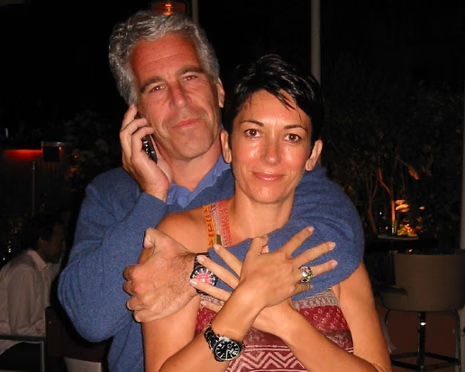
Convicted sex trafficker Ghislaine Maxwell invoked her Fifth Amendment protection against self-incrimination throughout a House Oversight Committee deposition Monday, refusing to answer questions about Jeffrey Epstein’s criminal network while her attorney declared she would provide comprehensive testimony only if President Donald Trump grants clemency for her 20-year federal sentence.
David Oscar Markus, representing the former Epstein confidant and girlfriend, explained he counseled his client to remain silent given her ongoing appeal challenging the 2021 conviction. However, he simultaneously dangled the prospect of full cooperation conditional upon presidential intervention erasing her legal jeopardy.
“Only she can provide the complete account” of Epstein’s actions, Markus asserted in a statement following Maxwell’s brief virtual appearance before the panel, where she consistently declined to answer substantive inquiries. “Some may not like what they hear, but the truth matters. For example, both President Trump and President Clinton are innocent of any wrongdoing. Ms. Maxwell alone can explain why, and the public is entitled to that explanation.”
The Monday deposition unfolded just days after the Justice Department released three million pages of documents from governmental Epstein investigative files, materials obtained through the Epstein Files Transparency Act that Congress enacted last year to compel disclosure following prolonged delays. Many documents consist of email exchanges between Epstein, Maxwell and third parties that may illuminate the scope of their sex trafficking operation.
House Oversight Chairman James Comer, the Kentucky Republican who subpoenaed Maxwell, characterized her deposition as disappointing. Comer disclosed to The Independent that the committee considered offering immunity to secure her testimony but ultimately rejected that approach after consulting with survivors of Epstein’s abuse.
“This was something new today, obviously that’s not for me to decide, that’s for the president to decide,” Comer acknowledged regarding the clemency proposal, though he later clarified: “I don’t think she should be granted any type of immunity or clemency.”
Maxwell maintained silence when confronted with questions about her knowledge of Epstein’s criminal activities but told lawmakers that both Trump and former President Bill Clinton were innocent of wrongdoing—assertions she claims to possess evidence supporting but refuses to share without clemency guarantees.
Markus had previously warned Comer that his client would invoke Fifth Amendment protections if subpoenaed, citing concerns that congressional testimony could jeopardize her current habeas corpus petition challenging the conviction’s legal foundation. The attorney characterized Maxwell’s trial as “fundamentally unfair” and suggested her testimony might undermine ongoing appellate arguments.
“If this Committee and the American public truly want to hear the unfiltered truth about what happened, there is a straightforward path. Ms. Maxwell is prepared to speak fully and honestly if granted clemency by President Trump,” Markus declared Monday, framing the clemency demand as the exclusive mechanism for obtaining Maxwell’s cooperation.
The clemency gambit represents a calculated legal and public relations strategy. By simultaneously claiming to possess exculpatory information about two presidents while demanding clemency as the price for disclosure, Maxwell and her attorney attempt to generate political pressure on Trump while avoiding testimony that could strengthen prosecution arguments in her ongoing appeals.
Trump has not publicly ruled out pardoning Maxwell, though he expressed minimal engagement with the question during a November exchange with reporters aboard Air Force One. “I haven’t thought about it for months. Maybe I haven’t thought about it at all,” Trump offered. “I don’t talk about that. I don’t rule it in or out.”
This noncommittal posture leaves open possibilities that Maxwell’s legal team appears intent on exploiting, though granting clemency to a convicted child sex trafficker would generate substantial political controversy regardless of what information she might provide in exchange.
Representative James Walkinshaw, a Democrat serving on the House Oversight Committee, confirmed that Maxwell provided no “substantive answers to questions that were asked that would advance” the investigation. Representative Suhas Subramanyam noted that “she, through her lawyer, explicitly stated that she wants to be out of prison through a clemency that this president would grant,” characterizing the deposition as a clemency solicitation rather than cooperative engagement.
Prior to Monday’s deposition, Representative Ro Khanna, a California Democrat on the oversight panel, requested clarification regarding which specific questions Maxwell intended to invoke Fifth Amendment protections against. Khanna inquired whether Maxwell would address her “four named co-conspirators” and 25 men who entered secret settlements; whether Epstein provided Trump access to underage girls during their friendship; or foreign governments with which Epstein maintained relationships.
Trump has not been charged with offenses connected to Epstein and has consistently denied wrongdoing. Clinton similarly denies impropriety and has never faced law enforcement accusations regarding Epstein associations.
Justice Department officials previously interviewed Maxwell about other individuals who may have committed crimes against Epstein’s victims. Following an interview spanning two days, Maxwell was abruptly transferred from a high-security Florida prison to a minimum-security Texas facility—a relocation that generated speculation about potential cooperation agreements or preferential treatment.
Markus characterized that earlier Justice Department interview differently than Monday’s congressional appearance, asserting Maxwell answered “every single question… honestly, truthfully, to the best of her ability” during the federal session. The contrasting approaches suggest Maxwell and her legal team distinguish between cooperating with prosecutors pursuing additional defendants and testifying before congressional investigators whose findings carry different legal implications.
Deputy Attorney General Todd Blanche questioned Maxwell in July under limited immunity granted by the Justice Department specifically for that interview. During that session, Maxwell denied allegations against her and claimed she never witnessed Epstein or associates acting inappropriately—assertions encompassing both Trump and Clinton, who each spent time with the politically connected financier before his initial 2006 criminal charges.
A senior administration official disclosed to NBC News in July that the limited immunity enabled Maxwell to answer Epstein-related questions without creating additional criminal exposure. Maxwell’s attorneys subsequently requested similar immunity from the House Oversight Committee but lawmakers rejected the proposal, likely recognizing that immunity grants would prevent any prosecution based on her congressional testimony.
Maxwell was convicted in 2021 on federal sex trafficking charges including conspiracy to entice minors to travel for illegal sexual activity, participation in sex trafficking conspiracy, and sex trafficking of a minor. She is serving her sentence at a minimum-security prison camp in Texas following the controversial transfer from higher-security Florida confinement.
Epstein, a convicted sex offender with connections to political, business and academic elites, died in a New York jail cell in August 2019 while awaiting trial on sex trafficking charges. Medical examiners ruled his death a suicide, though the circumstances generated persistent conspiracy theories that Trump himself amplified during his 2024 presidential campaign. Maxwell remains the only other person charged and convicted in connection with Epstein’s extensive criminal network.
Maxwell attempted appealing her conviction to the Supreme Court last year, but the high court declined to hear her case in October. She has since launched separate legal action challenging the conviction through habeas corpus petitions that remain pending—the basis for her attorney’s argument that congressional testimony could prejudice those proceedings.
Following Markus’ clemency statement, Khanna posted on social media: “Here is my conclusion after sitting through Maxwell’s deposition with her refusing to answer a single question about the men who raped underage girls, saying she would only do so for clemency. She must immediately be sent back to the maximum security prison where she belongs.”
Markus responded via X: “A sitting Congressman wants to punish someone for invoking a constitutional right. Sending someone to harsher confinement because they invoke a constitutional right is something we associate with authoritarian regimes, not the United States Congress. Sad.”
The exchange illustrates tensions between lawmakers seeking accountability for Epstein’s network and constitutional protections against self-incrimination. Khanna’s demand for harsher confinement based on Fifth Amendment invocation raises legitimate civil liberties concerns regardless of Maxwell’s culpability, while Maxwell’s strategic use of constitutional protections to leverage clemency negotiations frustrates investigative efforts.
The brother and sister-in-law of late Epstein survivor Virginia Roberts Giuffre condemned Maxwell’s refusal to answer questions in a letter obtained by NBC News. “Ghislaine Maxwell, you were not a bystander. You were not ‘misled.’ You were a central, deliberate actor in a system built to find children, isolate them, groom them, and deliver them to abuse,” they wrote. “You used trust as a weapon. You targeted vulnerability and turned it into access. That is not a mistake. That is not poor judgment. That is predation.”
The family members urged the oversight panel to investigate Maxwell’s prison transfer and examine potential inconsistencies in prior sworn testimony. They concluded by invoking Giuffre’s final wishes: “Ghislaine, you deserve to spend the rest of your life in a jail cell. Trapped in a cage forever just like you trapped your victims.”
The clemency-for-testimony proposition creates ethical dilemmas for investigators and policymakers. Granting clemency to obtain information about other potential offenders might advance justice for additional victims, but simultaneously rewarding a convicted sex trafficker with freedom undermines accountability principles and potentially incentivizes similar leverage attempts by other convicted defendants.
Maxwell’s assertion that she possesses exculpatory information regarding Trump and Clinton complicates the political calculus. If accurate, such information might clear both former presidents of longstanding suspicions regarding Epstein associations. However, Maxwell’s credibility remains questionable given her conviction for systematic deception and exploitation of minors, making her unsupported claims difficult to evaluate.
The Monday deposition underscores fundamental challenges in addressing Epstein’s criminal network posthumously. With Epstein dead and Maxwell convicted yet uncooperative, identifying and prosecuting additional participants requires piecing together fragmentary evidence from documents, victim testimony and reluctant witnesses rather than obtaining comprehensive insider accounts of the operation’s scope and participants.
AUCHI, Nigeria — A medical doctor who survived a harrowing kidnapping ordeal that claimed his younger brother’s life identified two of his abductors when they brought a sick infant to the very hospital where he works, triggering arrests that may dismantle a criminal network terrorizing communities in Edo State’s Etsako West region, Nigeria.
Dr. Abu Ibrahim Babatunde, completing his housemanship at Edo State University Teaching Hospital in Auchi, recognized suspects Idris Abubakar and Sani Abubakar on February 8 when they appeared at the facility’s Special Care Baby Unit with an ailing child requiring emergency treatment. The doctor discreetly alerted hospital security and contacted the Auchi Divisional Police, precipitating a swift apprehension that authorities characterize as a significant breakthrough in combating organized kidnapping operations.
Edo State Police Command spokesperson Eno Ikoedem disclosed the arrests Sunday in a statement describing sustained intelligence-led operations targeting the criminal syndicate responsible for abductions throughout Auchi and surrounding areas. The February 8 hospital arrests represent two of three suspects now in custody connected to Dr. Babatunde’s January ordeal and the murder of his sibling Abu Tahir.
The kidnapping commenced January 2, 2026, when armed men seized Dr. Babatunde and his younger brother Tahir while the victims were opening the gate to their residence along City Pride Road in Igbira Camp, Auchi. The abduction shocked the medical community and intensified concerns about deteriorating security conditions affecting healthcare professionals and ordinary citizens across Nigeria’s southern regions.
The family paid a ransom totaling ₦50 million (approximately $31,000) for the doctor’s release, a substantial sum reflecting both the family’s desperation and the kidnappers’ brazen financial demands. Despite the payment, the criminals killed Tahir, whose body was discovered January 5 near the Orley River along City Pride Road. Police investigators suspect the younger brother was executed by his captors despite ransom compliance, adding murder charges to the kidnapping allegations facing arrested suspects.
Dr. Babatunde secured release January 15 after thirteen days in captivity, returning to his medical duties while presumably processing the trauma of his ordeal and his brother’s death. His presence at the hospital February 8 for wound dressing—injuries possibly sustained during the kidnapping—positioned him to identify two men who had held him captive just weeks earlier.
The suspects’ decision to seek medical care for their sick child at the hospital employing one of their recent kidnapping victims represents either stunning audacity or catastrophic failure to recognize the risks of returning to a location where their victim worked. The miscalculation provided law enforcement an unexpected opportunity to apprehend individuals who might otherwise have evaded capture.
Dr. Babatunde’s recognition triggered coordinated response involving hospital security personnel and police officers. The Divisional Police Officer mobilized operatives to the hospital premises, executing the arrest without incident and preventing the suspects’ escape. Authorities specifically identified Idris Abubakar as the individual who received the ₦50 million ransom payment, making him a central figure in the criminal enterprise.
“Both suspects have also been identified as part of the gang that abducted Dr Abu Babatunde on January 2, 2026,” Ikoedem’s statement confirmed, noting that an identification parade substantiated Dr. Babatunde’s recognition of the men as members of the kidnapping gang.
The February 8 hospital arrests followed an earlier apprehension that demonstrated police and community collaboration against kidnapping networks. On February 3, operatives from the Auchi Division working alongside local hunters and vigilante groups arrested suspect Saminu Kawujie during bush-combing operations at Warake Forest, a dense wilderness area providing sanctuary for criminal elements operating in the region.
A search of Kawujie yielded two knives, two mobile phones, one UBA ATM card and ₦20,250 in cash. An identification parade subsequently confirmed his involvement in Dr. Babatunde’s abduction, linking him to the criminal syndicate now facing prosecution. The recovered items may provide forensic evidence and investigative leads connecting suspects to additional crimes.
The three arrests represent progress in dismantling organized kidnapping operations that have plagued Auchi and environs, though authorities acknowledge that additional gang members remain at large. “Efforts have been intensified towards conducting a comprehensive and discreet investigation aimed at dismantling the entire notorious organised criminal network responsible for the kidnappings in Auchi and its environs,” Ikoedem’s statement emphasized.
Commissioner of Police Monday Agbonika reassured Edo State residents of the command’s determination to pursue kidnapping cases to logical conclusions and deliver perpetrators to justice through sustained intelligence-led policing and aggressive bush-combing operations throughout the state. This commitment reflects recognition that kidnapping for ransom has become a lucrative criminal enterprise threatening citizens across socioeconomic strata.
The transferred suspects now face investigation at the Edo State Police Command headquarters in Benin City, where detectives will attempt to extract information identifying additional gang members, recover weapons and establish connections to other kidnapping incidents in the region. Successful prosecution will require assembling evidence demonstrating each suspect’s specific role in the kidnapping conspiracy, ransom collection and Tahir’s murder.
The case illuminates the profound insecurity challenges confronting Nigeria, where kidnapping for ransom has evolved from sporadic criminal activity into organized industry. Medical professionals, business owners, students and ordinary citizens face abduction risks that fundamentally undermine societal stability and economic development. Families routinely liquidate assets, borrow money or sell property to meet ransom demands, experiencing financial devastation alongside psychological trauma.
Dr. Babatunde’s kidnapping particularly alarmed the medical community, as healthcare workers already contend with inadequate facilities, low compensation and dangerous working conditions. When doctors cannot safely travel to their residences without risking violent abduction, the sustainability of healthcare delivery systems faces existential threats. Medical professionals may relocate to safer regions or emigrate internationally, exacerbating Nigeria’s healthcare crisis.
The suspects’ willingness to bring a sick child to a hospital demonstrates that even criminals require access to medical services, creating situational vulnerabilities that law enforcement can occasionally exploit. The infant’s medical condition may have created urgency overriding caution about returning to locations where their kidnapping victim worked. This lapse in operational security provided the fortuitous break enabling arrests.
Dr. Babatunde’s composure and quick thinking in recognizing his former captors while maintaining discretion to prevent their escape deserves recognition. Many kidnapping survivors experience post-traumatic stress that might impair cognitive functioning or trigger panic responses upon encountering former captors. The doctor’s ability to maintain professional demeanor while alerting authorities reflects remarkable psychological resilience.
The investigation’s success depends substantially on witness cooperation, forensic evidence analysis and intelligence gathering about the syndicate’s structure, leadership and operations. Arrested suspects may negotiate reduced sentences by providing information identifying accomplices and revealing kidnapping locations, weapons caches and operational procedures. Such cooperation could produce arrests cascading through the criminal network.
Community collaboration proved essential to the investigation’s progress. Local hunters and vigilante groups possessing intimate knowledge of forest terrain and suspicious activities provided critical assistance during bush-combing operations that led to Kawujie’s arrest. This partnership between formal law enforcement and informal community security structures reflects pragmatic responses to inadequate police resources and personnel.
The arrests may deter some potential kidnappers by demonstrating that even successful ransom collections don’t guarantee impunity. However, addressing Nigeria’s kidnapping epidemic requires comprehensive strategies combining aggressive law enforcement with economic development reducing poverty that drives criminal recruitment, governance improvements limiting corruption enabling criminal networks, and justice system reforms ensuring swift prosecution and meaningful punishment.
For Dr. Babatunde, the arrests provide partial closure though they cannot restore his murdered brother or erase trauma from thirteen days of captivity. His return to medical practice despite recent ordeal demonstrates professional dedication, while his role in identifying suspects contributes to justice for his brother and protection of future potential victims.
As investigators pursue remaining gang members, the case serves as reminder that criminal arrogance or desperation can create unexpected vulnerabilities. The suspects’ ill-fated hospital visit transformed them from successful kidnappers who had collected substantial ransom into defendants facing lengthy imprisonment for kidnapping and murder charges that could result in death sentences under Nigerian law.