

Britain is sending a warship to the Middle East to position itself for a potential multinational mission to protect commercial shipping through the Strait of Hormuz, the Ministry of Defence confirmed Saturday — a move that signals London and Paris are preparing military options for the moment diplomacy creates the conditions to act.
HMS Dragon, a Type 45 air defense destroyer based in Portsmouth with a crew of 200, will move from the Eastern Mediterranean, where it has been stationed since March following the outbreak of the U.S.-Iran war, to a forward position in the region. The ship has spent recent weeks conducting weapons testing off the coast of Crete after briefly returning to port last month for maintenance following a fault with its water systems.
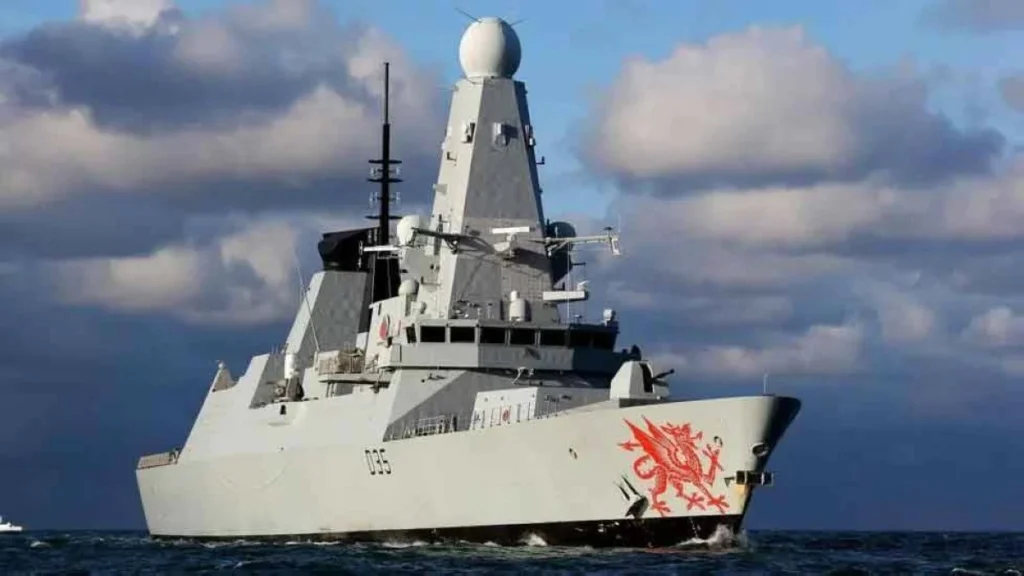
“The pre-positioning of HMS Dragon is part of prudent planning that will ensure that the UK is ready, as part of a multinational coalition jointly led by the UK and France, to secure the strait, when conditions allow,” a Ministry of Defence spokesperson said Saturday.
The deployment is defensive in its stated purpose. Britain and France are not moving to force the strait open — that is the American approach, which stumbled badly last week when Trump’s “Project Freedom” operation produced two ship transits and a set of burning Iranian boats before being suspended within 48 hours. What London and Paris are building is something different: a peacekeeping framework designed to restore commercial confidence in the waterway once a diplomatic agreement creates the space to operate.
The Franco-British Plan
France moved its carrier strike group to the southern Red Sea earlier, and Saturday’s HMS Dragon announcement fits into a coordinated posture the two countries have been quietly assembling for weeks. Prime Minister Keir Starmer and French President Emmanuel Macron have championed the multinational coalition concept, which would see participating nations deploy vessels as a protective escort force for commercial shipping transiting the strait.
At least a dozen countries have indicated willingness to take part in the framework, according to the Ministry of Defence. Sky News reported the figure could ultimately reach 40 participating nations.
The plan requires something the current moment does not yet provide: Iranian consent, or at least the absence of Iranian military opposition. Coordinating passage with Tehran is built into the framework’s design. That makes it fundamentally different from the American unilateral approach and far more dependent on the outcome of peace negotiations still grinding through Pakistani mediation.
A defense source told The Sun the reasoning behind Dragon’s repositioning directly. “Dragon is a highly capable warship, so naturally she is likely to be part of our UK contribution to restoring confidence for global trade through the strait. This move is all about being prepared, should the conditions allow for our coalition to begin its work. The UK and France will continue to lead these efforts, turning diplomatic consensus into military options.”
Washington’s Shadow
The British deployment carries a second dimension that neither London nor Washington has articulated publicly but that sits just beneath the surface of Saturday’s announcement.
U.S. Defense Secretary Pete Hegseth declared last week that American forces would not guard the Strait of Hormuz indefinitely. Announcing the short-lived Project Freedom operation, Hegseth said the world needed the waterway far more than the United States did and that it was time for other nations to step up. Trump has repeatedly criticized NATO allies, including Britain, for not contributing enough to shared security burdens.
By sending HMS Dragon and publicly committing to coalition leadership alongside France, Britain is doing precisely what Washington asked — while doing it on terms that preserve London’s ability to coordinate with both the Americans and the European partners that have been more cautious about the U.S. military approach to the strait.
Trump met with King Charles during the British state visit this week and described the relationship warmly. Saturday’s deployment gives that diplomatic warmth a tangible military expression.
The Royal Navy’s Limits
Britain’s announcement comes with an honest acknowledgment that the Royal Navy is not what it once was. The Ministry of Defence confirmed that the UK’s ability to participate in any protective mission will be constrained by a fleet that has shrunk significantly in recent decades and has had to retire vessels before replacements entered service.
HMS Dragon is one of six Type 45 destroyers in the Royal Navy’s inventory — ships designed primarily for air defense and regarded as among the most capable in their class globally. The 500-foot vessel carries sophisticated missile systems suited to defending against exactly the kind of drone and missile attacks Iran has used against commercial shipping throughout the war.
Whether Dragon’s capabilities translate into meaningful deterrence in the strait will depend heavily on the rules of engagement any coalition agrees to, the legal framework governing the mission, and — above all — whether the U.S.-Iran negotiations produce an agreement that permits coalition forces to operate without becoming targets themselves.
Where Talks Stand
The diplomatic backdrop to Saturday’s deployment is a peace process that has moved haltingly through Pakistani mediation and produced one round of direct U.S.-Iran talks without a follow-up meeting. Iran submitted a 14-point proposal. The U.S. responded through Pakistani intermediaries. Tehran said Friday it had not yet reached a conclusion.
Trump said Friday he was expecting a letter from Iran. “I’m getting a letter supposedly tonight,” he told reporters. “We’ll find out soon enough.”
The U.S. has made clear that any durable ceasefire must address Iran’s nuclear program — a demand Tehran has insisted on deferring until after a basic war-ending agreement is in place. That gap has not closed. The ceasefire that took effect April 7 has largely held but has been punctuated by exchanges of fire, including Thursday’s confrontation in the strait involving three U.S. Navy destroyers and Iranian missiles, drones, and small boats.
Oil prices have surged as much as 40 percent since the war began, with direct effects on fuel costs for British consumers and businesses — a domestic economic pressure that gives Starmer’s government its own reasons to want the strait reopened quickly, beyond the alliance obligations that frame the public announcement.
Coalition Building as Strategic Patience
The HMS Dragon deployment reflects a bet that the strait will eventually reopen — not by force, but by agreement — and that the country positioned to lead the protective framework when that moment arrives will have disproportionate influence over how global shipping through the world’s most critical energy chokepoint is governed going forward.
Britain and France are playing a longer game than the Americans. Where Washington attempted to force the issue with destroyers and sank six Iranian boats for its trouble before suspending the operation, London and Paris are assembling the diplomatic and military infrastructure for the day after a deal is signed. That is a fundamentally different strategic calculation, and it reflects the different positions the two European powers occupy — close enough to Washington to maintain the alliance, distant enough from the U.S.-Iran conflict to position themselves as stabilizers rather than combatants.
The risk in that approach is timing. If negotiations collapse and the conflict escalates rather than resolves, a coalition designed for peacekeeping finds itself in a war it was never configured to fight. HMS Dragon is an air defense destroyer, not a strike platform. Its presence signals reassurance, not coercion.
For now, that distinction is the point. Britain is telling the world — and telling Tehran — that it is preparing to help reopen the strait, not to close it further. Whether Iran reads that signal the way London intends will go a long way toward determining whether HMS Dragon’s Middle East deployment ends as a peacekeeping success or simply another ship waiting for a deal that never comes.
TheSun/Reuters





