

Iran launched a series of ballistic missile strikes toward Israel early Thursday, including weapons carrying cluster munitions, injuring at least nine people and causing widespread damage across several cities as tensions between the two countries intensified.
Israeli defense officials identified seven waves of incoming missiles over Israel and parts of the West Bank during the morning. One of the strikes hit the central city of Kafr Qasim, injuring five people and damaging vehicles and nearby buildings, The Times of Israel detailed. Video circulating from the scene showed a powerful blast that flipped a parked car into the air, scattering debris and prompting people and animals to flee seconds before impact.
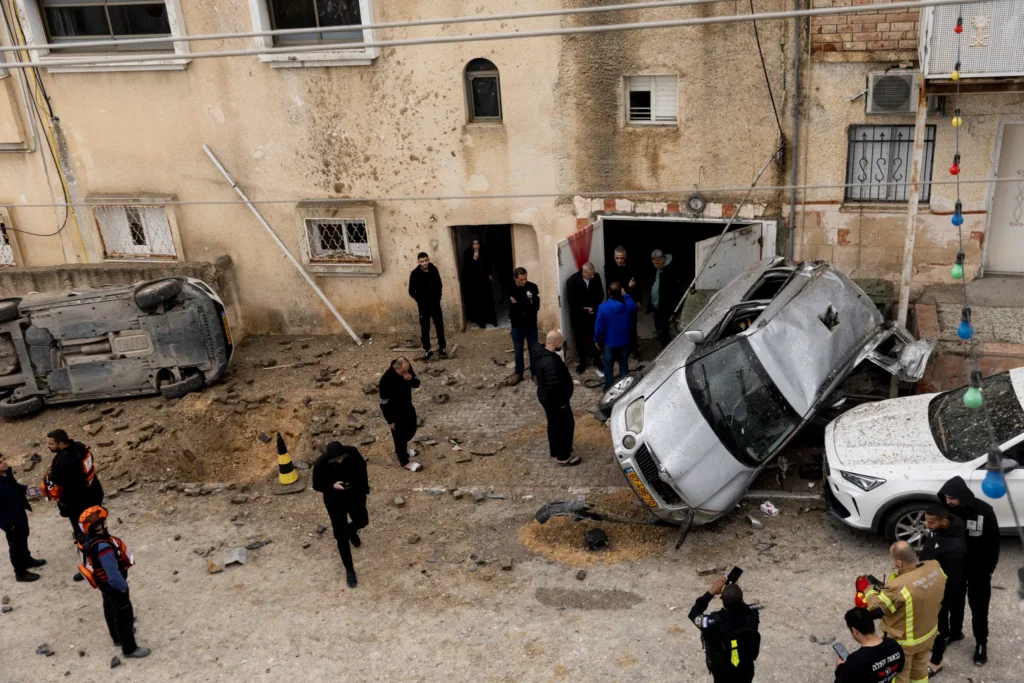
Additional footage from the area captured shattered storefronts and debris-covered streets after another projectile struck near parked vehicles, sending fragments of concrete flying. Emergency responders were dispatched to multiple locations as smoke rose from impact sites.
In Ganei Tikva, a missile strike destroyed several vehicles and ignited a fire that sent thick black smoke across the roadway. In Tel Aviv, two people were injured when a ballistic missile carrying cluster munitions dispersed smaller bomblets across a wide area. Images from the city showed significant damage to commercial properties, including a heavily damaged storefront.
Officials said similar submunitions struck areas in Haifa and other northern locations. In at least one instance, shrapnel from an explosion injured a civilian near a shopping center. The use of cluster munitions has raised alarm because such weapons scatter smaller explosives over a broad area, increasing the risk to civilians and leaving behind unexploded devices.
Two homes in Israeli settlements in the West Bank were also struck. According to the Samaria Regional Council, residents were unharmed after taking shelter in reinforced safe rooms, a measure commonly used during missile attacks.
Since the conflict began, Iran has launched more than 400 ballistic missiles toward Israel. The Israel Defense Forces (IDF) said its air defense systems have intercepted about 92% of missiles targeting populated areas and critical infrastructure. Despite that rate, several missiles have penetrated defenses, striking densely populated areas, killing at least 15 people and injuring hundreds more.
Israel has continued its own extensive military campaign in response. Israeli officials said the country’s air force has conducted thousands of strikes across Iran, targeting military infrastructure such as missile systems, air defenses, weapons production facilities and sites linked to nuclear development. The IDF estimates that about 5,000 Iranian personnel have been killed in those operations.
The United States has also expanded its involvement. U.S. Central Command chief Adm. Brad Cooper said Wednesday that American forces have struck more than 10,000 targets inside Iran, aiming to weaken its ability to carry out attacks beyond its borders.
The latest exchange highlights the growing risk of a broader regional conflict as both sides intensify military operations despite international calls for restraint. The use of cluster munitions in particular has drawn criticism from humanitarian organizations, which warn of long-term dangers to civilians. Unexploded bomblets can remain hazardous long after initial strikes, posing ongoing threats in urban areas.
Analysts say Iran’s continued missile launches, even with Israel’s high interception rate, reflect a strategy designed to overwhelm air defense systems through repeated attacks. While most missiles are intercepted, those that get through can still cause significant destruction, especially in populated areas.
At the same time, Israel’s sustained air campaign inside Iran signals a broader strategy aimed at weakening long-term threats rather than simply responding to individual attacks. By targeting infrastructure tied to weapons production and military command, Israeli leaders appear focused on reducing Iran’s capacity to sustain prolonged conflict.
The involvement of the United States adds another layer of complexity. Washington’s strikes on Iranian targets indicate a wider effort to counter Iran’s regional influence, but they also increase the risk of retaliation against U.S. interests, potentially widening the conflict further.
Despite the intensity of the fighting, diplomatic efforts to reduce tensions have made little progress. International mediators have struggled to bring both sides toward negotiations as military objectives continue to dominate.
For civilians, the impact has been severe. In Israel, repeated missile alerts have disrupted daily life, forcing residents into shelters and heightening anxiety. In Iran, ongoing airstrikes have damaged infrastructure and contributed to rising casualties.
The continued use of increasingly destructive weapons and the expansion of military targets suggest the conflict may be entering a more dangerous phase. Without a shift toward diplomacy, the cycle of retaliation risks deepening instability across the Middle East.
The reported use of cluster munitions marks a significant escalation in the conflict’s intensity and raises serious humanitarian concerns. These weapons are designed to spread smaller explosives over a wide area, increasing the likelihood of damage even when missile defense systems intercept part of an attack. Their deployment suggests Iran may be attempting to counter Israel’s advanced air defenses by increasing the probability that at least some ordnance reaches the ground.
Israel’s response strategy also reflects a shift toward long-term deterrence. By focusing on military infrastructure and weapons production inside Iran, Israeli forces appear to be targeting the foundation of Iran’s offensive capabilities rather than limiting strikes to immediate retaliation. This approach could weaken Iran’s ability to sustain prolonged attacks but also risks provoking further escalation.
The United States’ involvement signals that the conflict has moved beyond a strictly bilateral confrontation. Direct strikes on Iranian targets suggest broader strategic concerns, including regional stability and the protection of allied interests. However, deeper U.S. engagement increases the likelihood of a wider conflict involving additional actors.
If current trends continue, the conflict could evolve into a prolonged regional crisis with significant geopolitical and economic consequences, particularly if key infrastructure or international trade routes are affected.
AP





