

Iran launched a new wave of missile attacks against United States military positions in the Middle East on Wednesday, while American and Saudi forces carried out coordinated airstrikes against Tehran backed militias in Iraq, sharply escalating tensions across the region.
The renewed fighting comes after several days of relative calm and threatens to derail diplomatic efforts aimed at restoring a ceasefire between Washington and Tehran.
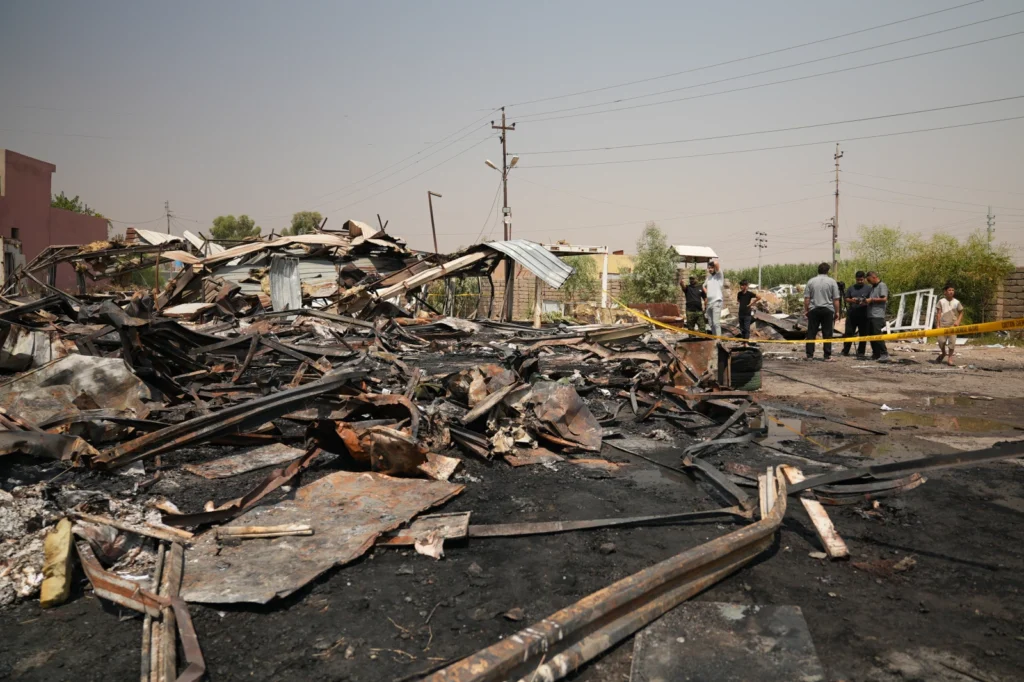
The Associated Press said the coordinated military operations killed at least 20 militia fighters and six Iranian military advisers in eastern Iraq, according to Iraqi militia officials.
Iran’s latest missile barrage targeted Muwaffaq Salti Air Base in Jordan, a major United States military installation supporting regional operations.
Iran’s Revolutionary Guard said it launched ballistic missiles against the base in retaliation for recent American military actions.
Jordan’s armed forces said air defense systems intercepted five incoming missiles before they reached their targets. Authorities reported no casualties or significant damage.
Shortly afterward, the United States military announced that American and Saudi fighter aircraft had struck multiple logistics centers and weapons storage facilities linked to Iran backed militias in eastern Iraq.
Saudi Arabia said the operation followed recent drone attacks targeting its oil infrastructure.
The Saudi Defense Ministry said the kingdom does not seek further escalation but would respond to attacks threatening its national security.
The Popular Mobilization Forces, a coalition of largely Shiite armed groups aligned with Iran, said the overnight strikes killed at least 20 fighters and wounded 32 others.
Two militia officials also confirmed that six Iranian military advisers died during the attacks. They spoke on condition of anonymity because they were not authorized to discuss military operations publicly.
The Iraqi government condemned the airstrikes, describing them as a violation of national sovereignty.
President Nizar Amidi’s office said the attacks breached Iraq’s territorial integrity, while the National Security Council said the government had already been working with American and Saudi officials to investigate earlier drone incidents.
The renewed violence forced the postponement of Iraqi Prime Minister Ali al Zaidi’s planned visit to Saudi Arabia, highlighting the growing diplomatic fallout.
The fighting extended beyond Iraq.
Two commercial vessels carrying natural gas caught fire after drone strikes at Egypt’s Damietta port, maritime security company Ambrey said.
One vessel is owned by a United States company while the other belongs to a Greek operator.
No injuries were reported, and investigators have not identified those responsible for the attacks.
The latest military exchanges have renewed concerns over energy security across the Middle East.
Saudi Arabia accused Iran backed militias operating from Iraq of launching drones against key oil facilities over the past two days.
An umbrella organization representing several Iraqi militias denied involvement.
Meanwhile, Yemen’s Houthi movement claimed responsibility for separate drone strikes targeting Saudi energy infrastructure, describing the attacks as part of its ongoing confrontation with the kingdom.
France24, citing Agence France Presse, said Saudi authorities intercepted several drones launched from Iraqi territory before they reached petroleum facilities in eastern Saudi Arabia and the capital, Riyadh.
Saudi officials urged Iraq to prevent armed groups from using its territory to launch attacks against neighboring countries.
The Houthis separately announced strikes on Saudi oil infrastructure, saying they were responding to alleged Saudi drone operations over Yemen.
Saudi authorities have not publicly confirmed the Houthi claims.
The latest exchanges threaten to deepen an already fragile regional security environment.
The Houthis have also declared a blockade targeting Saudi shipping routes through the Bab el Mandeb Strait, a critical maritime corridor connecting the Red Sea with the Gulf of Aden.
Earlier this week, satellite imagery analyzed by The Associated Press showed apparent damage to Saudi Aramco’s Abqaiq oil processing complex following previous attacks.
Regional officials also confirmed that a refinery in Jazan temporarily halted production after sustaining significant damage during recent strikes.
The refinery processes about 400,000 barrels of crude oil each day.
The renewed fighting has also complicated efforts to restore commercial shipping through the Strait of Hormuz.
Iran’s Deputy Foreign Minister Kazem Gharibabadi said Tehran rejected a proposal from Oman to jointly manage vessel traffic through the strategic waterway.
Instead, Iran proposed temporary shipping arrangements through its territorial waters while maintaining tighter control over maritime traffic.
Gharibabadi said Tehran does not intend to return the strait to its prewar operating conditions.
The Strait of Hormuz remains one of the world’s most important energy corridors, carrying roughly one fifth of global oil shipments.
Continued disruptions have fueled concerns about supply shortages and higher fuel costs worldwide.
Financial markets reacted quickly to the latest military escalation.
Brent crude oil rose 3.1 percent to $84.58 per barrel as traders assessed the potential impact on global energy supplies.
Diplomatic efforts continue despite the renewed fighting.
Regional mediators said negotiations remain active, although officials acknowledged that restoring a ceasefire has become increasingly difficult following renewed clashes around the Strait of Hormuz.
One regional official familiar with the talks said discussions are continuing with both Washington and Tehran but declined to provide details because of the sensitivity of the negotiations.
President Donald Trump signaled that additional military action remains possible.
“It is going to be straightened out,” Trump said. “In the meantime, we are going to be hitting them very hard because it is our turn to hit them.”
What we know so far
Iran launched ballistic missiles toward a United States military base in Jordan, where all reported missiles were intercepted.
American and Saudi aircraft struck Iran backed militia positions in Iraq, killing at least 20 fighters and six Iranian advisers, militia officials said.
Drone attacks also damaged two natural gas vessels at Egypt’s Damietta port, though responsibility has not been established.
Saudi Arabia says it intercepted additional drones targeting oil facilities, while Yemen’s Houthis claimed separate attacks on Saudi energy infrastructure.
Oil prices climbed as concerns grew over potential disruptions to global energy supplies.
What authorities are saying
Jordan’s military said its air defenses successfully intercepted all incoming missiles.
Saudi Arabia said it acted in self defense and called on Iraq to prevent armed groups from launching attacks from its territory.
Iraq condemned the airstrikes, calling them a violation of its sovereignty.
Iran defended its missile launches as part of its broader military response and rejected proposals that would reduce its control over shipping through the Strait of Hormuz.
Why this matters
The latest escalation illustrates how quickly localized military actions can spread across multiple countries in the Middle East.
The involvement of Iran, the United States, Saudi Arabia, Iraq, Jordan and Yemen increases the risk that isolated confrontations could develop into a broader regional conflict involving additional state and nonstate actors.
The attacks also threaten global energy markets. Any prolonged disruption to oil exports through the Strait of Hormuz or the Bab el Mandeb Strait could drive higher energy prices, increase inflation and place additional pressure on economies already coping with geopolitical uncertainty.
Diplomatic efforts now face greater challenges as military operations continue alongside stalled negotiations.
What happens next
Military officials are expected to assess the effectiveness of the latest operations while strengthening defenses around key regional bases and energy infrastructure.
Diplomatic mediators are likely to continue efforts to restore negotiations between Washington and Tehran, although further retaliation by either side could complicate those talks.
Energy markets will remain focused on developments around the Strait of Hormuz and Saudi oil facilities, where any additional disruption could have immediate global economic consequences.
Sources: This report is based on reporting by The Associated Press and France24, which cited Agence France Presse (AFP)





