

A viral photograph showing an Israeli soldier hitting a statue of Jesus Christ in southern Lebanon with a sledgehammer has sparked international outrage and condemnation from Israeli Prime Minister Benjamin Netanyahu, who characterized the desecration as contrary to Jewish values while promising punishment for those responsible.
In a statement Monday, the Israeli military confirmed the authenticity of the image that was widely shared online, garnering more than 5 million views on X. The military disclosed that following an initial review, it was determined that the photograph showed an Israeli soldier “operating in southern Lebanon,” where Israel last month launched a ground invasion in conjunction with aerial bombardment amid its joint war with the United States on Iran.
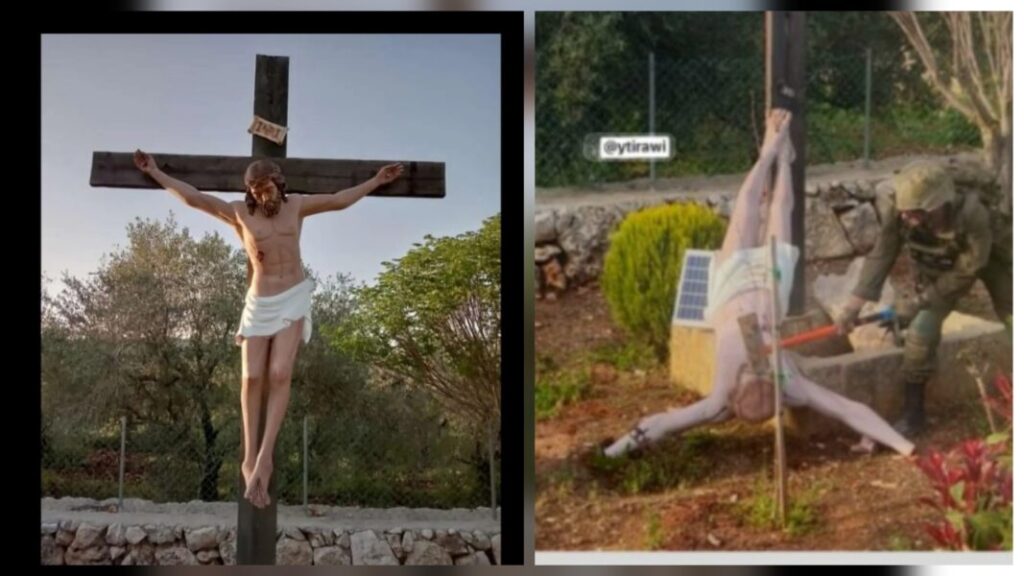
The military added that an investigation had been opened and that “appropriate measures will be taken against those involved in accordance with the findings”—language that left unspecified what punishment the soldier might face for the act that inflamed Christian communities worldwide.
Commenting on social media, Ayman Odeh, a Palestinian member of the Israeli parliament, wrote pointedly: “We’ll wait to hear the police spokesperson claim that ‘the soldier felt threatened by Jesus'”—sardonic reference to justifications Israeli authorities frequently offer for violence against Palestinians.
Ahmad Tibi, another Palestinian member of the Knesset, wrote on Facebook that those who blow up mosques and churches in Gaza and spit on Christian clergy in Jerusalem without punishment are not afraid to destroy a statue of Jesus Christ and publish it. “Perhaps these racists have also learned from Donald Trump to insult Jesus Christ and insult Pope Leo?” he asked, referring to the U.S. president’s recent controversies, including his now-deleted AI-generated image that portrayed him as a Jesus-like figure and his feud with the head of the Roman Catholic Church who has criticized the war on Iran.
Several activists, academics, and writers also criticized the desecration of the statue, which was located on the outskirts of the village of Debel in southern Lebanon near the border with Israel. Social media users condemned the international silence following attacks by Israeli soldiers and settlers against religious sites and symbols.
“When the Western world remains silent, racists go further,” Tibi declared, suggesting that lack of accountability for previous religious desecrations emboldened escalating acts of destruction.
Israeli forces repeatedly attacked religious sites, including mosques and churches, during Israel’s war on Gaza. In the occupied West Bank, meanwhile, settlers vandalized or attacked 45 mosques last year, according to the Palestinian Authority’s Ministry of Religious Affairs—a pattern critics characterize as systematic targeting of Islamic and Christian holy sites.
Separately, the Religious Freedom Data Center documented at least 201 incidents of violence against Christians, primarily committed by Orthodox Jews targeting international clergy or individuals displaying Christian symbols, between January 2024 and September 2025. The majority of these incidents, which included multiple forms of harassment such as spitting, verbal abuse, vandalism, and assaults, took place in Jerusalem’s Old City located in occupied East Jerusalem.
Reuters documented that Israel’s Prime Minister Netanyahu, foreign minister, and military on Monday condemned the desecration of a crucifix smashed by an Israeli soldier in a southern Lebanese village home to Christians. A photo that emerged online over the weekend shows a soldier taking the blunt side of an axe to a fallen sculpture of Jesus on the cross.
The image was posted by Younis Tirawi, who describes himself as a Palestinian reporter and has also posted images of Israeli soldiers’ apparent misconduct in Gaza. Reuters verified the location of the image as Debel, one of the few villages in southern Lebanon where residents remained through an Israeli military campaign against the Iranian-backed Hezbollah militia that began March 2 after the group fired rockets at Israel in support of Iran.
The cross was part of a small shrine in the garden of a family living on the edge of the village, Fadi Falfel, a priest in Debel, confirmed. “One of the Israeli soldiers broke the cross and did this horrible thing, this desecration of our holy symbols,” he stated, conveying the profound offense Christians felt at seeing their sacred imagery destroyed by occupying forces.
Netanyahu declared that the soldier’s actions went against Jewish values of tolerance and that he will be punished. “I was stunned and saddened to learn that an IDF soldier damaged a Catholic religious icon in southern Lebanon. I condemn the act in the strongest terms,” he wrote on X—employing language suggesting personal shock despite documented patterns of Israeli forces attacking religious sites.
U.S. Ambassador to Israel Mike Huckabee stated on X that “Swift, severe, & public consequences are needed”—calling for punishment visible enough to demonstrate accountability rather than administrative measures hidden from public view.
Israeli Foreign Minister Gideon Saar characterized the soldier’s actions as disgraceful and shameful. “We apologize for this incident and to every Christian whose feelings were hurt,” Saar wrote on X, framing the desecration as isolated incident rather than part of broader pattern critics identify.
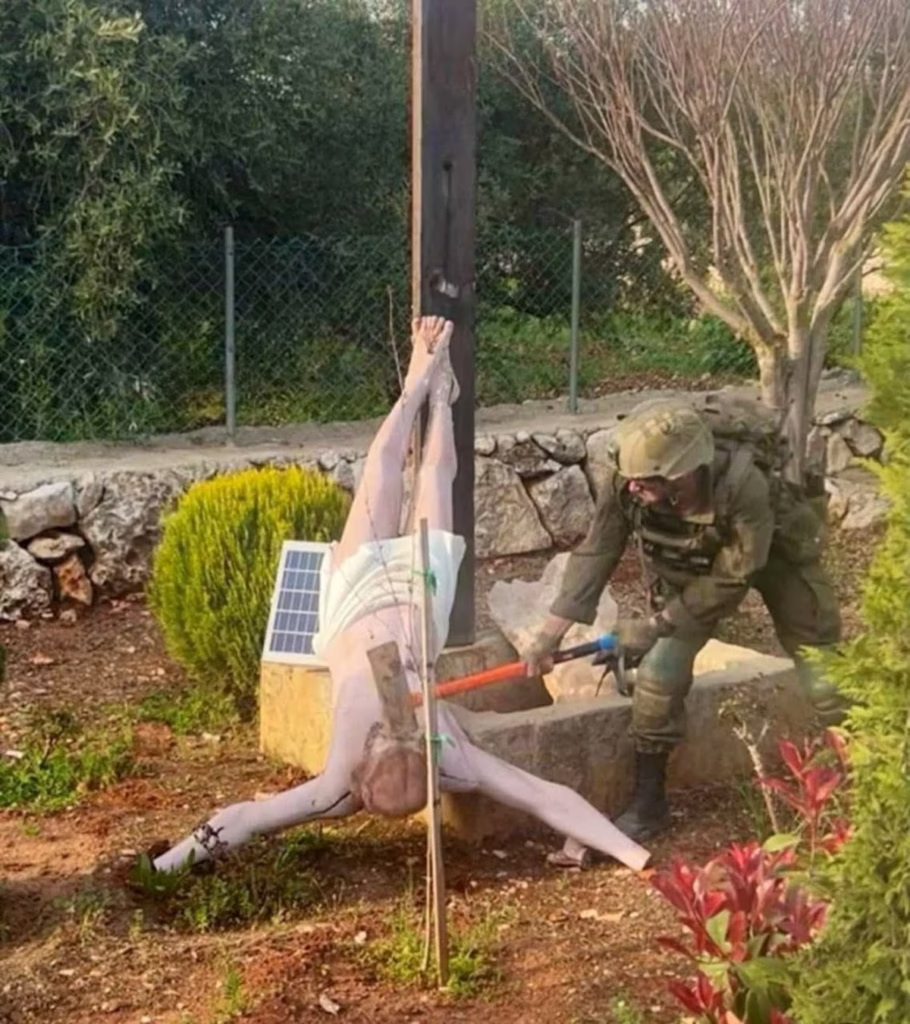
The Israeli military disclosed the incident was being investigated. “The IDF (Israel Defense Forces) views the incident with great severity and emphasizes that the soldier’s conduct is wholly inconsistent with the values expected of its troops,” the military stated. “The IDF is working to assist the community in restoring the statue to its place.”
Debel is one of dozens of villages in south Lebanon now under effective Israeli occupation. Israel and Lebanon on Thursday agreed to a U.S.-brokered ceasefire intended to halt fighting between Israel and Hezbollah—though the destruction of religious symbols occurred after the ceasefire was supposedly in effect.
“We have every kind of crisis,” Falfel disclosed. “We thought the ceasefire would bring us some relief but we’re still surrounded, unable to travel to and from the town. There are some houses on the edge of town that we’re barred from accessing.”
Israeli military officials claimed they are working with aid agencies to meet the humanitarian needs of Debel and other villages—assertions difficult to reconcile with reports of continued restrictions on movement and access to homes.
The viral photograph and subsequent condemnations highlight tensions between Israeli military operations and protection of religious sites in Lebanon—a country where Christian communities have maintained presence for millennia and where interfaith coexistence has been celebrated despite periodic conflicts.
For Christians in Lebanon and worldwide, the image of an Israeli soldier destroying a crucifix evokes historical memories of religious persecution and raises questions about whether occupying forces are adequately trained to respect sacred sites and symbols. The fact that the soldier apparently felt comfortable enough to pose for or allow photography of the desecration suggests either ignorance of how offensive the act would be or indifference to potential consequences.
Netanyahu’s swift condemnation and promise of punishment may reflect genuine concern about religious tolerance or calculated political response to avoid alienating Christian supporters in the United States and Europe whose backing Israel values. Whether actual consequences materialize beyond rhetorical denunciations will determine if the apologies represent sincere accountability or public relations damage control.
The incident also complicates Israeli claims that military operations in Lebanon target only Hezbollah militants rather than affecting civilian populations and their cultural heritage. Destruction of religious symbols in residential areas demonstrates how military campaigns inevitably impact communities beyond intended targets.
For Palestinian members of the Knesset like Odeh and Tibi, the Jesus statue destruction provided opportunity to highlight what they characterize as systematic disrespect for non-Jewish religious sites and symbols—patterns they argue reveal discriminatory attitudes embedded within Israeli military and settler cultures despite official rhetoric about tolerance.
The Religious Freedom Data Center’s documentation of 201 incidents of violence against Christians in occupied territories between January 2024 and September 2025 suggests the Debel desecration represents not aberration but continuation of established patterns where accountability rarely follows attacks on Christian clergy, symbols, or holy sites.
As investigations proceed and authorities promise appropriate punishment, fundamental questions remain about whether individual soldier accountability will address broader issues of religious site protection during military operations or if the episode will fade from attention while patterns of desecration continue largely unchecked despite periodic expressions of official concern.
For Debel’s Christian community, struggling under Israeli occupation while supposedly protected by ceasefire agreements, the smashed Jesus statue symbolizes broader vulnerability—their sacred spaces and symbols subject to destruction by forces claiming to uphold Western values while devastating the very communities that embody Christianity’s Middle Eastern origins.





