

Armed militants ambushed Nigerian security forces who were responding to warnings about a pending attack in northwestern Kebbi State, fatally shooting nine soldiers, one police officer, and a civilian resident in violence that underscores escalating insecurity across Nigeria’s conflict-battered northern regions where government authority remains tenuous.
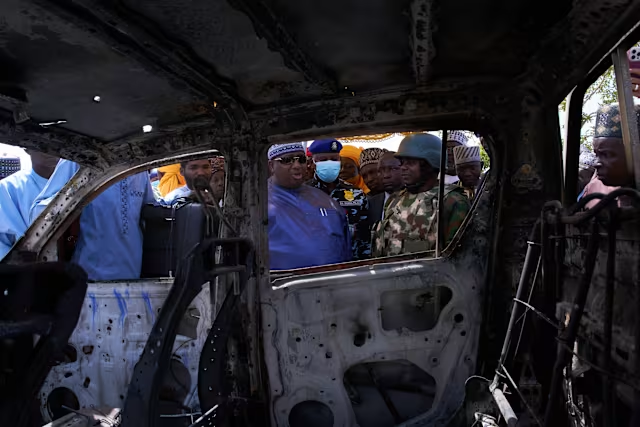
The militants targeted security personnel in Kebbi’s Shanga council area late Tuesday as troops were being deployed to address distress calls about an imminent assault, according to Yahaya Sarki, a spokesman for the Kebbi state government. The ambush occurred in the village of Giron Masa, where several additional soldiers sustained injuries during the firefight that erupted along a dusty road surrounded by dense forests that provide cover for insurgent movements.
Sarki shared photographs depicting burned military vehicles abandoned along the route where the ambush occurred, visual evidence of the intensity of combat that overwhelmed the security patrol before reinforcements could arrive. The images illustrated both the vulnerability of Nigerian security forces operating in remote areas and the tactical sophistication of militant groups capable of executing devastating attacks against well-armed military units.
Kebbi Governor Nasir Idris visited injured soldiers receiving treatment at the hospital Wednesday, acknowledging that the attack had inflicted grievous losses on the state. “Those that lost their lives, the government of Kebbi state will do everything to assist the families,” Idris pledged, offering condolences and promises of support to bereaved relatives who have lost breadwinners to violence that shows no signs of abating.
The assault represents the latest incident in a relentless cycle of violence plaguing Nigeria’s northwestern regions, where armed groups routinely target security forces and remote communities in areas characterized by limited state presence and insufficient security infrastructure. The pattern of attacks has created conditions where entire districts effectively operate beyond government control for extended periods, allowing militant organizations to establish quasi-territorial authority.
No organization immediately claimed responsibility for Tuesday’s ambush, though some residents suspected the Islamic State Sahel Province—known locally as Lakurawa—which has recently demonstrated increased lethality in states including Kebbi and Sokoto along Nigeria’s porous border with Niger Republic. The group’s expansion into these territories has coincided with deteriorating security conditions following political upheaval in neighboring countries.
Lakurawa was targeted by a U.S. military strike conducted in Nigeria this past December in collaboration with Nigerian armed forces. That American intervention came as part of broader U.S. engagement after President Donald Trump alleged that Christians were being systematically targeted in killings across Nigeria—claims that sparked diplomatic tensions and prompted Washington to expand counterterrorism operations in partnership with Nigerian security services.
The Nigerian military has previously indicated that Lakurawa maintains roots in neighboring Niger and became significantly more active in Nigeria’s border communities following a 2023 military coup in Niger that fractured diplomatic and security cooperation between the two nations. The breakdown in cross-border intelligence sharing and coordinated operations created opportunities for militant groups to exploit ungoverned spaces where neither country exercises effective control.
According to Sahara Reporters, suspected terrorists invaded Oro-Ago community in Ifelodun Local Government Area of Kwara State on Wednesday evening, killing a vigilante commander and shooting the town’s local chief security officer known as the Olu-òde. The attack occurred as heavily armed assailants stormed the community and attempted to seize the police station—an audacious assault on government installations that demonstrates militants’ growing confidence in challenging state authority directly.
Sources who spoke with SaharaReporters confirmed the attack transpired Wednesday evening as the assailants—equipped with substantial firepower—invaded the community and moved to capture the police facility. A source familiar with the incident disclosed that attackers killed the commander of the local vigilante group during the invasion while also shooting the town’s chief security officer, popularly known as the Olu-òde and identified as Odeyemi.
The attackers were reportedly attempting to take control of the Oro-Ago police station when confrontation with local security operatives erupted. “They wanted to invade the Oro-Ago police station, and they are operating currently. They killed the commander of the vigilante and shot the local chief security officer of the town,” the source explained, conveying the ongoing nature of the assault even as interviews were being conducted.
The source emphasized that militants had been actively operating in the community for over one hour at the time information was being gathered. “The bandits have been operating for the past one hour and they are still there as I’m speaking with you,” the source added, illustrating the delayed response times that allow armed groups to conduct extended operations before security reinforcements arrive.
Residents told SaharaReporters that the attack threw the town into chaos, with many people hiding inside their homes while others fled to nearby communities to escape the violence engulfing their neighborhoods. The civilian exodus reflects growing recognition among rural Nigerians that government security forces cannot reliably protect them from well-organized militant assaults that increasingly target both security installations and civilian populations.
As of the time SaharaReporters filed its account, security agencies had not issued official statements regarding the attack, and whether reinforcements had been deployed to the area remained unclear. The communication vacuum following major security incidents has become characteristic of Nigerian authorities’ responses to violence, creating information deficits that fuel rumors and prevent accurate casualty assessments.
Oro-Ago and several communities throughout Ifelodun Local Government Area have experienced rising security threats in recent months, including kidnappings and armed attacks by suspected bandits who operate with apparent impunity across territories where state authority has effectively collapsed. The escalating violence reflects broader patterns of insecurity affecting multiple Nigerian states simultaneously.
SaharaReporters previously documented that security agencies in Kwara State were placed on high alert following intelligence indicating that suspected terrorists were planning coordinated attacks on three local government areas in the Kwara South Senatorial District. The planned operations were believed to target Ifelodun, Irepodun, and Isin local government areas, with suspected terrorists reportedly preparing to strike simultaneously on March 23 and March 28, 2026.
Security personnel in affected areas were placed on heightened alert, with precautionary measures being reinforced to avert possible attacks on communities across the three local government areas. The advance warning was contained in a statement issued by Elder Oyin-Zubair, who urged residents to remain vigilant and cooperate with security agencies by reporting suspicious activities in their communities.
According to the statement, relevant authorities including the Kwara State Police Command and the chairmen of Ifelodun, Irepodun, and Isin local government areas, alongside other security agencies, received formal notification about the looming threat. “In view of the speculative bandits attacks on March 23, 2026 and March 28th, authorities including Kwara State Police Command, Chairmen of Ifelodun, Irepodun, and Isin LGAs, and other security agencies have been notified and are taking necessary precautions to protect citizens,” the statement read.
“We urge everyone to remain vigilant and report any suspicious activities to the appropriate authorities. Your safety is our priority. Let’s work together to keep our communities safe. Stay safe, stay alert,” the warning concluded, employing language reflecting the limited capacity of security forces to guarantee protection without civilian cooperation and self-defense measures.
Sahara Reporters also documented that tension gripped the Maraba/Masaka axis of Nasarawa State on the outskirts of Abuja following a violent clash between herders and local vigilantes that left at least three herdsmen dead and several houses burned. The incident occurred between late Tuesday night and early Wednesday morning, triggering panic among residents of Aso community near a primary school in the area.
The violence reportedly erupted after the body of a man suspected to be a herder was discovered under unclear circumstances, prompting what residents characterized as a reprisal attack by armed herders seeking vengeance for their kinsman’s death. “People believed to be Fulani herders came in large numbers early this morning. They were armed and started attacking people. They burnt houses and chased residents away,” a local source disclosed.
Another resident recounted how gunmen stormed the community firing sporadically and setting properties ablaze, forcing villagers to flee into nearby bushes for safety. “The attack was around the primary school in Aso. People ran for their lives. Some houses were completely razed,” the resident added, describing scenes of panic as armed men rampaged through residential areas.
Confirming the incident to SaharaReporters on Wednesday, Nasarawa Police Command Public Relations Officer Ramhan Nansel explained that the violence began after a Fulani herder allegedly encroached on farmland and attempted to harvest mangoes to feed his cattle, sparking confrontation with the farm owner and local vigilantes who objected to the trespass.
Nansel detailed that during the altercation, a vigilante reportedly shot the herder dead, provoking outrage among Fulani youths who later mobilized for a reprisal attack on the community. “An incident like that happened between last night and the early hours of this morning. Information was received that a corpse of a Fulani man was found, and due to that, the Fulani people came for reprisal,” Nansel conveyed.
“Our investigation revealed that the herder encroached into somebody’s farmland and tried to harvest mango trees to feed his cattle. A fight broke out, and a vigilante shot the herder, leading to his death and this crisis,” the police spokesman explained, providing context for the cycle of violence that erupted from what began as a property dispute over agricultural land and grazing access.
“So far, the CP has deployed security to the area, and normalcy has been restored. Three corpses of Fulani herdsmen have been recovered and taken to the hospital, while one suspect has been arrested,” Nansel confirmed, though “normalcy” in such contexts typically means the immediate violence has ceased rather than underlying tensions being resolved.
The Maraba/Masaka corridor bordering the Federal Capital Territory has witnessed recurring tensions linked to farmer-herder conflicts—disputes driven by competing claims over land use, traditional grazing routes, and access to water and other essential resources. These clashes reflect deeper structural issues including environmental degradation, population growth, climate change impacts on agriculture and pastoralism, and inadequate government capacity to mediate competing interests.
The convergence of multiple security crises across northwestern Nigeria—including Islamic State-affiliated terrorism, banditry, kidnapping for ransom, farmer-herder violence, and attacks on security forces—creates compounding challenges that overwhelm Nigerian military and police capabilities. The federal government’s inability to establish territorial control or guarantee citizen security across vast regions has created conditions where non-state armed actors effectively govern through violence and intimidation.
The escalating violence carries profound implications for Nigeria’s stability and economic development. Agricultural production declines as farmers abandon fields they cannot safely cultivate, while pastoralists lose livestock to theft and violence. Displaced populations crowd into urban areas lacking infrastructure to accommodate them, creating humanitarian crises and straining already inadequate public services.
International concern about Nigeria’s security deterioration has grown as violence threatens not only the nation’s 220 million citizens but potentially destabilizes the broader West African region. Whether Nigerian authorities can reverse these trends through enhanced security operations, political reforms addressing root causes, or negotiated settlements with various armed groups remains uncertain as casualties mount and territorial control continues fragmenting across the country’s northern regions.
The Associated Press





