At least 17 people were killed in two separate mass shootings in South Africa on Sunday, police said, as investigators hunted for the gunmen and examined whether one of the attacks was retaliation for an earlier massacre.
The shootings, about 536 kilometers (333 miles) apart, struck an informal settlement near the capital, Pretoria, and a semi-rural area outside the city of Pietermaritzburg in KwaZulu-Natal province. Police said motives for both attacks had not been established, The Associated Press said.
Nine found dead in a shack
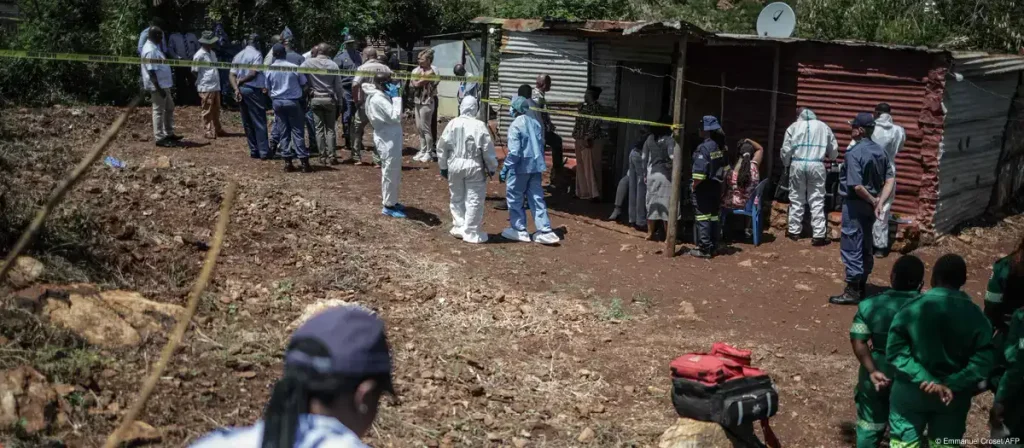
In Gauteng province, nine people, six men and three women, were found shot dead inside a four-room shack in the Jeffsville informal settlement in Pretoria’s Atteridgeville township, police said.
Gauteng police spokesperson Brig. Brenda Muridili said the shooting is believed to have taken place between 10 p.m. and 11 p.m. Sunday. Officers were alerted at about 7:30 a.m. Monday, the Mail & Guardian newspaper said. No arrests had been made.
Police did not immediately say whether any of the victims were children, the AP said.
Gauteng Provincial Police Commissioner Lt. Gen. Tommy Mthombeni said the killings could be tied to a shooting last year in the nearby Saulsville informal settlement, where 12 people were killed and 13 wounded.
“We cannot rule out that they may be linked, and may possibly have been a retaliation attack,” Mthombeni said.
He deployed additional resources, including Crime Intelligence and a specialized tracking team, to find the suspects, the Mail & Guardian said. The Gauteng Serious and Violent Crimes, Murder and Robbery Unit is leading the investigation. National Police Commissioner Gen. Fannie Masemola and Mthombeni were traveling to the scene, national police spokesperson Brig. Athlenda Mathe said.
Eight men in bullet-riddled car
In KwaZulu-Natal, police found eight men dead inside a vehicle riddled with bullets in Sweetwaters, outside Pietermaritzburg, on Sunday night.
“Inside the vehicle police found eight men who had multiple gunshot wounds and were certified dead at the scene,” a police statement said, according to Deutsche Welle, citing Agence France-Presse.
Police said they were still working to identify the victims and establish a motive. No suspects had been identified.
A KwaZulu-Natal police official noted that similar shootings in the province have stemmed from a range of causes. “We have seen these kinds of shootings before and there have been different motives from stock theft-related, to drugs-related to taxi violence,” the official said.
A pattern of mass killings
South Africa has seen a string of mass shootings in the past year, several linked by police to criminal gangs, the AP said.
In September, three gunmen stormed a small house in an impoverished area near Durban and opened fire on partygoers, killing at least 11 people, including a pregnant woman. In June, multiple gunmen killed 12 people in a poor Johannesburg neighborhood in an attack police tied to gangs. Two mass shootings two weeks apart last December killed 21 people, both carried out by multiple attackers.
DW said at least 28 people were killed in separate mass shootings in Gauteng and the Western Cape in September.
South Africa has one of the world’s highest murder rates, averaging about 60 killings a day, Reuters said. The country records between 36 and 45 murders per 100,000 people annually, DW said, and police grapple with heavy caseloads that contribute to low conviction rates. The country also faces high levels of gender-based and sexual violence.
Police urged anyone with information to contact their nearest police station or Crime Stop at 08600 10111, or to submit anonymous tips through the MySAPS app.
Violence that outpaces policing
Sunday’s twin massacres reflect a grim pattern in South Africa: mass shootings that have become frequent enough that each new incident joins a lengthening list. The common thread in many recent attacks, multiple gunmen targeting people gathered in homes or vehicles in poor communities, points to organized violence rather than random acts.
Mthombeni’s suggestion that the Jeffsville killings may be revenge for the Saulsville massacre, which occurred in the same broader Pretoria area, raises concern about cycles of retaliation. If confirmed, the link would indicate that unresolved killings are fueling new ones, a dynamic that can be difficult to break without arrests and convictions.
That points to a core challenge for South African authorities. The country’s low conviction rates, attributed partly to overwhelmed police caseloads, mean many perpetrators face little consequence.
The deployment of crime intelligence and tracking units, alongside visits by the national and provincial police chiefs, signals that the Jeffsville case is a priority, but successful prosecution will be the real measure.
The KwaZulu-Natal shooting underscores how varied the drivers of violence can be. The police official’s reference to stock theft, drugs and taxi industry disputes highlights rivalries that have long produced deadly feuds in the province, particularly in the minibus taxi sector, which is central to public transport but notorious for violent competition over routes.
The geographic spread of the attacks, in two provinces hundreds of kilometers apart, illustrates that the problem is national rather than local. Many victims in recent massacres have been residents of informal settlements and impoverished neighborhoods, where policing is often thin and economic hardship is acute.
With mass shootings recurring every few months, pressure is likely to mount on the government and police leadership to show progress, both in solving these cases and in reducing the conditions that allow such violence to flourish.
Sources: The Associated Press (AP); Reuters; Deutsche Welle (DW); Agence France-Presse (AFP); Mail & Guardian