

The U.S. military carried out strikes in southern Iran on Monday, hitting missile launch sites and boats attempting to lay mines in the Strait of Hormuz while President Donald Trump posted on social media that negotiations with Tehran were progressing well — a jarring contradiction that captured the volatile mixture of combat and diplomacy defining a war now entering its fourth month.
U.S. Central Command spokesman Capt. Tim Hawkins confirmed the strikes in a statement, describing them as acts of self-defense taken “to protect our troops from threats posed by Iranian forces” while the military was “using restraint during the ongoing ceasefire.”
No additional details about the specific threats or the scope of damage were immediately available.
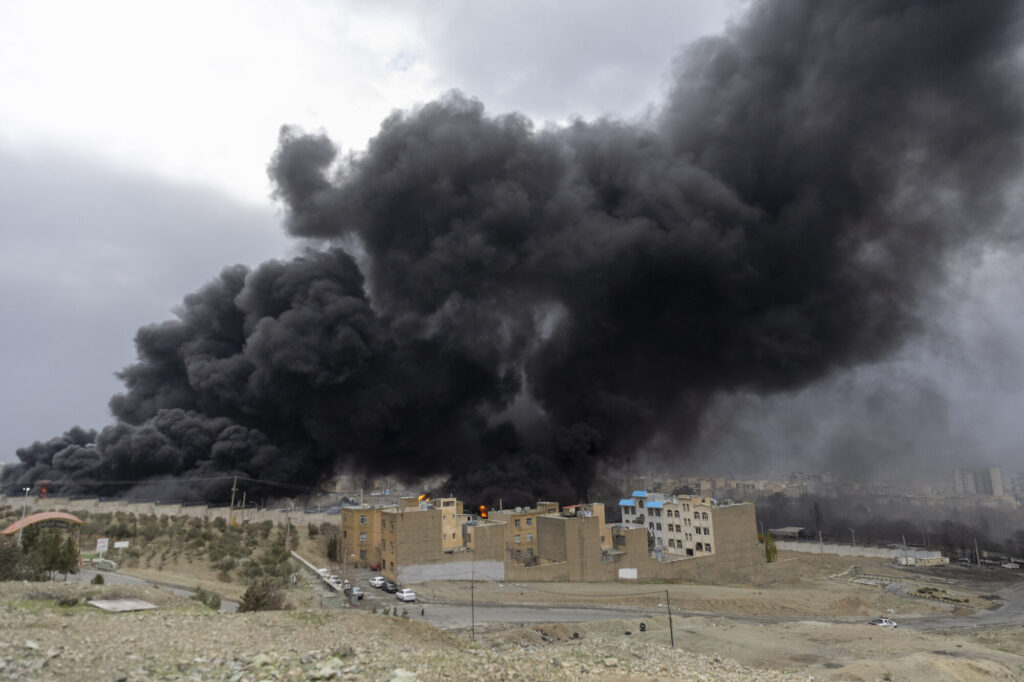
Iran’s response came through its own channels. The Tabnak news website, considered close to former Revolutionary Guard chief Mohsen Rezaei, identified four Revolutionary Guard troops it said were killed in American strikes on boats. Iranian state television separately reported explosions in and around Bandar Abbas, the city on the Strait of Hormuz that houses a major military port and a dual-use airport. Iran also said it shot down what it described as a hostile stealth drone using a newly developed air defense system, without identifying the drone’s origin.
The strikes landed as Iran’s foreign minister and top nuclear negotiator were in Doha for talks with Qatar’s prime minister on the framework for ending the war, an official briefed on the visit told Reuters. Iran’s central bank governor was also in Doha, attending discussions focused on the potential release of billions of dollars in frozen Iranian assets that Qatar holds as part of any eventual agreement.
Negotiations and Bombs at the Same Time
Secretary of State Marco Rubio, speaking to reporters on his plane in Jaipur, India, said Tuesday that finalizing a deal with Iran could “take a few days,” cooling expectations of an imminent end to the conflict. He described the Strait of Hormuz situation without diplomatic hedging.
“The straits have to be open, they’re going to be open one way or the other, so they need to be open,” Rubio said.
He said there was “a pretty solid thing on the table,” pointing to discussions over reopening the strait and what he called “a very real, significant, time-limited negotiation on the nuclear matter.” He told reporters in New Delhi earlier that the United States would give diplomacy every chance before considering whether to address Iran “in another way.”
Trump’s own account of where things stood was characteristically emphatic. In a lengthy Truth Social post Monday, he said talks with Iran were going “nicely” but warned he would resume full-scale attacks if diplomacy failed. “It will only be a Great Deal for all, or no Deal at all,” he wrote.
The simultaneous pursuit of military strikes and active negotiation reflects a posture the administration has maintained throughout the conflict: keeping military pressure on Tehran while leaving the diplomatic door open, calculating that the combination of pain and offramp produces faster concessions than either alone.
What Is on the Table in Doha
The Doha discussions, according to the official who briefed Reuters on the Iranian delegation’s visit, centered on two core issues that have defined the entire negotiating standoff since the April ceasefire took effect: the management of the Strait of Hormuz and Iran’s stockpile of highly enriched uranium.
Iranian Foreign Ministry spokesperson Esmaeil Baghaei said nuclear issues would only enter formal negotiation after a framework accord was first agreed on ending the war itself — a sequencing demand that Washington has resisted, preferring to address the nuclear question as part of the initial agreement rather than deferring it to a subsequent round of talks.
On the strait, Baghaei said the potential deal contained no specific provisions for managing traffic through the waterway. Iran would not charge tolls for passage, he said, but would impose fees for services including navigation assistance and environmental protection measures, under a protocol to be worked out with Oman, which sits on the opposite shore of the strait.
Japan’s Nikkei newspaper, citing a Middle East diplomatic source, said the two sides were discussing a plan that would reopen the strait approximately 30 days after a deal ending hostilities was signed.
Before the war began with U.S. and Israeli strikes on February 28, between 125 and 140 vessels passed through the strait daily. Since then, the number has dropped to a few dozen. The waterway normally carries roughly a fifth of the world’s seaborne oil and liquefied natural gas. Its effective closure has driven global oil prices sharply higher and pushed up the cost of fuel, food, and fertilizer across markets far removed from the Persian Gulf.
In early Asian trading Tuesday, U.S. West Texas Intermediate crude was slightly higher than Monday’s final price but down 5.5 percent from where it closed the previous Friday.
The Abraham Accords Complication
While the core Iran negotiations moved through Doha, Trump introduced a new element that immediately complicated the diplomatic picture. He said any agreement to end the war should include a requirement that additional countries, including Saudi Arabia and Pakistan, sign the Abraham Accords, the normalization agreements between Arab states and Israel that Trump brokered during his first term.
Trump posted that after all the effort the United States had invested in pulling the negotiations together, it should be “mandatory” that the relevant countries simultaneously sign the accords alongside any Iran deal. He pointed to Saudi Arabia and Qatar as countries that should sign “immediately.” He said he would accept one or two countries declining, but expected most to participate.
The proposal collided immediately with the political realities of the countries on his list. Saudi Arabia has for decades conditioned normalization with Israel on Israel’s withdrawal to its 1967 borders and the establishment of a Palestinian state with East Jerusalem as its capital. Israel’s conduct in Gaza has deepened that resistance across the Gulf Arab world and the broader Muslim world. Pakistan does not maintain diplomatic relations with Israel and has consistently made recognition of a Palestinian state a precondition for any shift in its posture.
Islamabad-based analyst Syed Mohammad Ali said Pakistan’s position on Israel had not changed as a result of Trump’s proposal. Masood Khan, Pakistan’s former ambassador to the United States, noted that introducing the Abraham Accords into negotiations that had not previously included that issue added an entirely new diplomatic dimension at an already complex moment.
“The invocation of the Abraham Accords at this stage gives an altogether new dimension to the diplomatic and mediatory processes because this issue was not on the agenda,” Khan said. He added that domestic pressure on Trump to deliver a favorable deal was visible in the proposal, but that “the diplomatic track is still working, and I believe Pakistan is very much at the center of it, supported by regional countries.”
Pakistan has served as a key intermediary throughout the ceasefire period, with Pakistani Foreign Minister Ishaq Dar maintaining regular contact with both Iranian and American counterparts. Trump’s suggestion that Pakistan join a normalization framework with Israel, while simultaneously asking Islamabad to continue mediating, put the Pakistanis in a position that their government had not publicly addressed as of Tuesday.
Trump also suggested Iran itself could eventually join the accords if a final agreement is reached, a notion Iranian officials had not commented on.
Lebanon and the Broader Regional Fire
The Iran negotiations are not the only front demanding attention. Israeli Prime Minister Benjamin Netanyahu said Monday that Israel would intensify strikes against the Iran-backed Hezbollah movement in Lebanon. The Israeli military moved quickly, announcing attacks on Hezbollah infrastructure in Lebanon’s eastern Bekaa Valley and other areas.
Israel and Lebanon reached a ceasefire in mid-April, but Israel has continued conducting airstrikes it characterizes as defensive responses to Hezbollah activity, with Hezbollah not having been a party to the ceasefire agreement. The escalating Israeli campaign in Lebanon adds pressure to a framework in which Iran has consistently demanded a halt to Israeli military action in Lebanon as a condition of any broader agreement.
The Price of Conducting Two Wars at Once
What Monday’s American strikes in southern Iran demonstrated, perhaps more clearly than any previous episode in this conflict, is the structural instability of a ceasefire that neither side has formally ended but both sides keep shooting through.
A ceasefire is a political and legal status. What has existed between the United States and Iran since April is something more ambiguous: a mutual acknowledgment that full-scale bombardment has paused, alongside continued exchanges of fire that each side characterizes as defensive or retaliatory but that in aggregate amount to ongoing armed conflict. The legal and diplomatic architecture surrounding that status is thin, which means it can absorb a certain number of strikes before it breaks entirely, but nobody knows in advance exactly where that threshold sits.
The Doha talks continuing on the same day American missiles hit Iranian boats represent either a demonstration of diplomatic resilience or a sign that both governments have concluded that combat and negotiation can coexist indefinitely without one destroying the other. The history of armed conflicts conducted alongside active negotiations is mixed on that question. Sometimes the military pressure accelerates concessions. Sometimes it hardens positions and provides domestic political ammunition to factions that oppose any deal.
Trump’s Abraham Accords addition to the negotiating demands illustrates a different kind of risk. Introducing new requirements into a negotiation that is already struggling to close on its existing agenda can signal seriousness of purpose or it can signal that the administration lacks the discipline to keep the negotiating focus narrow enough to succeed. The countries on Trump’s list have their own domestic constituencies, their own red lines on Israeli policy, and their own calculations about the costs of moving faster than their publics are prepared for. Asking Pakistan, Saudi Arabia, and Qatar to simultaneously normalize with Israel as part of an Iran ceasefire deal is asking them to take actions that their governments have spent years explaining to their populations they would not take without specific Israeli concessions that are not currently on offer.
Rubio’s “take a few days” assessment may prove accurate. Or it may prove to be the kind of diplomatic optimism that gets adjusted over subsequent days of leaked frustration and resumed military action. The strait remains closed. The oil markets remain unsettled. And somewhere in the Bekaa Valley, Israeli jets are dropping bombs on a ceasefire that is supposed to be holding.
Reuters/AP





