

STRAIT OF HORMUZ — The United States and Iran exchanged direct fire Thursday in the Strait of Hormuz, shattering a month of fragile calm and throwing the future of a ceasefire that had barely held since April 7 into serious doubt — just as Washington was waiting for Tehran’s answer on a peace proposal that could end the two-month war.
Three U.S. Navy guided-missile destroyers — USS Truxtun, USS Rafael Peralta, and USS Mason — came under attack as they transited the strait toward the Gulf of Oman. Iranian forces fired multiple missiles, drones, and deployed small boats against the ships, U.S. Central Command said in a post on X.
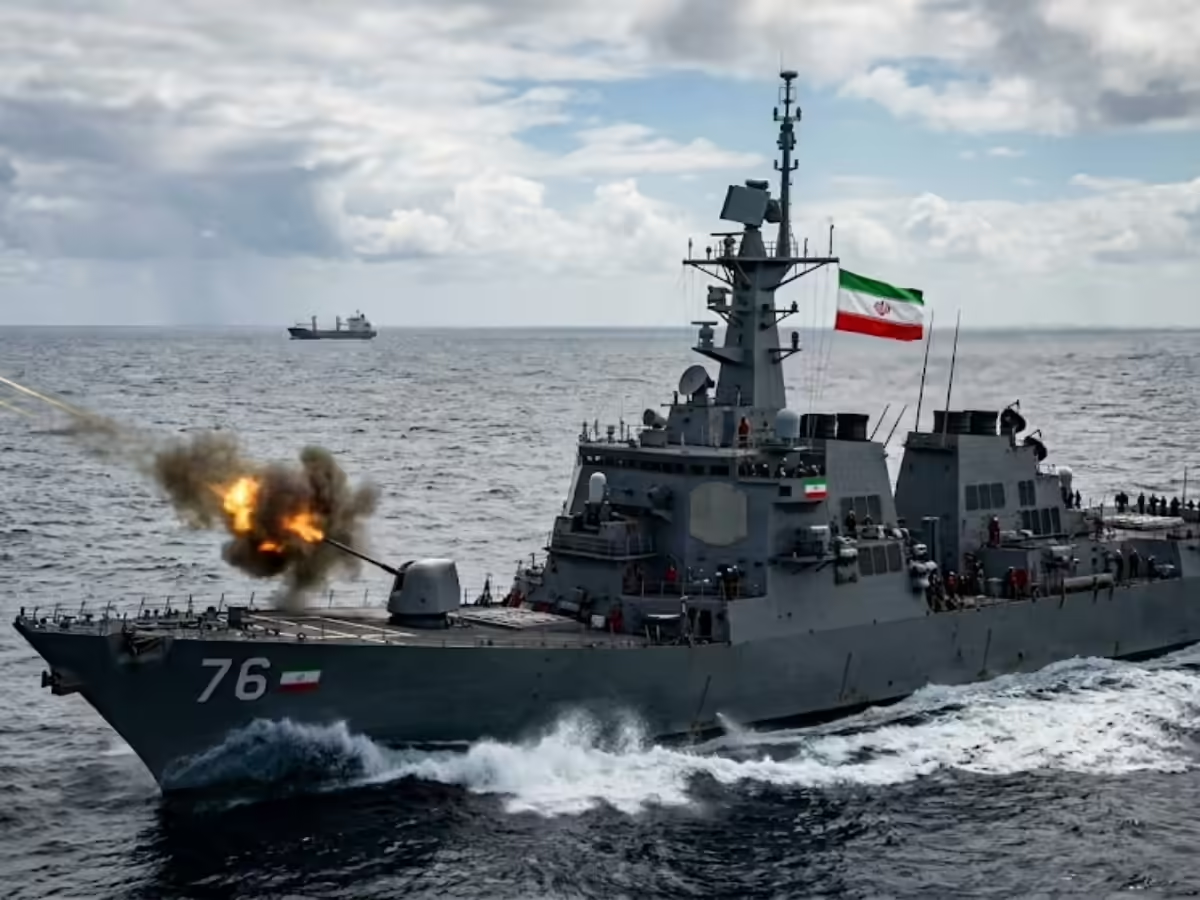
None of the American vessels were struck.
U.S. forces intercepted the incoming fire and hit back, targeting Iranian military facilities on the ground that CENTCOM said were directly responsible for the attack. Strikes hit at least two locations — Bandar Abbas and Qeshm Island — destroying missile and drone launch sites, command and control positions, and intelligence and surveillance nodes, a U.S. official told NBC News.
“CENTCOM does not seek escalation but remains positioned and ready to protect American forces,” the command said.
Iran’s top joint military command told a different story. Tehran accused the United States of violating the April 7 ceasefire by targeting an Iranian oil tanker and a second vessel attempting to enter the strait. Air defense systems were activated in the Iranian capital, the semiofficial Mehr news agency reported.
Each side accused the other of firing first. Neither account could be independently verified.
The exchange came at the worst possible diplomatic moment. Washington had submitted a peace proposal to Tehran through Pakistani intermediaries and was waiting for Iran’s response. Iran’s Foreign Ministry spokesperson said Thursday that Tehran had not yet reached a conclusion on the plan.
The proposed framework, according to sources and officials familiar with the negotiations, would unfold across three stages: a formal end to the war, resolution of the Strait of Hormuz crisis, and a 30-day negotiating window to address a broader agreement covering longer-term disputes.
What the proposal does not include is significant. It leaves Iran’s nuclear program unaddressed for now and does not require immediate reopening of the strait — the waterway that before the war carried one-fifth of the world’s oil and gas supply. Those omissions reflect the difficulty of bridging the gap between what Washington demands and what Tehran will accept, and they guarantee that even a successful first-stage agreement would leave the most combustible issues for later rounds of talks.
Iran’s foreign minister had said Wednesday that Tehran was reviewing the proposal. Thursday’s exchange of fire did not constitute an official breakdown of negotiations, but it made the path to a signed agreement considerably narrower.
The fighting in the strait was not the only escalation Thursday.
The U.S. imposed fresh sanctions on Iraq’s deputy oil minister and three militia leaders, citing their support for Iran. The move extended Washington’s economic pressure campaign beyond Iranian territory and into the regional network Tehran relies on for supply lines and proxy influence.
In Lebanon, Israel said it killed a Hezbollah commander in an airstrike on Beirut — the first Israeli strike on the Lebanese capital since a ceasefire there was agreed last month. A halt to Israeli attacks on Lebanon is one of Iran’s stated demands in negotiations with Washington, making the Beirut strike another variable complicating the diplomatic picture.
The war began Feb. 28 when the U.S. and Israel launched strikes against Iran. A ceasefire took effect April 7 and had largely held — marked by periodic violations but no full resumption of hostilities — until Thursday’s exchange in the strait.
What happened Thursday follows a pattern that historians of armed conflict recognize immediately. Two militaries operating in close proximity, each with rules of engagement that authorize defensive fire, each with a genuine incentive to frame whatever happened as the other side’s provocation — and a ceasefire with no enforcement mechanism, no neutral monitoring presence, and no agreed definition of what counts as a violation.
The U.S. says Iran fired first. Iran says the U.S. targeted its ships first. Both accounts are structurally convenient for the side offering them. In the absence of independent verification, the factual record becomes a function of which government’s narrative gains more traction internationally — a competition the United States typically wins in Western capitals and Iran typically wins nowhere, which does not necessarily mean Washington’s version is complete.
The more important question is what Thursday means for the peace process. Iran was reviewing a proposal. Thursday’s strikes give hardliners in Tehran who oppose any deal additional ammunition to argue that the United States cannot be trusted to honor a ceasefire even while negotiations are underway. It gives advocates for continued resistance a fresh grievance to point to. And it raises the domestic political cost, inside Iran, of the kind of concessions the American proposal apparently requires.
On the American side, the strikes on Bandar Abbas and Qeshm Island are described as defensive and limited — not a resumption of major combat operations. That framing matters legally and politically. But Iran does not necessarily accept the distinction between a targeted strike on its military facilities and an act of war, and the line between the two has a way of dissolving when missiles are landing.
Saudi Arabia has already said it will not allow its territory or bases to be used for U.S. military operations related to the strait. Russia and China have vetoed Security Council action. Pakistan is mediating but has no leverage to enforce compliance. The diplomatic architecture supporting a peace agreement is thin, and Thursday just put more weight on it than it was built to hold.
The ceasefire is not officially over. But it is no longer intact.
AP/NBC/Reuters





