

Gunmen abducted at least 39 schoolchildren and seven teachers in southwestern Oyo State, where authorities said one teacher was later killed in captivity, as security forces faced explosive devices during a rescue effort.
The attack unfolded Friday in the Ahoro Esinele community within the Oriire district, targeting multiple schools, including one secondary school and two primary schools, officials said.
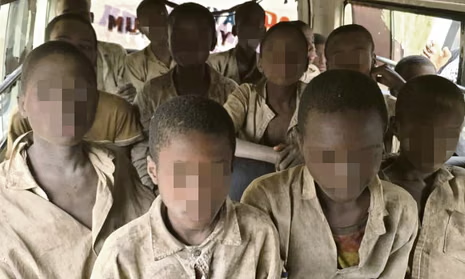
Governor Seyi Makinde said a video confirmed the killing of one abducted teacher on Sunday. He added that six suspects had been detained, including individuals accused of providing information and logistical support to the kidnappers.
Makinde said a joint rescue operation involving the military, police and local security groups was disrupted when responders encountered improvised explosive devices planted by the attackers. Several operatives were injured and are receiving treatment.
President Bola Tinubu condemned the killing, describing it as barbaric, and said federal authorities were working closely with state officials to secure the release of the victims. He added that specialized police and intelligence teams had been deployed to the area.
Mass abductions have become a persistent security crisis in Nigeria, with armed groups exploiting weak enforcement and porous borders to target schools, travelers and rural communities for ransom. While such incidents are more common in the north, attacks in the southwest remain relatively rare, raising fresh concerns about the spread of insecurity.
In a separate development, the Nigerian military said a joint operation with U.S. forces in northeastern Borno State killed more than 20 militants linked to the Islamic State group.
The operation took place in Metele, near the borders with Niger and Chad, and followed the recent killing of a senior militant leader, identified as Abu Bakr al-Mainuki. Military officials described the mission as a significant step in expanding operational coordination between Nigeria and the United States.
A U.S. military statement indicated that no American or Nigerian personnel were injured during the strikes.
Nigerian military spokesperson Samaila Uba said ongoing cooperation with U.S. forces aims to dismantle militant networks, eliminate fighters and prevent them from maintaining safe havens within the country.
The United States deepened its security partnership with Nigeria last year, initially focused on training and advisory support. Analysts say the latest operation suggests that cooperation has evolved into more direct involvement.
Nigeria continues to face a complex security challenge, with multiple armed groups operating across different regions. The insurgency, which began more than a decade ago, has driven widespread displacement and instability.
Human rights groups have raised concerns about civilian casualties linked to military operations. Earlier this month, Amnesty International alleged that a military strike killed dozens of civilians at a market, an accusation the Nigerian military has denied.
The twin developments highlight the widening scope of Nigeria’s security crisis. The school abduction in Oyo underscores how criminal networks are expanding beyond traditional hotspots, signaling a troubling shift that could place more regions at risk.
At the same time, the joint offensive in Borno reflects a more aggressive military posture supported by international cooperation. The involvement of U.S. forces points to growing concern in Washington over the spread of extremist groups in West Africa, where affiliates of global networks have become increasingly active.
However, the contrast between tactical military successes and ongoing kidnappings reveals a deeper structural challenge. While targeted operations may weaken militant leadership, they have not yet addressed the underlying conditions—such as poverty, weak governance and limited rural security—that allow such groups to operate.
The use of explosive devices against rescue teams also signals a shift in tactics, suggesting that armed groups are becoming more sophisticated and better equipped to counter government forces.
For Nigeria’s leadership, the challenge lies in balancing military action with long-term strategies that restore public confidence and protect vulnerable communities, particularly schools that continue to be seen as high-value targets.
AP/Reuters





