

Russia launched one of its most devastating overnight attacks on Ukraine in weeks Monday, killing at least nine people, wounding dozens more, and setting fire to a centuries-old monastery in Kyiv that stands as one of the most sacred sites in Christian history, authorities said.
The assault struck apartment buildings, emergency crews, and cultural landmarks across multiple cities, drawing immediate international condemnation and renewed calls for decisive action against Moscow.
What We Know So Far
Ukraine’s Air Force confirmed that Russia launched 70 missiles and 611 drones overnight, targeting Kyiv, Kharkiv, and Dnipro. Air defenses intercepted or electronically suppressed 632 aerial targets, including 50 missiles and 582 drones. Preliminary data showed 20 ballistic missiles and 27 attack drones reached 42 locations across the country, with debris from intercepted drones falling at 12 additional sites, the Associated Press confirmed.
In Kyiv, four people were killed and at least 30 injured, including two children aged five and six, Tymur Tkachenko, head of the Kyiv City Military Administration, said. Five strikes hit civilian locations in the Shevchenkivskyi district within less than 30 minutes, among them a 25-story apartment building, a market, and a grocery store. A nine-story residential building in the Obolonskyi district took a direct hit.
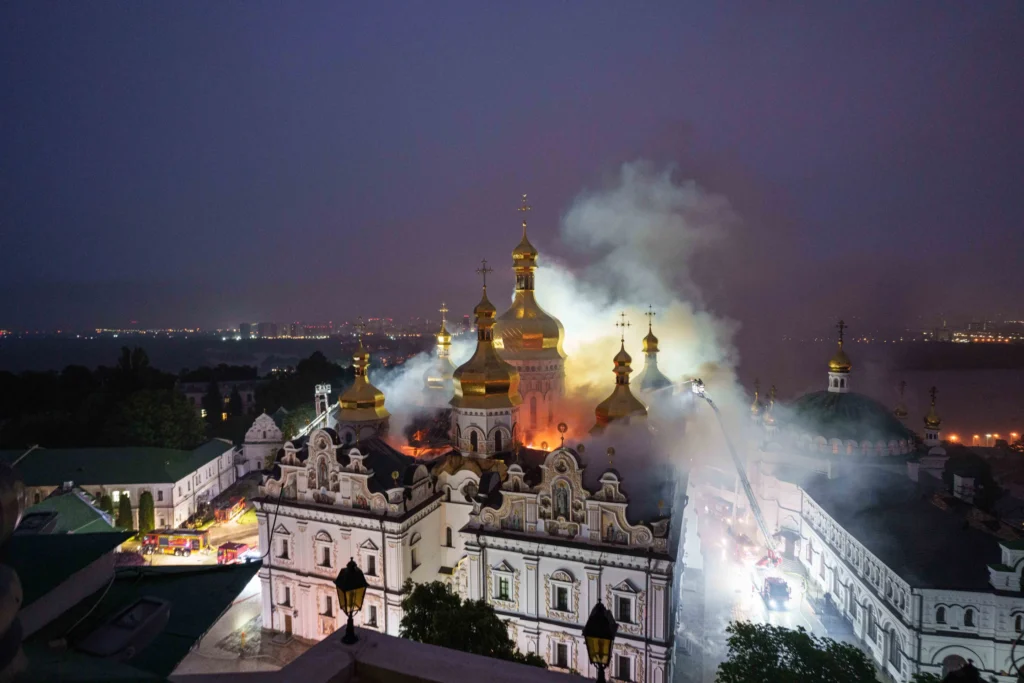
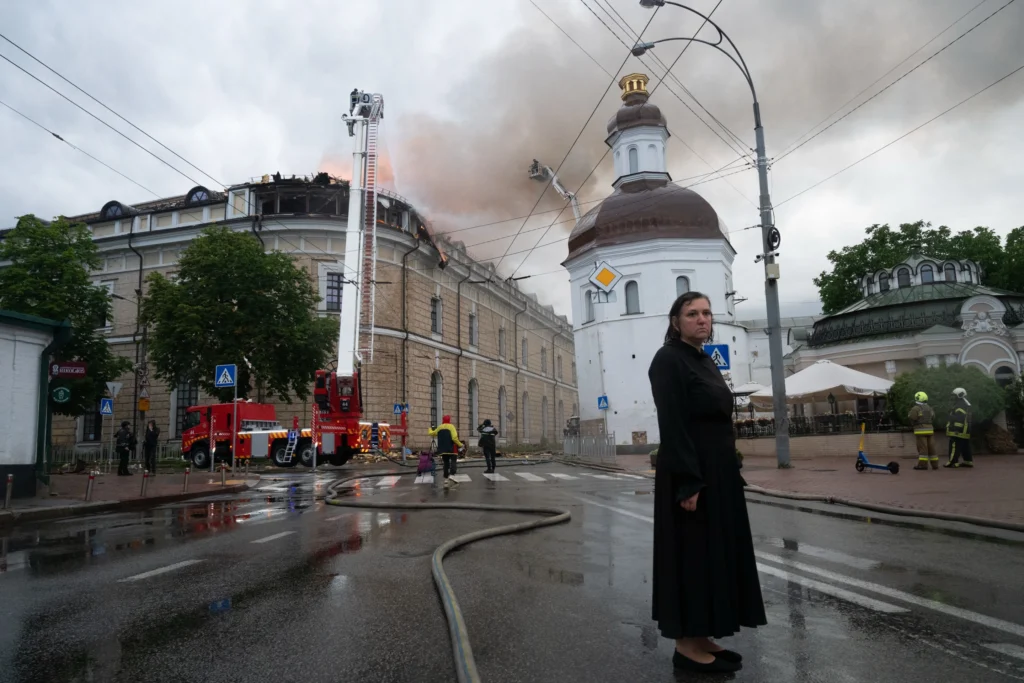
The most emotionally charged strike of the night fell on the Kyiv-Pechersk Lavra, also known as the Monastery of the Caves, a UNESCO World Heritage site founded in 1051 and one of the oldest and most revered religious complexes in the Eastern Christian world. The roof of its Dormition Cathedral caught fire during the attack, Metropolitan Epiphanius, head of the Orthodox Church of Ukraine, confirmed.
“A Russian strike on the Kyiv-Pechersk Lavra set the Dormition Cathedral on fire, a church whose history dates back to the 11th century. And this is one of Russia’s most serious crimes against Christian culture to date,” Ukrainian President Volodymyr Zelenskiy wrote on X.
In Kharkiv, Ukraine’s second-largest city, Russian forces used what authorities described as a deliberate double-tap tactic, launching four additional drone strikes on a site in the Kholodnohirskyi district after emergency crews had already arrived to respond to an earlier attack. Four emergency service workers and one municipal official were killed. Six rescuers and three civilians were injured, Interior Minister Ihor Klymenko confirmed on Telegram.
Three people, including a one-year-old child, were killed in a drone strike on the Russian city of Tula, south of Moscow, the regional governor said in a Telegram post, as Reuters noted Ukraine has intensified attacks on Russian industrial and energy targets in recent weeks.
In Dnipro, one building of a local college was destroyed and windows were shattered at a nearby school and the city’s House of Organ and Chamber Music, Dnipropetrovsk regional administration head Oleksandr Hanzha said. Two people were injured across multiple strikes in that area.
Three people, including a child, were wounded in Sumy after a Russian strike hit an apartment building, Ukraine’s State Emergency Service confirmed.
Ukraine also struck two bridges connecting the Crimean peninsula to Russian-controlled areas overnight, moving to cut off the annexed territory from further supply lines amid a reported fuel shortage there, Reuters confirmed.
What Authorities Are Saying
Zelenskiy described the monastery attack as among Russia’s gravest crimes against civilization and said Ukraine would urgently pursue responses through UNESCO and other international mechanisms.
Foreign Minister Andrii Sybiha announced Ukraine would initiate procedures within UNESCO “to ensure immediate and adequate responses to this state barbarism.” Estonia’s foreign minister, Margus Tsahkna, separately condemned the Russian strikes.
Metropolitan Epiphanius called the strike on the monastery a crime “against humanity, against history, against Christianity” and appealed for prayers to save the site.
Tkachenko accused Russia of deliberately targeting “the heart of one of the largest Christian shrines,” calling the decision to strike apartment blocks a calculated choice rather than a consequence of military operations nearby.
Russia’s Defense Ministry framed the night’s operations differently, insisting it had struck military industrial facilities, conscription offices, and air bases in Kyiv, Kharkiv, and Dnipro with long-range precision weapons. “The goals of the strikes have been fulfilled and all the designated facilities have been hit,” the ministry said. Russia separately claimed its air defenses downed 123 Ukrainian drones overnight.
Russia and Ukraine both deny deliberately targeting civilians. Reuters noted it could not independently verify casualty figures or claims from either side.
Air Force spokesperson Yuriy Ihnat acknowledged the continuing challenge posed by ballistic missiles. “Ballistic missiles remain a problem for us,” he said on national television. “Of the 34 ballistic missiles launched, only 15 were shot down, although that is a strong result.”
Poland scrambled fighter jets Monday in response to a possible airspace incursion before recalling the alert after determining no violation had occurred, its Armed Forces confirmed on X.
Why This Matters
The Kyiv-Pechersk Lavra is not merely a religious site. It is a sprawling complex of monasteries, churches, and underground caves spanning more than 600 meters, built across eight centuries from the 11th to the 19th, and it has served as a pilgrimage destination for Christians across Eastern Europe for nearly a thousand years. Its designation as a UNESCO World Heritage site reflects its irreplaceable status in global cultural heritage.
Its targeting, whether deliberate or incidental, carries symbolic weight that extends far beyond Ukraine’s borders. The Orthodox Church of Ukraine, the Ukrainian government, and international cultural institutions will all frame this as an attack not only on a nation at war but on a shared civilizational inheritance.
The broader military picture is equally significant. Monday’s assault was the heaviest attack on Kyiv in two weeks and came at a diplomatically sensitive moment. Zelenskiy had spoken with Trump just the day before, discussing pathways toward ending a conflict now stretching beyond four years, ahead of a G7 meeting in France. The Kremlin confirmed Sunday that Trump had also told Russian President Vladimir Putin that ending the Ukraine conflict was a priority and that he was prepared to help facilitate it.
Progress toward any Ukraine settlement has moved slowly, partly because U.S. diplomatic energy has been heavily concentrated on the Middle East, where Washington and Tehran announced a peace framework Sunday, Reuters noted. That agreement, expected to be formally signed in Switzerland on Friday, may now allow greater American attention to shift toward Kyiv.
The double-tap strike on Kharkiv that killed four emergency workers is a tactic that has drawn particular condemnation from human rights observers and military analysts. Deliberately targeting first responders arriving at a strike site is widely considered a war crime under international humanitarian law, and Monday’s incident will add to the mounting documentation that Ukrainian and international legal teams are compiling for future accountability proceedings.
What Happens Next
Zelenskiy has proposed direct talks with Putin, a proposal backed by Britain, Germany, and France. Putin has so far rejected that approach. The G7 meeting in France this week provides an opportunity for allied governments to coordinate a unified response, potentially including additional air defense systems that Ukraine has repeatedly requested and that Monday night’s attack underscored remain urgently needed.
UNESCO is expected to assess the damage to the Kyiv-Pechersk Lavra in the coming days. Ukraine’s foreign ministry has already signaled it will push for an emergency institutional response.
With the U.S.-Iran peace framework now in place, pressure on Washington to give greater attention to the Ukraine conflict is likely to increase. Whether that shift in diplomatic bandwidth translates into renewed momentum toward a ceasefire, or whether Russia uses the moment of reduced American focus elsewhere to press further military advantages, will be among the most consequential questions of the weeks ahead.
For the residents of Kyiv who sheltered underground through the night while one of their city’s most ancient landmarks burned above them, those questions carry a weight that no diplomatic communique has yet come close to answering.
AP/Reuters





