

LAGOS, Nigeria — Two-time world heavyweight boxing champion Anthony Joshua was released from hospital care Tuesday afternoon following a vehicular collision along Nigeria’s Lagos-Ibadan Expressway that claimed the lives of two close friends traveling with the British-Nigerian athlete.
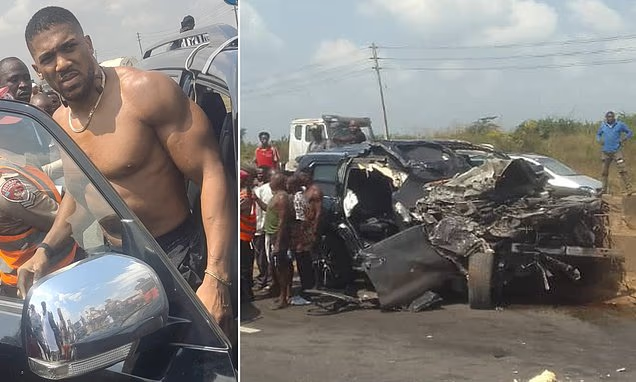
The governments of Lagos and Ogun states issued a joint statement Wednesday confirming Joshua’s discharge and expressing condolences for Lateef Ayodele and Cina Gami, who died in Monday’s crash. The statement, co-signed by Gbenga Omotoso, Lagos State Commissioner for Information and Strategy, and Kayode Akinmade, Special Adviser on Information and Strategy for Ogun State, reflected the regional significance of an accident involving one of boxing’s most prominent figures.
“The governments of Lagos and Ogun states once again commiserate with the families of the two young men, Lateef Ayodele and Cina Gami, who tragically and unfortunately lost their lives in the road accident involving Anthony Joshua. We pray The Almighty grant the repose of their souls whilst granting their families and loved ones the fortitude to bear this very sad and painful loss,” the official statement read.
Medical personnel at Lagoon Hospital in Ikoyi, an upscale Lagos neighborhood, determined Joshua was “clinically fit to recuperate from home” despite what officials described as the boxer being “heavy hearted and full of emotions over the loss of his two close friends.” The assessment indicated Joshua sustained injuries insufficient to require extended hospitalization, though the psychological impact of witnessing his companions’ deaths clearly weighed heavily on the athlete.
Hours after his discharge Tuesday afternoon, Joshua and his mother visited a Lagos funeral home where Ayodele and Gami’s bodies were being prepared for repatriation. The private visit allowed the boxer to pay final respects before the deceased were transported from Nigeria, though officials provided no details about destination countries or funeral arrangements. The gesture reflected the depth of Joshua’s relationship with the two men, whose connections to the boxer remain largely undisclosed in public statements.
PUNCH Online reported that the collision occurred at approximately 11 a.m. Monday when a Lexus SUV carrying Joshua, bearing registration number KRD 850 HN, struck a stationary truck along the heavily trafficked expressway connecting Nigeria’s commercial capital Lagos with Ibadan, the capital of Oyo State. The crash resulted in two passenger deaths and injuries to multiple occupants including the boxing champion, though the specific nature and severity of Joshua’s injuries have not been publicly disclosed.
The Lagos-Ibadan Expressway represents one of Nigeria’s most critical transportation corridors, carrying enormous volumes of commercial and passenger traffic between the country’s largest city and the populous southwestern interior. The 127-kilometer highway has gained notorious reputation for accidents attributed to factors including poor road maintenance, inadequate lighting, disabled vehicles left on roadways, and aggressive driving behaviors. The presence of stationary trucks on the expressway poses particular hazards, as broken-down commercial vehicles frequently remain on the roadway for extended periods without adequate warning markers.
The joint government statement specifically praised medical personnel who provided emergency and follow-up care following the accident. “The team of doctors and medical personnel at Lagoon Hospital, Ikoyi, who attended to Anthony and those that sustained injuries, displayed quality care and professionalism that is truly commendable,” officials noted. The commendation reflected both gratitude for successful treatment and an implicit acknowledgment of broader challenges facing Nigeria’s healthcare system, where quality emergency medical care remains inconsistent across regions and facilities.
Lagos State Governor Babajide Sanwo-Olu and Ogun State Governor Dapo Abiodun extended thanks to Nigerian President Bola Ahmed Tinubu and the general public for support during the crisis period. The high-level governmental involvement in what would typically constitute a routine traffic accident reflects Joshua’s celebrity status both internationally and within Nigeria, where his maternal heritage has created strong popular identification with the boxer despite his residence and training primarily occurring in the United Kingdom.
Joshua’s Nigerian connection runs through his mother, who maintains family ties in the country. The boxer has previously visited Nigeria for promotional events and maintains public identification with his Nigerian heritage alongside his British nationality and upbringing. This dual identity has made him a figure of particular interest in Nigeria, where successful diaspora athletes and entertainers receive intense public attention and are viewed as sources of national pride.
The accident occurred during what appears to have been a private visit to Nigeria, though neither Joshua’s representatives nor government officials have disclosed the purpose of his presence in the country or the planned destination when the collision occurred. Professional boxers of Joshua’s stature typically maintain carefully managed public schedules, making private travel relatively unusual and raising questions about whether the trip involved personal matters, potential business ventures, or charitable activities.
Authorities confirmed that investigations into the accident’s causes continue, though no preliminary findings have been released publicly. Standard accident investigations in Nigeria examine factors including vehicle mechanical condition, driver actions, road conditions, and whether stationary vehicles displayed proper warning signals. The involvement of a high-profile international athlete will likely ensure more thorough investigation than typical expressway accidents receive, potentially highlighting systemic road safety issues that contribute to Nigeria’s high traffic fatality rates.
Nigeria records among the world’s highest per-capita traffic death rates, with the Federal Road Safety Corps documenting thousands of fatalities annually on the country’s road network. The Lagos-Ibadan Expressway accounts for a disproportionate share of serious accidents given its heavy traffic volumes, aging infrastructure, and mixture of passenger vehicles with slow-moving commercial trucks. Advocacy groups have repeatedly called for comprehensive highway improvements including better lighting, emergency lanes, regular patrols to remove disabled vehicles, and enhanced enforcement of traffic regulations.
The crash underscores vulnerabilities facing even high-profile individuals traveling on Nigerian roads, where wealth and fame provide limited protection against infrastructure deficiencies and traffic hazards. Joshua’s ability to access immediate high-quality medical care at Lagoon Hospital contrasts sharply with experiences of typical accident victims, many of whom face delays reaching medical facilities or receive substandard emergency treatment that contributes to preventable deaths.
The statement requesting “patience and cooperation as officials manage the aftermath” suggested ongoing logistical and investigative activities beyond immediate medical care and victim repatriation. Authorities may be coordinating with British diplomatic officials given Joshua’s nationality, managing media attention, and ensuring proper documentation of the incident for insurance and legal purposes.
Joshua’s boxing career has established him as one of the sport’s biggest draws, with the former IBF, WBA, WBO, and IBO heavyweight champion commanding massive purses and pay-per-view audiences for his fights. His most recent competitive activity saw him navigate a complex heavyweight landscape dominated by figures including Tyson Fury, Oleksandr Usyk, and Deontay Wilder. The accident’s impact on his training schedule and upcoming fight plans remains unclear, though the psychological toll of losing two friends in a crash he survived will likely require processing before he can focus fully on athletic preparation.
The deaths of Ayodele and Gami represent the human tragedy underlying statistics about traffic accidents that might otherwise seem abstract to international audiences unfamiliar with Nigerian road conditions. The men’s relationships to Joshua, their ages, professions, and personal circumstances remain largely unexplored in official statements, reducing them to names in government press releases rather than fully realized individuals whose deaths created grief extending beyond the boxing champion to their own families and communities.
Public appeals for patience suggest awareness that Joshua’s celebrity status will generate sustained media attention and public curiosity about accident details that authorities may not be prepared to immediately disclose. Nigerian officials likely recognize that managing information flow carefully serves both investigative integrity and respect for grieving families who may not welcome intrusive coverage of their losses.
The incident arrives during a period when road safety advocates have intensified pressure on Nigerian federal and state governments to address systemic infrastructure failures contributing to the country’s traffic death toll. The Lagos-Ibadan Expressway has been subject to intermittent reconstruction efforts, but progress remains slow and funding inconsistent, leaving dangerous conditions that persist despite official awareness of risks.
Joshua’s discharge from hospital and ability to visit the funeral home suggest his physical injuries, while requiring medical evaluation and treatment, did not include life-threatening trauma or complications requiring intensive care. The focus on his emotional state in official statements indicates recognition that psychological impacts from the accident and his friends’ deaths may prove more significant than any physical harm he sustained.
Punchng





