

President Donald Trump signed three proclamations Monday imposing 50 percent tariffs on a wide range of Canadian exports, citing what the White House described as Canadian discrimination against American motor vehicles, alcoholic beverages, and dairy products, in the most aggressive escalation of the U.S.-Canada trade war since Trump returned to office.
The tariffs, set to take effect in 30 days on August 19, were imposed under Section 338 of the 1930 Tariff Act, a rarely used Great Depression-era provision that analysts described as the most powerful and legally expansive trade weapon in the American president’s arsenal, carrying implications that extend well beyond the bilateral dispute with Canada.
What We Know So Far
The White House fact sheet confirmed the tariffs apply to a sweeping range of Canadian goods, including dairy products, wine, beer, cider, hockey equipment, furniture, plywood, candles, kitchenware, cement, clothing, swimming pools, fishing rods, seeds, and wigs. Energy products, potash, fish, and critical minerals were excluded, as were goods already covered by separate Section 232 tariffs, the Associated Press confirmed.
Trump signed three distinct proclamations. The first targeted dairy, citing Canada’s tariff rate quota system which the White House said gives European producers more access to Canadian markets than American ones. The second addressed alcohol, pointing to the decision by most Canadian provinces to remove American spirits, wine, and beer from shelves in response to earlier U.S. tariffs. The White House said Canadian imports of American alcoholic beverages declined by 81 percent over the past year. The third proclamation addressed the automotive sector, citing a 25 percent Canadian tariff on U.S. vehicles not covered under the United States-Mexico-Canada Agreement, with the White House noting that Canadian imports of U.S. motor vehicles dropped 22 percent in the same period, CBC confirmed.
The tariffs apply regardless of whether goods qualify under the USMCA, effectively bypassing the trade deal’s protections. The USMCA was not renewed by the United States, triggering a new set of negotiations that could run until 2036, the Associated Press confirmed.
U.S. Trade Representative Jamieson Greer framed the measures as a direct response to Canadian retaliation. “While the Administration continues to secure fair and reciprocal trade deals with our trading partners, Canada, unlike other partners and allies, continues to retaliate against the United States for its efforts to rebalance trade and protect U.S. industry in national-security sensitive sectors,” Greer said in a statement.
A senior administration official told reporters on a conference call that the measures were defensive rather than aggressive. “This is not a trade war with Canada, these are defensive measures,” the official said, speaking on condition of anonymity to preview the president’s actions.
What Canadian Officials And Business Leaders Are Saying
Ontario Premier Doug Ford was among the first provincial leaders to respond, demanding a dollar-for-dollar Canadian retaliation. “I’ll never stop fighting to protect Ontario. If these tariffs proceed, Canada should respond tariff for tariff, dollar for dollar,” Ford posted on social media. He had earlier dismissed Trump’s threat to add tariffs based on Canadian wildfire smoke drifting into the United States as a “bunch of rubbish.”
Quebec Premier Christine Fréchette called the announcement “unjustified and concerning” in a French-language social media post, urging the federal government to maintain Canada’s supply management system for dairy. “As for supply management, any weakening is non-negotiable. We will defend it without compromise,” Fréchette wrote on X. She was attending a meeting of premiers in Charlottetown and said she would discuss the situation with Prime Minister Mark Carney.
Canadian Chamber of Commerce president and CEO Candace Laing urged calm and called for both sides to use the 30-day window before the tariffs take effect to advance formal negotiations. “While this is a regrettable escalation by the U.S. administration, we now have 30 days before this comes into effect. Both sides need to use this window to make meaningful progress in advancing formal talks,” Laing said, CBC confirmed.
The office of Prime Minister Carney did not immediately respond to requests for comment.
Flavio Volpe, president of Canada’s Automotive Parts Manufacturers’ Association, suggested the announcement might be a negotiating tactic rather than a final position. “I’m still bullish about a deal in the coming months. I know who we’re dealing with,” Volpe told CBC’s Power and Politics. “We went through similar things in 2018 and 2019. They turn the heat up at the end to create a little bit of drama.”
Brian Clow, former deputy chief of staff to Justin Trudeau, urged the Canadian government to respond patiently. “They should take that time, react calmly, not rush into any quick judgments or decisions here and think about their next steps,” Clow said, noting that Canada retained significant leverage because energy, potash, fish, and critical minerals had been left untouched by the tariffs.
What American Industry Is Saying
Not all American voices welcomed the tariffs. Chris Swonger, president and CEO of the Distilled Spirits Council of the United States, said while he appreciated the administration’s recognition of the damage caused by Canadian provinces pulling American spirits from shelves, he had hoped the dispute could be resolved without further escalation.
“Imposing a 50 percent tariff on imported spirits from Canada deepens trade tensions and raises the risk of further retaliation at a time when many U.S. hospitality businesses continue to face financial hardships,” Swonger said, urging policymakers on both sides to pursue a negotiated solution, Reuters confirmed.
Representative Suzan DelBene of Washington, chair of the Democratic Congressional Campaign Committee, said the tariffs would harm American families and backfire on the industries Trump was claiming to protect. “These new taxes will raise prices on American families and likely lead to retaliation against the very industries Trump purportedly wants to protect,” DelBene said.
Why This Matters
The invocation of Section 338 of the 1930 Tariff Act is the most consequential legal decision embedded in Monday’s announcement. The provision, dormant for decades, allows the president to impose tariffs of up to 50 percent on any foreign country found to have placed unreasonable duties or discriminatory barriers on American goods, and it requires no complex legal process beyond a presidential finding, legal experts writing in the Global Trade Law Blog noted, describing it as a “trade warrior’s dream,” CBC confirmed.
Scott Lincicome, vice president of general economics at the Cato Institute, described the move in stark terms. “We crossed the Rubicon. The invocation of 338 is the nuclear option for Trump tariffs,” Lincicome said. The concern is that Section 338 is not limited to Canada and could theoretically be applied to any U.S. trading partner, injecting what Lincicome called massive uncertainty into the global trading system.
The timing is also politically loaded. Trump faces the November midterm elections with weak approval ratings on the economy, an annual inflation rate that has risen since he took office, and the ongoing economic disruption caused by the Iran war’s impact on oil prices. His April 2025 Liberation Day tariffs provoked a financial market meltdown severe enough to prompt a partial retreat, and the Supreme Court ruled in February that those tariffs had been imposed without proper legal authority, forcing the administration to find alternative statutory vehicles for its trade agenda. Section 338 is one such vehicle.
The irony of the situation is not lost on trade analysts. The Canadian measures Trump cites as discriminatory, including provincial bans on American alcohol and the automotive tariffs, were themselves retaliatory responses to earlier American tariffs imposed on Canada on the stated grounds of fentanyl smuggling, a justification Canadian officials consistently rejected. The escalating sequence of action and retaliation has created a cycle in which each government’s defensive measure becomes the other’s justification for the next round of punishment.
Canadian trade lawyer Rambod Behboodi of Borden Ladner Gervais told CBC that the timing reflected Trump’s need to show domestic voters a win before the midterms. “That win is not going to be in the form of a win-win trade agreement with Canada,” Behboodi said. “I’m not surprised about the timing.”
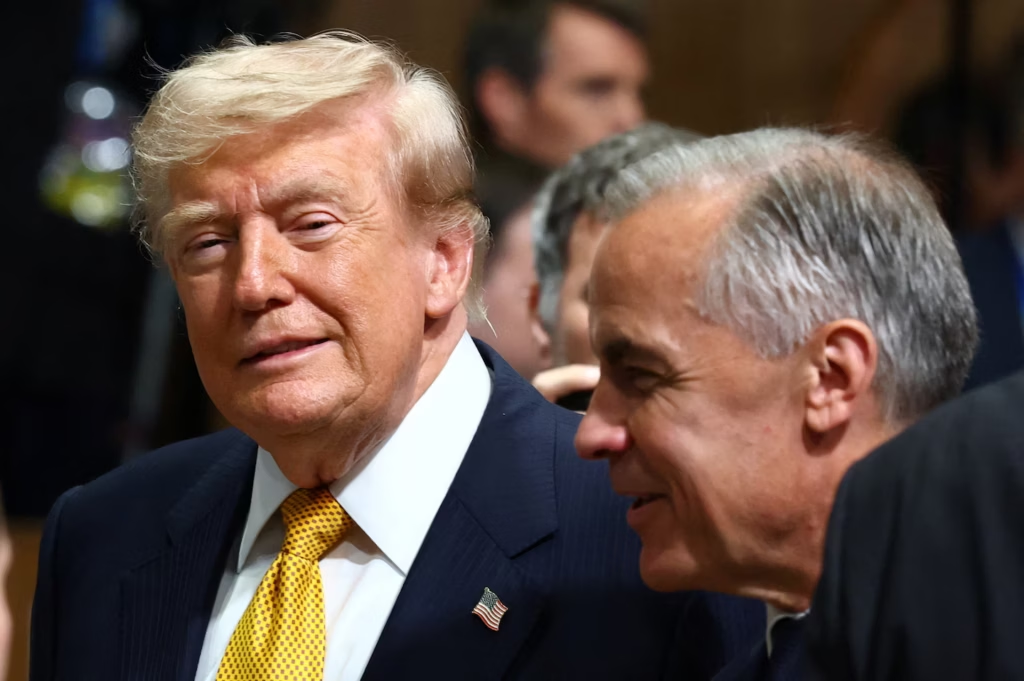
The context of the World Cup final on Sunday, where Trump sat alongside Canadian Prime Minister Carney to watch Argentina face Spain, adds a layer of diplomatic incongruity to Monday’s announcement. The administration confirmed their time together at the match was not a working meeting on trade.
What Happens Next
The 30-day window before the tariffs take effect on August 19 represents the immediate diplomatic opportunity. Both the Canadian Chamber of Commerce and American business associations have called explicitly for negotiations within that window, and Volpe’s assessment that a deal remains possible in the coming months reflects a cautious optimism that the tariff announcement is a pressure tactic rather than a settled policy.
Carney, who was elected on a platform of standing up to the United States and has actively pursued trade diversification with other partners, will face pressure from provincial premiers, industry groups, and the public to respond decisively. Ford’s call for dollar-for-dollar retaliation represents the hardest available position. The federal government’s approach to that decision in the coming days will define the diplomatic temperature heading into the formal negotiating period.
For American consumers, the tariffs add to an existing cost burden from previous rounds of import taxes on Canadian goods. Canada is one of the largest trading partners of the United States, and goods ranging from lumber to dairy to automotive parts flow across the border in volumes that make any significant tariff increase immediately felt in retail prices.
Whether the 30-day window produces a negotiated resolution, a partial retreat similar to what followed the Liberation Day meltdown, or a full implementation of the 50 percent rate on August 19 will be the defining trade story of the summer and a significant factor in November’s congressional elections.
Reuters/AP/CBC




