

A new attack on a commercial oil tanker in the Strait of Hormuz has intensified fears of a wider regional conflict as the United States launched a tenth consecutive night of military strikes against Iran, further escalating a confrontation that is disrupting one of the world’s most important energy corridors.
The latest developments underscore the growing risks to international shipping, global energy markets and regional security as both nations continue to exchange military blows despite ongoing diplomatic efforts to revive a collapsed ceasefire agreement.
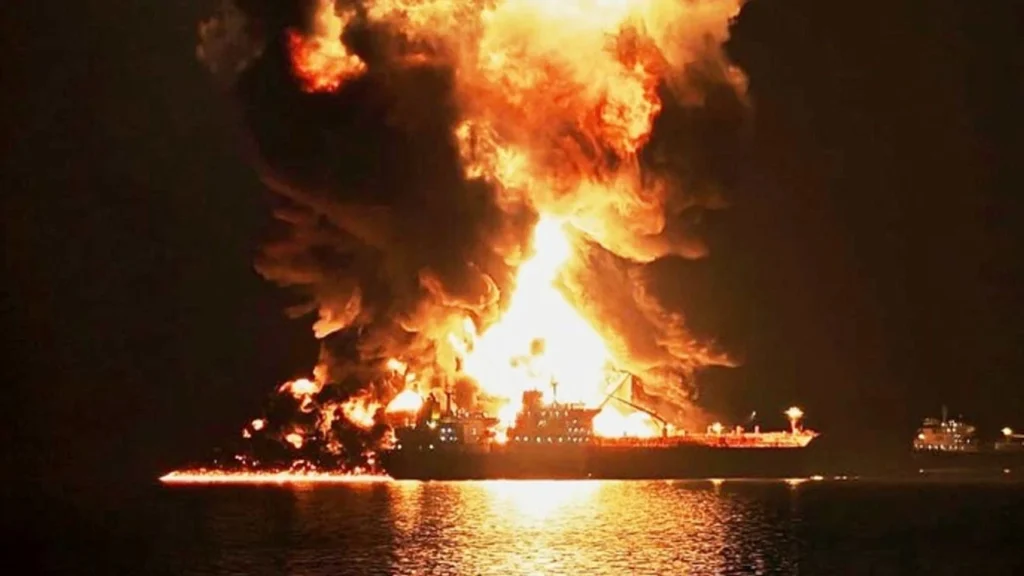
The United States says its latest strikes targeted Iranian military facilities used to threaten maritime traffic, while Iran has continued attacks on commercial vessels and military installations linked to Washington and its regional allies.
The conflict between the United States and Iran entered another dangerous phase Tuesday after an oil tanker came under attack in the Strait of Hormuz, forcing its crew to abandon the vessel. The incident coincided with fresh United States airstrikes against Iranian military targets, marking the tenth consecutive night of military operations aimed at weakening Tehran’s military capabilities around the strategic waterway.
As violence spreads across the Gulf, shipping traffic has slowed dramatically, oil prices continue to climb, and concerns are mounting that two of the world’s most critical maritime trade routes could face simultaneous disruption.
The Associated Press, Reuters and other international news organizations cited military officials and maritime authorities in confirming the latest developments.
What We Know So Far
The British military’s United Kingdom Maritime Trade Operations center said a commercial tanker was attacked early Tuesday in the Strait of Hormuz near the coast of Oman, forcing crew members to abandon the ship for safety.
Iran’s Revolutionary Guard claimed responsibility for the latest assault, following two similar attacks on commercial vessels a day earlier.
At the same time, United States Central Command announced another wave of airstrikes targeting Iranian military headquarters, missile launch sites, drone facilities, coastal defense positions and air defense systems.
Military officials said the operations are intended to reduce Iran’s ability to threaten commercial shipping moving through the Strait of Hormuz.
The latest exchanges come as commercial traffic through the waterway continues to decline sharply. Shipping data cited by Reuters showed only four commodity vessels crossed the strait on Monday, compared with seven the previous day. Before the conflict intensified, roughly 130 vessels passed through the channel daily.
Reuters also noted that no very large crude carriers or liquefied natural gas tankers were visibly transiting the route Monday, while many ships have reportedly switched off public tracking systems because of security concerns.
Meanwhile, President Donald Trump vowed stronger retaliation following recent American military casualties.
The Pentagon has identified two United States service members killed during Iranian attacks in Jordan, while another soldier died in Iraq during the controlled destruction of unexploded ordnance recovered from a downed Iranian drone. Seventeen American service members have now been killed since the conflict began on Feb. 28.
Trump is expected to attend the arrival ceremony for at least one fallen service member at Dover Air Force Base.
Iran has also continued attacks against countries allied with the United States.
Jordan’s military intercepted several incoming missiles without reported casualties, Kuwait activated its air defenses against incoming projectiles, and Bahrain condemned Iranian drone attacks aimed at its air traffic systems.
What Authorities Are Saying
United States Central Command said American forces remain fully prepared to respond to further Iranian attacks against civilian shipping.
Military officials stated that the latest operations were designed to hold Iran accountable for aggression against commercial maritime traffic while protecting freedom of navigation through international waters.
President Donald Trump warned that every attack resulting in the death of an American soldier would bring a much stronger United States response.
The State Department also issued a global security advisory warning that Iran or groups aligned with Tehran could target American interests worldwide.
Pentagon spokesman Sean Parnell said nearly one hundred United States service members have suffered injuries since military operations resumed earlier this month, although he said most sustained minor concussions and have already returned to active duty. He rejected suggestions that the Defense Department was concealing casualty figures.
Iranian officials continue to accuse Washington of violating previous agreements and insist military operations will continue until United States attacks stop.
Iran’s Interior Minister Eskandar Momeni traveled to Pakistan for discussions aimed at exploring diplomatic options, while United States Secretary of State Marco Rubio said Washington remains willing to negotiate if Iran demonstrates genuine commitment to diplomacy.
Rubio acknowledged that current conditions remain unfavorable for meaningful negotiations.
Why This Matters
The Strait of Hormuz remains the world’s most strategically important oil shipping corridor.
Before fighting escalated, approximately one fifth of globally traded crude oil and liquefied natural gas moved through the narrow passage linking the Persian Gulf to international markets.
Continued disruption threatens energy supplies across Asia, Europe and North America.
Oil prices have already risen above eighty eight dollars per barrel, while gasoline prices in the United States have climbed to approximately four dollars per gallon, increasing pressure on consumers and businesses alike.
The conflict also raises concerns over inflation, transportation costs and broader economic instability.
An additional concern emerged this week after Yemen’s Houthi movement announced plans to block shipping through the Bab el Mandeb Strait, another vital maritime passage connecting the Red Sea with the Gulf of Aden.
Reuters said shipping companies received written warnings advising them not to load or unload cargo at Saudi Arabian ports or risk being targeted by Houthi forces.
Should both the Strait of Hormuz and the Bab el Mandeb become heavily restricted, global energy markets could face unprecedented disruption.
Saudi Arabia relies on the Bab el Mandeb route to move significant oil exports after restrictions around Hormuz, making simultaneous blockades particularly damaging to world trade.
The military confrontation has expanded well beyond direct exchanges between Washington and Tehran.
Commercial shipping, energy infrastructure and regional transportation networks are increasingly becoming strategic targets, indicating that both sides are attempting to apply economic pressure alongside military operations.
Iran appears to be using maritime disruption as leverage, recognizing that sustained instability in global energy markets can create political and economic pressure on Western governments.
The United States, meanwhile, is pursuing a strategy aimed at degrading Iran’s military capabilities while maintaining freedom of navigation through one of the world’s busiest shipping lanes.
However, prolonged military operations carry growing risks.
Each additional strike increases the possibility of accidental escalation involving neighboring Gulf states, international naval forces or commercial vessels operating in increasingly dangerous waters.
Diplomatic efforts involving Pakistan and other regional intermediaries suggest both sides recognize the dangers of a prolonged conflict, but current military actions indicate neither government is yet prepared to make significant concessions.
Markets will likely remain highly sensitive to developments in both the Strait of Hormuz and the Bab el Mandeb over the coming days.
What Happens Next
Attention is now focused on whether additional commercial vessels will attempt to transit the Strait of Hormuz as military operations continue.
The United States is expected to maintain pressure through continued air operations, while Iran has indicated it will keep responding through attacks on military and maritime targets connected to Washington and its regional partners.
International diplomatic efforts involving Pakistan and other regional governments may provide opportunities for renewed negotiations, although recent military exchanges suggest any breakthrough remains uncertain.
Energy traders, shipping companies and governments worldwide will closely monitor developments as the conflict continues to threaten global trade routes and international oil supplies.
Sources: AP; Reuters




