

The United States is preparing to deploy at least 1,000 troops from the elite 82nd Airborne Division to the Middle East in the coming days, according to officials familiar with the planning.
The deployment is expected to include a battalion from the division’s 1st Brigade Combat Team, along with senior leadership, including Maj. Gen. Brandon Tegtmeier and supporting staff. The officials spoke on condition of anonymity because they were not authorized to discuss sensitive military plans publicly.
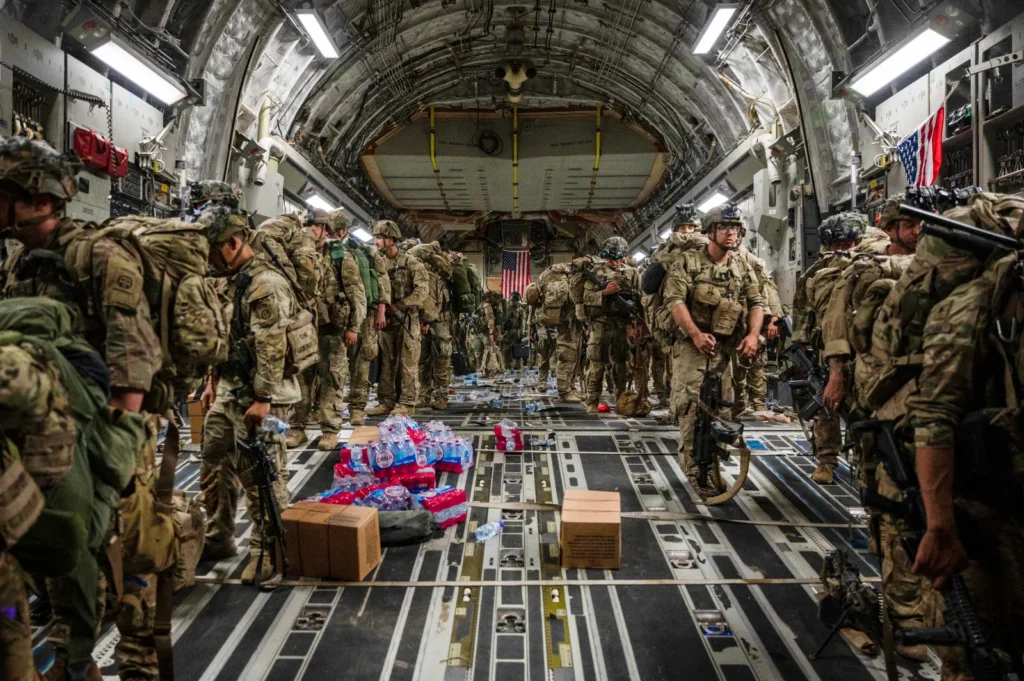
The 82nd Airborne Division, based at Fort Bragg in North Carolina, is the Army’s primary rapid-response force and is trained for quick deployment into hostile or contested areas.
Unlike Marine units already heading to the region, which often focus on embassy security, evacuations and disaster response, the airborne troops are trained to conduct parachute operations to secure strategic locations, including airfields and key infrastructure.
The planned deployment comes as the Pentagon continues to increase its military presence in the region amid ongoing conflict involving Iran.
U.S. officials have confirmed that thousands of Marines and sailors are also being sent to the Middle East aboard Navy ships, including amphibious assault vessels. These reinforcements are expected to add roughly 5,000 Marines and additional naval personnel.
The United States already has about 50,000 troops stationed across the region.
White House spokesperson Anna Kelly said decisions on troop movements would be announced by the Pentagon, adding that President Donald Trump retains full flexibility over military options.
Members of the Senate Armed Services Committee are expected to receive a classified briefing from Pentagon officials on Capitol Hill, where the potential deployment will be discussed in detail.
Officials have not disclosed the exact destination or timeline for the troop movement, though planning is said to be underway.
The deployment comes as the Trump administration says it is pursuing diplomatic efforts aimed at ending the conflict.
President Trump said the United States is currently engaged in negotiations, with senior officials including envoy Steve Witkoff, Secretary of State Marco Rubio and Vice President JD Vance involved in discussions.
However, Iranian officials have denied that direct talks with the United States are taking place, underscoring the uncertainty surrounding diplomatic efforts.
Officials said no final decision has been made to deploy U.S. ground forces inside Iran, but the additional troops would expand military options if the conflict intensifies.
Military planners are also reviewing broader strategies, including securing critical waterways and key energy infrastructure in the region.
The deployment follows earlier moves to reposition naval forces and rapid-response units closer to potential areas of operation.
The buildup comes amid mixed public opinion in the United States over the expanding conflict.
Recent polling indicates that a majority of Americans oppose military strikes related to the conflict, reflecting concerns about deeper involvement in the region.
The potential use of ground forces could carry political risks, particularly as the administration weighs its next steps.
The planned deployment of the 82nd Airborne Division highlights the growing seriousness of the situation and the U.S. military’s effort to prepare for a range of possible scenarios.
As a rapid-response force, the division is often used in situations where speed and flexibility are critical. Its presence in the region would significantly enhance the United States’ ability to respond quickly to changing conditions.
At the same time, the buildup reflects a dual-track approach that combines military readiness with ongoing diplomatic outreach. While U.S. officials have expressed interest in negotiations, the continued movement of troops suggests that Washington is preparing for the possibility that talks may not succeed.
The uncertainty surrounding negotiations adds to the complexity of the situation. Conflicting statements from U.S. and Iranian officials indicate that there may be limited direct communication, which could make it more difficult to reach an agreement.
The broader regional impact is also a key concern. Increased military activity raises the risk of further escalation, particularly if additional forces are deployed or if operations expand beyond current targets.
As the situation develops, the balance between diplomacy and military action will likely play a decisive role in determining whether the conflict escalates further or moves toward de-escalation.
Reuters/AP





