

The Republic of Congo’s constitutional court on Saturday upheld the re election of President Denis Sassou Nguesso, confirming the veteran leader’s victory in the recent national vote and granting him a fifth term in office.
Court president Auguste Iloki announced that Sassou Nguesso secured 94.90 percent of the vote, an outcome he described as an outright majority. The ruling follows provisional figures released March 17 by Interior Minister Raymond Zephirin Mboulou, which had already placed the 82 year old incumbent far ahead with 94.82 percent support.
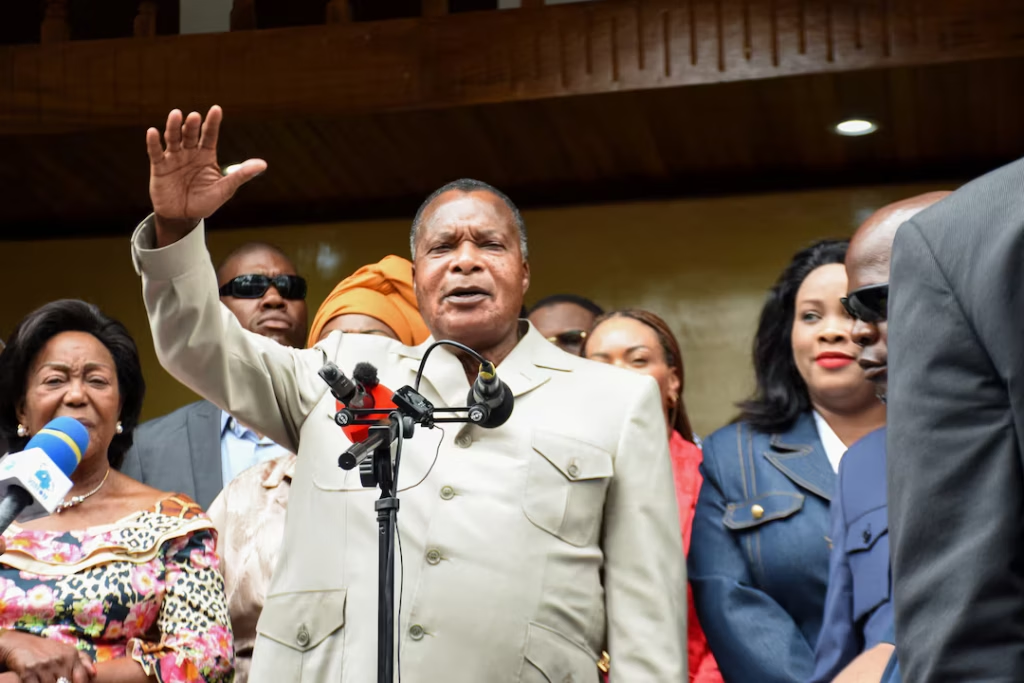
The confirmation effectively dismisses legal challenges filed by opposition candidates who disputed the credibility of the election. One of the challengers, Uphrem Mafoula, had formally petitioned the court to void the results. Judges rejected the appeal, affirming the legitimacy of the vote.
The March 15 election drew six challengers against Sassou Nguesso, who has dominated the political landscape of the oil producing Central African nation for decades. Despite the presence of multiple candidates, the campaign period underscored a stark imbalance, with the incumbent widely seen as holding a significant advantage in visibility and resources.
According to accounts published by Channelstvng, Sassou Nguesso’s campaign stood apart as he traveled across the country to rally support, while opposition figures struggled to match his reach. In the capital, Brazzaville, campaign displays prominently featured his image, reinforcing his presence throughout the electoral period.
Two major opposition parties boycotted the vote, citing concerns about fairness and transparency. Opposition leaders have consistently challenged previous election outcomes, arguing that the process has not met democratic standards.
Sassou Nguesso’s political career spans more than four decades. He first took power in 1979 under a single party system and governed until 1992, when he lost the country’s first multi party election. He returned to leadership in 1997 following a civil conflict that removed the sitting government. Since then, he has secured repeated electoral victories, each met with criticism from opposition groups.
The constitutional framework that allowed his continued candidacy was reshaped in 2015, when a referendum removed presidential age and term limits. That change enabled Sassou Nguesso to remain eligible for office despite his age and extended tenure.
Saturday’s court ruling reinforces his position as one of the longest serving leaders on the African continent, alongside Cameroon’s President Paul Biya and Equatorial Guinea’s President Teodoro Obiang Nguema Mbasogo.
While supporters credit Sassou Nguesso with maintaining relative stability in a country that experienced periods of unrest, critics and rights organizations have raised concerns about political freedoms and the treatment of opposition figures. Some former political rivals have faced lengthy prison sentences after being accused of threatening national security.
Economic challenges remain a pressing issue for the country. Despite its substantial oil resources, the Republic of Congo continues to grapple with high levels of debt and widespread poverty. World Bank data indicate that the country’s debt stands at 94.5 percent of its gross domestic product, while more than half of its population of 5.7 million lives below the poverty line.
Youth unemployment is also a growing concern, with nearly half of the population under the age of 18. Analysts say the lack of economic opportunity for young people could pose long term risks to stability if not addressed.
The court’s decision to validate the election result underscores the entrenched nature of political power in the Republic of Congo. Sassou Nguesso’s continued leadership reflects a broader pattern seen in parts of Africa, where long serving incumbents maintain control through a combination of institutional influence, constitutional changes and fragmented opposition.
The removal of term and age limits in 2015 marked a turning point, effectively clearing the path for Sassou Nguesso to extend his rule. Such constitutional revisions have been a recurring feature in several countries, often sparking debate about democratic norms and governance standards.
The opposition’s inability to mount a unified and competitive challenge highlights structural barriers within the political system. Boycotts and legal appeals, while signaling dissent, have had limited impact on electoral outcomes. Without stronger institutional checks or broader political reform, analysts suggest that similar results may continue in future elections.
At the same time, the country’s economic realities present a contrast to its political continuity. Oil wealth has not translated into broad based prosperity, and persistent inequality remains a central issue. High debt levels and limited job opportunities, particularly for young people, could intensify public dissatisfaction over time.
Looking ahead, Sassou Nguesso’s current term is expected to be his last under the existing constitution, which bars him from running again in 2031. However, observers note that political landscapes can shift, and future developments will depend on both domestic pressures and regional dynamics.
For now, the court’s ruling cements the status quo, extending the tenure of one of Africa’s longest serving leaders while leaving unresolved questions about governance, economic reform and political inclusion.





