

U.S. Vice President JD Vance arrived in Pakistan on Saturday to lead high-level negotiations with Iranian officials, marking the first direct engagement between the two sides since the conflict began more than a month ago and testing whether a fragile ceasefire can hold.
The American delegation, which includes special envoy Steve Witkoff and adviser Jared Kushner, is seeking to stabilize a temporary halt in fighting brokered by Shehbaz Sharif’s government and lay the groundwork for a broader peace agreement.
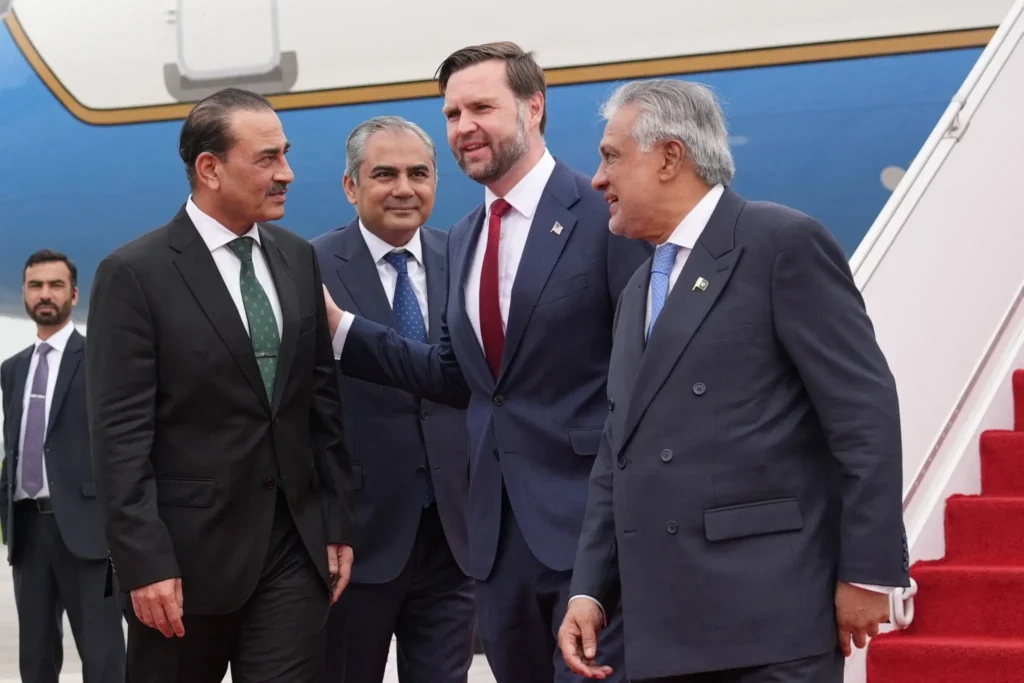
Iranian representatives, led by parliament speaker Mohammad Bagher Ghalibaf, arrived earlier in the capital. Ghalibaf indicated that meaningful discussions would depend on conditions including a halt to Israeli military actions in Lebanon and the release of frozen Iranian assets.
Tensions remain high despite the ceasefire, with continued exchanges of fire between Israeli forces and Hezbollah fighters along southern Lebanon’s border raising doubts about the agreement’s durability.
President Donald Trump has publicly pressed Iran ahead of the talks, portraying its negotiating position as weak while accusing Tehran of leveraging control over the Strait of Hormuz to influence global energy flows. In social media posts, Trump said the negotiations represent a critical moment for determining whether a lasting deal is possible.
Security across Islamabad was tightened ahead of the meetings, with major roads sealed and residents urged to remain indoors. The usually busy capital appeared largely deserted as authorities implemented sweeping precautions.
Sharif described the negotiations as entering a decisive stage, calling the current moment critical as both sides attempt to transition from a temporary pause in fighting to a more durable settlement.
Before departing Washington, Vance expressed cautious optimism about the talks but warned that the United States would not respond favorably to what he described as insincere engagement.
Meanwhile, diplomatic efforts are expanding beyond the U.S.-Iran channel. The office of Lebanese President Joseph Aoun said direct talks between Israel and Lebanon are expected to begin Tuesday in Washington. The discussions are aimed at ending hostilities involving Hezbollah and addressing long-standing security concerns along the border.
Israel, led by Prime Minister Benjamin Netanyahu, has maintained that its operations in Lebanon fall outside the scope of the ceasefire with Iran, a position that has fueled friction and threatened to derail broader peace efforts. Recent airstrikes in Lebanon have caused significant casualties, further complicating negotiations.
At the center of the dispute remains the Strait of Hormuz, a vital shipping route through which a significant portion of the world’s oil supply passes. Iran’s restrictions on traffic through the waterway have disrupted global markets, driving up energy prices and adding urgency to the talks. Only a limited number of vessels have transited the route since the ceasefire took effect, far below normal levels.
The Islamabad talks represent a high-stakes diplomatic effort shaped as much by military leverage as by negotiation strategy. The United States is entering discussions from a position of force, reinforced by military deployments and public messaging from President Trump, while Iran is relying on its control of a critical global energy route to strengthen its hand.
This dynamic creates a delicate balance. While both sides have incentives to avoid renewed conflict, their core demands remain far apart. Iran’s insistence on linking the ceasefire to developments in Lebanon adds a regional dimension that complicates what might otherwise be a bilateral negotiation.
The continued fighting involving Hezbollah underscores the risk that parallel conflicts could undermine diplomatic progress. Even if Washington and Tehran reach a framework, unresolved tensions involving Israel and Lebanon could quickly destabilize any agreement.
Economically, the disruption of shipping through the Strait of Hormuz has already demonstrated how regional conflict can ripple across global markets. Sustained restrictions could intensify inflationary pressures worldwide, making the outcome of these talks significant far beyond the Middle East.
Ultimately, the negotiations in Pakistan may determine whether the current pause in fighting evolves into a lasting settlement or collapses into another phase of escalation. The presence of senior officials from both sides signals the seriousness of the effort, but the competing conditions and ongoing violence suggest the path to peace remains uncertain.
NewYorkPost





