

Artemis II’s astronauts returned from the moon with a dramatic splashdown in the Pacific Ocean on Friday to close out humanity’s first lunar voyage in more than half a century, marking a triumphant milestone in NASA’s effort to establish permanent human presence beyond Earth orbit.
It was a victorious homecoming for the crew of four whose record-breaking lunar flyby revealed not only expansive regions of the moon’s far side—never before witnessed by human eyes—but also a total solar eclipse visible only from their unique vantage point in deep space. Commander Reid Wiseman, pilot Victor Glover, Christina Koch, and Canada’s Jeremy Hansen hit the atmosphere traveling Mach 33—or 33 times the speed of sound—a blistering velocity not experienced since NASA’s Apollo moonshots of the 1960s and 1970s.
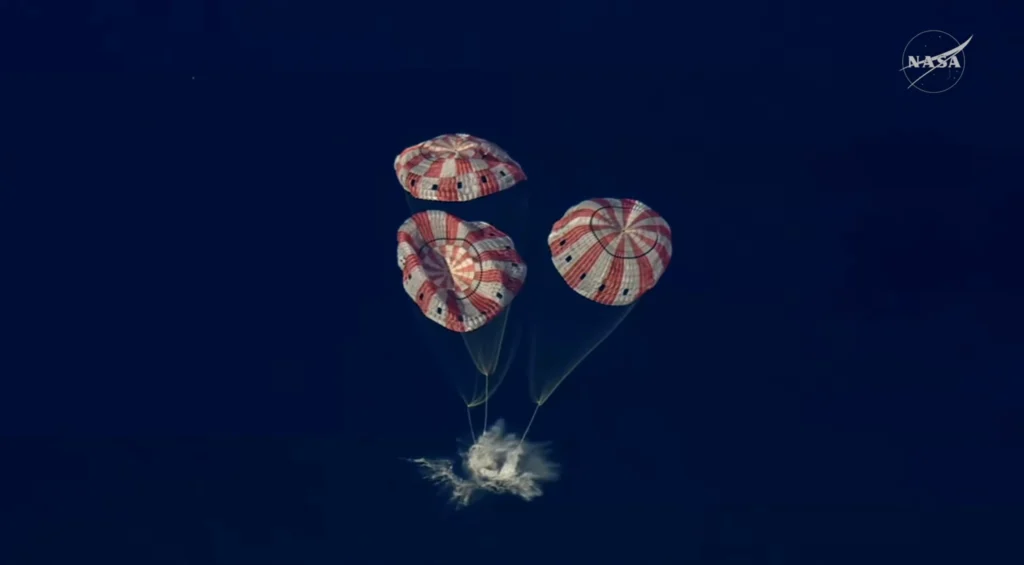
Their Orion capsule, christened Integrity, made the plunge on automatic pilot as four astronauts sat helplessly strapped in their seats while computers managed the precise atmospheric entry angles required to prevent the spacecraft from skipping off Earth’s atmosphere like a stone across water or burning up from excessive friction.
The tension in Mission Control mounted as the capsule became engulfed in red-hot plasma during peak heating and entered a planned communication blackout that left ground controllers blind to the crew’s status. All eyes focused on the capsule’s life-protecting heat shield that had to withstand thousands of degrees during reentry—a critical test given concerns about its performance.
On the spacecraft’s only previous test flight in 2022 with no crew aboard, the shield’s charred exterior returned looking as pockmarked as the moon itself, raising questions about whether modifications would be required before risking human lives. The successful performance of the heat shield during Artemis II’s reentry validates the design for future missions carrying astronauts to lunar surface.
Like so many others, lead flight director Jeff Radigan anticipated feeling some of that “irrational fear that is human nature,” especially during the six-minute blackout that preceded the opening of the parachutes. The recovery ship USS John P. Murtha awaited the crew’s arrival off the San Diego coast, along with a squadron of military planes and helicopters positioned to provide assistance if the landing went awry.
The last time NASA and the Defense Department collaborated for a lunar crew’s reentry was Apollo 17 in 1972—making the Artemis II recovery the first such operation in 53 years and requiring relearning of procedures and capabilities that had atrophied during decades of low-Earth orbit operations aboard space shuttles and the International Space Station.
Artemis II was projected to come screaming back at 36,170 feet per second—equivalent to 24,661 miles per hour—just shy of the record before slowing to a 19 mph splashdown through a carefully choreographed sequence of parachute deployments. “A perfect bull’s-eye splashdown,” Mission Control’s Rob Navias announced, confirming the capsule landed precisely where trajectory calculations predicted.
Launched from Florida on April 1, the astronauts accumulated one success after another as they deftly navigated NASA’s long-awaited lunar comeback—the first major step in establishing a sustainable moon base that could serve as staging point for eventual Mars missions. Artemis II didn’t land on the moon or even orbit it, instead performing a figure-eight trajectory that took the crew around the lunar far side before returning to Earth.
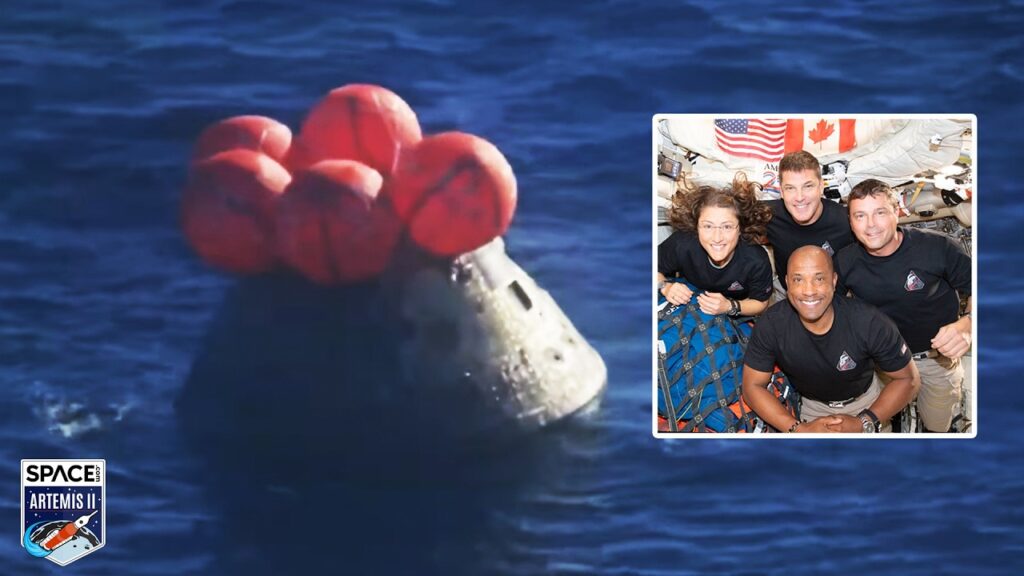
But the mission broke Apollo 13’s distance record and marked the farthest that humans have ever journeyed from Earth when the crew reached 252,756 miles from home. The record eclipsed Apollo 13’s previous mark set in 1970 during that mission’s emergency circumlunar trajectory after an oxygen tank explosion forced abandonment of landing plans.
In the mission’s most emotionally resonant moment, the tearful astronauts requested permission to name a pair of craters after their moonship and Wiseman’s late wife Carroll. Mission Control granted the request, creating permanent lunar monuments to both technological achievement and personal loss that future astronauts will see when they traverse those regions.
During Monday’s record-breaking flyby, they documented scenes of the moon’s far side never witnessed before by human observers along with a total solar eclipse visible only from deep space. The eclipse in particular “just blew all of us away,” Glover disclosed, conveying the profound impact of witnessing celestial mechanics from perspectives impossible to achieve from Earth’s surface.
Their sense of wonder and profound connection to the mission awed everyone monitoring from the ground, as did their breathtaking photographs of the moon and Earth. The Artemis II crew channeled Apollo 8’s first lunar explorers with Earthset images showing our Blue Marble setting behind the gray moon—reminiscent of Apollo 8’s famous Earthrise photograph from 1968 that transformed humanity’s perspective on our planet’s fragility.
“It just makes you want to continue to go back,” Radigan reflected on the eve of splashdown. “It’s the first of many trips and we just need to continue on because there’s so much” more to learn about the moon and what sustained human presence there could teach us about living beyond Earth.
Their moonshot drew global attention as well as celebrity endorsements, earning recognition from President Donald Trump; Canadian Prime Minister Mark Carney; Britain’s King Charles III; Ryan Gosling, star of the latest space film “Project Hail Mary”; Scarlett Johansson of the Marvel Cinematic Universe; and even Captain Kirk himself, William Shatner of television’s original “Star Trek.” The cultural resonance demonstrated space exploration’s enduring power to unite diverse audiences.
Despite its rich scientific yield, the nearly 10-day flight was not without technical challenges. Both the capsule’s drinking water and propellant systems experienced valve problems that required troubleshooting while traveling through deep space. In perhaps the most high-profile predicament, the toilet kept malfunctioning—forcing the astronauts to employ backup waste management procedures not designed for multi-day use.
The astronauts shrugged off all difficulties with characteristic pilot composure. “We can’t explore deeper unless we are doing a few things that are inconvenient,” Koch observed, “unless we’re making a few sacrifices, unless we’re taking a few risks, and those things are all worth it.” Her perspective reflected the pioneering spirit that has driven exploration throughout human history.
Hansen added: “You do a lot of testing on the ground, but your final test is when you get this hardware to space and it’s a doozy.” The Canadian astronaut’s comment acknowledged the irreplaceable value of actual flight testing versus simulations, no matter how sophisticated ground-based preparations become.
Under the revamped Artemis program, next year’s Artemis III will witness astronauts practicing docking their capsule with a lunar lander or two in orbit around Earth—critical maneuvers required before attempting actual moon landings. Artemis IV will attempt to land a crew of two near the moon’s south pole in 2028, targeting regions where permanently shadowed craters may contain ice deposits useful for life support and rocket fuel production.
The Artemis II astronauts’ primary allegiance was to those future crews whose missions will build upon lessons learned during this pioneering flight, Wiseman emphasized. “But we really hoped in our soul is that we could for just for a moment have the world pause and remember that this is a beautiful planet and a very special place in our universe, and we should all cherish what we have been gifted,” he reflected.
As recovery helicopters plucked the four astronauts from the bobbing capsule in Pacific swells and transported them to the USS John P. Murtha for initial medical examinations and debriefings, NASA officials began the complex process of extracting every possible lesson from the mission to improve future flights.
Engineers will meticulously examine the returned heat shield to understand exactly how the thermal protection system performed under the extreme conditions of lunar return velocities. The valve problems in both water and propellant systems will be investigated to determine whether design modifications are required or if the issues reflected one-time anomalies unlikely to recur.
The toilet malfunctions—while seemingly mundane compared to dramatic reentry sequences—actually represent significant engineering challenges given the difficulty of waste management in zero gravity and the health risks of inadequate sanitation systems on missions lasting weeks or months. Solving these problems proves essential for sustainable deep space exploration.
For the four Artemis II astronauts, the return to Earth gravity after 10 days in weightlessness will require days or weeks of physical rehabilitation as their bodies readjust to bearing their own weight and pumping blood against gravitational pull. The physiological impacts of extended spaceflight remain among the most significant challenges for eventual Mars missions that could last years.
As Wiseman, Glover, Koch, and Hansen begin that recovery process surrounded by families and colleagues celebrating their safe return, they can take satisfaction in knowing they have reignited humanity’s push beyond low Earth orbit after decades of circling our planet at relatively safe altitudes. Their successful mission demonstrates that the United States—in partnership with Canada and other international allies—retains the capability to venture into deep space despite the retirement of Apollo-era infrastructure.
Whether that capability translates into sustained lunar presence and eventual Mars exploration depends on political will, continued funding, and successful execution of increasingly complex missions building toward permanent off-world human settlements. For now, the triumphant splashdown of Artemis II proves that humanity’s reach can still extend to the moon and beyond when vision, resources, and courage align.
The Associated Press





