

A court in the Nigerian capital of Abuja on Friday convicted more than 300 terrorism suspects in a mass trial that spanned four days, delivering sentences of up to 20 years in prison as the government sought to demonstrate progress in combating the insurgency that has devastated northern regions for more than a decade.
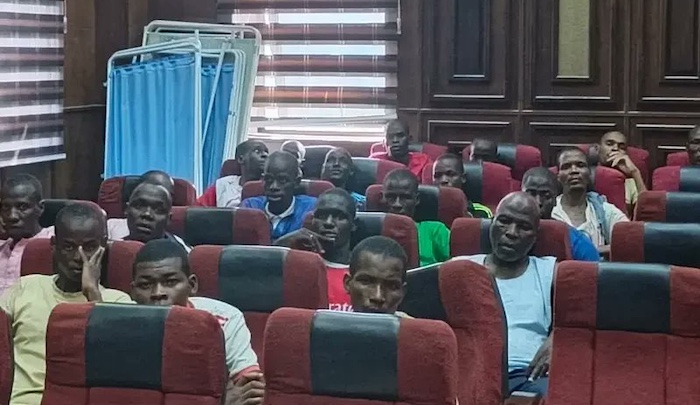
The mass trial commenced Tuesday, with many suspects pleading guilty to charges brought against them by the Nigerian government. The expedited proceedings before a panel of 10 judges reflected governmental determination to process the enormous backlog of terrorism cases that have accumulated as security forces captured hundreds of suspected militants.
Many defendants have since been sentenced to up to 20 years in prison after they appeared before the judicial panel. “In total, we brought about 508 cases. Of these 508, we were able to secure 386 convictions,” Nigeria’s Attorney General Lateef Fagbemi told journalists after the mass trial concluded Friday, characterizing the conviction rate as evidence of effective prosecution.
“We have been able to bring justice to them, or bring them to justice. So this is the clear signal that we are sending,” Fagbemi declared, framing the convictions as deterrent message to active insurgent groups and demonstration that captured militants will face legal consequences rather than indefinite detention without trial.
The Associated Press documented that Nigeria is battling a complex security crisis, especially in the north, where there is a decade-long insurgency and several armed groups that kidnap for ransom. The insurgency in the country’s northeast has lasted more than a decade, killing tens of thousands and displacing millions while devastating local economies.
Among the most prominent militant groups are Boko Haram and its breakaway faction affiliated with the Islamic State group and known as Islamic State West Africa Province. There is also the Islamic State-linked Lakurawa group operating in communities in the northwestern part of the country that borders Niger Republic, demonstrating how insurgent violence has spread beyond traditional strongholds.
There are also disputes over land and grazing between mostly Muslim Fulani herders and largely Christian farming communities that frequently escalate into deadly clashes in the north-central and northwestern regions of the country. Criminal gangs who kidnap for ransom are also active, creating multiple overlapping security threats that overwhelm governmental capacity to respond.
The insurgency in the northeast has led to death and displacement of many, according to the United Nations, though precise casualty figures remain difficult to verify given limited access to conflict zones and governmental restrictions on reporting.
According to DW citing AP and Reuters, prosecutions that commenced Tuesday are part of a series of trials involving Boko Haram and Islamic State West Africa Province suspects. “We brought 508 cases to court and out of this number, we were able to secure 386 convictions, eight discharges, two acquittals and 112 cases to the next session or phase,” Attorney General Fagbemi disclosed, providing detailed breakdown of outcomes.
Many suspects pleaded guilty to charges brought against them by the Nigerian government—a fact that raises questions about whether defendants received adequate legal representation or felt pressured to accept guilt in exchange for lighter sentences or simply to conclude prolonged detention.
Court officials confirmed that international observers, including representatives from the United Nations Office on Drugs and Crime, Amnesty International, and the Nigerian Bar Association, monitored the court proceedings to ensure the legal process was fair. The presence of international monitors reflected concerns about due process in mass trials where hundreds of defendants are processed in days rather than receiving individual hearings that could span months.
A 16-year insurgency has ravaged northern Nigeria, killing tens of thousands, displacing two million, and causing major damage to the local economy. The prolonged conflict has created humanitarian catastrophe across multiple states where government services have collapsed and populations survive on international aid.
Groups like Boko Haram and its offshoot Islamic State West Africa Province have been active for nearly two decades. Their campaign to establish a caliphate in the country has claimed the lives of tens of thousands of people and displaced millions across the country’s northeast, transforming entire regions into war zones where normal economic and social life has become impossible.
The mass trial represents governmental effort to demonstrate that captured insurgents face justice rather than languishing indefinitely in military detention facilities where conditions have drawn criticism from human rights organizations. However, the expedited nature of proceedings—processing over 500 cases in four days—raises questions about whether individual defendants received adequate opportunity to mount defenses or present mitigating circumstances.
The 386 convictions out of 508 cases represent a 76 percent conviction rate that prosecutors will cite as evidence of strong cases against defendants. However, the fact that many suspects pleaded guilty suggests either overwhelming evidence against them or calculation that accepting responsibility might result in more lenient treatment than contesting charges.
The sentences of up to 20 years in prison mean that many convicted militants—particularly younger defendants—will spend their prime adult years incarcerated. Whether Nigerian prisons possess adequate deradicalization programs to prevent these inmates from emerging more radicalized remains uncertain given chronic underfunding of correctional systems.
For victims of insurgent violence who have lost family members, homes, and livelihoods to attacks by Boko Haram and affiliated groups, the convictions may provide some measure of justice and closure. However, no legal proceedings can restore destroyed communities or resurrect the dead, leaving many survivors focused on practical needs for security and economic recovery rather than retributive justice.
The eight discharges and two acquittals demonstrate that not every defendant was convicted, suggesting the judicial panel did exercise some independent judgment rather than rubber-stamping prosecutorial requests. However, the small number of acquittals relative to convictions may reflect either genuinely strong evidence against most defendants or inadequate defense representation.
The 112 cases deferred to next sessions indicate the trials will continue as additional defendants are processed. Whether subsequent proceedings will maintain the same pace or slow to allow more thorough examination of individual cases remains to be seen.
As Nigeria continues confronting the insurgency that shows no signs of ending despite years of military operations and billions spent on security, the mass trials represent one component of broader counterinsurgency strategy that includes military action, community engagement, and efforts to address underlying grievances about poverty, marginalization, and lack of opportunity that make young people vulnerable to extremist recruitment.
Whether convicting hundreds of suspected militants will meaningfully degrade insurgent capabilities or merely remove foot soldiers while leadership remains intact and capable of recruiting replacements will determine the trials’ strategic impact beyond their symbolic demonstration of governmental determination to impose legal consequences on captured fighters.
For now, the 386 convicted defendants begin serving sentences that will keep them imprisoned for years or decades while the insurgency that spawned their radicalization continues claiming lives across northern Nigeria with depressing regularity despite governmental assurances that victory is near.
DW/AP/Reuters





