

Donald Trump indicated that U.S. military action against Iran could resume if a temporary ceasefire expires without a broader agreement, while also maintaining that restrictions on Iranian shipping will remain in place.
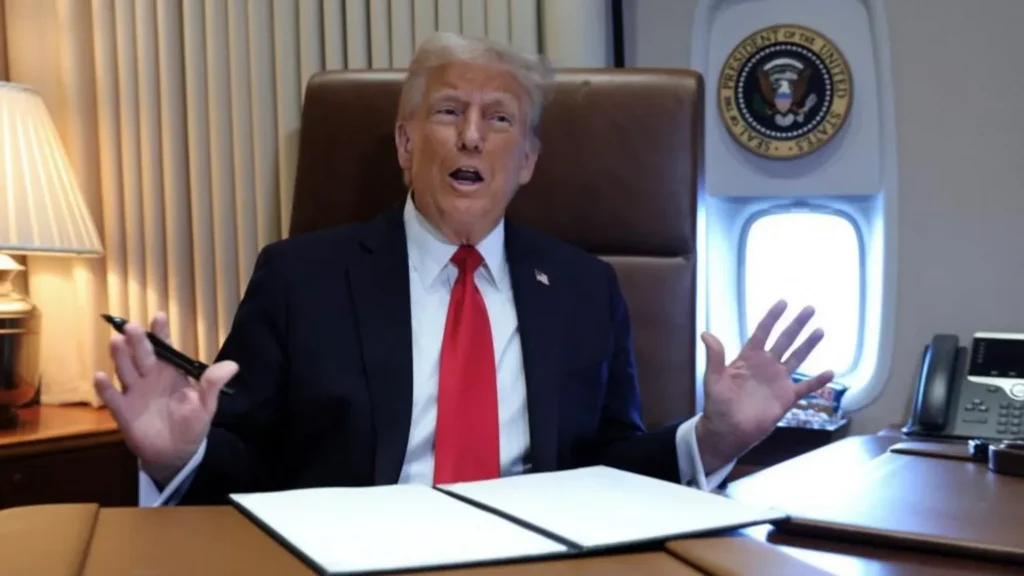
Speaking to reporters Friday night, Trump said the blockade affecting Iranian maritime activity would continue regardless of diplomatic progress. When asked about the possibility of extending the ceasefire beyond next week, he suggested uncertainty about the administration’s next move.
“I don’t know. Maybe I won’t extend it, but the blockade is going to remain,” Trump said. “If it’s not extended, then we may have to start bombing again.”
At the same time, Trump expressed cautious optimism about ongoing negotiations, telling reporters aboard Air Force One that he expects a deal could be reached. “I think it’s going to happen,” he said.
Tensions remain high around the Strait of Hormuz, a critical global shipping route through which roughly one-fifth of the world’s oil supply passes. Iranian officials said Friday that the waterway had been reopened to commercial traffic, but warned it could be closed again if U.S. restrictions on Iranian vessels continue.
Uncertainty persists over how freely ships can move through the strait. Iranian authorities have signaled that access may be conditional, with oversight by security forces determining which vessels are permitted to pass.
Iranian lawmaker Ebrahim Azizi said commercial vessels must comply with new navigation rules and pay required fees before transiting the waterway. He emphasized that the regulations were established by Iran and could be adjusted if tensions escalate.
A spokesperson for Iran’s Defense Ministry, Brig. Gen. Reza Talaei-Nik, stated that access to the strait is limited and tied to the current ceasefire. He said military vessels and ships linked to adversarial forces would not be permitted to pass.
The developments follow a period of heightened conflict involving Iran, Israel and allied groups, which has resulted in thousands of casualties across the region. The violence has also drawn in global powers and raised concerns about the stability of energy markets and international shipping routes.
In a separate development, Pakistan’s army chief Asim Munir concluded a visit to Tehran, where he held talks with senior Iranian officials, including President Masoud Pezeshkian and Foreign Minister Abbas Araghchi. According to the Pakistani military, the discussions focused on reducing tensions and supporting diplomatic efforts aimed at stabilizing the region.
Trump also dismissed suggestions that Iran could impose transit fees or additional restrictions on ships passing through the strait. “No, that’s not going to happen,” he said when asked about the possibility of tolls.
Meanwhile, Iran has begun partially reopening its airspace after weeks of closures tied to the conflict. State media reported that some flight routes have resumed, with a gradual return to normal operations expected, though no specific timeline has been provided.
The latest statements from President Donald Trump highlight the fragile nature of the current ceasefire and the narrow window for diplomacy. By signaling a willingness to resume military action while also expressing confidence in a potential agreement, the administration appears to be applying pressure on negotiations while keeping options open.
The continued focus on the Strait of Hormuz underscores its central role in the conflict. As one of the world’s most important energy corridors, any disruption to shipping in the strait has immediate global implications. Even the threat of restrictions can influence oil prices, insurance costs, and shipping routes.
Iran’s approach to managing access to the strait suggests a strategy of controlled escalation. By allowing limited commercial traffic while maintaining the ability to impose restrictions, Tehran retains leverage without fully closing the waterway. This balancing act may be aimed at avoiding a broader international response while still asserting control over a critical chokepoint.
The question of enforcement remains key. Monitoring and regulating traffic through such a heavily used route requires significant coordination and resources. Any miscalculation or confrontation involving naval forces could quickly escalate into a larger conflict.
The involvement of regional actors, including Pakistan, points to growing concern about the wider impact of the tensions. Diplomatic outreach efforts reflect an understanding that the conflict could have far-reaching consequences beyond the immediate parties involved.
From a U.S. perspective, maintaining the blockade while negotiating a ceasefire presents both opportunities and risks. The pressure may encourage concessions from Iran, but it could also harden positions and complicate efforts to reach a lasting agreement.
The partial reopening of Iran’s airspace signals a tentative step toward normalization, but it also highlights how deeply the conflict has disrupted civilian and commercial activity. Restoring full operations will depend on sustained stability, which remains uncertain.
Ultimately, the coming days will be critical in determining whether the ceasefire evolves into a broader agreement or gives way to renewed hostilities. The outcome will likely shape not only U.S.-Iran relations but also the broader security and economic landscape of the region.
The Associated Press/Ksat.com





