

A private helicopter crashed in a remote forest on Indonesia’s Borneo island, killing all eight people on board after losing contact with air traffic control minutes into the flight, authorities said Friday.
The aircraft, identified as an Airbus H130 operated by local aviation company Matthew Air Nusantara, disappeared from radar about five minutes after takeoff Thursday morning in West Kalimantan province, according to Indonesia’s Transport Ministry.
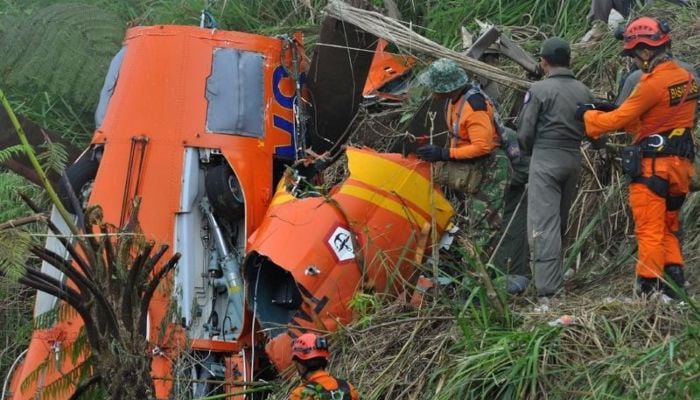
Officials said the helicopter was traveling between palm oil plantation sites when communication was lost. A search operation was launched shortly afterward, with rescue teams working through difficult terrain to locate the aircraft.
Civil aviation director general Lukman F. Laisa confirmed that all eight individuals aboard the helicopter—two crew members and six passengers—were killed in the crash. One of the victims was a Malaysian national.
“The joint search and rescue team located the crash site, and information from the field confirms there were no survivors,” Laisa said in an official statement.
Rescue crews later found the wreckage in a heavily forested area with steep slopes in Sekadau district. I Made Junetra, head of the national search and rescue agency, told Agence France-Presse that the victims were recovered Thursday evening after hours of searching under challenging conditions.
The bodies were transported to the provincial capital, Pontianak, officials said.
The flight had departed from Melawi district and was heading to another plantation site in Kubu Raya district when it crashed, according to the National Search and Rescue Agency and the Transport Ministry, as reported by The Associated Press.
Indonesia, an archipelago of more than 17,000 islands, depends heavily on air travel to connect remote regions. However, the country has faced ongoing concerns about transportation safety, particularly involving aircraft operating in difficult environments such as mountainous terrain and dense forests.
Recent years have seen multiple fatal aviation incidents. In January, a turboprop aircraft chartered by Indonesia’s fisheries ministry crashed into a mountain on Sulawesi island, killing all 10 people on board. In September of the previous year, a helicopter crash in South Kalimantan province killed eight people, including passengers and crew. Less than two weeks later, another helicopter accident in Papua’s Ilaga district killed four people.
The latest helicopter crash highlights ongoing risks in Indonesia’s aviation sector, particularly for flights operating in remote regions where infrastructure is limited and terrain presents serious challenges. Aircraft serving industries such as palm oil production often fly at low altitudes over dense forests, where navigation and emergency response can be more difficult.
One key issue is the reliance on small aircraft for short-distance transport between industrial sites. While these flights are essential for economic activity, they often operate under conditions that leave little room for error, including unpredictable weather patterns, limited radar coverage, and few options for emergency landings.
The rapid loss of contact—just five minutes after takeoff—raises questions about possible mechanical failure, weather conditions, or operational issues. Investigators are expected to review flight data, maintenance records, and pilot communications to determine the cause. However, gathering evidence from remote crash sites can take time, which may delay conclusions.
Indonesia’s aviation safety record has improved in recent years following regulatory reforms and increased oversight, but incidents like this point to continuing challenges. Smaller operators may face difficulties maintaining consistent safety standards due to financial and logistical constraints.
The economic importance of industries such as palm oil also plays a role. Helicopters are widely used to transport workers and oversee operations across large plantation areas, making them a key part of daily business. Ensuring safety while meeting operational demands remains a significant concern for both regulators and companies.
From a broader perspective, the crash may lead to renewed calls for better monitoring systems, stricter enforcement of safety standards, and improved emergency response capabilities in remote areas. Advances in tracking and communication technology could help improve response times and flight safety.
For the families of the victims, the focus remains on the immediate loss. The crash adds to a series of aviation accidents that continue to shape public concern about air travel safety in Indonesia, particularly in remote parts of the country.
Geo.tv/AP





