

Mali’s defense minister, Gen. Sadio Camara, was killed during a sweeping wave of coordinated attacks that saw armed groups seize towns and military installations across the country, multiple sources confirmed Sunday, marking a major escalation in the West African nation’s long-running conflict.
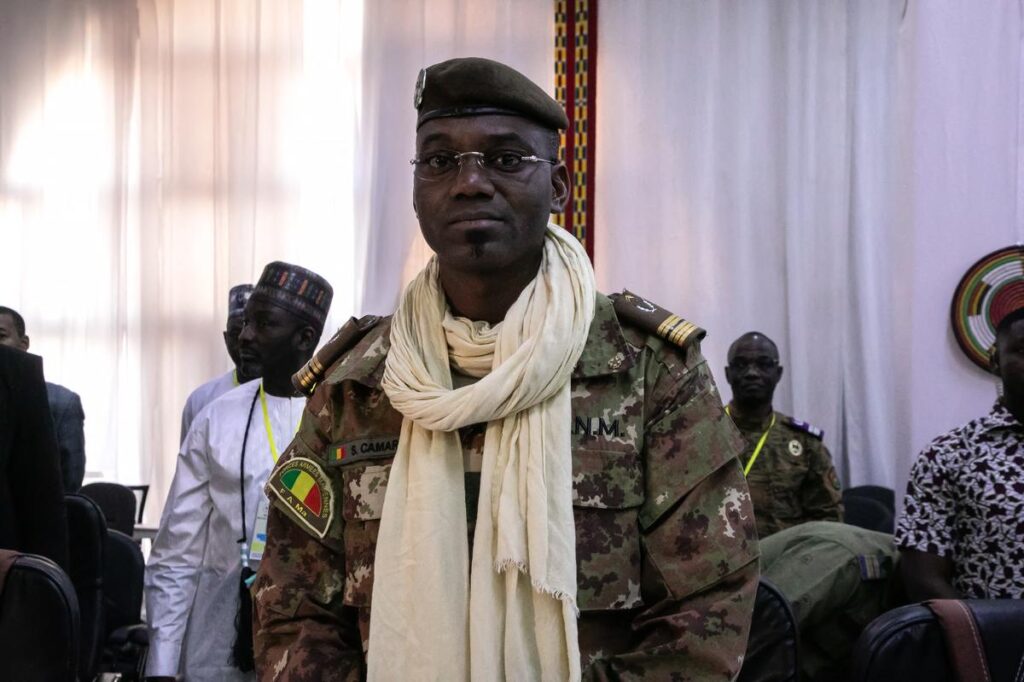
A military officer, speaking on condition of anonymity because he was not authorized to speak publicly, said the minister died when his residence was targeted during Saturday’s assault. The account was confirmed by a civil society leader and a security official familiar with the incident. Malian authorities had not issued an official statement on the reported killing as of Sunday.
The attacks, described as among the most extensive in recent years, involved a rare alliance between separatist fighters and extremist groups. The combined forces launched coordinated operations in the capital, Bamako, and several other cities, leaving at least 16 people wounded, including civilians and members of the security forces, government spokesperson Gen. Issa Ousmane Coulibaly said in a televised address late Saturday. He did not provide a death toll for the broader assault but said several attackers were killed.
Separatist leaders later indicated that their forces, along with allied fighters, had taken control of key northern areas, including the strategic city of Kidal. A spokesperson for the separatist Azawad Liberation Front declared the city “free,” adding that Malian troops and allied foreign fighters had withdrawn following an arrangement that allowed for their exit.
The Malian military did not immediately respond to requests for comment regarding the reported withdrawal or the current status of Kidal.
The latest violence highlights a worsening security crisis in Mali, where armed groups have intensified operations despite years of military campaigns and shifting alliances. Separatists have long sought independence for northern regions, while extremist factions have fought to weaken the central government for more than a decade.
Saturday’s coordinated offensive marked the first known instance of operational collaboration between separatist forces and an extremist network linked to a global militant movement. Both groups claimed responsibility for attacks targeting Bamako’s international airport and multiple cities across central and northern Mali.
A spokesperson for the separatists acknowledged the partnership, describing it as a joint effort to confront the military leadership in the capital. Security analysts said the development represents a significant shift in the conflict’s dynamics.
“The scale and timing of these attacks show a new level of coordination,” said a regional security analyst familiar with the situation. “This points to both tactical and political alignment, which could reshape the conflict and make it more difficult to contain.”
Authorities imposed a nighttime curfew in parts of Bamako following the attacks as security forces worked to restore order and prevent further violence.
The Economic Community of West African States condemned the assaults, urging governments and security forces across the region to strengthen cooperation against armed groups operating across borders. The bloc called for a united response to what it described as a growing threat to regional stability.
Mali has faced repeated political upheaval in recent years, including military takeovers that brought the current leadership to power. Since then, the government has shifted away from traditional Western allies and strengthened ties with foreign security partners in an effort to combat insurgent groups. Despite those efforts, violence has increased, with attacks becoming more frequent and more coordinated.
The reported loss of Kidal would represent both a symbolic and strategic setback for the government. The city had been retaken by state forces and allied fighters in 2023, a move widely seen as a turning point in the conflict. Its apparent fall now raises questions about how secure those gains were.
Analysts say the reported killing of the defense minister could further disrupt the government’s security operations at a critical moment. The loss of a senior official during active conflict can weaken coordination and delay response efforts, potentially allowing armed groups to expand their control.
Beyond the immediate battlefield impact, the attacks reflect deeper challenges related to governance, public trust, and the effectiveness of current security strategies. Reports of civilian casualties and accusations of abuses by security forces have fueled resentment in some communities, creating conditions that armed groups have used to strengthen their influence.
The involvement of multiple armed factions acting together also signals a shift toward more complex conflict patterns, where groups with different goals may cooperate for short-term gains. Such alliances can increase the scale and impact of attacks while placing additional pressure on already stretched government resources.
Regional observers warn that without a broader approach that combines security operations with political dialogue and economic development, Mali risks further instability. Large rural areas with limited government presence continue to provide space for armed groups to operate freely.
The coming days are likely to test the government’s ability to respond both militarily and politically. Much will depend on whether authorities can regain control of affected areas and reassure a population that has endured years of violence.
The coordinated nature of the attacks suggests a turning point in Mali’s conflict, where previously separate armed groups may now be aligning for greater impact. This raises concerns not only for Mali but for the wider Sahel region, where weak border controls allow fighters to move between countries. The reported death of the defense minister could disrupt leadership at a critical time, potentially slowing decision-making and weakening military coordination. At the same time, the situation highlights the limits of a strategy focused mainly on military force. Without addressing economic hardship, governance gaps, and local grievances, security gains may remain temporary. The conflict’s evolution toward more organized and cooperative attacks indicates that the threat is becoming more sophisticated, requiring a more comprehensive response.
AP





