

Kenya’s Sabastian Sawe delivered a landmark performance Sunday, becoming the first runner to officially break the two-hour barrier in a marathon while winning the London Marathon in a world-record time of 1 hour, 59 minutes, 30 seconds.
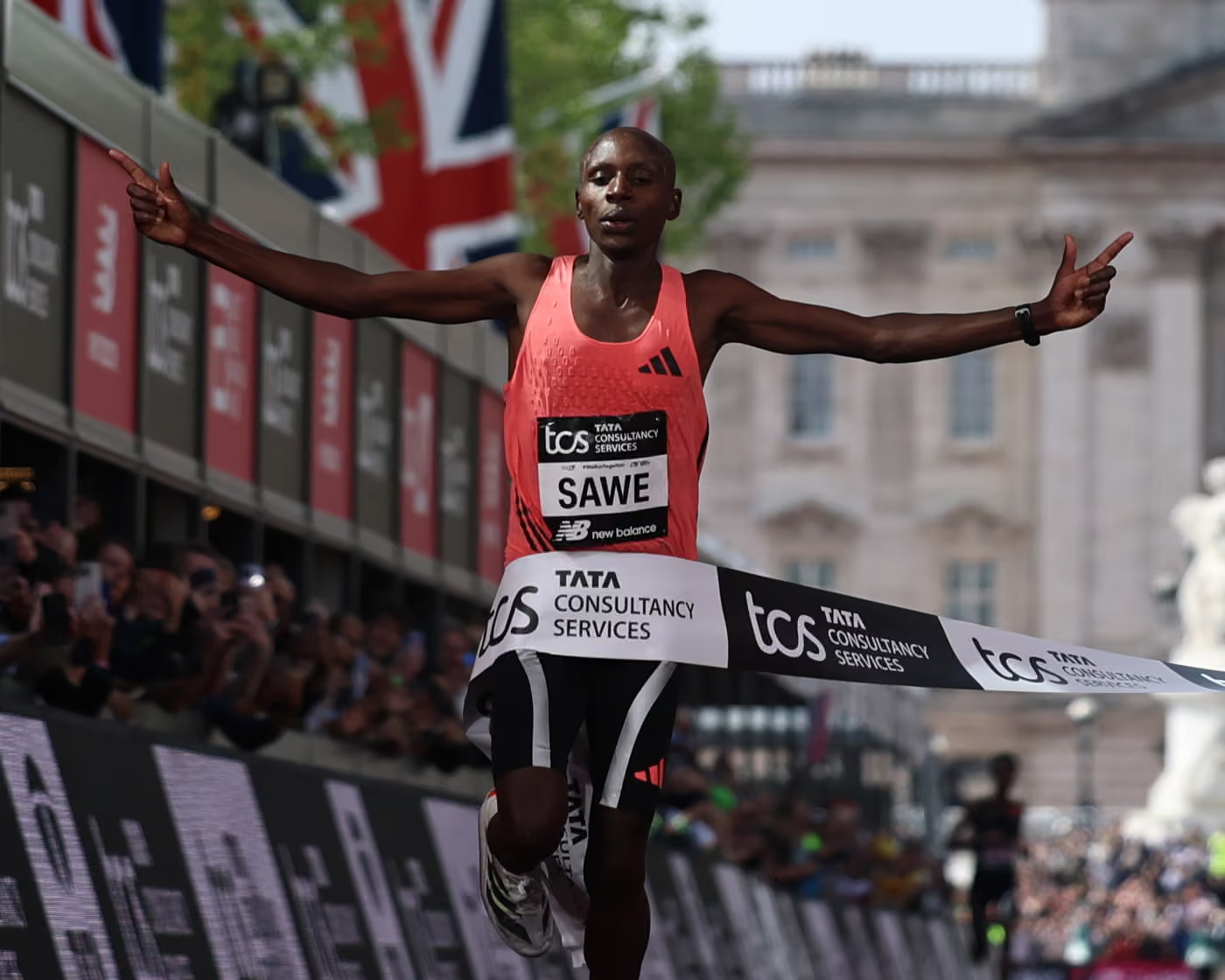
The achievement marks a defining moment in distance running, eclipsing the previous men’s world record of 2:00:35 set in 2023 by Kelvin Kiptum in Chicago. Sawe’s run not only reset the record but also pushed the sport into territory long considered beyond reach under official race conditions.
Sawe surged ahead in the closing stages of the race, pulling away from Ethiopia’s Yomif Kejelcha, who also delivered a historic performance by finishing in 1:59:41. Uganda’s Jacob Kiplimo placed third in 2:00:28, meaning all three podium finishers surpassed the previous world record in an extraordinary display of endurance and speed.
The Associated Press highlighted the significance of the race, noting that Sawe’s time lowered the world record by more than a minute, a rare margin at the elite level of marathon running. The result cements Sawe’s place among the sport’s all-time greats.
The feat draws inevitable comparisons to Eliud Kipchoge, who famously ran 1:59:40 in 2019. However, that performance was not recognized as an official world record because it took place under controlled conditions that did not meet standard competition rules, including the use of rotating pacemakers and a closed course.
Sunday’s race in London, by contrast, met all official requirements, making Sawe’s achievement the first sub-two-hour marathon to be ratified in competition.
From the early stages, Sawe signaled his intent. He remained in a lead pack of six runners through the halfway mark, clocking 1:00:29. As the race progressed, the group thinned, leaving Sawe and Kejelcha locked in a duel that stretched into the final miles.
With the finish line approaching, Sawe unleashed a decisive burst of speed, creating separation and securing victory in front of a stunned crowd. His finishing time immediately reverberated across the athletics world.
France24 noted that Kejelcha’s performance, particularly in his marathon debut, added further weight to the historic nature of the race, while Kiplimo’s third-place finish underscored the depth of talent in the field.
The event also produced a standout performance in the women’s race. Ethiopia’s Tigst Assefa defended her title with a time of 2:15:41, the fastest ever recorded in a women’s-only marathon. Although her mark fell just short of the overall course record set by Paula Radcliffe in 2003 during a mixed race, it remains a significant milestone in women’s distance running.
In the wheelchair divisions, Switzerland dominated. Marcel Hug claimed his sixth consecutive men’s title and eighth overall, while Catherine Debrunner edged out Tatyana McFadden in a closely contested women’s race to retain her crown.
Sawe’s performance signals a turning point in marathon running, where advancements in training, strategy and equipment are converging to redefine human limits. While the idea of a sub-two-hour marathon has been discussed for decades, it was widely believed that achieving it under official race conditions would take years longer.
One key factor behind this breakthrough is the evolution of running technology. Sawe competed in a new generation of ultra-light racing shoes, designed to enhance efficiency and reduce fatigue over long distances. While footwear alone does not account for such a dramatic improvement, it represents a critical piece of a broader shift in how elite athletes prepare and compete.
Equally important is race strategy. The pace maintained by the leading group through the halfway point suggests a deliberate effort to sustain record-breaking speed from the outset, rather than building gradually. This aggressive approach, combined with favorable conditions and elite competition, created the ideal environment for a historic result.
The depth of the field also played a role. With multiple runners capable of challenging the record, the race avoided the tactical slowdowns that often occur in major marathons. Instead, it became a sustained contest at near-maximum intensity, pushing all contenders beyond previous limits.
From a broader perspective, Sawe’s achievement may reshape expectations for the sport. Just as the four-minute mile once seemed unattainable before being broken, the two-hour marathon barrier could soon become a new benchmark rather than an outlier.
However, the performance also raises questions about the future trajectory of marathon records. As times continue to drop, governing bodies may face increased scrutiny over equipment regulations and race conditions to ensure a level playing field.
For fans and athletes alike, the race represents both a culmination and a beginning. It closes a chapter in the pursuit of the sub-two-hour marathon while opening a new era in which the boundaries of endurance are being redrawn.
Sawe’s victory in London will likely stand as one of the defining moments in modern athletics, not only for its statistical significance but for what it reveals about the evolving nature of human performance.
AP/France24





