

Two senior officials from Mexico’s ruling party in Sinaloa state, Mexico, say they are stepping back from their duties after U.S. prosecutors unveiled sweeping drug trafficking charges that have sent shockwaves through the country’s political landscape.
Sinaloa Gov. Rubén Rocha Moya and Culiacán Mayor Juan de Dios Gámez Mendívil announced they would take temporary leave following a U.S. indictment that names them among 10 current and former officials accused of aiding the powerful Sinaloa cartel.
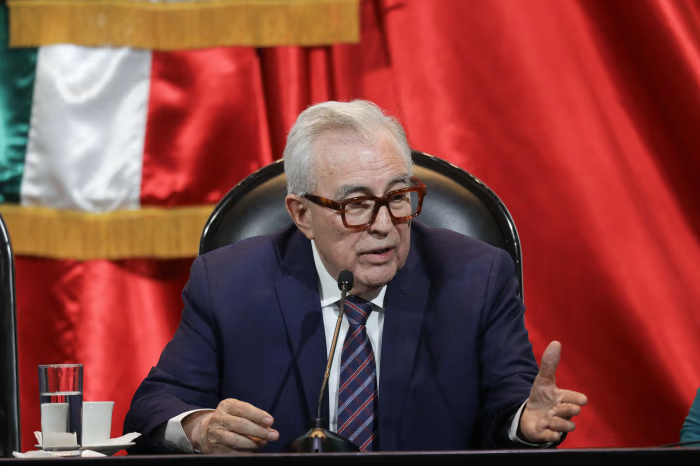
The case, unsealed in New York, alleges that those charged played roles in moving large quantities of illegal drugs into the United States, in some cases in exchange for substantial bribes. The indictment has added pressure on Mexican President Claudia Sheinbaum as she navigates growing demands from Washington to intensify efforts against organized crime.
In a late-night video message, Rocha rejected the accusations and insisted he had done nothing wrong. He said he would step aside temporarily to address what he described as baseless claims and to cooperate with Mexican authorities reviewing the matter.
“My conscience is clear,” Rocha said, speaking directly to residents of Sinaloa. He added that he has never betrayed the public and intends to defend his record.
Gámez Mendívil issued a similar message, denying wrongdoing and confirming he would also take leave. Local officials moved quickly to install an interim mayor in Culiacán, the state capital.
Both men retain legal immunity under Mexican law while in office, meaning formal prosecution would require action by Congress. Their decision to step aside, rather than resign, allows them to keep that protection for now.
The charges have created a delicate political moment for Sheinbaum, who has sought to balance domestic priorities with pressure from President Donald Trump to confront drug cartels more aggressively. Sheinbaum has said her administration has not yet seen conclusive evidence supporting the U.S. claims but pledged that Mexican investigators would conduct their own review.
She also made clear that any prosecution would take place in Mexico if solid proof emerges, signaling a firm stance on national sovereignty that could complicate cooperation with U.S. authorities.
“We will not subordinate ourselves,” Sheinbaum said, framing the issue as one of national dignity.
Mexico’s attorney general’s office indicated that, for now, no arrests will be made locally, even as the United States seeks extradition of those charged. The government has not disclosed how it will respond to those requests.
Rocha, a longtime ally of former President Andrés Manuel López Obrador, has been linked to controversy before. In 2024, his name surfaced in a letter attributed to a Sinaloa cartel figure who claimed he was en route to meet the governor before being abducted by a rival faction. Rocha has denied any connection.
The Associated Press previously detailed that the indictment includes allegations of conspiracy to import narcotics and possession of heavy weapons. If convicted in the United States, some defendants could face decades in prison or life sentences.
The case also casts a spotlight on members of the Morena party, Mexico’s ruling political force. Several of those named have argued the charges are politically motivated, raising concerns about cross-border tensions and the use of legal action in broader geopolitical disputes.
The timing of the indictment matters. It comes as relations between Mexico and the United States face renewed strain over security policy, migration, and economic ties. By naming sitting officials, U.S. prosecutors have escalated the stakes beyond criminal enforcement into the realm of diplomacy.
For Sheinbaum, the challenge is twofold. At home, she must maintain credibility on crime while avoiding the perception of yielding to outside pressure. Abroad, she must manage expectations from Washington, where calls for tougher action against cartels have grown louder.
The decision by Rocha and Gámez Mendívil to step aside suggests an attempt to contain political fallout while preserving legal defenses. It also reflects how sensitive the allegations are within Mexico, where public trust in institutions has long been tested by corruption scandals.
At a broader level, the case underscores the persistent reach of organized crime into political systems. Even unproven allegations can damage confidence and complicate governance, particularly in regions like Sinaloa, which has long been associated with cartel activity.
There is also a strategic dimension. By pursuing charges in U.S. courts, American authorities are signaling they will target not just traffickers but also alleged facilitators in government. That approach could reshape cooperation between the two countries, especially if Mexico resists extradition or insists on handling cases domestically.
For now, the legal process remains in its early stages. None of the accused are in U.S. custody, and the outcome will depend on evidence that has yet to be fully presented in court. But the political impact is already clear.
The case has exposed fault lines within Mexico’s leadership, tested its legal framework, and raised new questions about how far international law enforcement can reach into sovereign governments.
AP





