

KYIV, Ukraine — A nine-story apartment building in Kyiv’s Darnytsia neighborhood collapsed in a Russian missile strike before dawn Thursday, killing nine people including a 12-year-old girl and trapping dozens beneath concrete rubble, as Russia launched its third consecutive day of massive aerial bombardment in what Ukrainian officials called the largest aerial assault since the full-scale invasion began in 2022.
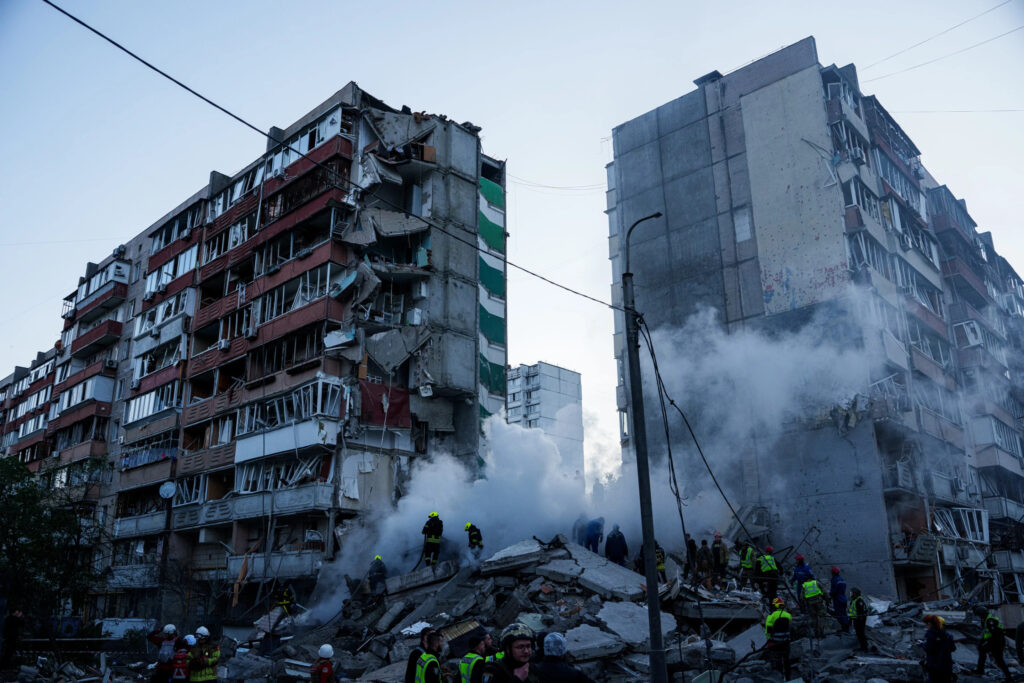
Emergency workers picked through the debris as wisps of smoke rose from the building’s ruins in the early morning light. The structure’s entrance had been obliterated in the strike, trapping residents inside before they could escape. All 18 apartments in the building were destroyed. More than 30 people were pulled out injured. About 20 remained unaccounted for.
“There were people there, children. What happened to them? You have to understand, an entire building collapsed,” said Alla Komisarova, 74, a pensioner who lives across from the destroyed building. “I heard something flying, it’s flying nearby. And then there was such a terrible sound, and our house, which is opposite, jumped and staggered.”
Lyudmila Hlushko, 78, said she was jolted awake around 3 a.m. “Then the house shook violently and there was a loud bang, breaking the glass in my house,” she told the Associated Press. Windows shattered across the surrounding neighborhood.
“It was a terrible night,” said neighbor Nadiia Lobanova. “We’re used to this. Well, it’s impossible to get used to this, but somehow we held on.”
Kyiv Mayor Vitali Klitschko declared Friday a day of mourning. Damage was recorded across six districts of the capital.
The Scale of the Assault
The overnight attack on Kyiv was part of a campaign that has grown in scale with each passing day. Ukrainian President Volodymyr Zelensky said Russia had fired more than 1,560 drones at Ukrainian population centers since Wednesday — more than 670 drones and 56 missiles in Thursday’s overnight assault alone. In total, 180 sites across the country were damaged, including more than 50 residential buildings.
Ukraine’s air force said its defenses shot down or jammed 693 Russian targets overnight — 41 missiles and 652 drones — achieving an interception rate of more than 93 percent. Fifteen missiles and 23 drones still scored direct hits across 24 locations. Debris from downed drones fell across 18 additional areas.
Air force spokesperson Yurii Ihnat told Ukrainian public broadcaster Suspilne the strain on air defenses was severe. “We are now experiencing the largest strikes since the start of the full-scale invasion,” Ihnat said.
Cities across Ukraine absorbed punishment through the night. Kremenchuk, Bila Tserkva, Kharkiv, Sumy, and Odesa were all struck. In Kharkiv, 28 people including three children were wounded and civilian infrastructure was targeted, regional governor Oleh Syniehubov confirmed. Strikes on energy infrastructure cut power to customers in Kyiv and 11 other regions, national grid operator Ukrenergo said. Port infrastructure in the southern Odesa region and railway lines were also hit.
A vehicle carrying United Nations humanitarian staff delivering aid to residents in the southern city of Kherson was struck by Russian drones, Foreign Minister Andrii Sybiha confirmed. The vehicle was clearly marked. It was hit twice, in two separate locations. Nobody was hurt.
Zelensky said initial analysis identified a recently manufactured Russian Kh-101 cruise missile as the weapon that destroyed the Kyiv apartment building and called for renewed international efforts to cut off Russian access to such technology.
Russia’s Defense Ministry claimed its military targeted Ukraine’s military-industrial complex — air bases, fuel facilities, and transport infrastructure — and said it hit all its intended targets. Among the weapons deployed, Moscow said, were Kinzhal hypersonic missiles capable of flying at 10 times the speed of sound. Russia made no immediate comment on the civilian casualties.
While Trump Was in Beijin
The timing of the assault was not lost on Ukrainian officials. U.S. President Donald Trump arrived in Beijing Wednesday for talks with Chinese President Xi Jinping — a visit that had generated cautious hope that the two most powerful leaders in the world might apply combined pressure on Moscow to end the war.
Sybiha addressed both governments directly. “At the very time when leaders of the most powerful countries are meeting in Beijing, and the world hopes for peace, predictability and cooperation, Putin launched hundreds of drones, ballistic and cruise missiles at the capital of Ukraine,” he posted on X. “I am certain that the leaders of the United States and China have enough leverage over Moscow to tell Putin to finally end the war. Only pressure on Moscow can make him stop.”
Zelensky was less diplomatic. Russian President Vladimir Putin had said just days earlier, on Saturday, that the war was “coming to an end.” Zelensky’s response to Thursday’s carnage was pointed. “These are definitely not the actions of those who believe the war is coming to an end,” he said.
The attacks directly contradicted the ceasefire Trump said he had brokered for May 9 through 11. Fighting continued throughout that 72-hour window, though Ukrainian officials said it was reduced in intensity. The resumed full-scale bombardment following the ceasefire’s expiration made clear that the pause had changed nothing in Russia’s military posture or intentions.
British Defense Secretary John Healey called Thursday’s attack “shocking” and said he had accelerated United Kingdom deliveries of air defense systems to Ukraine.
Wednesday’s Attack Set the Stage
Thursday’s destruction followed a devastating Wednesday. A rare daytime attack on Kyiv that day killed at least six people in an assault involving 800 drones that struck approximately 20 regions across Ukraine in one of the longest single attacks of the war.
The Kyiv office of defense contractor Skyeton, which specializes in reconnaissance drones, was destroyed in the overnight strikes, though the company said it had anticipated such targeting and relocated its production beforehand.
More than 1,500 rescue workers were deployed across Ukraine to respond to the two-day assault’s aftermath, including nearly 600 in Kyiv alone. At least 22 civilians were killed across the two days combined, officials confirmed.
In a separate development, Hungary summoned the Russian ambassador over a drone attack near its border with Ukraine — a notably sharp shift in tone from new Prime Minister Péter Magyar toward Moscow after years of warm relations under his predecessor Viktor Orbán.
Latvia’s Prime Minister Evika Silina resigned Thursday after her coalition government lost its majority following pressure over the government’s handling of multiple incidents involving stray drones crossing into Latvian territory from the direction of Ukraine.
The Gap Between Putin’s Words and Russia’s Bombs
The three-day bombardment carries a specific message, and it is addressed as much to Washington and Beijing as it is to Kyiv. Putin told reporters Saturday that the war was coming to an end. Days later, Russia launched what Ukrainian officials called the largest aerial assault of the entire conflict. The gap between those two things is not an accident — it is a strategy.
Russia’s negotiating posture has consistently used escalation as leverage. When diplomatic momentum builds toward a settlement, Moscow intensifies military pressure to establish that any agreement must be made on Russian terms, not because Russia has run out of weapons or will. The timing of this week’s assault — synchronized with Trump’s Beijing trip and the post-ceasefire window — signals that Putin intends to keep fighting until he gets a deal that reflects the territorial and political gains Russia has made, not one imposed by outside pressure.
For Trump, the optics are difficult. He declared the May 9-11 ceasefire a success. Russia spent the days immediately following it flattening apartment buildings in Kyiv. His argument that he has leverage over Putin — and that engaging Moscow diplomatically will produce results — takes a significant credibility hit every time a Kh-101 missile destroys a nine-story building full of sleeping families.
Ukraine’s 93 percent interception rate is genuinely impressive and reflects years of investment in layered air defense. But the mathematics of the current campaign work against Kyiv in a specific way: when Russia fires 1,560 drones and missiles over 48 hours, the 7 percent that get through still kill people, collapse buildings, and cut power to millions. Quantity is its own quality, and Russia has demonstrated a willingness to sustain this volume of fire regardless of international condemnation.
Sybiha’s appeal to Trump and Xi is the clearest articulation of what Ukraine needs right now — not just weapons and solidarity, but the kind of direct great-power pressure on Moscow that neither government has yet chosen to fully apply. Whether that pressure materializes before another apartment building collapses in Kyiv is the question on which the war’s next chapter turns.
Reuters/AP





