

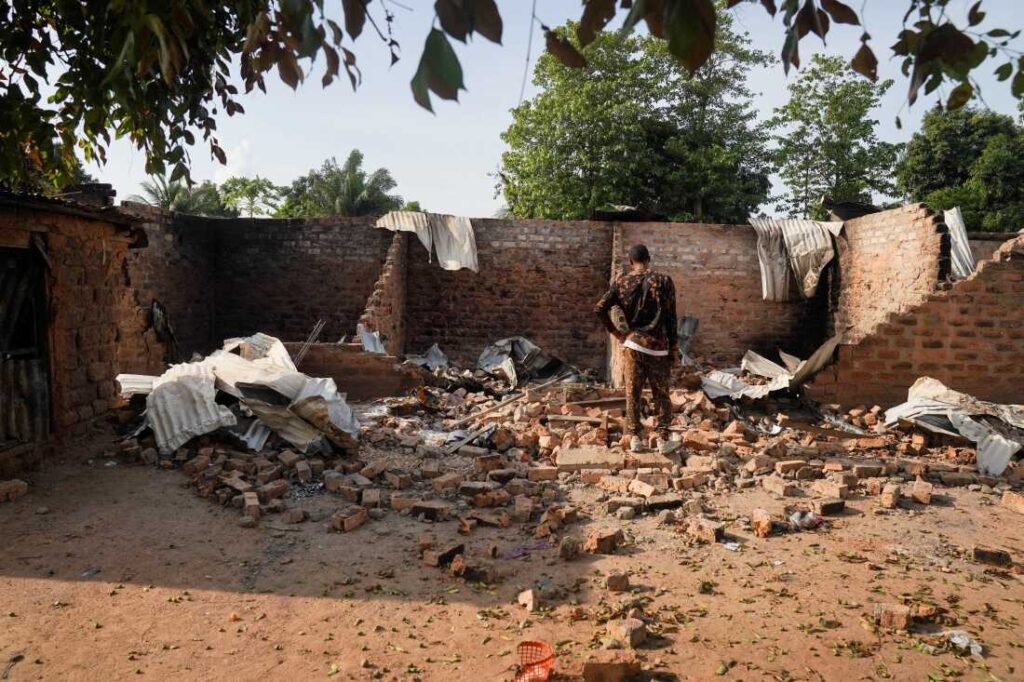
Gunmen on motorcycles rode into a residential compound on Aliade Street in the early hours of Monday and killed eight people, executing four as they slept and shooting four more who stepped outside after hearing the gunfire — the latest in a string of cult-related killings that have turned parts of Nigeria’s Benue State capital into a shooting gallery.
The attack happened between 2 a.m. and 2:30 a.m., according to Makurdi Local Government Area Chairman Joseph Keffi, who confirmed the killings and their cult connection in a phone conversation with journalists Monday morning.
“It is quite ugly and pathetic,” Keffi said.
The trigger, he explained, was a conflict that started elsewhere and followed a man to his friend’s doorstep. A suspected cult member from the North Bank area of Makurdi had a falling out with his group and fled to stay with an acquaintance at High Level, another part of the city. His former associates tracked him there. What followed was a massacre of people who had nothing to do with the dispute.
“Unfortunately, those killed were not cult members, but because they accommodated the boy, they were attacked,” Keffi said.
Residents who spoke to journalists on condition of anonymity described the attackers arriving on motorcycles and moving directly to their target compound with apparent foreknowledge of who was inside and where they were sleeping. The first four victims were woken up and shot where they lay. The second four died when they came out to see what the noise was.
Bodies from the attack were deposited at the morgue of Benue State University Teaching Hospital and a private medical facility in Makurdi.
Benue State Commissioner of Police Ifeanyi Emenari confirmed the attack but disputed the death toll, saying the number of casualties was lower than eight without providing a specific figure. He said the police public relations officer would issue a formal statement.
Monday’s bloodshed did not arrive without warning. Less than a week earlier, at least three people were killed in a separate cult clash in Agwan Jukun, also within Makurdi, in attacks along Market Street and Wukari Street that began around 8 p.m. on a Sunday night and continued into the early hours of Monday. Residents described armed youths moving through the area with surgical precision, going straight for specific targets while neighbors fled and businesses shut without warning.
“They came into the area around 8 p.m. and went straight for their targets. It was clear they knew who they were looking for,” one resident said at the time.
Another resident alleged the attackers had inside information about their victims’ movements — a detail that points to infiltration of community networks and makes the violence harder to predict or prevent.
The neighborhoods bearing the brunt of Makurdi’s cult war — North Bank, Wadata, High Level, and Wurukum — have seen repeated clashes over recent months as rival criminal networks fight for territory and settle scores with weapons and motorcycles in the hours when most people are asleep.
Keffi raised an allegation Monday that goes beyond the immediate attack and points to a deeper failure of the justice system in containing the violence. He said residents had identified one of the primary cult leaders responsible for repeated attacks in Makurdi — a man who operates on a cycle of striking, fleeing the state, and returning to kill again.
“He comes in, strikes, and leaves. Right now, he is not in the state. The day he returns, he kills and disappears again. We do not know how he escapes,” Keffi said.
He added that the suspect had been arrested before and subsequently released — a pattern that residents say has repeated itself across multiple gang leaders and has fundamentally undermined confidence that arrests lead to accountability.
Security agencies were notified following Monday’s attack, and Keffi said operatives were already working to track those responsible. The area around the Aliade Street compound was cordoned off as investigations continued.
What Makurdi is experiencing is not random urban violence. It is the product of a specific and recurring failure — the inability or unwillingness of the criminal justice system to break the cycle once it has been identified.
The chairman of the local government knows who one of the primary perpetrators is. Residents know. The police have previously arrested him. He was released. He came back. People died again. That sequence, repeated across Makurdi’s most affected neighborhoods, has created a population that no longer believes the arrest of a gang leader changes anything, because experience has taught them it does not.
Cult violence in Benue State draws from multiple sources. Economic marginalization pushes young men toward criminal networks that offer income, protection, and identity. Weak prosecution allows known gang leaders to cycle through the justice system without consequence. Political patronage occasionally shields criminal figures who provide election-day muscle. And a community that has watched neighbor after neighbor killed in the night learns that the safest response is silence — which is exactly what the gangs count on.
The victims on Aliade Street Monday morning were not combatants. They were people who gave a friend a place to sleep and paid for it with their lives. Their deaths are not just a crime story. They are the outcome of a system that has consistently failed to match its stated commitment to security with the institutional follow-through that commitment requires.
Residents have been calling for sustained police operations, dismantling of cult networks, and prosecution of arrested suspects for months. The calls keep coming because the killings keep coming. Until one of those realities changes, nothing in Makurdi changes.
PremiumTimes/Punchng





